Abyssinian gladiolus
Gladiolus murielae. Family Iridaceae. Bulb.
Also called Peacock orchid, Acidanthera, Fragrant gladiolus, Gladiolus callianthus.
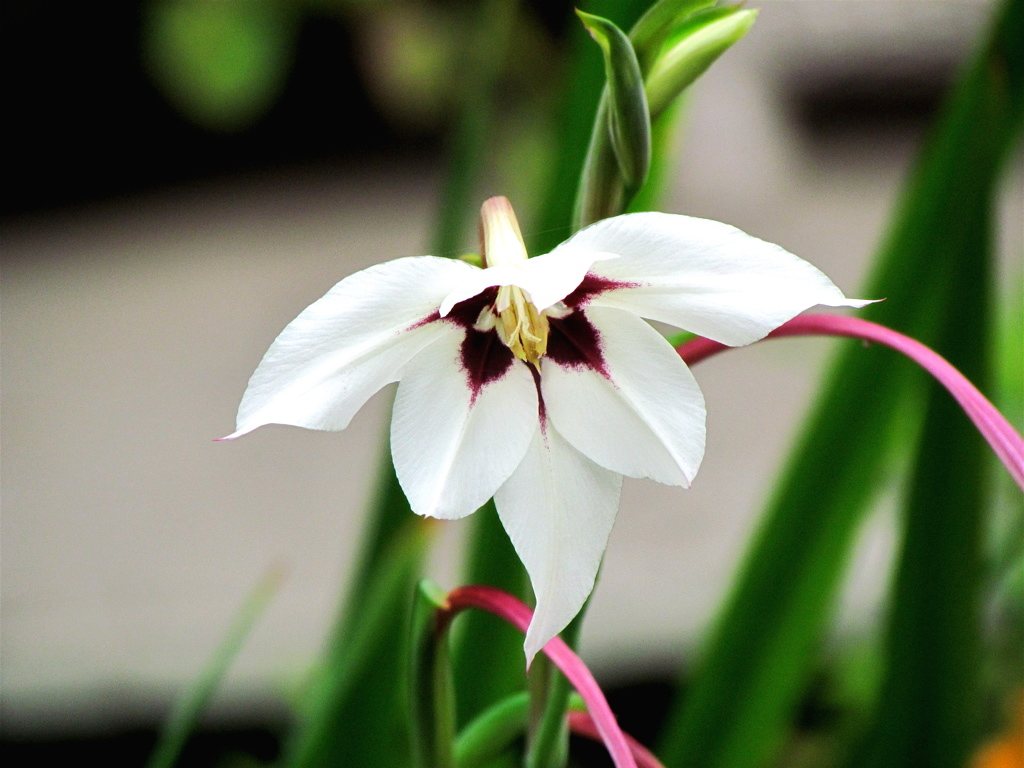
This summer-growing, corm-forming perennial has upright, sword-shaped leaves and fragrant white flowers with dark burgundy centres. Gardeners grow it for late-season flowers and evening scent, especially near paths and seating. In cold climates, lift and store the corms for winter rather than leaving them outdoors.
At a glance
- Sun
- Full sun; choose a warm, sheltered position, especially where summers are cool.
- Water
- Water regularly during active growth, keeping the soil lightly moist but never waterlogged. Reduce watering as the leaves yellow and keep dormant corms dry.
- Soil
- Fertile, well-drained soil; improve heavy soil or grow in containers with free-draining potting compost.
- Height
- 2-3 ft (0.6-0.9 m)
- Spread
- 0.5-1 ft (0.15-0.3 m)
- Flowers
- Late summer to early autumn; nodding, fragrant white flowers with a dark burgundy-purple star at the centre.
- Foliage
- Upright, narrow, sword-shaped green leaves that die back after the growing season.
- Growth
- Moderate; reaches flowering height within one growing season from mature corms.
- Care needed
- Medium
The year at a glance
- Pollinators
- Heat tolerant
- Low allergen
- Fragrant
| J | F | M | A | M | J | J | A | S | O | N | D | |
|---|---|---|---|---|---|---|---|---|---|---|---|---|
| Flowers | ||||||||||||
| Plant |
Northern hemisphere months. In Australia, shift them by six.
- Difficulty
- Moderate
- Toughness
- Fairly tough
Will it suit your garden?
Pick your zone, country, light and whether you have pets.
Full sun is 6 or more hours of direct sun a day, part shade 3 to 6 hours, shade under 3.
How it grows
Planting day
0.5 ft (0.15 m)
After 1 year
2.5 ft (0.75 m)
full size
About 1 years to full size.
From a typical nursery size, at an average rate for this kind of plant. A rule of thumb, not a forecast.
Good to know
- Cats and dogs
- Toxic
- Growth rate
- Moderate
Care
Jobs through the year
- WaterMay–Jun, every 7 days
- Water established clumps when rainfall is insufficient, keeping soil lightly moist.
- WaterJul–Sep, every 5 days
- Water deeply during dry weather; new plantings may need more, but never leave soil soggy.
- WaterOct, every 14 days
- Water only if leaves remain green and soil is dry; stop once foliage yellows.
- ProtectMay–Jun
- Protect emerging shoots from slugs and add discreet supports in windy sites.
- DeadheadAug–Oct, every 7 days
- Remove finished flower stems while leaving green foliage intact.
- PruneOct–Nov
- Cut foliage back only after it has yellowed naturally.
- ProtectOct–Nov
- Lift before hard frost, dry the corms and store cool, dry and frost-free.
- ProtectJan–Mar, Dec
- Check stored corms and discard any that are soft, mouldy or infested.
- Plant corms in spring after frost, about 4-6 in (10-15 cm) deep and 4-6 in (10-15 cm) apart.
- Water during dry spells while leaves and flower stems are growing, but do not leave pots standing in water.
- Feed container plants every two weeks with a balanced liquid fertiliser during active growth.
- Use discreet stakes in windy positions before flower stems begin to lean.
- Lift corms before hard frost in cold or wet-winter areas; dry them and store somewhere cool, dry and frost-free.
- Where corms remain outdoors, mulch for winter and keep the site well drained; survival is less dependable at the colder end of its range.
Pruning. Remove spent flower stems unless you want seed, but leave the leaves to replenish the corms. Cut foliage back once it has yellowed and died naturally.
Through the year
- Early spring
- Check stored corms and discard any that are soft or mouldy; in cool climates, start sound corms in pots under frost-free cover.
- Late spring
- Plant outdoors after frost when the soil has warmed, choosing the sunniest sheltered spot available.
- Summer
- Water during dry weather, feed container plants and support stems where necessary.
- Late summer
- Remove faded flower stems while keeping the foliage intact.
- Autumn
- Reduce watering as foliage yellows; lift and dry corms before hard frost where winter survival is doubtful.
- Winter
- Keep stored corms dry and frost-free, checking occasionally for rot.
In the garden
- Plant in groups through sunny borders so the slim stems rise between lower perennials.
- Grow in containers beside a patio or doorway where the evening fragrance can be enjoyed.
- Combine with silver foliage and white flowers for a restrained late-summer display.
- Thread through fine ornamental grasses for contrast between upright leaves and airy seed heads.
Garden styles it suits: Cottage garden, Sensory garden, White garden, Moon garden, Modern courtyard and Romantic rose garden.
Plant it with: Lavender, Catmint, Gaura, Salvia, Lamb's ears and Dwarf fountain grass.
Wildlife: The fragrant flowers can attract nectar-feeding insects, including moths, although visits vary with local conditions.
Problems to watch for
- Corm rot in wet soil or storage: improve drainage, dry lifted corms thoroughly and discard soft or mouldy ones.
- Thrips causing streaked leaves or damaged flowers: inspect new growth, remove badly affected flowers and discard infested corms rather than storing them.
- Slugs and snails eating emerging shoots: check plants after dark and use barriers, hand-picking or an appropriate labelled bait.
- Leaves but few flowers: provide more sun and summer warmth, avoid excessive nitrogen and use mature corms; small offsets may need several seasons to flower.
Safety
Treat as toxic to cats, dogs and horses, and do not eat any part. The corms are the main concern; ingestion can cause vomiting, diarrhoea and abdominal pain, with larger amounts potentially causing more serious illness. Gladiolus sap can irritate sensitive skin, and ingestion by people may cause stomach upset.
Easily confused with
Garden gladiolus (Gladiolus hybrids)
Most have denser spikes of larger flowers in many colours; Abyssinian gladiolus has a looser arrangement of white flowers with dark central markings and a strong fragrance.
Marsh Afrikaner (Gladiolus tristis)
It also has evening fragrance, but its flowers are usually cream to pale yellow, often finely marked, without the bold burgundy central star.
The name
Gladiolus comes from the Latin for 'little sword', referring to the shape of the leaves.
Propagation. Separate small cormlets from mature corms when lifting or replanting, then grow them on separately; they usually need several seasons to reach flowering size. Seed is possible but slower.
Checked against open data
- Accepted botanical name
- Gladiolus murielae
- Native range
- Burundi, Chad, Ethiopia, Malawi, Mozambique and Tanzania.
Sources: GBIF (CC BY 4.0) and Trefle (CC BY 4.0). The care and design notes are LandscapeGPT's own.
See it in your own yard.
Upload a photo of your yard and see it redesigned with plants that suit your climate, each checked against your zone.