Algerian iris
Iris unguicularis. Family Iridaceae. Perennial.
Also called Winter iris, Iris stylosa.
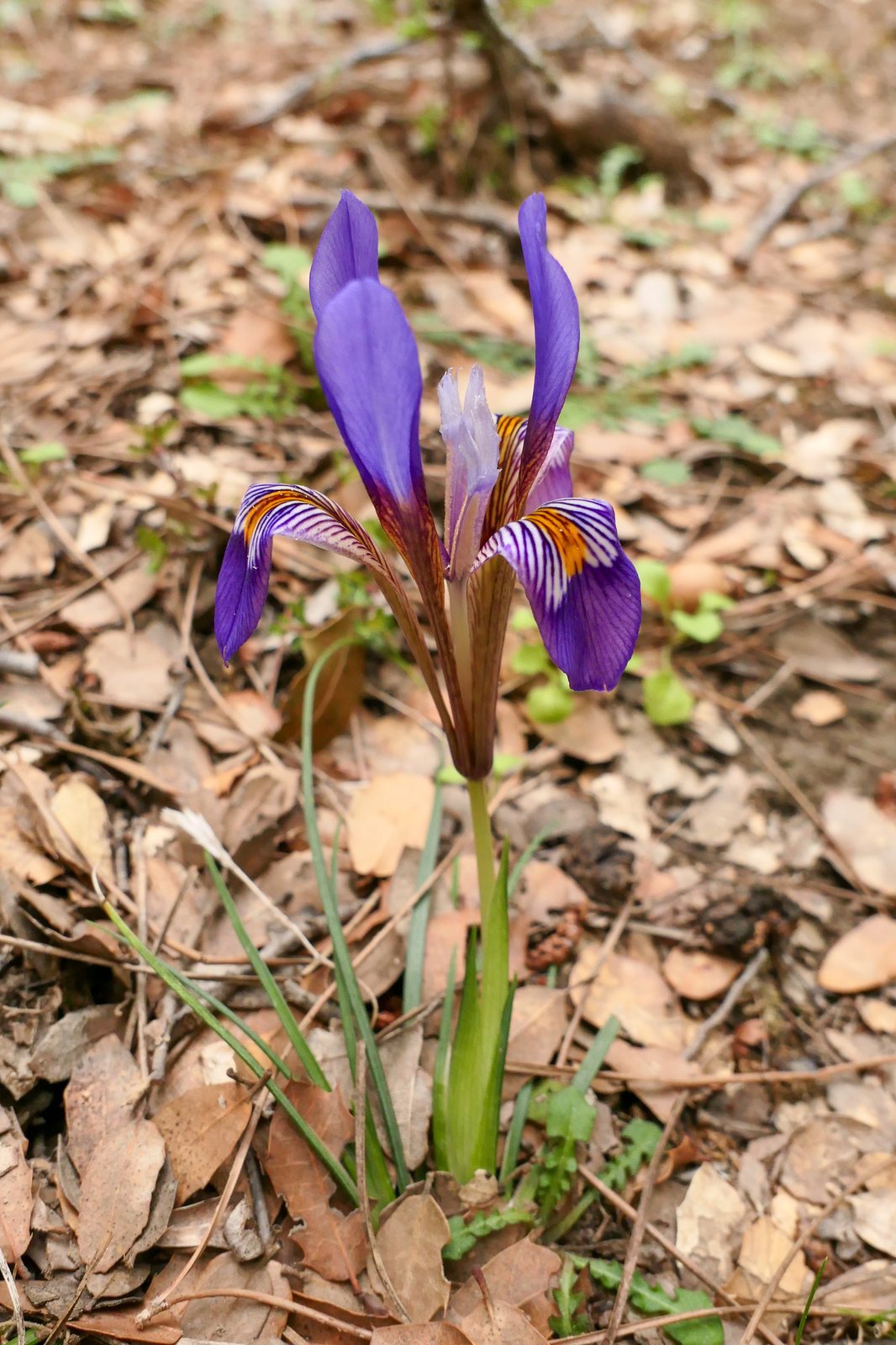
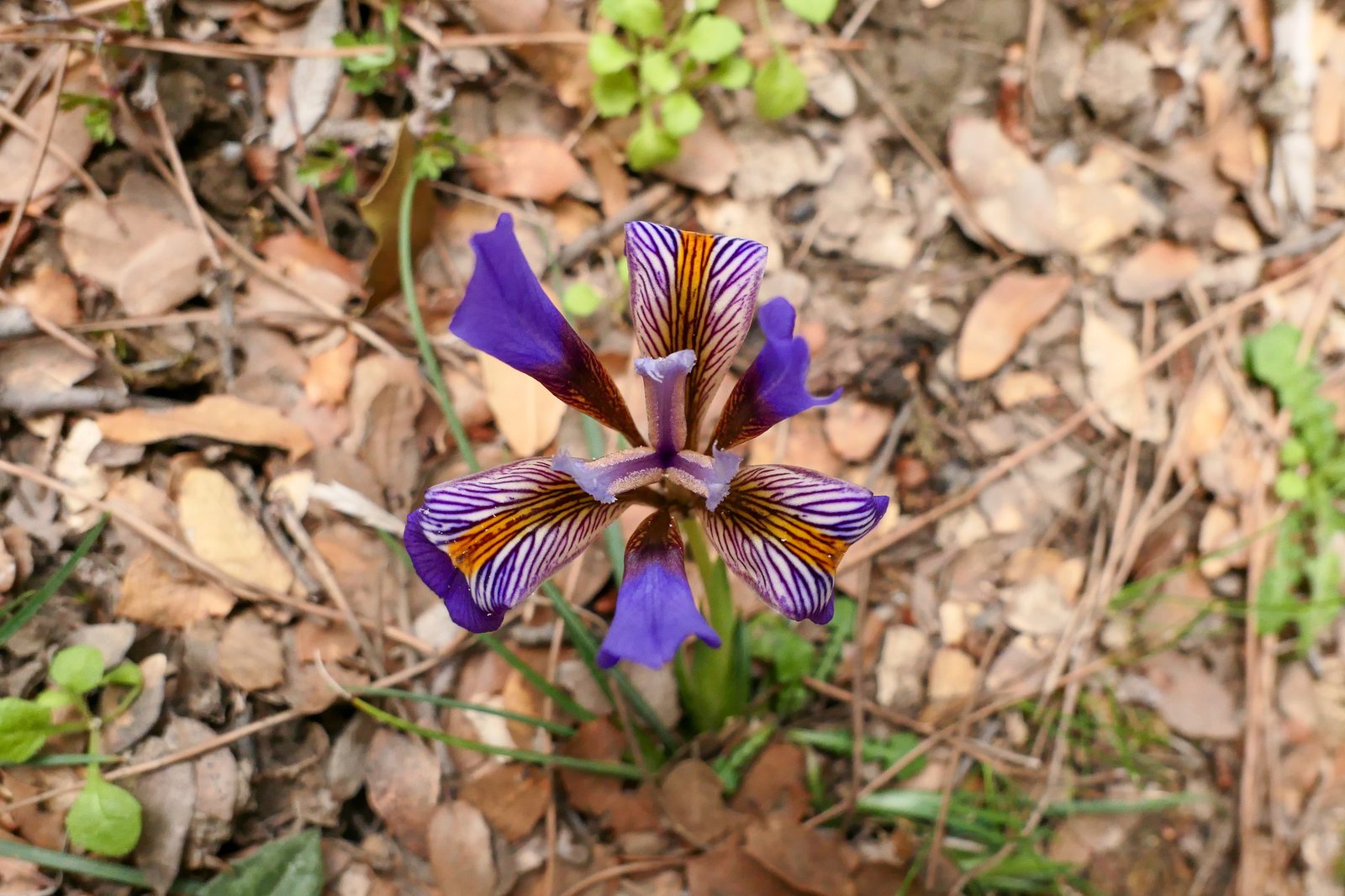
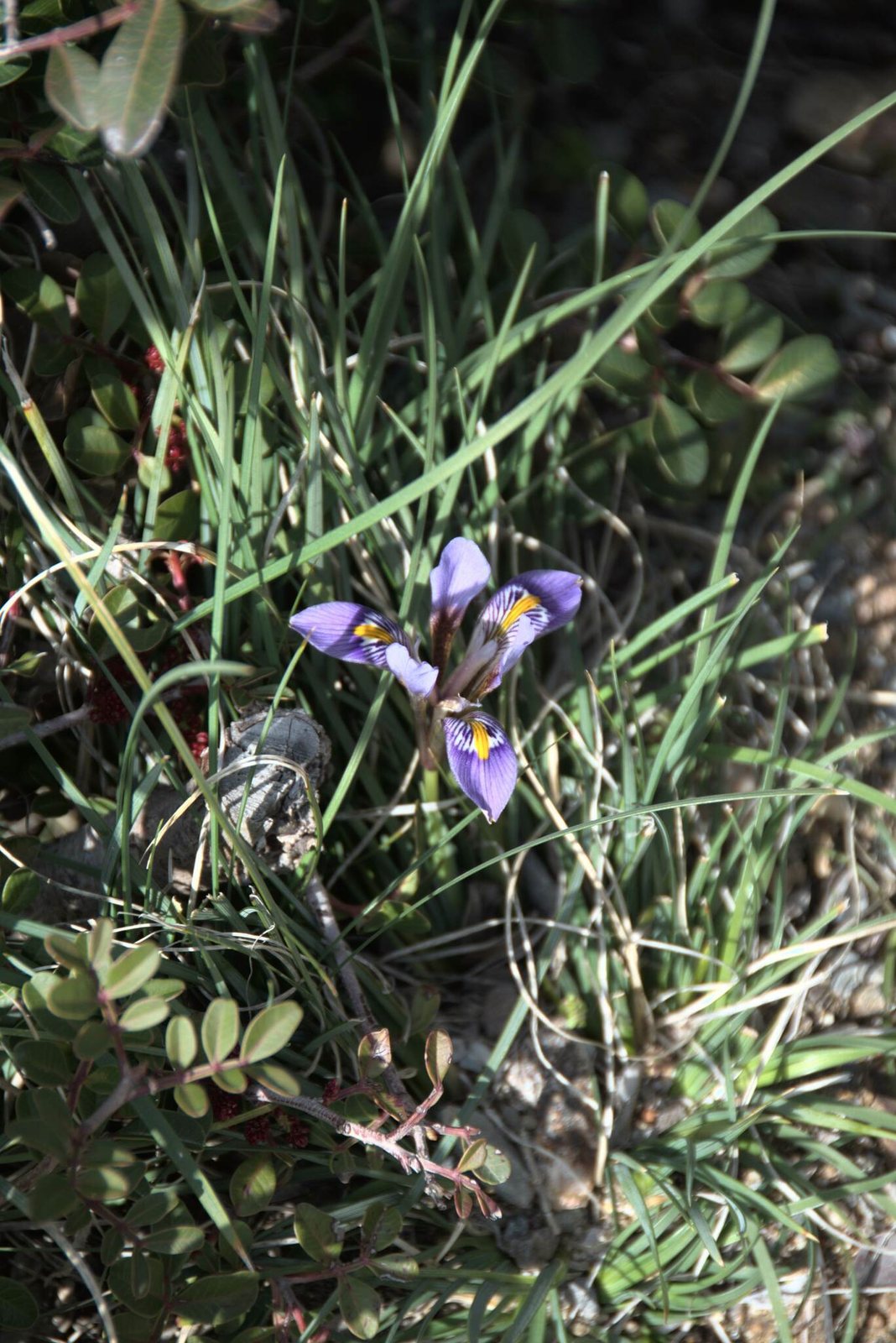
Algerian iris is a clump-forming, evergreen perennial grown for fragrant violet-blue flowers that open among narrow leaves in winter and early spring. It flowers best in a warm, sheltered spot with excellent drainage, particularly beside a sunny wall; individual blooms can be damaged by frost.
At a glance
- Sun
- Full sun; tolerates light shade, but usually flowers less freely.
- Water
- Low once established. Water during establishment, then sparingly in summer; avoid persistently wet soil, especially in winter.
- Soil
- Well-drained sandy, stony or loamy soil, preferably neutral to alkaline. Avoid heavy, waterlogged ground.
- Height
- 1-1.5 ft (0.3-0.45 m)
- Spread
- 1-2 ft (0.3-0.6 m)
- Flowers
- Winter to early spring, sometimes beginning in late autumn; fragrant violet-blue flowers with white and yellow markings on the falls.
- Foliage
- Evergreen. Dense clumps of narrow, arching, dark green, strap-shaped leaves that can partly conceal the flowers.
- Growth
- Slow to moderate; clumps may take several years to settle and flower freely.
- Care needed
- Low
The year at a glance
- Pollinators
- Deer resistant
- Drought tolerant
- Heat tolerant
- Low allergen
- Fragrant
| J | F | M | A | M | J | J | A | S | O | N | D | |
|---|---|---|---|---|---|---|---|---|---|---|---|---|
| Flowers | ||||||||||||
| Plant |
Northern hemisphere months. In Australia, shift them by six.
- Difficulty
- Moderate
- Toughness
- Fairly tough
Will it suit your garden?
Pick your zone, country, light and whether you have pets.
Full sun is 6 or more hours of direct sun a day, part shade 3 to 6 hours, shade under 3.
How it grows
Planting day
1 ft (0.3 m)
After 1 year
1 ft (0.32 m)
After 2 years
1.1 ft (0.34 m)
After 3 years
1.2 ft (0.36 m)
After 5 years
1.2 ft (0.38 m)
full size
About 4 years to full size.
From a typical nursery size, at an average rate for this kind of plant. A rule of thumb, not a forecast.
Good to know
- Cats and dogs
- Toxic
- Growth rate
- Slow
Care
Jobs through the year
- WaterApr–May, Sep–Oct, every 14 days
- For established ground clumps, water only in prolonged dry weather; water new plants more regularly.
- WaterJun–Aug, every 21 days
- Established ground clumps prefer dry summers; water only during exceptional drought.
- PruneAug–Sep
- Remove dead leaves and selectively thin foliage hiding flowers; do not cut the whole clump down.
- DivideAug–Sep
- Divide only overcrowded clumps, replanting promptly with rhizomes near the surface.
- ProtectJan–Mar, Nov–Dec
- Keep crowns free of wet debris, protect buds from slugs, and use a sheltered site; zone 6 needs extra winter shelter.
- Plant in a warm, sheltered position, keeping the rhizomes close to the soil surface rather than deeply buried.
- Water new plants through their first growing season, allowing the soil to drain between waterings.
- Keep established clumps relatively dry in summer and prevent winter waterlogging.
- Avoid rich manure and high-nitrogen fertilisers, which encourage leaves at the expense of flowers.
- Keep mulch away from the crown and divide only when necessary; established clumps resent frequent disturbance.
Pruning. In late summer or early autumn, remove dead and damaged leaves at the base and selectively thin foliage that hides developing flowers. Do not routinely cut the whole clump to the ground.
Through the year
- Spring
- Plant container-grown plants after severe frost has passed, choosing a sunny site with sharp drainage.
- Summer
- Water recently planted clumps during dry spells; leave established plants relatively dry.
- Late summer
- Divide only overcrowded clumps or those needed for propagation, then replant promptly.
- Early autumn
- Remove dead leaves and check that mulch and neighbouring plants are not covering the crown.
- Late autumn
- Check emerging buds for slugs and snails and clear debris that shelters them.
- Winter
- Check drainage after prolonged rain and remove frost-damaged flowers without cutting healthy foliage.
In the garden
- Plant at the foot of a sunny wall, where shelter and retained warmth encourage winter flowering.
- Use along a sheltered path or near a doorway so the low flowers and fragrance can be enjoyed in winter.
- Group in a gravel garden with rock roses and other plants that prefer dry summers.
- Combine with early bulbs in an open, sunny border for flowers above and among evergreen foliage.
Garden styles it suits: Mediterranean, Dry gravel garden, Winter interest, Sensory garden, Cottage garden and Small-space.
Plant it with: Rock rose, Lavender, Rosemary, Winter aconite, Species crocus and Dwarf daffodil.
Wildlife: Flowers can offer food to visiting insects during mild winter weather, although cold conditions often limit insect activity. Dense foliage provides some shelter for small invertebrates.
Problems to watch for
- Slugs and snails chew buds and flowers: inspect during mild, damp weather, remove hiding places and use wildlife-conscious controls where needed.
- Rhizome rot in wet soil: improve drainage or move the plant to raised ground; remove rotten tissue and discard badly affected plants.
- Few flowers: increase sunlight, stop high-nitrogen feeding and avoid repeated division; recently moved plants may need several years to settle.
- Frost-damaged flowers: choose a sheltered position and remove spoiled blooms; unopened buds often provide later flowers.
Safety
Toxic if eaten by people, cats, dogs or horses. All parts should be treated as poisonous, especially the rhizomes; ingestion can cause drooling, vomiting, abdominal pain or diarrhoea. Sap may irritate skin, so wear gloves when dividing and seek medical or veterinary advice after ingestion.
Easily confused with
Lazistan iris (Iris lazica)
Has broader, glossier leaves and generally flowers in late winter or spring. It tolerates more shade and moisture than Algerian iris.
Bearded iris (Iris germanica)
Usually has broader, upright leaf fans and flowers on taller stems in late spring or early summer; its falls carry conspicuous fuzzy beards, which Algerian iris lacks.
The name
The common name refers to Algeria, part of its native range, while unguicularis means 'having a small claw', referring to the narrow bases of the flower segments.
Propagation. Divide established clumps in late summer or early autumn, keeping several healthy leaf fans and sound roots on each division. Replant shallowly and water in; flowering may be reduced while divisions establish. Seed is slower and seedlings may differ from the parent.
Checked against open data
- Accepted botanical name
- Iris unguicularis
- Native range
- Algeria, East Aegean Is., Greece, Kriti, Lebanon-Syria, Morocco, Tunisia and Turkey.
Sources: GBIF (CC BY 4.0) and Trefle (CC BY 4.0). The care and design notes are LandscapeGPT's own.
See it in your own yard.
Upload a photo of your yard and see it redesigned with plants that suit your climate, each checked against your zone.