Amur maple
Acer tataricum subsp. ginnala. Family Sapindaceae. Tree.
Also called Acer ginnala, Siberian maple.
Amur maple is a small deciduous tree or large, multistemmed shrub grown for its rounded crown and orange to scarlet autumn foliage. It tolerates cold winters and established plants withstand some drought, but it seeds freely and is invasive in parts of North America; check local restrictions before planting.
At a glance
- Sun
- Full sun to partial shade; autumn colour is usually strongest in sun.
- Water
- Water regularly while establishing. Once established, water during prolonged dry spells, especially in shallow or sandy soil.
- Soil
- Well-drained soil with moderate moisture; tolerates clay if drainage is adequate. Prefers slightly acidic to neutral soil and may develop iron chlorosis in alkaline ground.
- Height
- 15-20 ft (4.6-6.1 m)
- Spread
- 15-20 ft (4.6-6.1 m)
- Flowers
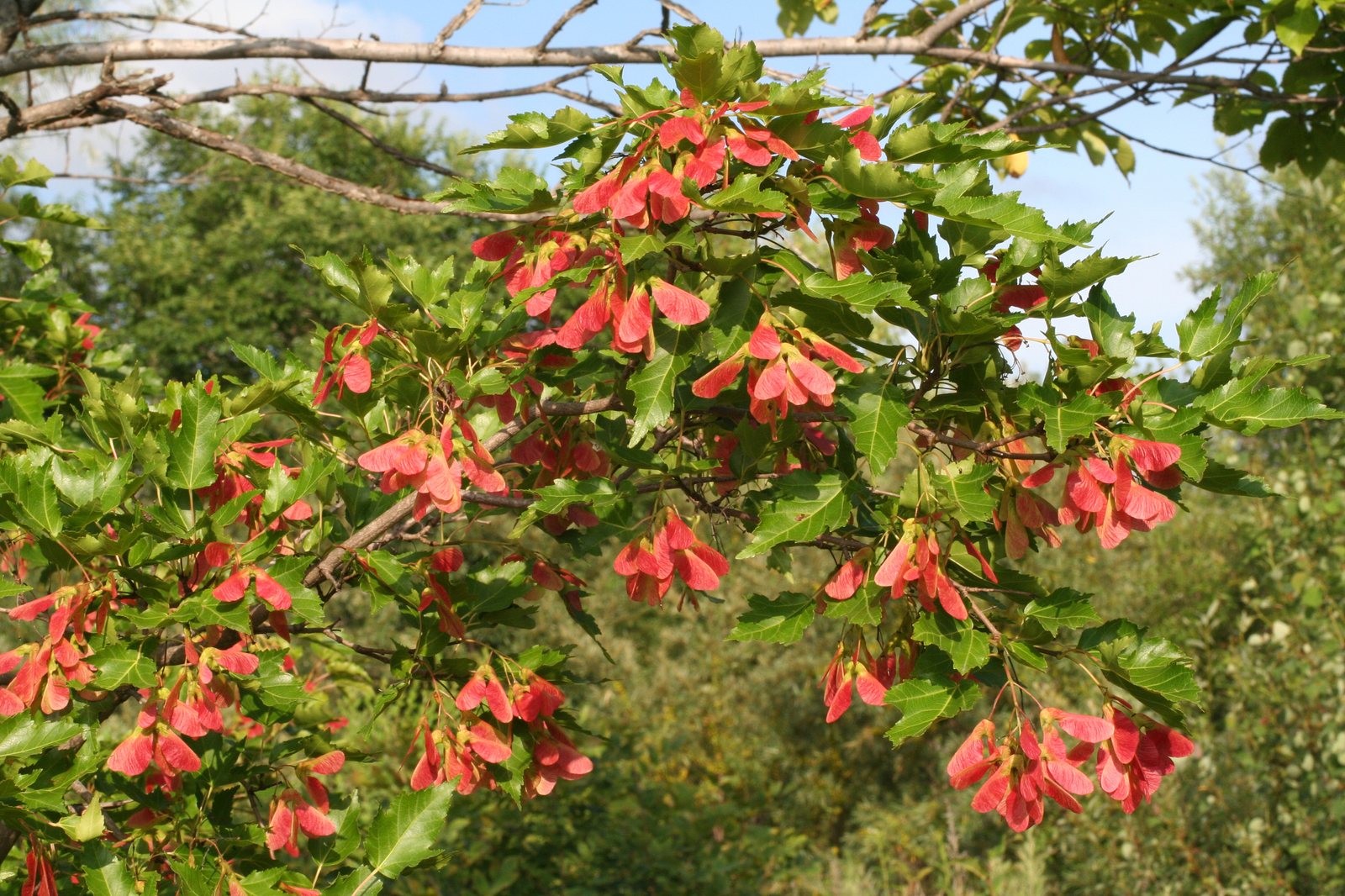
- Small, fragrant, creamy-white flowers in clusters in late spring, followed by paired winged seeds that often turn red before ripening brown.
- Foliage
- Opposite, toothed green leaves, usually with three lobes and an elongated central lobe; yellow, orange or red in autumn. Autumn colour varies between seedlings and growing conditions.
- Growth
- Moderate, sometimes fast when young.
- Care needed
- Medium
The year at a glance
- Pollinators
- Drought tolerant
- Cold hardy
- Wildlife
- Fragrant
| J | F | M | A | M | J | J | A | S | O | N | D | |
|---|---|---|---|---|---|---|---|---|---|---|---|---|
| Flowers | ||||||||||||
| Fruit | ||||||||||||
| Plant |
Northern hemisphere months. In Australia, shift them by six.
- Difficulty
- Easy
- Toughness
- Very tough
Will it suit your garden?
Pick your zone, country, light and whether you have pets.
Full sun is 6 or more hours of direct sun a day, part shade 3 to 6 hours, shade under 3.
How it grows
Planting day
7 ft (2 m)
After 1 year
7 ft (2.2 m)
After 2 years
8 ft (2.4 m)
After 3 years
9 ft (2.6 m)
After 5 years
10 ft (3 m)
About 16 years to full size.
From a typical nursery size, at an average rate for this kind of plant. A rule of thumb, not a forecast.
Good to know
- Cats and dogs
- Safe
- Invasive in
- the US and Canada
- In the garden
- Spreads vigorously: plan to contain it.
- Growth rate
- Fast
Care
Jobs through the year
- WaterApr–May, Sep–Oct, every 21 days
- Water established trees deeply only during prolonged dry spells; water more often for the first two years.
- WaterJun–Aug, every 14 days
- Soak the root zone during prolonged dry weather, especially on shallow or sandy soil.
- MulchMar–Apr
- Maintain 5–8 cm of organic mulch over the root zone, leaving the trunk clear.
- PruneAug–Sep
- Prune lightly to remove crossing or weak branches; avoid heavy cuts and spring sap bleeding.
- Water deeply during dry weather for the first two growing seasons, moistening the root zone rather than sprinkling the surface.
- Spread 2-3 in (5-8 cm) of organic mulch over the root zone, keeping it clear of the trunk.
- Do not feed routinely; use a soil test before applying fertiliser to a struggling tree.
- Stake only if the root ball moves in wind, and remove supports after the first growing season.
- Pull seedlings promptly, including those beyond the canopy; do not plant where the tree is restricted or invasive.
Pruning. Prune in late summer, removing dead, crossing or poorly attached branches and selecting a single leader if you want a tree rather than a multistemmed shrub. Avoid heavy pruning and late-winter or early-spring cuts, which can bleed sap.
Through the year
- Early spring
- Check winter damage, remove broken branches and pull seedlings as they emerge.
- Spring
- Plant container-grown trees while conditions are cool; water thoroughly and mulch.
- Late spring
- Check new leaves for aphids and yellowing between green veins.
- Summer
- Water young trees during dry spells and check that stakes or ties are not rubbing the bark.
- Late summer
- Carry out light structural pruning if needed.
- Autumn
- Collect fallen seeds from beds and paths, and check nearby ground for unwanted seedlings.
In the garden
- Use as a small lawn specimen where its rounded crown and autumn colour can be seen clearly, but only where it is not invasive.
- Train as a multistemmed tree beside a patio, allowing enough room for its mature spread.
- Place against dark evergreen shrubs to contrast with its red autumn foliage.
- Underplant with shade-tolerant perennials such as hostas and hardy geraniums.
Garden styles it suits: Traditional, Cottage garden, Woodland, Autumn colour, Japanese and Modern courtyard.
Plant it with: Hostas, Hardy geraniums, Epimediums, Christmas fern, Oakleaf hydrangea and Switchgrass.
Wildlife: The flowers attract bees and other insects, and the branches provide cover for birds. In invaded habitats, dense growth can displace native vegetation and reduce habitat quality.
Problems to watch for
- Iron chlorosis: young leaves turn yellow between green veins in alkaline soil. Test soil pH; iron chelate suitable for the measured pH may help temporarily, but a better-adapted tree is often the lasting solution.
- Verticillium wilt: sudden wilting or branch dieback can occur. Seek a diagnosis, remove dead wood and reduce drought stress; there is no reliable cure for an infected tree.
- Aphids: curled leaves and sticky honeydew may appear in spring. Wash small colonies off with water and conserve ladybirds and other predators.
- Leaf scorch: brown leaf margins can follow drought, heat or drying wind. Water the root zone deeply, maintain mulch and avoid excess fertiliser.
Safety
Not known to be toxic to people, cats or dogs, though it is not an edible plant. Safety for horses is not well established; keep leaves, seeds and prunings out of paddocks and feed, since some other maple species cause serious poisoning.
Where it spreads. Spreads aggressively by seed in parts of the northern United States and southern Canada, especially the Upper Midwest, northeastern United States and Ontario. It is listed as invasive or regulated in several jurisdictions, including Minnesota. Seedlings can establish in grassland, woodland edges and open woods; check current local rules and choose a non-invasive alternative in affected regions.
Easily confused with
Tatarian maple (Acer tataricum subsp. tataricum)
Its leaves are usually unlobed or only shallowly lobed, whereas Amur maple normally has three distinct lobes with a long central lobe.
Trident maple (Acer buergerianum)
Its three leaf lobes are generally shorter and broader, with mostly smooth or sparsely toothed margins; Amur maple has conspicuously toothed leaves and a longer central lobe.
Japanese maple (Acer palmatum)
Most forms have five to seven deeply divided leaf lobes radiating from one point, rather than Amur maple's usual three lobes.
The name
The common name refers to the Amur River region of northeastern Asia, part of the plant's native range.
Propagation. Seed requires cold, moist stratification and produces variable plants. Named cultivars are usually propagated by grafting or cuttings to preserve their characteristics. Do not propagate or distribute it where restricted or invasive.
Checked against open data
- Accepted botanical name
- Acer tataricum ginnala
Sources: GBIF (CC BY 4.0). The care and design notes are LandscapeGPT's own.
See it in your own yard.
Upload a photo of your yard and see it redesigned with plants that suit your climate, each checked against your zone.