Anouk Spanish lavender
Lavandula stoechas 'Anouk'. Family Lamiaceae. Shrub.
Also called French lavender 'Anouk', Butterfly lavender 'Anouk', Lavandula stoechas 'Anouk'.
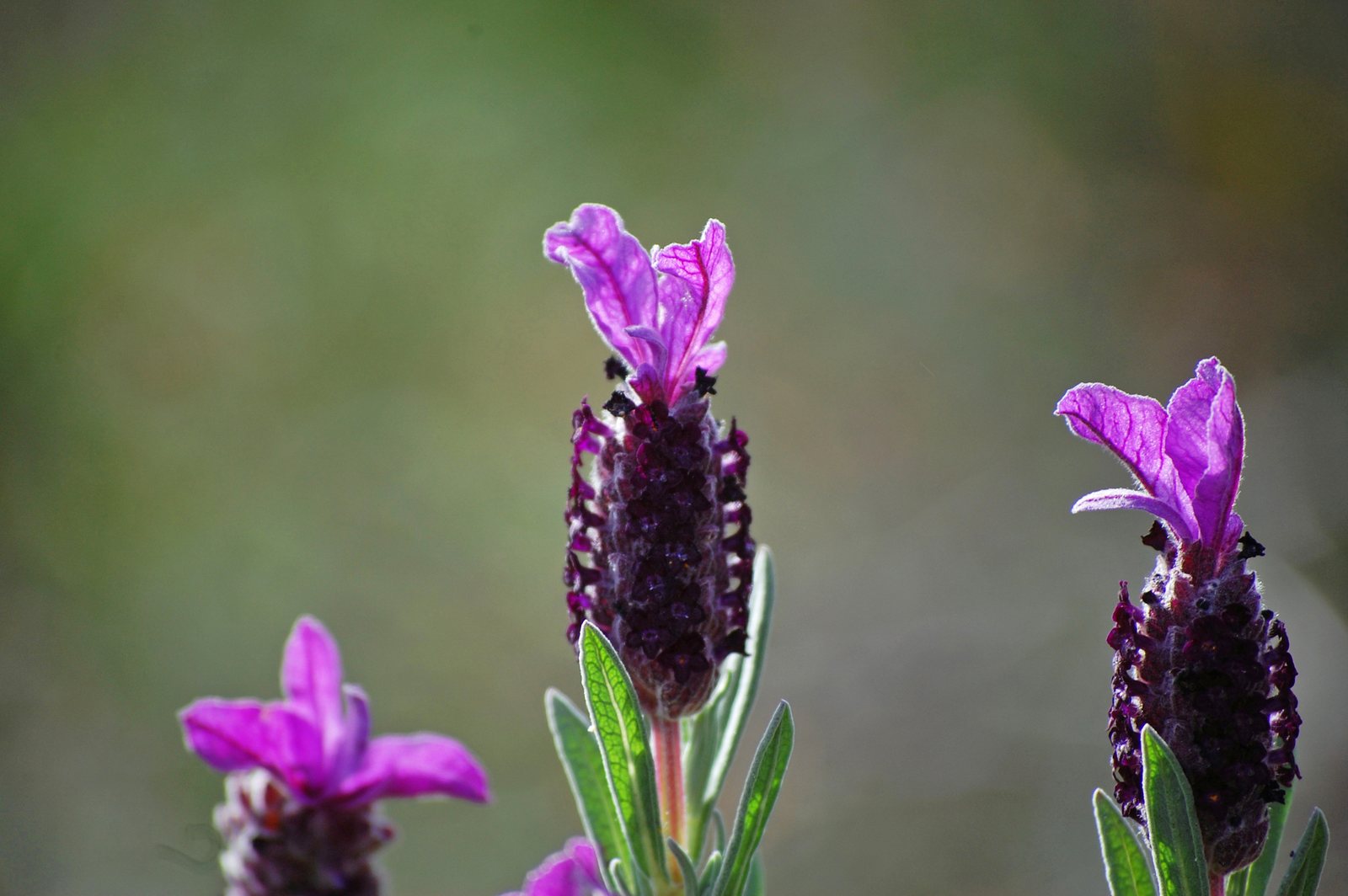
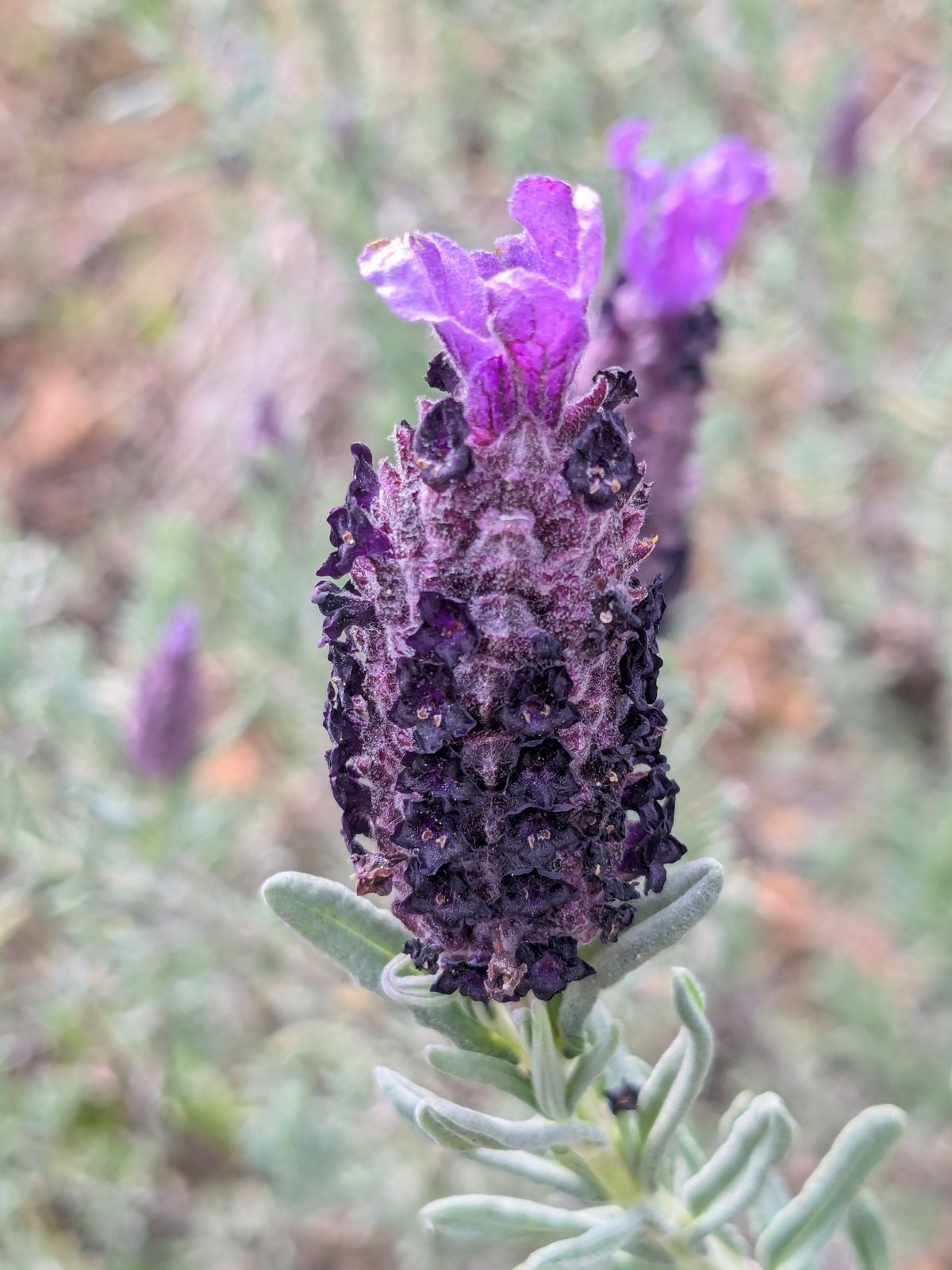
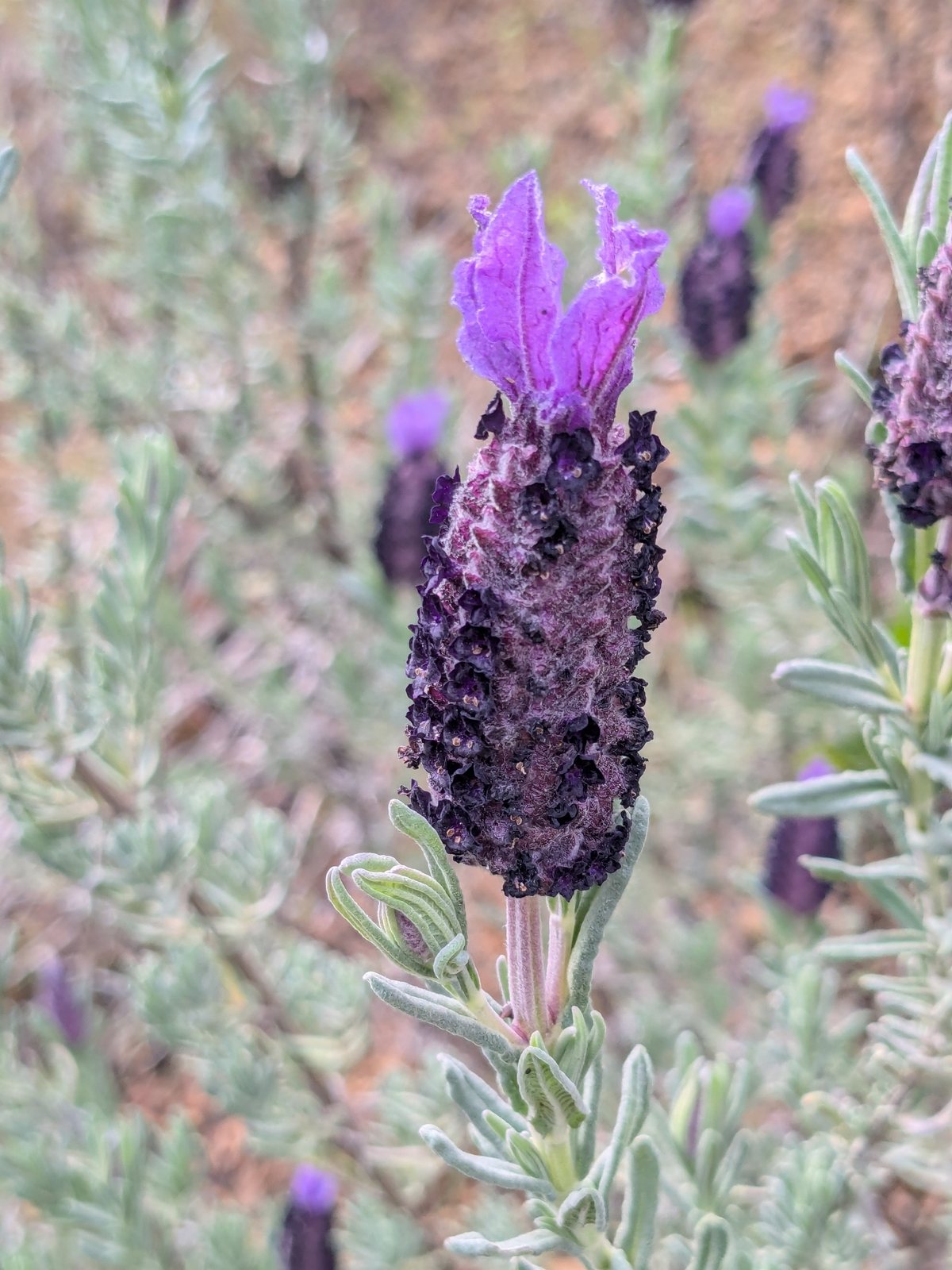
A compact evergreen shrub with aromatic grey-green leaves and dark purple flower heads topped by conspicuous purple bracts resembling rabbit ears. Gardeners grow it for spring and summer colour in sunny containers, gravel gardens and border edges; it needs excellent drainage and is less cold-hardy than English lavender.
At a glance
- Sun
- Full sun, ideally at least 6 hours daily.
- Water
- Water regularly during establishment, letting the soil surface dry between waterings. Once established, water sparingly in the ground; containers need more frequent checks.
- Soil
- Lean to moderately fertile, sharply drained sandy or gravelly soil, preferably slightly acidic to neutral. Avoid waterlogged ground and heavy, unimproved clay.
- Height
- 1-2 ft (0.3-0.6 m)
- Spread
- 1-2 ft (0.3-0.6 m)
- Flowers
- Dark purple flower heads with brighter purple upright bracts, mainly in spring and early summer; repeat flowering is possible after trimming in warm conditions.
- Foliage
- Evergreen. Narrow, aromatic grey-green leaves on woody, branching stems.
- Growth
- Moderate
- Care needed
- Medium
The year at a glance
- Pollinators
- Deer resistant
- Drought tolerant
- Heat tolerant
- Low allergen
- Fragrant
| J | F | M | A | M | J | J | A | S | O | N | D | |
|---|---|---|---|---|---|---|---|---|---|---|---|---|
| Flowers | ||||||||||||
| Plant |
Northern hemisphere months. In Australia, shift them by six.
- Difficulty
- Moderate
- Toughness
- Needs looking after
Will it suit your garden?
Pick your zone, country, light and whether you have pets.
Full sun is 6 or more hours of direct sun a day, part shade 3 to 6 hours, shade under 3.
How it grows
Planting day
1.5 ft (0.45 m)
full size
About 5 years to full size.
From a typical nursery size, at an average rate for this kind of plant. A rule of thumb, not a forecast.
Good to know
- Cats and dogs
- Toxic
- Invasive in
- the US and Australia
- In the garden
- Spreads vigorously: plan to contain it.
- Growth rate
- Moderate
Care
Jobs through the year
- WaterApr–May, Sep–Oct, every 14 days
- For established in-ground plants, water only if dry; new plants and containers need closer checks.
- WaterJun–Aug, every 10 days
- Water established in-ground plants only in dry weather; let the surface dry and never leave pots standing in water.
- PruneApr–May
- After hard frosts, trim damaged tips back to living leafy growth, never bare old wood.
- DeadheadJun–Sep, every 14 days
- Snip faded heads to encourage possible repeat flowering.
- PruneJun–Jul
- Lightly shape leafy shoots after the main flush; avoid hard autumn pruning.
- ProtectJan–Apr, Oct–Dec
- Not reliably hardy in zones 6–7: overwinter in a bright, cool, frost-free container shelter; keep barely moist.
- Water at soil level and allow the surface to dry before watering again; never leave pots standing in water.
- Use containers with drainage holes and a gritty, free-draining potting mix.
- Avoid rich manure and routine feeding; feed container plants lightly in spring only if growth is weak.
- Keep the crown clear of damp organic mulch; use a thin gravel mulch if needed.
- In cold or persistently wet winters, move containers to a bright, cool, frost-free shelter.
Pruning. Trim off spent flower heads after the main flush, lightly shaping the leafy shoots to encourage fresh growth. Never cut into bare old wood, and avoid hard pruning in autumn.
Through the year
- Early spring
- Check for winter damage and trim dead tips back to living, leafy growth once severe frosts have passed.
- Spring
- Plant after hard frosts, choosing full sun and sharply drained soil.
- Late spring
- Check newly planted shrubs and containers for drying soil; water deeply rather than giving frequent small amounts.
- Early summer
- Remove faded flower heads and lightly shape the plant after its main flowering flush.
- Late summer
- Where cultivation is permitted, take semi-ripe cuttings from healthy non-flowering shoots.
- Autumn
- Reduce watering as growth slows and move pots under bright, frost-free cover where winters are too cold or wet.
In the garden
- Plant along a sunny path edge where the aromatic foliage can be appreciated without spilling into the walkway.
- Repeat in terracotta pots around a sunny courtyard for a compact Mediterranean planting.
- Combine with rock roses, santolina and thyme in a free-draining gravel border.
- Use as a low, informal edging around sunny beds, allowing enough space for air to circulate between plants.
Garden styles it suits: Mediterranean, Modern Mediterranean, Dry gravel garden, Modern courtyard, Sensory garden and Pollinator garden.
Plant it with: Rock rose, Santolina, Creeping thyme, Rosemary, Catmint and Dianthus.
Wildlife: Flowers attract bees and other nectar-feeding insects. Do not plant it for wildlife where Spanish lavender is an invasive weed.
Problems to watch for
- Root rot and crown rot in wet soil: improve drainage or grow in a raised bed or container; replace plants with extensively rotted roots.
- Winter dieback from frost and wet conditions: choose a sheltered site and protect container plants in a bright, frost-free place.
- Woody, bare growth: trim lightly after flowering each year; replace badly bare plants rather than cutting hard into old wood.
- Poor flowering and floppy growth: provide more direct sun and stop high-nitrogen feeding.
Safety
Lavender is toxic to cats, dogs and horses if eaten, usually causing digestive upset such as nausea, vomiting where the animal is able to vomit, or reduced appetite. Leaves and flowers contain aromatic compounds, and concentrated essential oil presents a greater poisoning risk. This is not a culinary lavender; people should not ingest its essential oil, and its sap or oil may irritate sensitive skin.
Where it spreads. Lavandula stoechas, often called topped lavender in Australia, is a serious invasive weed in parts of southern Australia, including Victoria, South Australia and Western Australia; cultivation and sale are restricted in some jurisdictions. It is also invasive in parts of California. Do not assume 'Anouk' is sterile or exempt from local restrictions; check before buying or planting.
Easily confused with
English lavender (Lavandula angustifolia)
Has slender flower spikes without the large upright terminal bracts of Spanish lavender and is generally much more cold-hardy.
Fringed lavender (Lavandula dentata)
Has noticeably toothed leaf margins; 'Anouk' has narrow leaves with un-toothed margins.
Portuguese lavender (Lavandula pedunculata)
Usually carries its flower heads on much longer, conspicuously bare stalks, often with longer, spreading terminal bracts; 'Anouk' has a more compact habit.
The name
The name stoechas comes from the ancient Greek name for the Stoechades islands, now the Îles d’Hyères off southern France, where this lavender grew.
Propagation. Where cultivation is permitted, root softwood cuttings in spring or semi-ripe cuttings in summer in a gritty propagation mix. Seed-grown plants will not reliably retain the characteristics of 'Anouk'.
Checked against open data
- Accepted botanical name
- Lavandula stoechas
- In the US and Canada
- Introduced in the lower 48 states.
- Native range
- Algeria, Baleares, Corse, Cyprus, East Aegean Is., France, Greece, Italy, Kriti, Lebanon-Syria, Morocco and Palestine.
- Measured
- Soil pH 4.5 to 5. Average height 75 cm.
Sources: GBIF (CC BY 4.0), USDA PLANTS and Trefle (CC BY 4.0). The care and design notes are LandscapeGPT's own.
See it in your own yard.
Upload a photo of your yard and see it redesigned with plants that suit your climate, each checked against your zone.