Aubrieta
Aubrieta deltoidea. Family Brassicaceae. Perennial.
Also called Purple rock cress, False rock cress.
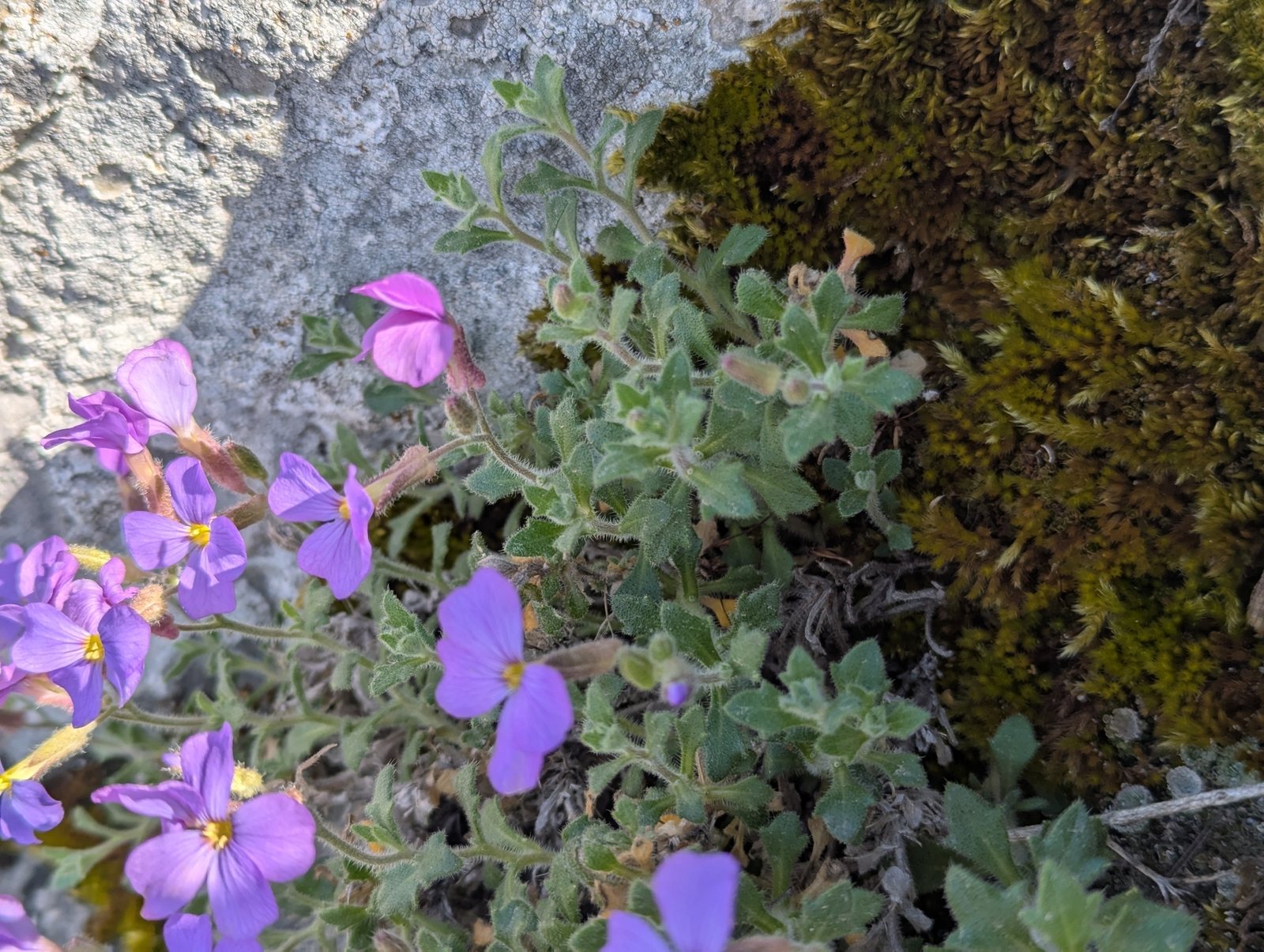
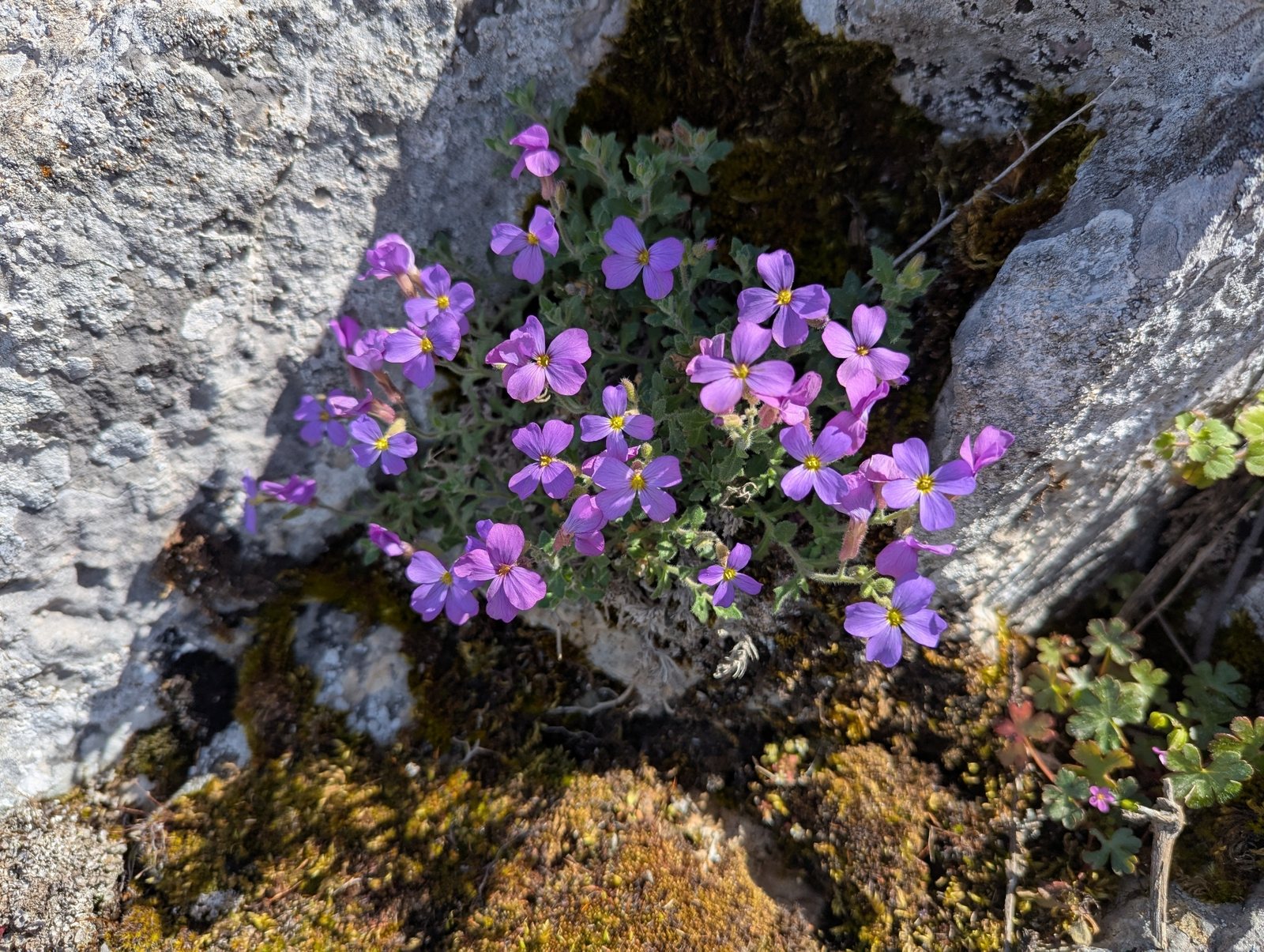
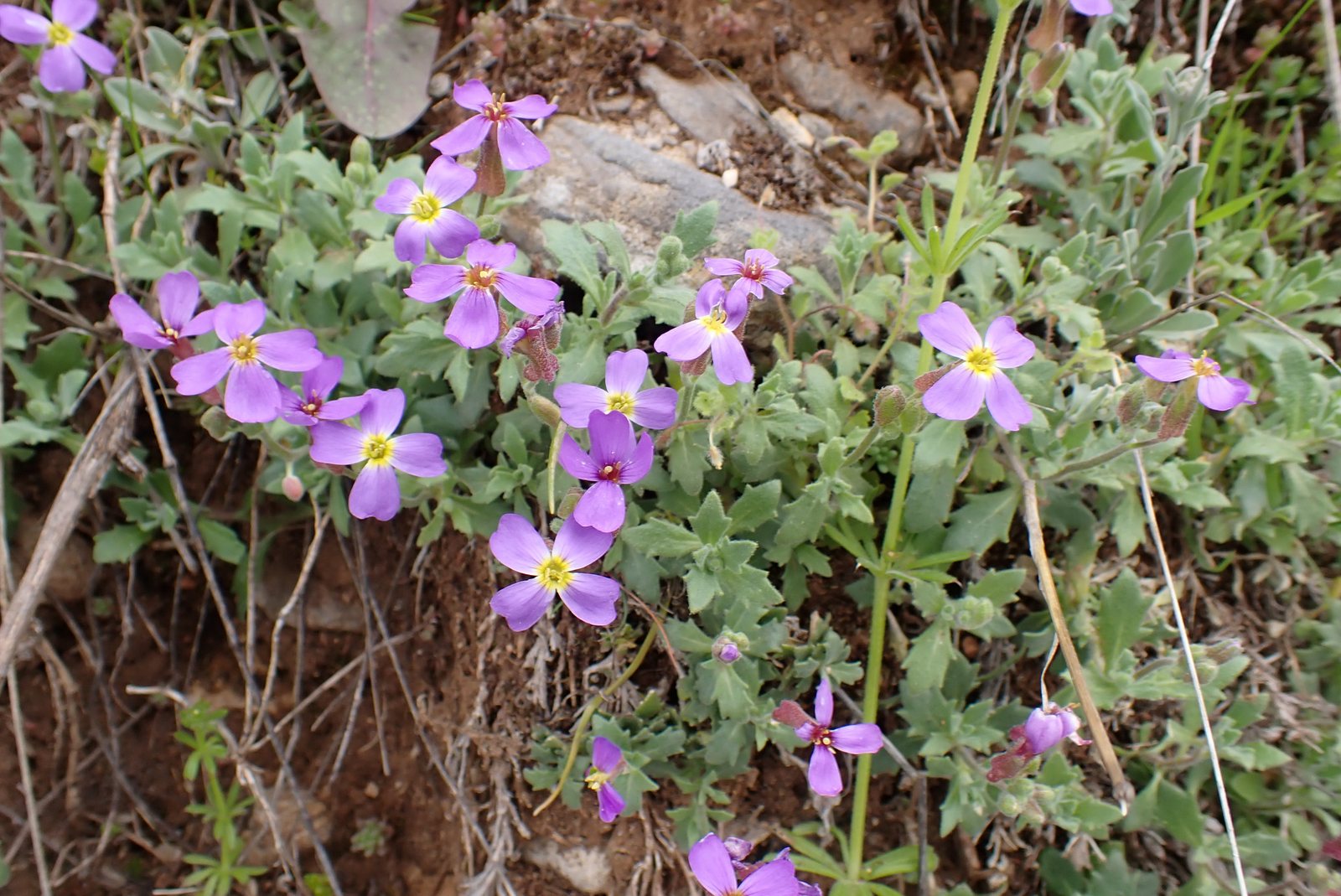
Aubrieta is a low, mat-forming perennial grown for its mass of purple flowers in spring. It spreads over sunny rock gardens, gravel edges and retaining walls, keeping a low carpet of foliage after flowering. It performs best in cool to mild climates with excellent drainage.
At a glance
- Sun
- Full sun; light afternoon shade can help in hotter gardens.
- Water
- Water regularly while establishing, then during prolonged dry spells. Avoid persistently wet soil, especially in winter.
- Soil
- Well-drained, moderately fertile, neutral to alkaline soil. Gritty or stony soil suits it; heavy clay needs improved drainage or a raised planting position.
- Height
- 0.25-0.5 ft (0.08-0.15 m)
- Spread
- 1-2 ft (0.3-0.6 m)
- Flowers
- Mid- to late spring; small, four-petalled violet-purple to lilac flowers, sometimes with a lighter centre.
- Foliage
- Small, softly hairy, grey-green leaves form a dense mat. Usually evergreen, but foliage may thin or suffer damage in severe winters.
- Growth
- Moderate
- Care needed
- Low
The year at a glance
- Pollinators
- Deer resistant
- Drought tolerant
- Cold hardy
- Low allergen
| J | F | M | A | M | J | J | A | S | O | N | D | |
|---|---|---|---|---|---|---|---|---|---|---|---|---|
| Flowers | ||||||||||||
| Plant |
Northern hemisphere months. In Australia, shift them by six.
- Difficulty
- Easy
- Toughness
- Very tough
Will it suit your garden?
Pick your zone, country, light and whether you have pets.
Full sun is 6 or more hours of direct sun a day, part shade 3 to 6 hours, shade under 3.
How it grows
Planting day
0.4 ft (0.12 m)
full size
About 3 years to full size.
From a typical nursery size, at an average rate for this kind of plant. A rule of thumb, not a forecast.
Good to know
- Cats and dogs
- Safe
- Growth rate
- Moderate
Care
Jobs through the year
- WaterApr–May, Sep, every 21 days
- Water established mats only in extended dry spells; water new plants when surface soil dries.
- WaterJun–Aug, every 14 days
- Water established plants deeply only during prolonged drought; avoid keeping crowns wet.
- FeedMar
- Use a light balanced feed only if growth is weak; avoid rich feeding.
- PruneMar
- Remove winter-damaged shoots without cutting into bare woody stems.
- PruneMay–Jun
- Immediately after flowering, shear spent stems and lightly trim the leafy mat.
- MulchMar–Apr
- Use a thin gravel mulch if needed; keep damp organic mulch away from crowns.
- ProtectJan–Feb, Oct–Dec
- Clear fallen leaves and keep drainage open to prevent winter crown rot.
- Plant with the crown at soil level in a position that drains freely.
- Water new plants when the surface soil dries; established plants need water mainly during extended drought.
- Avoid rich feeding; use a light application of balanced fertiliser in spring only if growth is weak.
- Keep damp organic mulch away from the crown; a thin gravel mulch is more suitable.
- Remove weeds from the mat by hand before they become established.
Pruning. Immediately after flowering, shear off spent flower stems and lightly trim the leafy growth to keep the mat compact. Avoid cutting deeply into bare, woody stems.
Through the year
- Early spring
- Remove winter-damaged shoots and check that water is not collecting around the crown.
- Spring
- Plant into freely draining soil and water regularly while roots establish.
- Late spring
- After flowering, shear lightly to remove spent stems and tidy the mat.
- Summer
- Water during prolonged drought and take cuttings from healthy non-flowering shoots.
- Autumn
- Clear fallen leaves from the foliage and keep nearby drains or gravel channels open.
- Winter
- Check container drainage and avoid leaving pots standing in water.
In the garden
- Let it spill over a sunny retaining wall to soften stone edges with spring colour.
- Plant between rocks alongside dwarf irises and alpine pinks for a low spring display.
- Use along a sunny path or gravel border where its mat can spread without covering smaller plants.
- Grow in a shallow trough with other drainage-loving alpines for a compact courtyard display.
Garden styles it suits: Alpine rock garden, Cottage garden, Dry gravel garden, Cotswold cottage, Pollinator garden and Small-space.
Plant it with: Creeping phlox, Perennial candytuft, Alpine pinks, Basket-of-gold, Dwarf irises and Creeping thyme.
Wildlife: The spring flowers provide nectar and pollen for bees and other visiting insects.
Problems to watch for
- Crown or root rot in wet soil: improve drainage, move plants out of low spots and replace badly affected plants.
- Sparse, woody centres: trim lightly after flowering and replace ageing mats with rooted cuttings.
- Flea beetles making small holes in leaves: keep young plants watered and use fine insect mesh over vulnerable seedlings.
- Slugs and snails damaging young shoots: remove hiding places and check plants after dark, especially during establishment.
Safety
Not known to be toxic to people, cats, dogs or horses; no particular part is recognised as poisonous. It is an ornamental plant, not a food plant.
Easily confused with
Creeping phlox (Phlox subulata)
Has narrow, needle-like leaves and flowers with five petal lobes; aubrieta has broader, hairy leaves and four petals.
Rock cress (Arabis caucasica)
Usually has white flowers held above more distinct leafy rosettes; aubrieta usually forms a tighter mat covered in violet-purple flowers.
Perennial candytuft (Iberis sempervirens)
Has smooth, dark green leaves and dense white flower clusters with noticeably unequal petals.
The name
Aubrieta honours the French botanical artist Claude Aubriet, while deltoidea refers to the roughly triangular shape of the leaves.
Propagation. Sow seed in spring, or take softwood to semi-ripe cuttings from non-flowering shoots in summer. Seed-grown plants can vary; use cuttings to preserve a particular plant's flower colour and habit.
Checked against open data
- Accepted botanical name
- Aubrieta deltoidea
- In the US and Canada
- Introduced in the lower 48 states.
- Native range
- East Aegean Is., Greece, Kriti, Sicilia and Turkey.
- Measured
- Soil pH 7 to 7.5. Average height 14 cm.
Sources: GBIF (CC BY 4.0), USDA PLANTS and Trefle (CC BY 4.0). The care and design notes are LandscapeGPT's own.
See it in your own yard.
Upload a photo of your yard and see it redesigned with plants that suit your climate, each checked against your zone.