Autumn Blaze maple
Acer × freemanii 'Jeffersred'. Family Sapindaceae. Tree.
Also called Acer × freemanii 'Jeffersred', Autumn Blaze Freeman maple.
A fast-growing, deciduous hybrid of red maple and silver maple, grown for its upright, rounded crown and orange-red to scarlet autumn foliage. It makes a substantial shade tree for a large garden, but shallow roots and potentially weak branch unions make careful siting and early structural pruning important.
At a glance
- Sun
- Full sun gives the strongest autumn colour; tolerates light partial shade.
- Water
- Keep young trees evenly moist while they establish. Established trees tolerate occasional dry spells but benefit from deep watering during prolonged drought.
- Soil
- Moist, well-drained, slightly acidic soil is best. Tolerates clay and brief wet periods, but alkaline soil can cause persistent yellowing.
- Height
- 40-55 ft (12-17 m)
- Spread
- 30-40 ft (9-12 m)
- Foliage
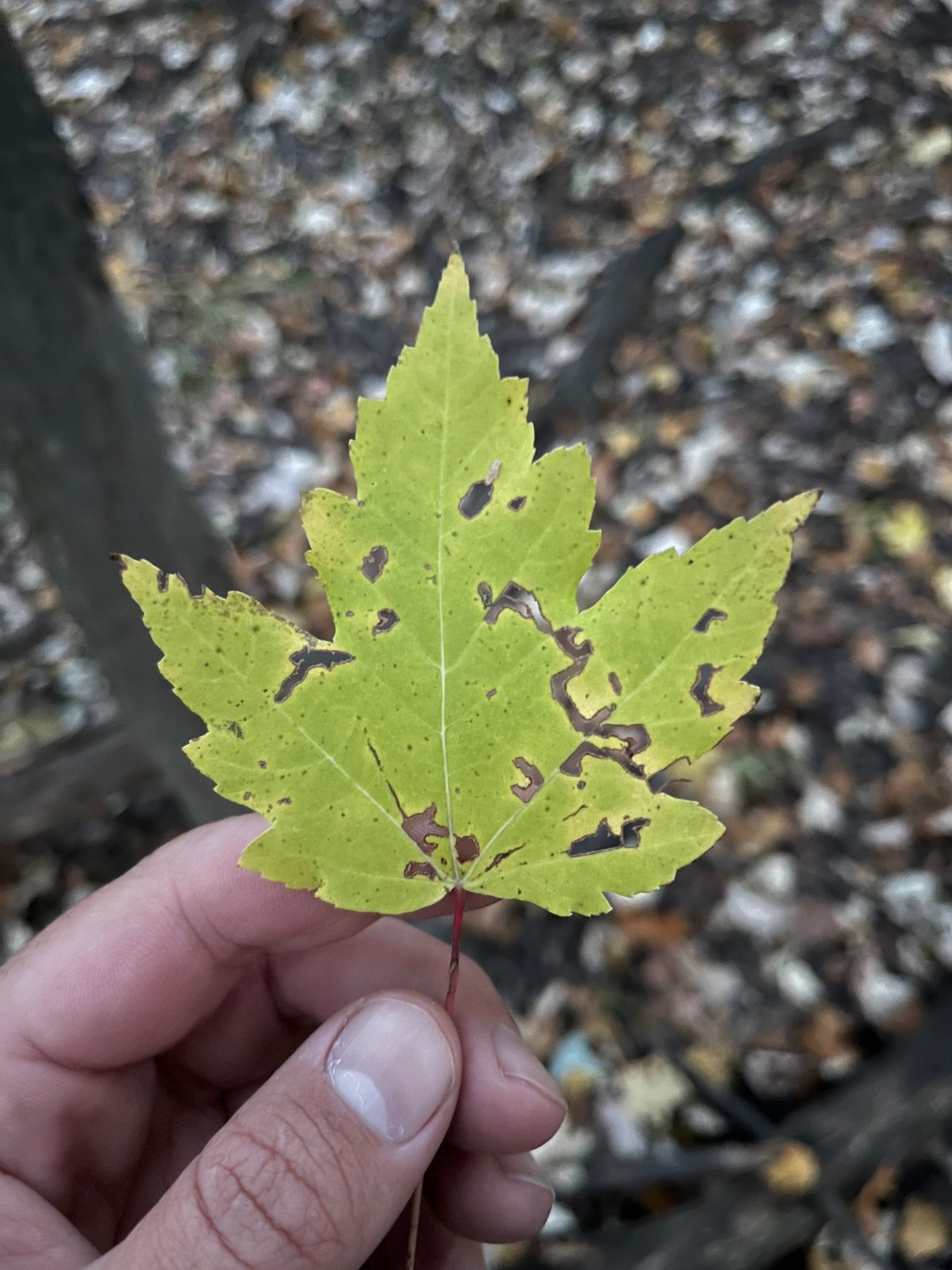
- Green, deeply lobed leaves with pale undersides turn orange-red to scarlet in autumn. Colour intensity varies with climate and growing conditions.
- Growth
- Fast; often 2-3 ft (0.6-0.9 m) a year while young in favourable conditions.
- Care needed
- Medium
The year at a glance
- Cold hardy
- Wildlife
| J | F | M | A | M | J | J | A | S | O | N | D | |
|---|---|---|---|---|---|---|---|---|---|---|---|---|
| Plant |
Northern hemisphere months. In Australia, shift them by six.
- Difficulty
- Moderate
- Toughness
- Fairly tough
Will it suit your garden?
Pick your zone, country, light and whether you have pets.
Full sun is 6 or more hours of direct sun a day, part shade 3 to 6 hours, shade under 3.
How it grows
Planting day
7 ft (2 m)
After 1 year
10 ft (3 m)
After 2 years
13 ft (3.9 m)
After 3 years
16 ft (4.9 m)
After 5 years
22 ft (6.8 m)
About 13 years to full size.
From a typical nursery size, at an average rate for this kind of plant. A rule of thumb, not a forecast.
Good to know
- Cats and dogs
- Safe
- Growth rate
- Fast
Care
Jobs through the year
- WaterApr–May, Sep–Oct, every 21 days
- Deep-water established trees only during prolonged dry spells; young trees need regular watering for 2–3 years.
- WaterJun–Aug, every 14 days
- During prolonged drought, soak the established root area deeply rather than sprinkling near the trunk.
- MulchMar–Apr
- Maintain 5–8 cm of organic mulch over the root area, clear of the trunk and root flare.
- PruneJul–Aug
- Make small formative cuts on young trees, retaining one leader; use an arborist for major defects and never top.
- ProtectFeb–Mar
- Inspect for storm damage and weak branch unions; seek professional assessment of major defects.
- ProtectApr
- Check young-tree ties and remove stakes after the first growing season if the root ball is stable.
- Plant with the root flare visible at soil level; correct circling roots before backfilling.
- Water deeply through the first two or three growing seasons whenever the root zone begins to dry.
- Spread 2-3 in (5-8 cm) of organic mulch over the root area, keeping it away from the trunk.
- Avoid routine feeding; use a soil test before treating poor growth or yellow leaves.
- Allow generous rooting space away from paving, drains and buildings; surface roots can lift nearby hard surfaces.
- Stake only if the root ball moves in wind, and remove supports after the first growing season.
Pruning. Prune lightly in midsummer, or arrange structural pruning with a qualified arborist while the tree is young. Retain one main leader, reduce competing upright stems and remove rubbing branches; never top the crown.
Through the year
- Autumn
- Plant while the soil is workable, water thoroughly and mulch the root area.
- Late winter
- Check the bare crown for split unions, storm damage and competing leaders; arrange professional assessment of major defects.
- Spring
- Refresh mulch without covering the root flare, and check whether young trees still need their stakes.
- Late spring
- Inspect new leaves for yellowing between green veins; test soil pH before applying treatments.
- Summer
- Water deeply during prolonged dry weather, especially while the tree is establishing.
- Midsummer
- Carry out light formative pruning on young trees, keeping cuts small.
In the garden
- Use as a single shade tree in a large lawn, leaving room for its mature crown and roots.
- Place where its autumn colour can be seen from the house, with evergreen planting behind it for contrast.
- Use in a spacious informal avenue, allowing each tree enough room to develop without repeated crown reduction.
- Underplant the outer canopy with spring bulbs and shade-tolerant perennials rather than relying on lawn beneath dense shade.
Garden styles it suits: Traditional, Grand estate, Woodland, Autumn colour, Family-friendly and New England.
Plant it with: Daffodils, Epimedium, Christmas fern, Hellebores and Pennsylvania sedge.
Wildlife: The crown provides shelter and nesting sites for birds, and the foliage can support leaf-feeding insects. This cultivar produces little or no seed, so it offers less seed food than many other maples.
Problems to watch for
- Weak, narrow branch unions: train a single leader while young and have an arborist reduce competing stems before they become large.
- Iron chlorosis on alkaline soil: test soil pH; avoid planting in strongly alkaline ground, where repeated iron treatments may offer only temporary improvement.
- Leaf scorch during drought or heat: water the root zone deeply and maintain mulch; avoid excess fertiliser.
- Verticillium wilt, causing branch dieback: seek a diagnosis, remove dead wood and reduce water stress. There is no reliable cure; severely affected trees may need removal.
Safety
Not known to be toxic to cats, dogs or people. Red maple leaves, especially wilted or dried leaves, can cause fatal poisoning in horses; the risk from this red-maple hybrid is not well established, so keep its leaves and prunings out of horse paddocks and feed.
Easily confused with
Red maple (Acer rubrum)
Usually has shallower leaf sinuses and conspicuous red flowers before the leaves emerge; Autumn Blaze has more deeply cut leaves and little or no flowering.
Silver maple (Acer saccharinum)
Has very deeply cut leaves with strongly silvery undersides, often drooping branches and usually yellow autumn foliage rather than a consistently red display.
Other Freeman maples (Acer × freemanii)
Leaf shape and autumn colour overlap considerably among cultivars. A reliable nursery label or planting record is needed to confirm 'Jeffersred'.
The name
Freeman maple honours hybridiser Oliver Freeman, while the trade name Autumn Blaze refers to the tree's bright autumn foliage.
Propagation. Propagated commercially by rooting cuttings or grafting. Seed, if produced, will not reliably reproduce 'Jeffersred'; buy a correctly labelled tree to obtain this cultivar.
Checked against open data
- Accepted botanical name
- Acer freemanii
Sources: GBIF (CC BY 4.0). The care and design notes are LandscapeGPT's own.
See it in your own yard.
Upload a photo of your yard and see it redesigned with plants that suit your climate, each checked against your zone.