Baby blue eyes
Nemophila menziesii. Family Hydrophyllaceae. Annual.
Also called California bluebell.
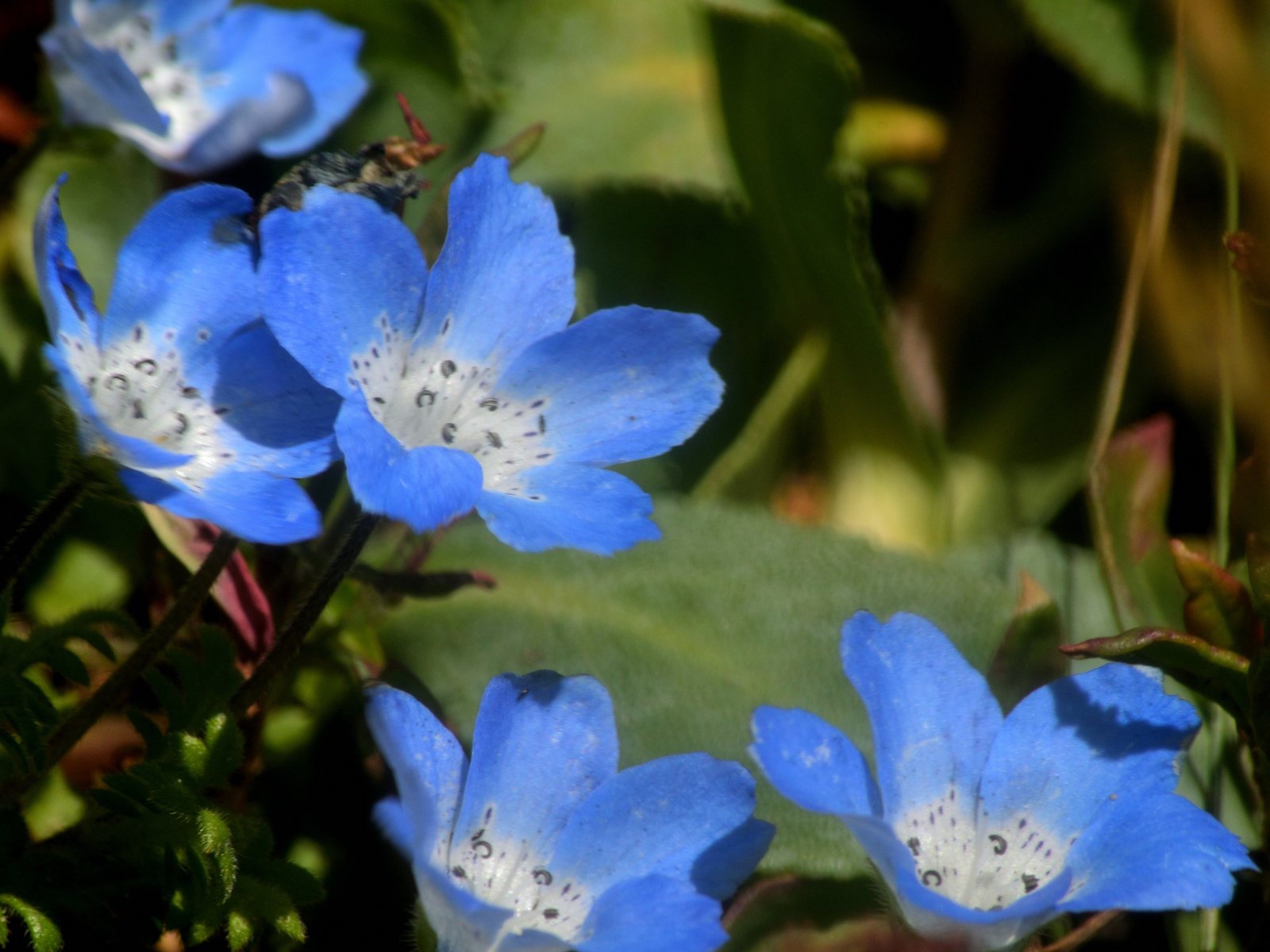
Baby blue eyes is a low, spreading wildflower native to western North America, grown as an annual for its sky-blue flowers with pale centres. It makes a soft carpet along paths, beneath spring bulbs or in cool-season containers. It flowers best in mild weather and usually declines in summer heat.
At a glance
- Sun
- Full sun in cool climates; light afternoon shade where spring weather becomes hot.
- Water
- Keep evenly moist while seedlings establish and during flowering, without leaving the soil waterlogged.
- Soil
- Well-drained loam or sandy soil with modest fertility; tolerates slightly acidic to slightly alkaline conditions.
- Height
- 0.5-1 ft (0.15-0.3 m)
- Spread
- 0.5-1 ft (0.15-0.3 m)
- Flowers
- Spring to early summer, sometimes longer in cool climates; sky-blue, open cup-shaped flowers with white centres.
- Foliage
- Soft, pale to medium green, deeply lobed leaves on low, branching, somewhat hairy stems.
- Growth
- Fast; germinates, flowers and sets seed within one growing season.
- Care needed
- Low
The year at a glance
- Pollinators
- Low allergen
| J | F | M | A | M | J | J | A | S | O | N | D | |
|---|---|---|---|---|---|---|---|---|---|---|---|---|
| Flowers | ||||||||||||
| Fruit | ||||||||||||
| Plant |
Northern hemisphere months. In Australia, shift them by six.
- Difficulty
- Easy
- Toughness
- Fairly tough
Will it suit your garden?
Pick your zone, country, light and whether you have pets.
Full sun is 6 or more hours of direct sun a day, part shade 3 to 6 hours, shade under 3.
How it grows
Planting day
0.5 ft (0.15 m)
After 1 year
0.7 ft (0.22 m)
full size
Full size in one season.
From a typical nursery size, at an average rate for this kind of plant. A rule of thumb, not a forecast.
Good to know
- Cats and dogs
- Safe
- Native to
- the US
- Growth rate
- Fast
Care
Jobs through the year
- WaterMar–May, every 7 days
- Water established plants when the surface dries; check seedbeds and seedlings more often to keep them lightly moist.
- WaterJun–Jul, every 4 days
- Water flowering plants at soil level during dry weather, keeping soil moist but not waterlogged.
- DeadheadMay–Jul, every 7 days
- Remove faded flowers to prolong blooming, leaving some capsules for self-seeding.
- ProtectMar–Apr
- Cover emerging seedlings with fleece during severe frost and protect them from slugs.
- Sow directly where plants are to flower, covering the seed lightly; avoid disturbing established roots.
- Thin seedlings to about 6-8 in (15-20 cm) apart so air can move between plants.
- Water gently during establishment, then water when the soil surface starts to dry.
- Avoid heavy feeding; rich soil encourages leafy growth rather than flowers.
- Keep thick mulch away from seedlings and leave some bare soil if you want plants to self-seed.
Pruning. No structural pruning is needed. Remove faded flowers to extend the display, or leave some seed capsules to ripen before pulling out plants once they have died back.
Through the year
- Early spring
- In cold-winter regions, sow directly once the soil is workable; protect emerging seedlings from severe frost.
- Spring
- Thin crowded seedlings and keep the soil lightly moist while roots establish.
- Late spring
- Remove faded flowers if you want to prolong flowering, and water during dry spells.
- Early summer
- Allow a few seed capsules to turn brown for self-seeding or seed collection.
- Summer
- Remove spent plants after heat ends flowering; replace them with plants suited to warmer weather.
- Autumn
- In mild-winter regions, sow outdoors for a spring display. Use local seasons rather than Northern Hemisphere dates.
In the garden
- Sow along the front of borders for a low ribbon of blue in spring.
- Plant between spring bulbs to soften bare soil around their stems.
- Combine with low white or yellow annuals for a loose, cool-season flower carpet.
- Use in shallow containers or window boxes that stay cool and drain freely.
- Include in California-native annual displays, leaving patches of open soil for self-seeding.
Garden styles it suits: Cottage garden, Wildflower, California native, Pollinator garden, Blues and silvers and Pastel border.
Plant it with: California poppy, Sweet alyssum, Poached egg plant, Five spot, Grape hyacinth and Dwarf daffodil.
Wildlife: The open flowers provide pollen and nectar for bees and other small visiting insects.
Problems to watch for
- Slugs and snails can eat young seedlings: inspect after dark, remove hiding places and use wildlife-conscious control where needed.
- Seedlings collapse in persistently wet soil: improve drainage, thin crowded plants and avoid frequent heavy watering.
- Powdery mildew may develop on crowded or stressed plants: improve airflow, water at soil level and remove badly affected plants.
- Flowering stops and foliage browns in hot weather: sow earlier, provide afternoon shade and treat it as a cool-season annual rather than trying to keep it through intense heat.
Safety
Not known to be toxic to people, cats, dogs or horses. Species-specific safety information is limited, so do not treat it as edible or encourage pets or livestock to eat it.
Easily confused with
Five spot (Nemophila maculata)
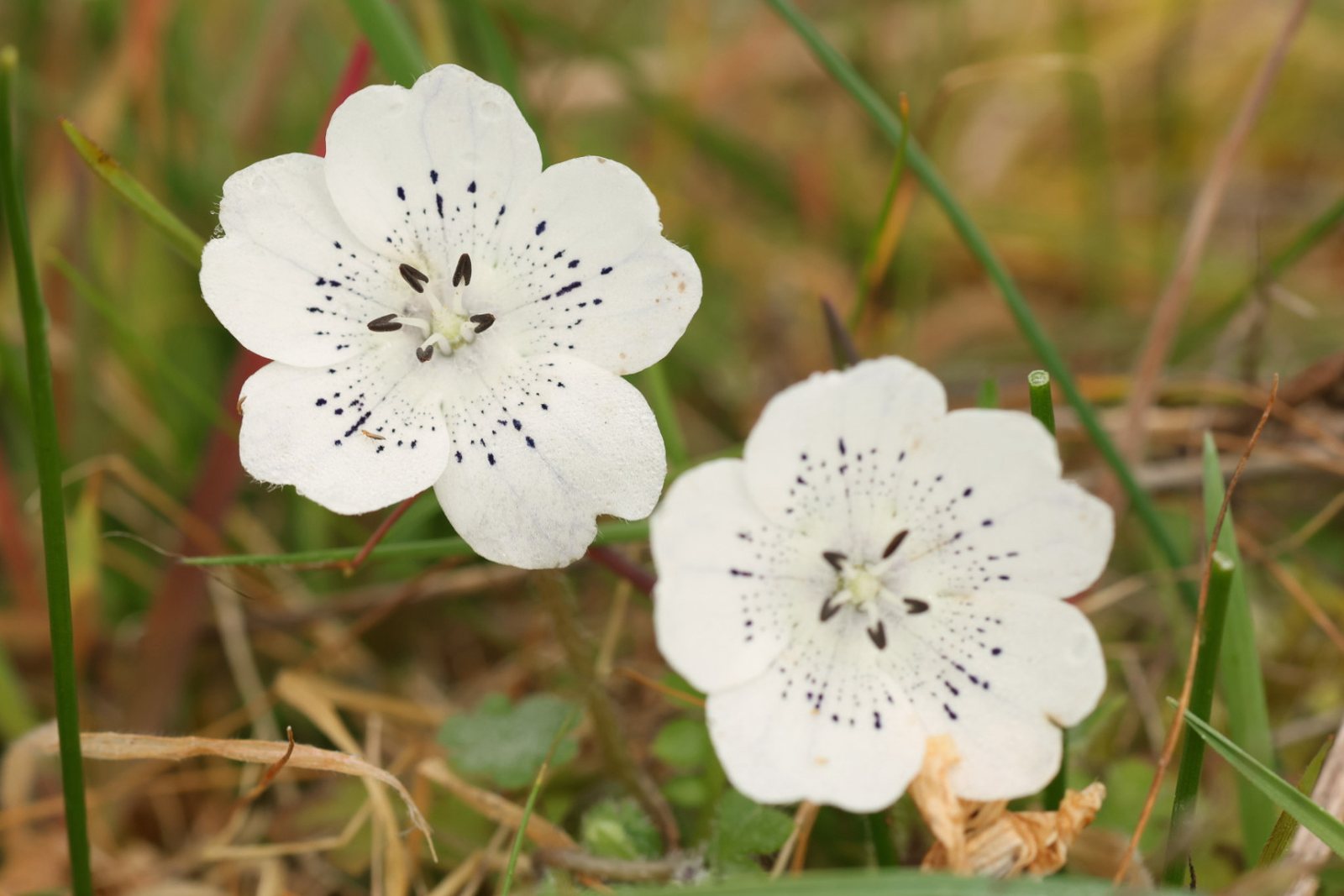
Has white flowers with a distinct purple-blue spot at the tip of each of the five lobes, rather than mainly blue flowers.
Wood forget-me-not (Myosotis sylvatica)
Has clusters of much smaller blue flowers with yellow eyes and simple, unlobed leaves.
Desert bluebells (Phacelia campanularia)
Has deeper blue, more bell-shaped flowers, conspicuous projecting stamens and broad, toothed rather than deeply lobed leaves.
The name
Nemophila comes from Greek words meaning woodland-loving, menziesii honours naturalist Archibald Menzies, and baby blue eyes describes the flowers.
Propagation. Grow from seed, sown directly in early spring in cold-winter areas or in autumn where winters are mild. Cover lightly and keep moist until germination; it may self-seed where some seed reaches open soil.
Checked against open data
- Accepted botanical name
- Nemophila menziesii
- In the US and Canada
- Native in the lower 48 states. Introduced in Alaska.
- Native range
- California, Mexico Northwest, Nevada, Oregon and Wyoming.
Sources: GBIF (CC BY 4.0), USDA PLANTS and Trefle (CC BY 4.0). The care and design notes are LandscapeGPT's own.
See it in your own yard.
Upload a photo of your yard and see it redesigned with plants that suit your climate, each checked against your zone.