Bearberry cotoneaster
Cotoneaster dammeri. Family Rosaceae. Groundcover.
Also called Creeping cotoneaster.
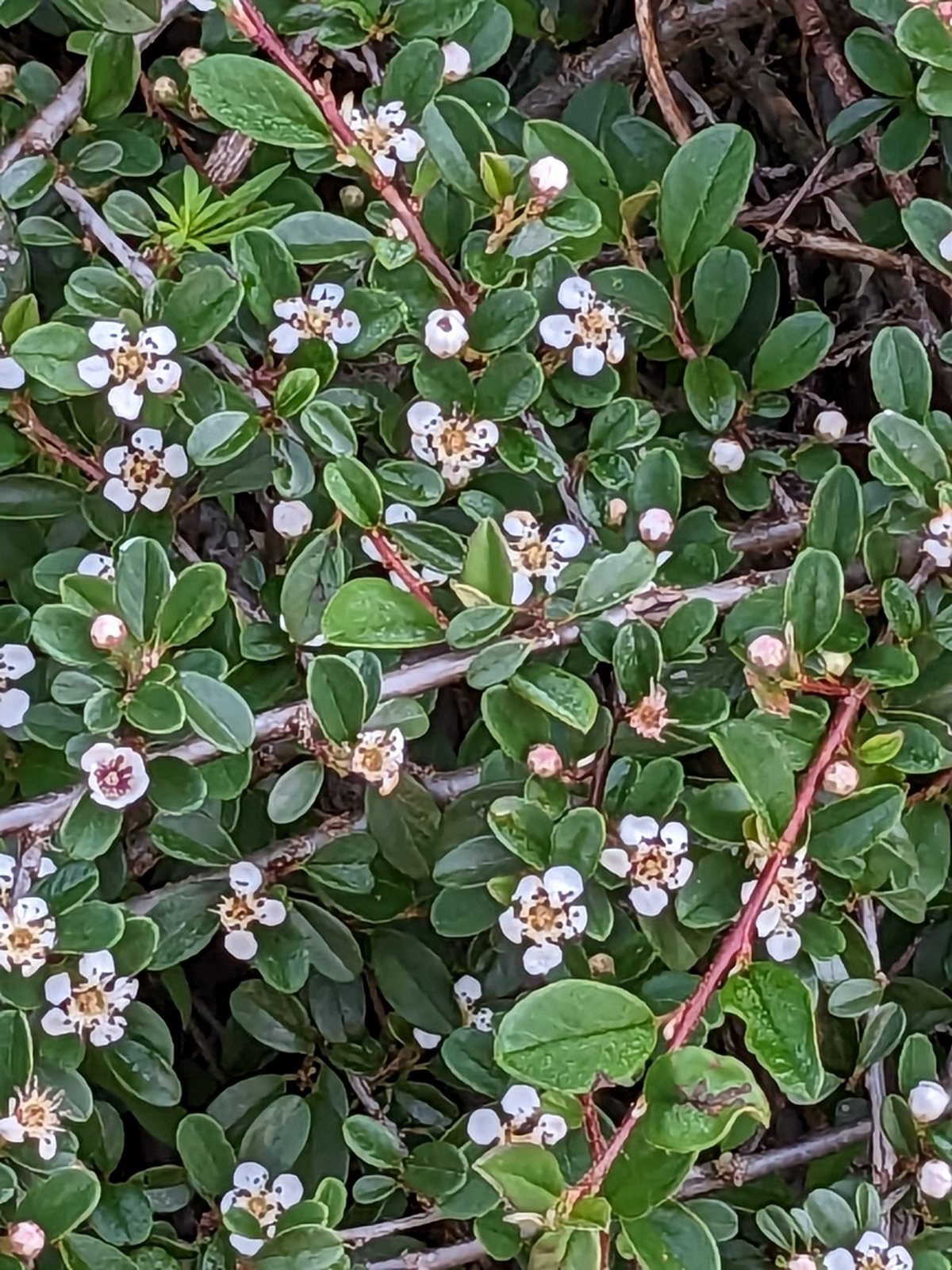
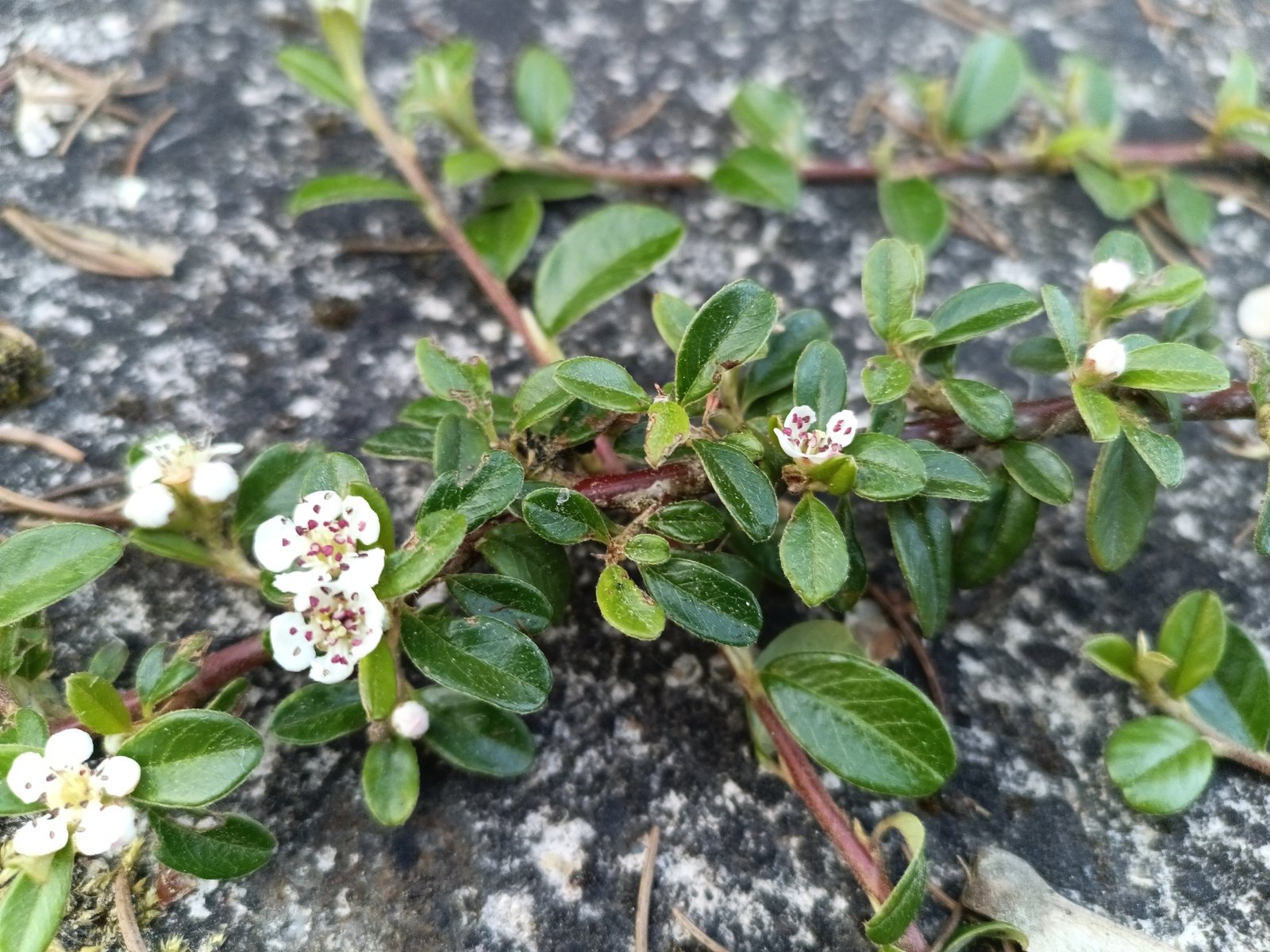
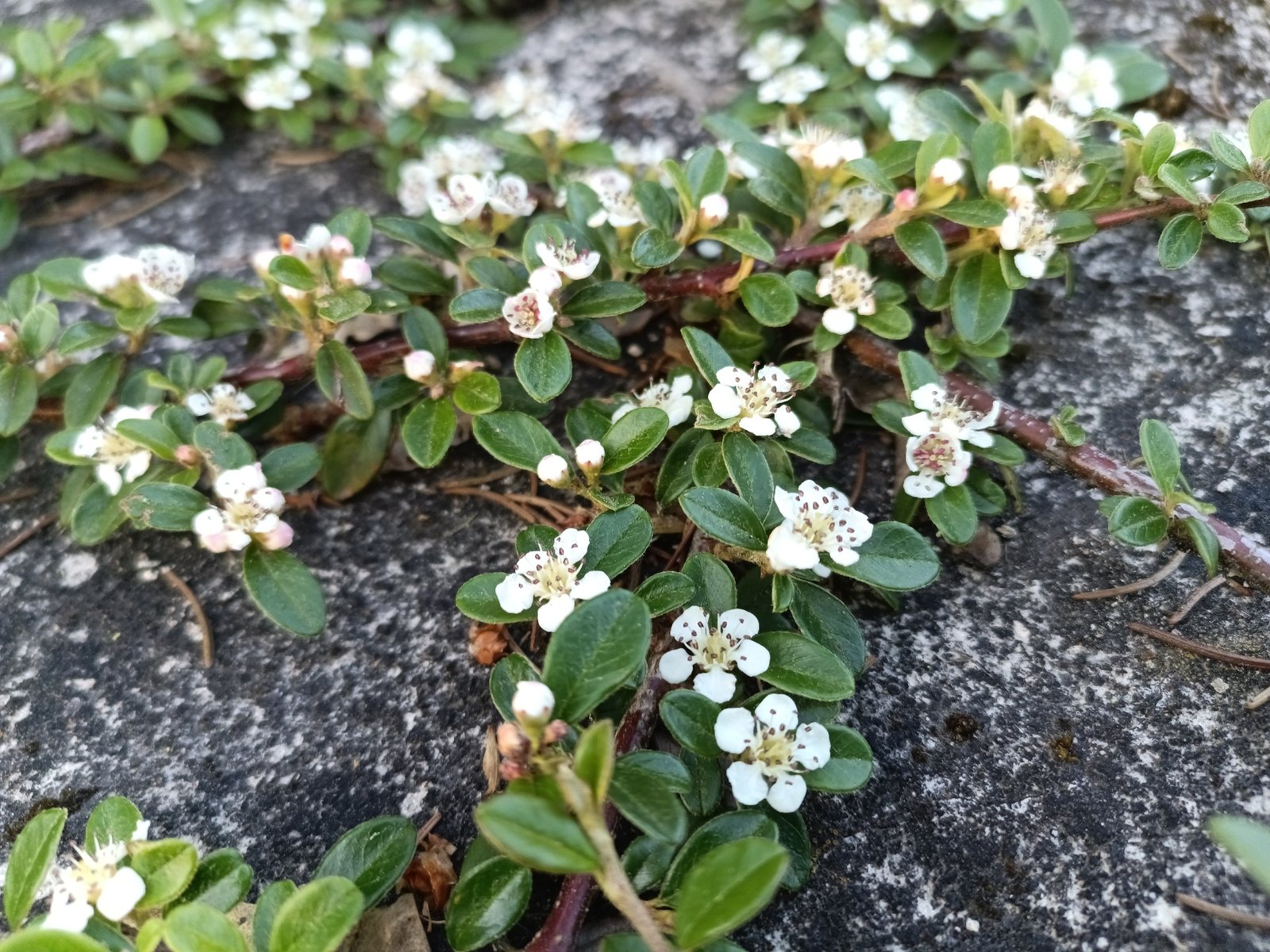
Bearberry cotoneaster is a low, spreading evergreen shrub with trailing stems that root where they touch the soil. Gardeners grow it to cover banks, soften retaining walls and provide glossy foliage, small white flowers and red autumn berries.
At a glance
- Sun
- Full sun to partial shade; flowering and berry production are usually best in sun.
- Water
- Water regularly during the first growing season. Once established, it tolerates dry spells but benefits from deep watering during prolonged drought.
- Soil
- Well-drained soil, including sandy, loamy or stony ground; tolerates a broad pH range. Avoid waterlogged soil.
- Height
- 0.5-1 ft (0.15-0.3 m)
- Spread
- 4-6 ft (1.2-1.8 m), eventually wider where stems root
- Flowers
- Small white flowers in late spring to early summer, followed by red berries that often persist into winter.
- Foliage
- Evergreen. Small, rounded to oval, glossy dark-green leaves with paler undersides; some turn bronze or reddish in cold weather.
- Growth
- Moderate to fast once established.
- Care needed
- Low
The year at a glance
- Pollinators
- Drought tolerant
- Wildlife
- Low allergen
| J | F | M | A | M | J | J | A | S | O | N | D | |
|---|---|---|---|---|---|---|---|---|---|---|---|---|
| Flowers | ||||||||||||
| Fruit | ||||||||||||
| Plant |
Northern hemisphere months. In Australia, shift them by six.
- Difficulty
- Easy
- Toughness
- Very tough
Will it suit your garden?
Pick your zone, country, light and whether you have pets.
Full sun is 6 or more hours of direct sun a day, part shade 3 to 6 hours, shade under 3.
How it grows
Planting day
0.2 ft (0.06 m)
After 1 year
0.5 ft (0.14 m)
After 2 years
0.7 ft (0.22 m)
full size
About 2 years to full size.
From a typical nursery size, at an average rate for this kind of plant. A rule of thumb, not a forecast.
Good to know
- Cats and dogs
- Toxic
- Invasive in
- the US, Canada and Australia
- In the garden
- Spreads vigorously: plan to contain it.
- Growth rate
- Fast
Care
Jobs through the year
- WaterApr–May, Sep–Oct, every 21 days
- Water established plants only in prolonged dry weather; water new plants more often.
- WaterJun–Aug, every 14 days
- During prolonged drought, soak the root zone deeply rather than sprinkling.
- PruneFeb–Mar
- Remove dead stems and selectively shorten spreading growth; avoid shearing flowers and berrying wood.
- PruneJun–Sep
- Lift or cut unwanted rooted runners and remove seedlings beyond the planting area.
- FeedMar–Apr
- Feed lightly only if growth is weak; avoid high-nitrogen feeding.
- MulchMar–Apr
- Mulch gaps between young plants after weeding, keeping main stems clear.
- ProtectNov–Dec
- Remove smothering debris from young plants and keep drainage clear.
- Water deeply when the root zone begins to dry during the first growing season.
- Remove perennial weeds before planting; they are difficult to extract once the stems form a mat.
- Apply a thin layer of mulch between young plants, keeping it away from the main stems.
- Feed lightly in spring only if growth is weak; rich feeding encourages excessive leafy growth.
- Lift or trim stems before they root beyond the intended planting area.
Pruning. In late winter or early spring, remove dead or damaged stems and shorten growth that reaches paths or neighbouring plants. Thin congested growth selectively rather than shearing the entire surface; heavy pruning reduces flowers and berries.
Through the year
- Late winter
- Remove dead stems and trim growth that has spread beyond its allotted space.
- Spring
- Plant in well-drained ground, water thoroughly and mulch the gaps between plants.
- Late spring
- Check fresh shoots for aphids and distorted growth; wash off small colonies with water.
- Summer
- Water young plants during dry weather and remove unwanted rooted runners.
- Autumn
- Check nearby beds for seedlings and remove them before they establish.
- Winter
- Check that drainage remains free and keep fallen debris from smothering young plants.
In the garden
- Cover a sunny, well-drained bank with a low evergreen mat, away from natural habitats where it could escape.
- Let stems trail over a retaining wall to soften its edge.
- Use beneath widely spaced shrubs where enough light reaches the ground.
- Combine with ornamental grasses and upright perennials for contrasting height and texture.
Garden styles it suits: Traditional, Low-maintenance, Dry gravel garden, Winter interest, Coastal and Urban city garden.
Plant it with: Lavender, Catmint, Feather reed grass, Dwarf pines and Daffodils.
Wildlife: Flowers provide nectar and pollen for insects, and birds eat the berries and may disperse the seeds. Dense growth offers cover for small animals, but it can displace native vegetation where it escapes cultivation.
Problems to watch for
- Fire blight causes blackened, dying shoots, sometimes with hooked tips. Cut back into healthy wood in dry weather, disinfect tools between cuts and avoid heavy nitrogen feeding.
- Lace bugs can cause pale stippling on leaves. Check leaf undersides and use insecticidal soap if damage is significant, following the product label.
- Root rot and dieback occur in waterlogged soil. Improve drainage or move healthy plants to a better-drained site.
- Rooting stems and bird-sown seedlings can spread beyond the bed. Remove seedlings promptly and cut off unwanted rooted growth.
Safety
The berries and seeds contain cyanogenic compounds and are potentially harmful to people, cats and dogs if eaten, particularly in quantity. Poisoning is usually mild, with stomach upset, but larger amounts can be more serious. Information specific to horses is limited; keep clippings and berries out of grazing areas and seek veterinary advice after ingestion.
Where it spreads. Escapes cultivation through bird-dispersed seed and rooting stems. It is reported as invasive in coastal British Columbia and parts of the US Pacific Northwest, and as an environmental weed in parts of Victoria and Tasmania, Australia. Check local guidance before planting near bushland, woodland or other natural areas.
Easily confused with
Bearberry (Arctostaphylos uva-ursi)
Also forms an evergreen mat with red fruit, but has clusters of small pinkish-white, urn-shaped flowers rather than open white flowers.
Rockspray cotoneaster (Cotoneaster horizontalis)
Has conspicuous herringbone branching and is usually deciduous or semi-evergreen, with strong autumn leaf colour.
Small-leaved cotoneaster (Cotoneaster microphyllus)
Usually has much smaller leaves with distinctly whitish, felted undersides and a more woody, mounded habit.
The name
Cotoneaster means quince-like, dammeri honours the German botanist Udo Dammer, and bearberry refers to its resemblance to the unrelated bearberry.
Propagation. Separate naturally rooted stems in spring or autumn, or take semi-ripe cuttings in summer. Named cultivars should be propagated vegetatively because seedlings may differ from the parent.
Checked against open data
- Accepted botanical name
- Cotoneaster dammeri
- Native range
- China North-Central and China South-Central.
Sources: GBIF (CC BY 4.0) and Trefle (CC BY 4.0). The care and design notes are LandscapeGPT's own.
See it in your own yard.
Upload a photo of your yard and see it redesigned with plants that suit your climate, each checked against your zone.