Bigleaf magnolia
Magnolia macrophylla. Family Magnoliaceae. Tree.
Also called Large-leaved cucumber tree.
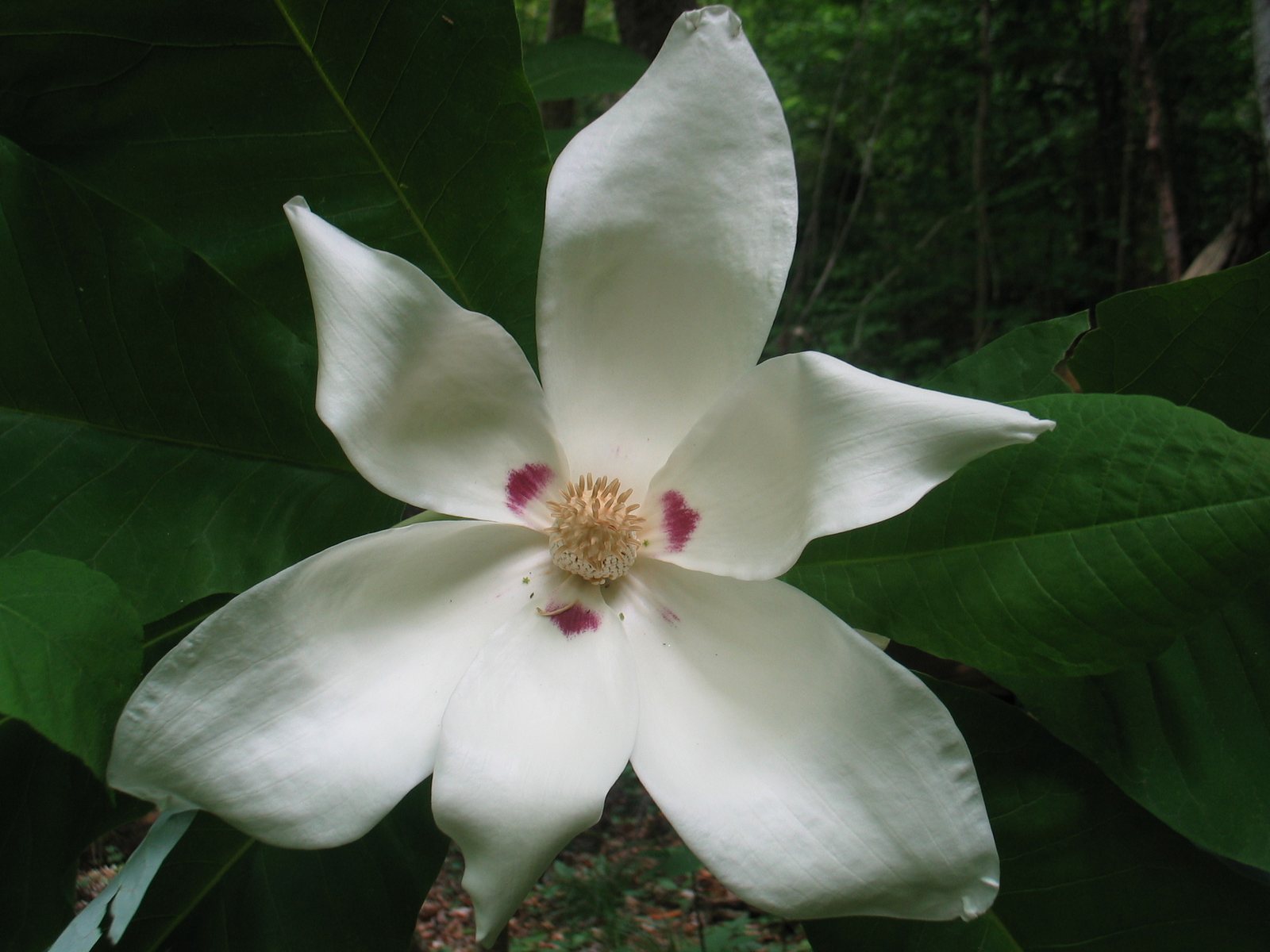
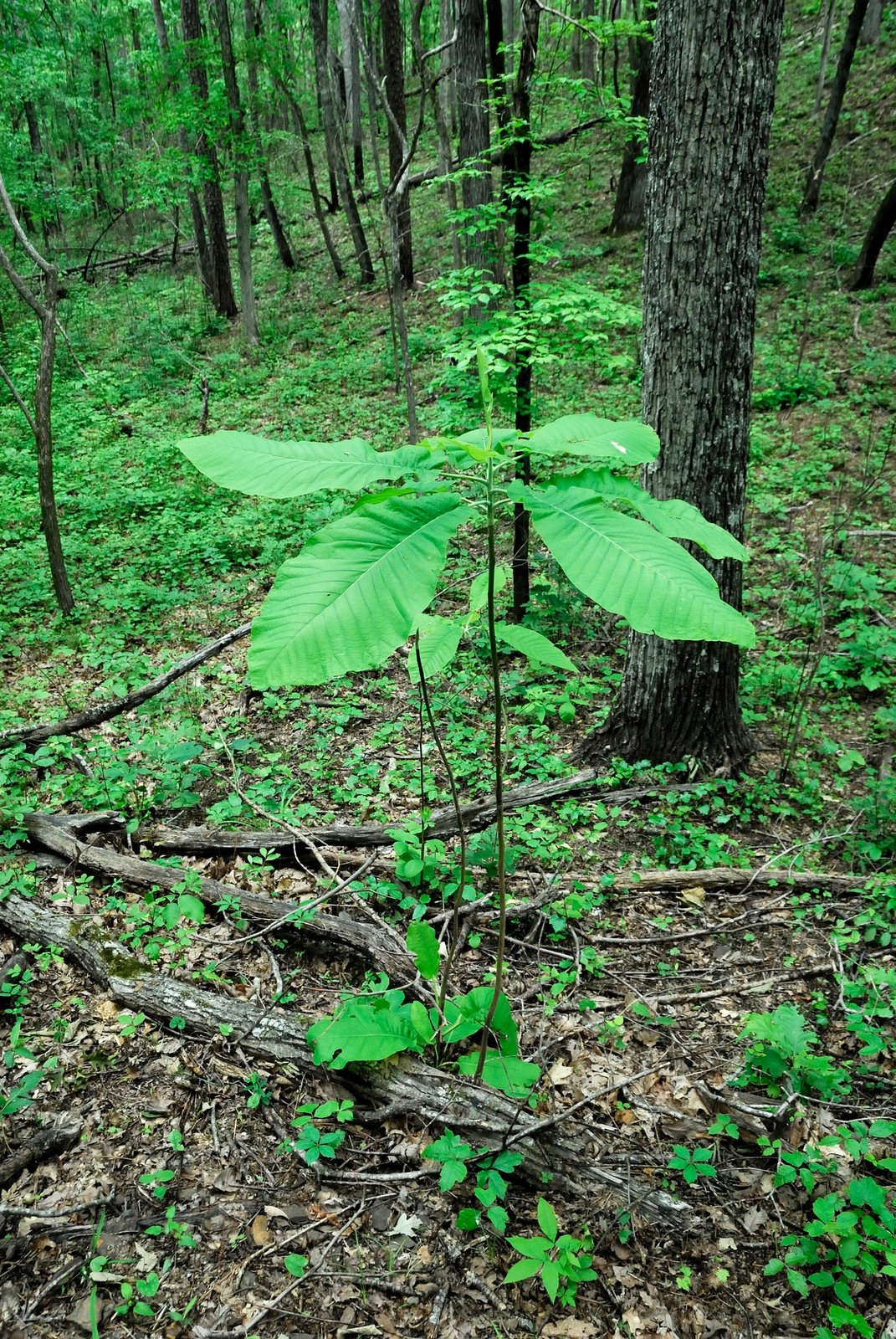
Bigleaf magnolia is a deciduous tree native to the southeastern United States, grown for its enormous leaves and large, fragrant, creamy-white flowers. Give it a sheltered position and plenty of room: wind readily tears the leaves, and its broad crown is best suited to a large garden.
At a glance
- Sun
- Full sun to partial shade; light afternoon shade is helpful in hot summers. Shelter from strong winds.
- Water
- Keep the root zone consistently moist but not waterlogged. Water deeply during dry spells, especially while establishing.
- Soil
- Deep, fertile, humus-rich, well-drained soil, preferably acidic to neutral. Avoid dry, shallow soil and poorly drained sites.
- Height
- 30-40 ft (9-12 m)
- Spread
- 30-40 ft (9-12 m)
- Flowers
- Late spring to early summer; fragrant, creamy-white flowers 8-12 in (20-30 cm) across, often with purple markings near the bases of the inner petals. Young trees may take many years to flower.
- Foliage
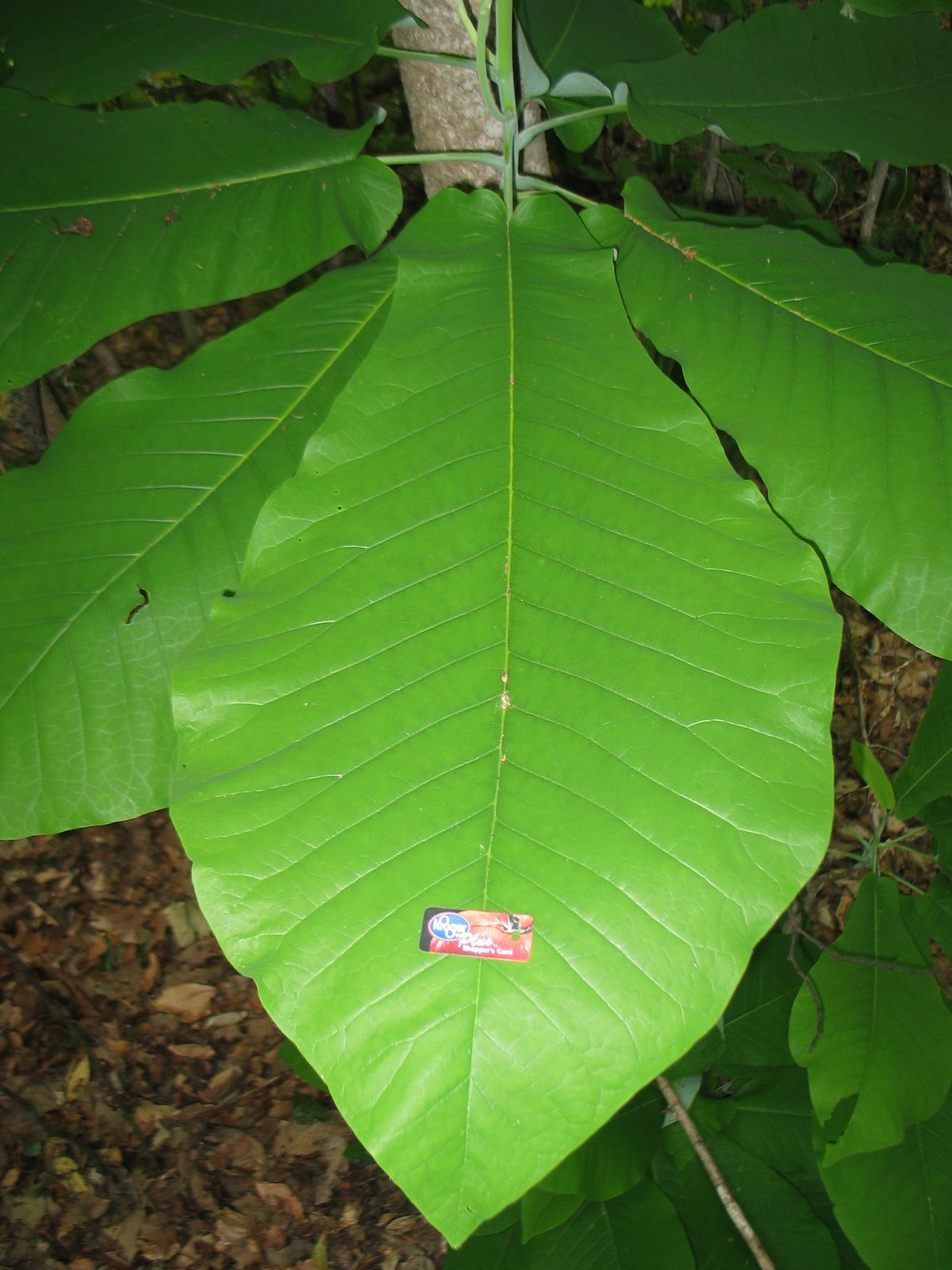
- Huge, oblong leaves, often 12-30 in (30-75 cm) long, green above and silvery beneath. Leaves cluster near branch tips and turn yellowish or brown before falling.
- Growth
- Moderate in moist, fertile soil.
- Care needed
- Medium
The year at a glance
- Pollinators
- Wildlife
- Low allergen
- Fragrant
| J | F | M | A | M | J | J | A | S | O | N | D | |
|---|---|---|---|---|---|---|---|---|---|---|---|---|
| Flowers | ||||||||||||
| Fruit | ||||||||||||
| Plant |
Northern hemisphere months. In Australia, shift them by six.
- Difficulty
- Moderate
- Toughness
- Fairly tough
Will it suit your garden?
Pick your zone, country, light and whether you have pets.
Full sun is 6 or more hours of direct sun a day, part shade 3 to 6 hours, shade under 3.
How it grows
Planting day
7 ft (2 m)
After 1 year
8 ft (2.4 m)
After 2 years
9 ft (2.8 m)
After 3 years
11 ft (3.3 m)
After 5 years
14 ft (4.1 m)
About 20 years to full size.
From a typical nursery size, at an average rate for this kind of plant. A rule of thumb, not a forecast.
Good to know
- Cats and dogs
- Safe
- Native to
- the US
- Growth rate
- Moderate
Care
Jobs through the year
- WaterApr–May, Sep–Oct, every 14 days
- Water established trees when soil begins drying; young trees need more frequent watering.
- WaterJun–Aug, every 7 days
- Water deeply during dry weather to keep the shallow root zone moist but not waterlogged.
- MulchMar–Apr
- Spread 5–8 cm of leaf mould or composted bark over roots, clear of the trunk.
- FeedApr
- Feed only for weak growth or a confirmed deficiency; avoid heavy nitrogen applications.
- PruneJul–Aug
- After flowering, remove only damaged or crossing branches using small cuts.
- ProtectApr–Jun
- Shelter young expanding leaves from strong, drying winds without disturbing shallow roots.
- Plant a young, container-grown tree in its permanent position; established magnolias resent root disturbance.
- Water deeply during dry weather, keeping the soil moist throughout the first few growing seasons.
- Apply 2-3 in (5-8 cm) of leaf mould or composted bark over the root zone, keeping it clear of the trunk.
- Avoid digging, lawn cultivation and heavy foot traffic beneath the crown because the roots are shallow.
- Feed in spring only if growth is weak or a soil test indicates a deficiency; avoid heavy nitrogen feeding.
Pruning. Prune as little as possible. Remove dead, damaged or crossing branches in summer after flowering, making small cuts rather than reducing major limbs.
Through the year
- Spring
- Plant while the soil is workable and moist; in colder areas, wait until severe frost has passed.
- Spring
- Refresh the mulch and check that it is not touching the trunk.
- Late spring
- Protect young growth from drying winds and monitor soil moisture as the large leaves expand.
- Summer
- Water deeply in dry spells and remove damaged or crossing branches after flowering if necessary.
- Autumn
- Collect ripe seeds for propagation, removing their fleshy red coating before sowing.
- Late autumn
- Clear fallen leaves from paths and lawns; shred or compost them for use as mulch.
In the garden
- Use as a specimen in a sheltered lawn where the broad crown can develop without repeated pruning.
- Plant at a woodland edge with an open view of the flowers and silvery leaf undersides.
- Combine with ferns, hostas and shade-tolerant shrubs for contrasting leaf sizes and textures.
- Use as a bold foliage focal point in a sheltered courtyard large enough to accommodate a full-sized tree.
Garden styles it suits: Woodland, Architectural minimal, Southern, Grand estate, Green on green and Modern tropical.
Plant it with: Oakleaf hydrangea, Rhododendrons, Hostas, Christmas fern, Foamflower and Solomon's seal.
Wildlife: Flowers provide pollen for beetles and other visiting insects. Birds and small mammals eat the red-coated seeds, and the crown provides cover.
Problems to watch for
- Torn or browned leaves: choose a site sheltered from strong winds; damaged leaves will not repair themselves.
- Leaf scorch and premature leaf drop in drought: water the root zone deeply and maintain an organic mulch.
- Scale insects and sooty mould: inspect twigs and leaf undersides; treat a confirmed infestation with horticultural oil at the label-recommended stage.
- Root decline in waterlogged soil: improve drainage before planting or choose another site; do not leave the tree standing in saturated ground.
Safety
Not known to be toxic to people, cats, dogs or horses. Species-specific information is limited, so do not treat the leaves, bark or seeds as food; eating plant material may cause digestive upset.
Easily confused with
Ashe's magnolia (Magnolia ashei)
A closely related, much smaller tree or large shrub that often flowers while young. Its leaves are generally smaller; it is sometimes classified as a subspecies of bigleaf magnolia.
Umbrella magnolia (Magnolia tripetala)
Also has large leaves clustered at branch tips, but their bases taper rather than having the distinct ear-like lobes of bigleaf magnolia. Its flowers have an unpleasant rather than sweet fragrance.
Fraser magnolia (Magnolia fraseri)
Has ear-like lobes at the leaf bases, but the leaves are much smaller and lack the strongly silvery undersides typical of bigleaf magnolia.
The name
Magnolia honours the French botanist Pierre Magnol, while macrophylla means large-leaved, referring to the tree's exceptionally large foliage.
Propagation. Grow from fresh seed collected when the red-coated seeds emerge from ripe fruits. Remove the fleshy coating, keep the seeds moist and sow outdoors in autumn for natural winter chilling, protecting them from rodents; germination can be uneven. Cuttings are difficult and usually require specialist conditions.
Checked against open data
- Accepted botanical name
- Magnolia macrophylla
- In the US and Canada
- Native in the lower 48 states.
- Native range
- Alabama, Arkansas, Georgia, Kentucky, Louisiana, Mississippi, North Carolina, Ohio, South Carolina, Tennessee and Virginia.
- Measured
- Average height 1512 cm.
Sources: GBIF (CC BY 4.0), USDA PLANTS and Trefle (CC BY 4.0). The care and design notes are LandscapeGPT's own.
See it in your own yard.
Upload a photo of your yard and see it redesigned with plants that suit your climate, each checked against your zone.