Black-eyed Susan vine
Thunbergia alata. Family Acanthaceae. Climber.
Also called Clock vine.
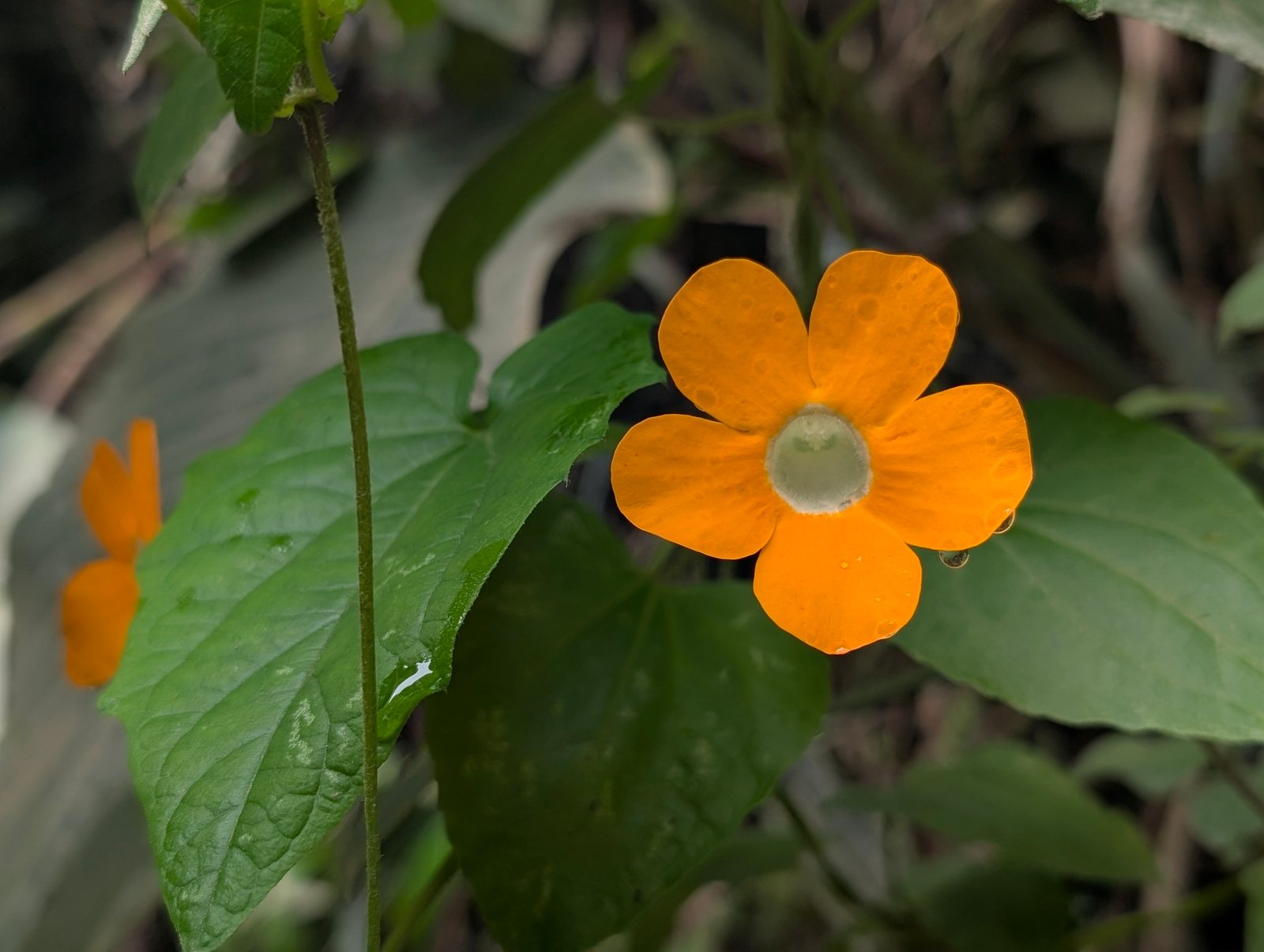
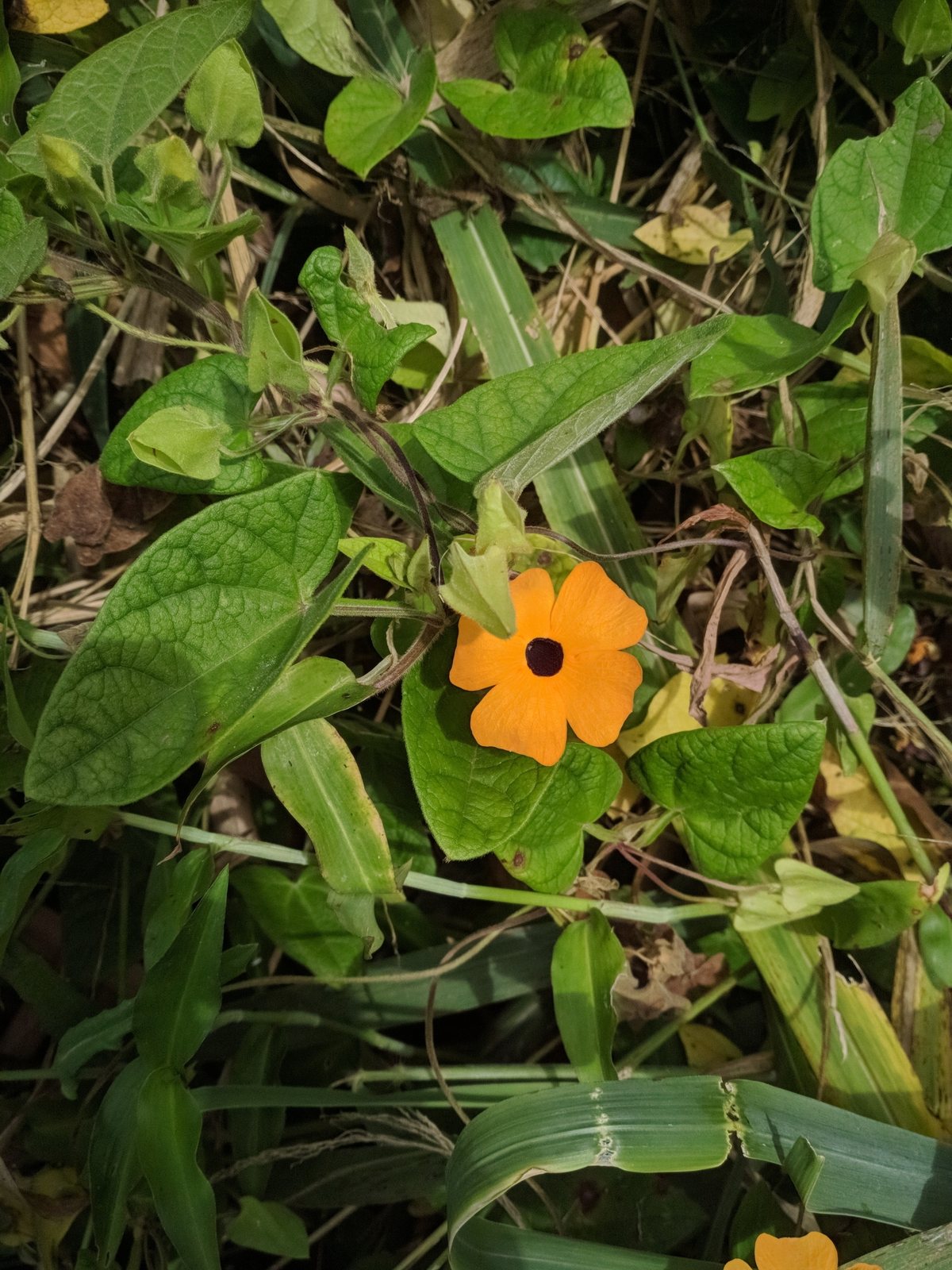
Thunbergia alata is a frost-tender, twining perennial grown for its yellow or orange flowers with dark central eyes. It is usually grown as an annual in the United States, the United Kingdom and Canada, covering small trellises or trailing from containers through summer. In frost-free parts of Australia and other warm regions, it can persist and spread beyond the garden.
At a glance
- Sun
- Full sun to partial shade; provide afternoon shade in very hot climates.
- Water
- Keep evenly moist but not waterlogged. Containers may need daily watering during hot, windy weather.
- Soil
- Fertile, well-drained soil that retains some moisture; use a good-quality container potting mix in pots.
- Height
- 6-10 ft (1.8-3 m) in one growing season; potentially taller where perennial
- Spread
- 3-6 ft (0.9-1.8 m)
- Flowers
- Summer until frost; potentially much of the year in frost-free climates. Usually yellow or orange with a dark brown-purple eye; cultivated forms also include white, cream, pink and apricot.
- Foliage
- Evergreen. Soft, green, heart-shaped to triangular leaves with slightly toothed edges, carried on twining stems.
- Growth
- Fast in warm weather
- Care needed
- Medium
The year at a glance
- Pollinators
- Heat tolerant
- Low allergen
| J | F | M | A | M | J | J | A | S | O | N | D | |
|---|---|---|---|---|---|---|---|---|---|---|---|---|
| Flowers | ||||||||||||
| Plant |
Northern hemisphere months. In Australia, shift them by six.
- Difficulty
- Moderate
- Toughness
- Needs looking after
Will it suit your garden?
Pick your zone, country, light and whether you have pets.
Full sun is 6 or more hours of direct sun a day, part shade 3 to 6 hours, shade under 3.
How it grows
Planting day
2 ft (0.6 m)
After 1 year
3 ft (1.1 m)
After 2 years
5 ft (1.5 m)
After 3 years
6 ft (1.8 m)
full size
About 3 years to full size.
From a typical nursery size, at an average rate for this kind of plant. A rule of thumb, not a forecast.
Good to know
- Cats and dogs
- Safe
- Invasive in
- the US and Australia
- In the garden
- Spreads vigorously: plan to contain it.
- Growth rate
- Fast
Care
Jobs through the year
- WaterMay, Sep–Oct, every 7 days
- Water established in-ground plants when surface soil starts drying; check new plants more often.
- WaterJun–Aug, every 3 days
- Water in-ground plants during dry weather; containers may need daily watering.
- FeedJun–Sep, every 14 days
- Feed containers with balanced liquid fertiliser; feed in-ground plants only on poor soil.
- MulchMay–Jun
- Mulch after planting to retain moisture, leaving stems clear.
- PruneMay–Jun
- Pinch young shoot tips to encourage branching and guide stems onto slender supports.
- PruneJul–Sep
- Shorten stems that stray beyond their support.
- ProtectSep–Oct
- Before frost, move containers to a bright frost-free place if keeping plants over winter.
- Plant outside only after frost danger has passed and nights are consistently mild.
- Provide thin trellis wires, netting or slender canes for the stems to twine around.
- Water at the soil surface when the top layer begins to dry; do not leave pots standing in water.
- Feed container plants every two weeks during active growth with a balanced liquid fertiliser at the label rate.
- Mulch plants in the ground to conserve moisture, keeping mulch clear of the stems.
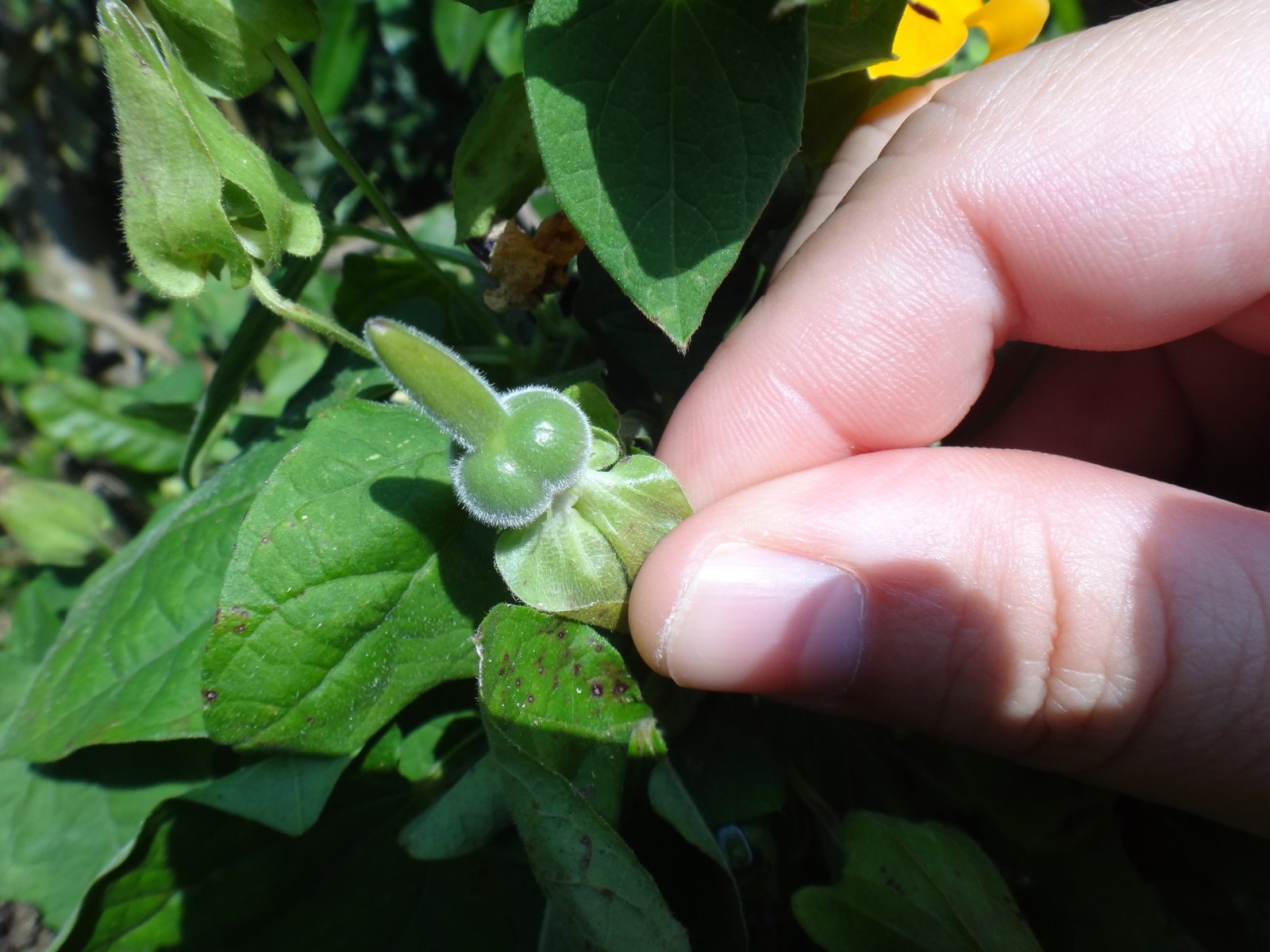
- In frost-free regions, contain growth and remove seed capsules before they ripen where escape is a concern.
Pruning. Pinch young shoot tips in spring to encourage branching, then shorten stray stems during the growing season. Cut back overwintered plants in late winter or early spring to remove weak growth and fit their support.
Through the year
- Late winter
- Sow seeds indoors in warmth, about six to eight weeks before your expected last frost.
- Spring
- Harden off young plants gradually and plant out after frost danger has passed.
- Late spring
- Install supports, guide the first stems onto them and pinch tips if plants are sparse.
- Summer
- Check container moisture frequently, feed regularly and trim stems that stray beyond their support.
- Autumn
- Remove frost-killed plants, or move a manageable container into a bright, frost-free place before cold weather.
- Winter
- Keep overwintering plants bright and barely moist; inspect regularly for whitefly and spider mites.
In the garden
- Train up a narrow trellis beside a sunny patio for seasonal flowers without a large permanent climber.
- Let stems trail from hanging baskets or raised containers, paired with trailing petunias or lobelia.
- Grow over a small obelisk among bedding plants to add height and repeated flower colour.
- Use on removable netting to soften balcony railings or temporarily screen a utility corner.
Garden styles it suits: Cottage garden, Tropical, Modern courtyard, Small-space, Hot border and Urban city garden.
Plant it with: Petunias, Trailing lobelia, Zinnias, Salvias, Coleus and Sweet potato vine.
Wildlife: Flowers provide nectar for visiting insects, including bees and butterflies. It is not a native host plant in the United States, the United Kingdom, Canada or Australia, and its wildlife value does not outweigh its escape risk in susceptible warm regions.
Problems to watch for
- Spider mites cause stippled leaves and fine webbing, especially under cover: rinse leaf undersides, reduce drought stress and use insecticidal soap labelled for the plant if needed.
- Whitefly and aphids gather on soft shoots: inspect new growth, wash off small infestations and treat persistent infestations with an appropriate labelled insecticidal soap.
- Wilting or root rot follows waterlogged soil: improve drainage, empty saucers and let the surface begin to dry between waterings.
- Few flowers can result from deep shade or excessive nitrogen: move to a brighter position and avoid high-nitrogen feeds.
Safety
Not known to be toxic to cats, dogs, horses or people. No particular part is established as poisonous, but species-specific safety information is limited; do not treat the flowers, leaves or seeds as food.
Where it spreads. Invasive in Hawaii and an environmental weed in parts of eastern Australia, particularly Queensland and northeastern New South Wales. In warm, moist conditions it can escape cultivation and smother nearby vegetation; check local guidance before planting.
Easily confused with
Black-eyed Susan (Rudbeckia hirta)
An upright, non-climbing plant with daisy-shaped flowers and a raised dark central cone, rather than a twining vine with tubular flowers.
Orange clock vine (Thunbergia gregorii)
Has similar twining growth and orange flowers, but the flowers lack the dark central eye.
Blue trumpet vine (Thunbergia grandiflora)
A much larger, vigorous climber with large leaves and hanging clusters of pale blue to violet flowers with pale throats.
The name
Thunbergia honours Swedish botanist Carl Peter Thunberg, alata means 'winged' and refers to the winged leaf stalks, and black-eyed Susan describes the flower's dark centre.
Propagation. Sow seeds indoors in warm conditions in late winter or spring; soaking them overnight can help germination. Take softwood cuttings during active growth to preserve the characteristics of a particular plant, since seedlings may vary.
Checked against open data
- Accepted botanical name
- Thunbergia alata
- Native range
- Botswana, Burundi, Cameroon, Central African Repu, Congo, Djibouti, Eritrea, Ethiopia, Ghana, Guinea, Ivory Coast and Kenya.
- Measured
- Average height 13 cm.
Sources: GBIF (CC BY 4.0) and Trefle (CC BY 4.0). The care and design notes are LandscapeGPT's own.
See it in your own yard.
Upload a photo of your yard and see it redesigned with plants that suit your climate, each checked against your zone.