Black Hamburgh grape
Vitis vinifera 'Black Hamburgh'. Family Vitaceae. Climber.
Also called Black Hamburg grape, Trollinger, Schiava Grossa.
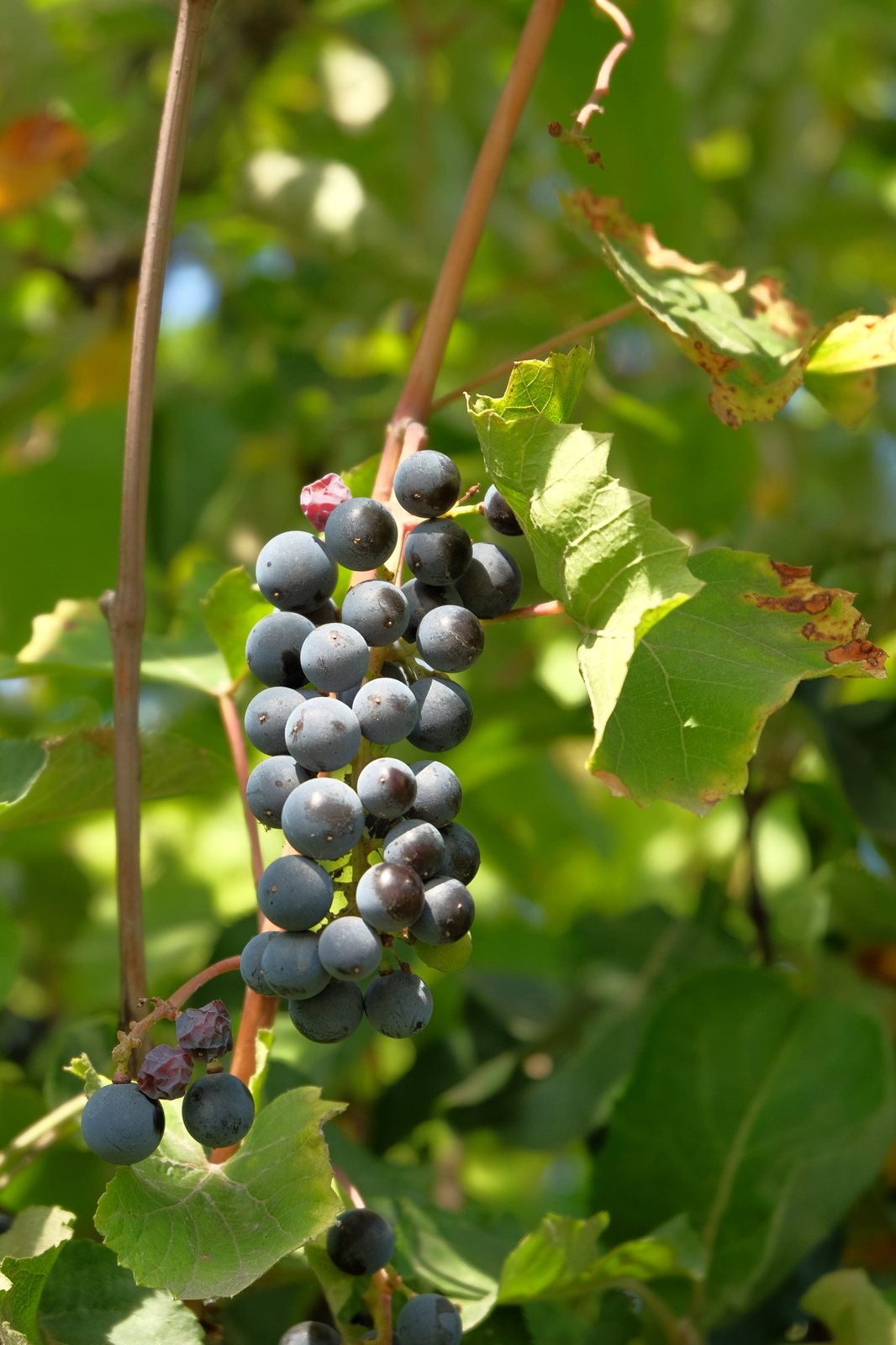
A vigorous, deciduous grapevine grown for large bunches of sweet, seeded, blue-black dessert grapes. It crops best with a long, warm growing season; in much of the United Kingdom and cooler parts of Canada, a greenhouse gives more reliable ripening than outdoor planting.
At a glance
- Sun
- Full sun, with shelter from cold winds; fruit needs plenty of warmth to ripen.
- Water
- Water deeply during establishment and dry spells. Keep the root zone evenly moist while berries develop, but never waterlogged.
- Soil
- Deep, well-drained loam is ideal; tolerates chalky soil but performs poorly in wet, compacted ground.
- Height
- 15-30 ft (4.5-9 m), depending on training and pruning
- Spread
- 6-12 ft (1.8-3.6 m) when trained; unpruned vines can spread farther
- Flowers
- Small, greenish flowers in late spring to early summer.
- Foliage
- Large, lobed green leaves, usually turning yellow in autumn.
- Growth
- Fast once established
- Care needed
- High
The year at a glance
- Heat tolerant
- Wildlife
- Edible
| J | F | M | A | M | J | J | A | S | O | N | D | |
|---|---|---|---|---|---|---|---|---|---|---|---|---|
| Flowers | ||||||||||||
| Fruit | ||||||||||||
| Plant |
Northern hemisphere months. In Australia, shift them by six.
- Difficulty
- Hard
- Toughness
- Fairly tough
Will it suit your garden?
Pick your zone, country, light and whether you have pets.
Full sun is 6 or more hours of direct sun a day, part shade 3 to 6 hours, shade under 3.
How it grows
Planting day
2 ft (0.6 m)
After 1 year
3 ft (1.1 m)
After 2 years
5 ft (1.5 m)
After 3 years
6 ft (1.8 m)
full size
About 3 years to full size.
From a typical nursery size, at an average rate for this kind of plant. A rule of thumb, not a forecast.
Good to know
- Cats and dogs
- Toxic
- Growth rate
- Fast
Care
Jobs through the year
- WaterApr–May, Sep–Oct, every 14 days
- Water established vines deeply during dry spells; young vines need more frequent watering.
- WaterJun–Aug, every 7 days
- During dry weather, keep established roots evenly moist as berries develop.
- FeedMar–Apr
- Top-dress with compost and a modest balanced feed; avoid excess nitrogen.
- MulchApr
- Mulch the root area, keeping the trunk clear.
- PruneNov–Dec
- After leaf fall, prune fully dormant vines, retaining the framework and shortening laterals to two buds.
- PruneJun–Aug, every 14 days
- Tie in selected shoots, remove crowded growth and trim fruiting laterals two leaves beyond the last bunch.
- ProtectApr–May
- Cover emerging shoots during late frosts; greenhouse shelter improves ripening in cool gardens.
- ProtectAug–Oct
- Fit wildlife-safe netting or bunch bags before birds and wasps damage ripening fruit.
- HarvestAug–Oct, every 7 days
- Taste berries for sweetness before cutting whole ripe bunches.
- Provide strong wires, a trellis or a pergola before the vine becomes heavy.
- Water young vines regularly and established vines deeply during prolonged dry weather.
- Apply compost and a modest balanced feed in spring; avoid heavy nitrogen feeding, which encourages leaves at the expense of fruit.
- Mulch the root area, keeping mulch clear of the trunk.
- Ventilate greenhouses and tie in shoots with space between them for airflow.
- Remove most flower clusters from young vines while their permanent framework develops.
Pruning. Prune in early winter while fully dormant, before sap begins rising; retain a permanent framework and shorten suitable side shoots to two buds. In summer, tie in selected shoots, remove crowded growth and shorten fruiting laterals to about two leaves beyond the last bunch.
Harvest
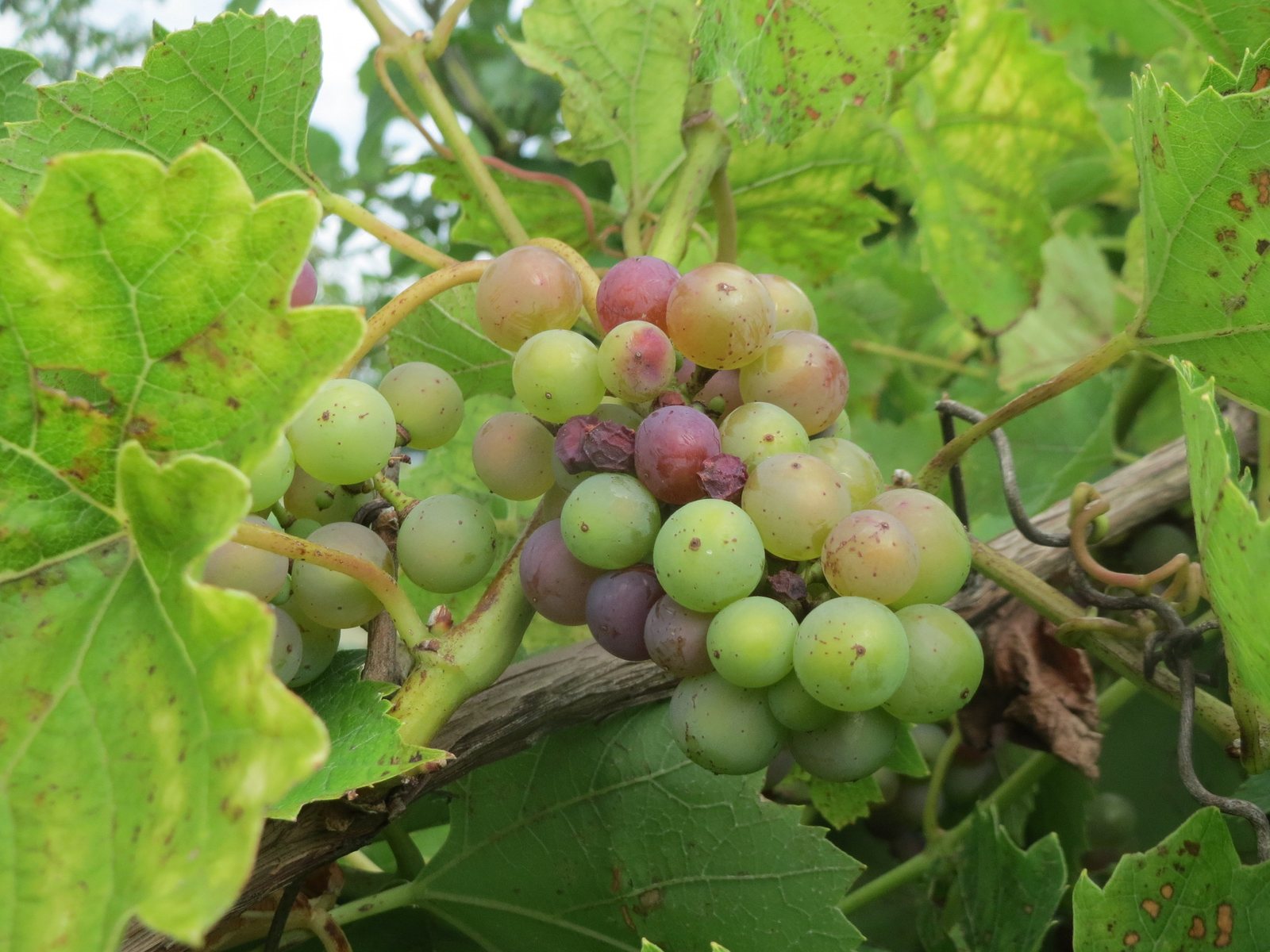
Cut whole bunches with secateurs in late summer or autumn, when the berries are fully blue-black and taste sweet; colour alone does not prove ripeness, and grapes do not sweeten after picking. Expect the first worthwhile crop about 3-4 years after planting, depending on warmth, establishment and training.
Through the year
- Late winter
- Plant dormant vines when the ground is workable and not waterlogged; install permanent supports.
- Spring
- Apply compost and a modest feed, renew mulch and protect emerging shoots from frost.
- Late spring
- Select and tie in well-spaced shoots; remove excess shoots and flowers on young vines.
- Summer
- Shorten fruiting side shoots, maintain steady soil moisture and ventilate greenhouse vines.
- Late summer to autumn
- Taste berries before cutting ripe bunches; net outdoor fruit against birds.
- Early winter
- Prune after leaf fall while fully dormant and remove old fruit and diseased debris.
In the garden
- Train over a sturdy pergola to provide summer shade and hanging bunches of fruit.
- Grow on wires against a sunny, sheltered wall to make use of stored heat.
- Train as a cordon in a greenhouse where outdoor summers are too cool for reliable ripening.
- Use along a sunny boundary in an edible garden, allowing room for pruning and picking.
Garden styles it suits: Edible landscape, Potager (kitchen garden), Mediterranean, Cottage garden, Victorian and Homestead.
Plant it with: Lavender, Thyme, Oregano, Chives and Calendula.
Wildlife: Birds and wasps eat ripe grapes, and the foliage provides shelter for insects. Secure netting carefully so birds and other animals cannot become trapped.
Problems to watch for
- Powdery mildew: keep shoots well spaced, avoid excessive nitrogen and use a locally approved grape treatment if needed.
- Grey mould and bunch rot: improve ventilation, remove damaged berries and avoid wetting ripening bunches.
- Birds and wasps: use securely fitted wildlife-safe netting or individual bunch bags before fruit ripens.
- Poor ripening: choose the warmest sunny position, reduce excessive crop loads and use greenhouse protection in cool climates.
Safety
Grapes and raisins can cause severe, potentially fatal kidney injury in dogs; keep fruit, fallen berries and dried grapes out of reach and seek urgent veterinary advice after ingestion. Toxicity in cats is not well established, so keep fruit away from them too. Ripe grapes and properly prepared grape leaves are edible for people; the plant is not known to be toxic to horses.
Easily confused with
Concord grape (Vitis labrusca 'Concord')
Concord has a distinctive musky flavour, slip-skin berries and leaves with conspicuously pale, felted undersides; Black Hamburgh lacks that strongly musky flavour.
Virginia creeper (Parthenocissus quinquefolia)
Virginia creeper has five separate leaflets rather than a single lobed grape leaf; its small dark berries are not edible.
The name
Vitis is Latin for vine, vinifera means wine-bearing, and Black Hamburgh is a traditional grape name referring to Hamburg and the dark fruit.
Propagation. Take dormant hardwood cuttings in winter or layer a low shoot. Cuttings reproduce the cultivar, but use certified grafted vines where phylloxera is a risk or local rules require them; seed-grown plants will not reliably match the parent.
Checked against open data
- Accepted botanical name
- Vitis vinifera
- In the US and Canada
- Introduced in the lower 48 states, Pacific Basin and Puerto Rico.
- Native range
- Albania, Austria, Bulgaria, Corse, Cyprus, Czechoslovakia, France, Germany, Greece, Hungary, Iran and Iraq.
- Measured
- Soil pH 7 to 7.5. Average height 2000 cm.
Sources: GBIF (CC BY 4.0), USDA PLANTS and Trefle (CC BY 4.0). The care and design notes are LandscapeGPT's own.
See it in your own yard.
Upload a photo of your yard and see it redesigned with plants that suit your climate, each checked against your zone.