Blue flax lily
Dianella caerulea. Family Asphodelaceae. Perennial.
Also called Blueberry lily, Paroo lily.
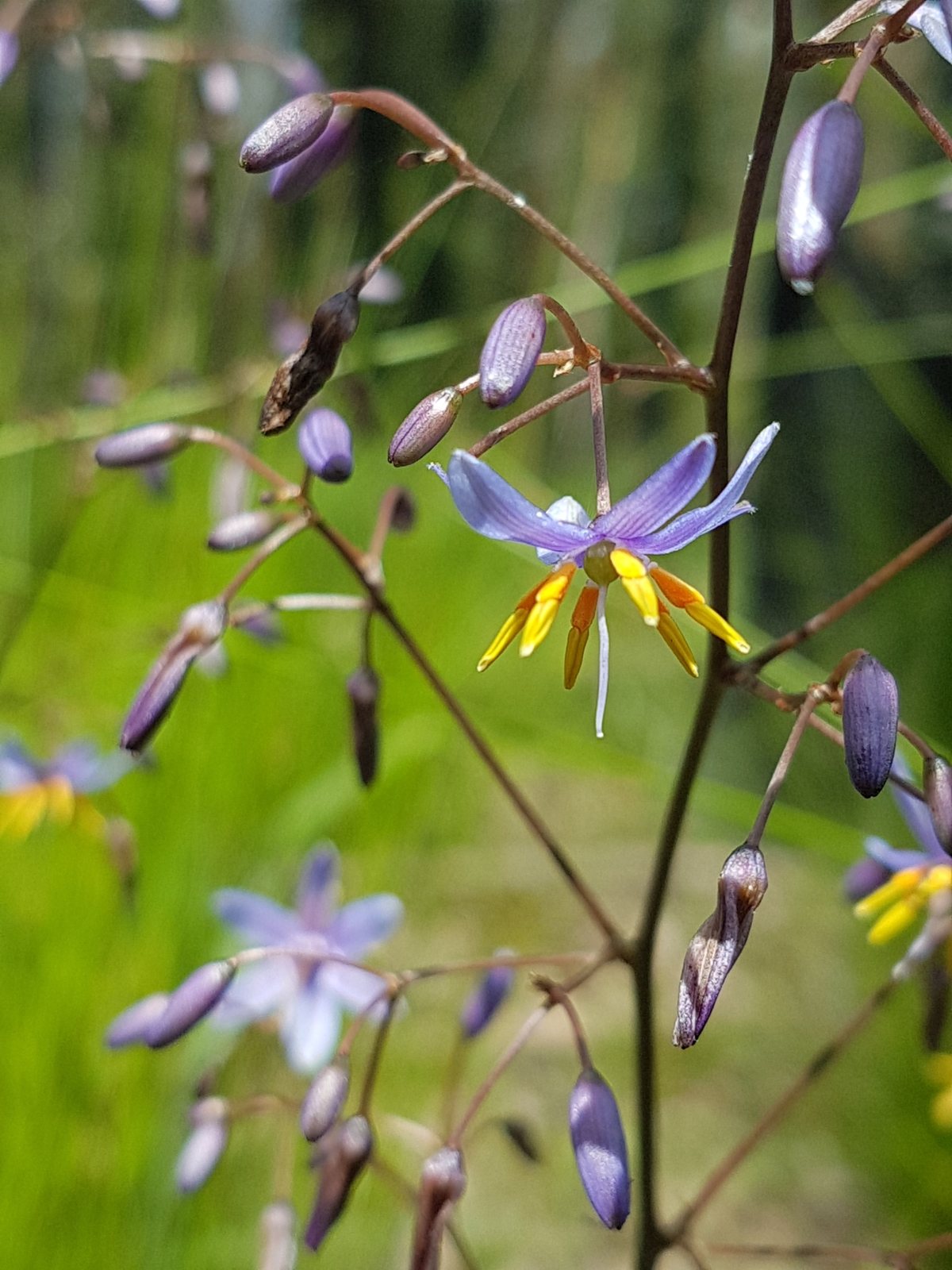
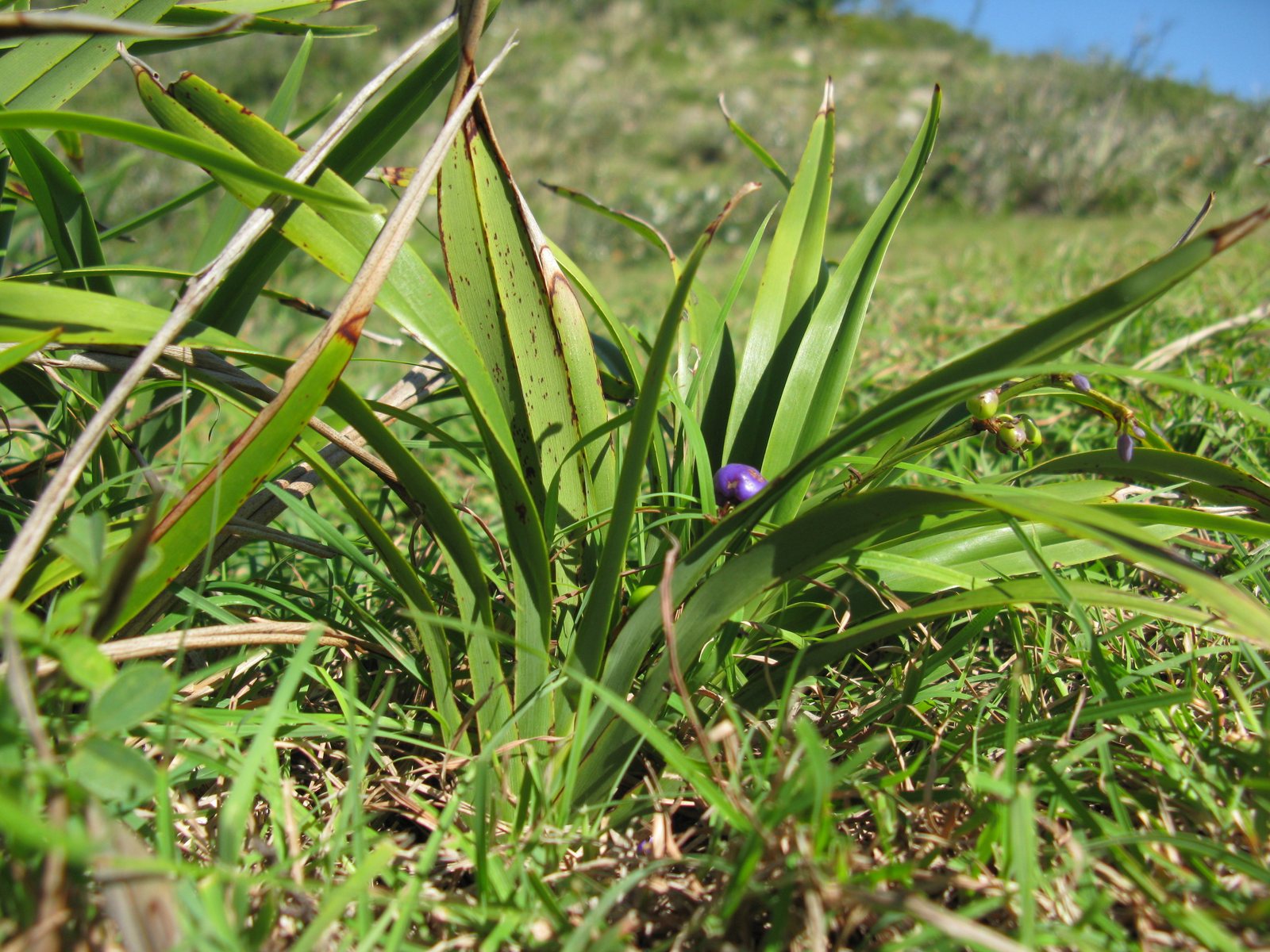
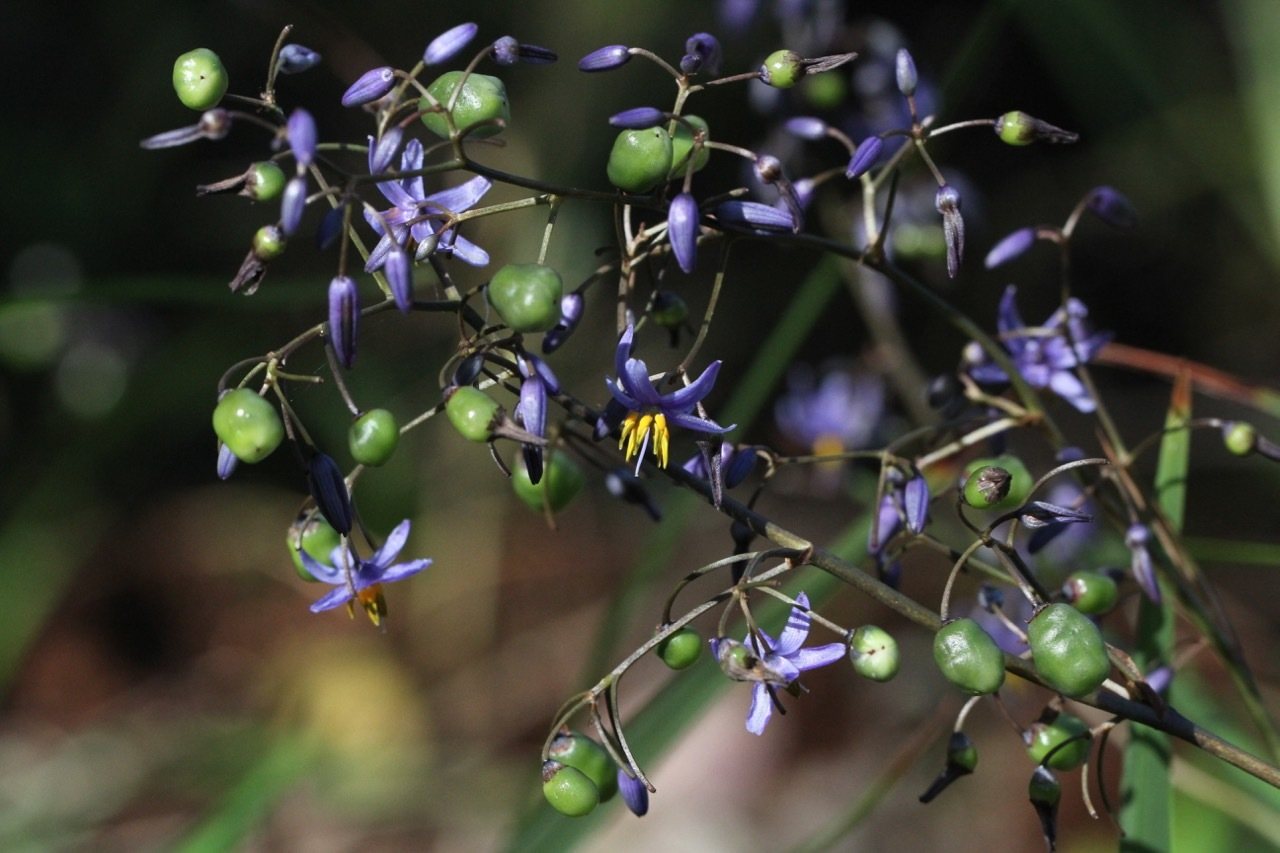
Blue flax lily is an Australian clump-forming perennial grown for its upright, strap-shaped leaves, small blue flowers and glossy blue berries. It gives borders and containers a grass-like texture without being a true grass. It suits mild-winter gardens; in colder areas, grow it in a pot that can be sheltered from freezing weather.
At a glance
- Sun
- Full sun to partial shade; afternoon shade helps in hot, dry inland gardens.
- Water
- Water regularly while establishing. Established plants tolerate dry spells, but grow better with occasional deep watering during prolonged drought.
- Soil
- Well-drained sandy, loamy or clay soil; avoid ground that stays waterlogged, especially in winter.
- Height
- 1.5-4 ft (0.45-1.2 m), depending on the form and growing conditions
- Spread
- 1.5-3 ft (0.45-0.9 m), gradually widening through rhizomes
- Flowers
- Spring to summer; small blue to violet-blue flowers with conspicuous yellow anthers, followed by blue berries.
- Foliage
- Evergreen. Tough, narrow, green strap-shaped leaves arising in fans; leaf width and plant size vary considerably within the species.
- Growth
- Moderate
- Care needed
- Low
The year at a glance
- Pollinators
- Deer resistant
- Drought tolerant
- Heat tolerant
- Wildlife
- Low allergen
| J | F | M | A | M | J | J | A | S | O | N | D | |
|---|---|---|---|---|---|---|---|---|---|---|---|---|
| Flowers | ||||||||||||
| Fruit | ||||||||||||
| Plant |
Northern hemisphere months. In Australia, shift them by six.
- Difficulty
- Moderate
- Toughness
- Fairly tough
Will it suit your garden?
Pick your zone, country, light and whether you have pets.
Full sun is 6 or more hours of direct sun a day, part shade 3 to 6 hours, shade under 3.
How it grows
Planting day
1 ft (0.3 m)
After 1 year
1.6 ft (0.47 m)
After 2 years
2.1 ft (0.65 m)
After 3 years
2.7 ft (0.83 m)
full size
About 3 years to full size.
From a typical nursery size, at an average rate for this kind of plant. A rule of thumb, not a forecast.
Good to know
- Cats and dogs
- Mildly toxic: may upset a stomach
- Native to
- Australia
- Growth rate
- Moderate
Care
Jobs through the year
- WaterApr–May, Sep–Oct, every 21 days
- For established ground plants in mild climates, water during prolonged drought; new plants and pots need more.
- WaterJun–Aug, every 14 days
- Deep-water established ground plants during dry spells, allowing the surface to dry between waterings.
- WaterJan–Mar, Nov–Dec, every 21 days
- Check frost-free overwintering pots and water lightly only as needed to keep roots barely moist.
- FeedApr–May
- Apply a light balanced slow-release feed only if growth is weak.
- MulchMay
- Apply a light organic mulch around the clump, leaving the crown exposed.
- PruneMar–Apr
- Remove dead or badly damaged leaves individually at the base without cutting the crown.
- PruneOct
- Remove spent flower stems after the berries finish, or earlier to prevent seedlings.
- DivideApr–May
- Divide crowded clumps in spring and water divisions until new growth appears.
- ProtectSep–Oct
- Not reliably hardy in zones 6–7; move containers to bright, frost-free shelter before freezing weather.
- ProtectMay–Jun
- Move overwintered pots outdoors after frost danger passes and acclimatise gradually.
- Water deeply during the first growing season, allowing the soil surface to dry between waterings.
- Keep the crown at soil level and avoid planting in poorly drained hollows.
- Apply a light dressing of balanced, slow-release fertiliser in spring if growth is weak; avoid heavy feeding.
- Mulch around the clump, leaving the crown clear.
- Divide crowded clumps in spring and water the divisions until new growth appears.
- Move container plants to a bright, frost-free place where winters are too cold.
Pruning. In late winter or early spring, cut dead and badly damaged leaves individually at the base without cutting into the crown. Remove spent flower stems after the berries finish, or earlier if you do not want seedlings.
Through the year
- Spring
- Plant or divide clumps once the risk of hard frost has passed.
- Spring
- Remove winter-damaged leaves and feed lightly if needed.
- Summer
- Water new plants regularly and established clumps during prolonged dry weather.
- Late summer
- Leave berries for display and birds, or remove fruiting stems to limit seedlings.
- Autumn
- Move pots under cover before freezing weather in colder regions.
- Winter
- Keep sheltered pots barely moist and check that outdoor crowns are not sitting in wet soil.
In the garden
- Plant repeated clumps along paths for a loose, evergreen edge.
- Use beneath open-canopied trees where its upright leaves contrast with softer groundcovers.
- Combine with lomandra, small grevilleas and other Australian plants in informal borders.
- Grow in containers beside a sheltered entrance or courtyard.
- Mass on well-drained banks for year-round foliage and seasonal blue fruit.
Garden styles it suits: Australian native, Modern, Architectural minimal, Coastal, Low-maintenance and Wildlife garden.
Plant it with: Lomandra, Kangaroo paw, Westringia, Dwarf grevillea, Coral bells and Cast-iron plant.
Wildlife: Flowers provide pollen for bees, and birds may eat the berries. Dense established clumps provide shelter for small garden animals.
Problems to watch for
- Root or crown rot in waterlogged soil: improve drainage, reduce watering and replace badly rotted plants.
- Rust or fungal leaf spotting: remove affected leaves, improve air circulation and water at soil level.
- Scale insects: inspect leaf bases and undersides; remove small infestations by hand or use a labelled horticultural oil.
- Brown or frost-damaged foliage: shelter from severe cold and drying winds, then remove damaged leaves when spring growth begins.
Safety
Reports about the edibility of Dianella berries conflict, and species are easily confused. Treat the berries as potentially harmful rather than edible; ingestion may cause digestive upset. Reliable species-specific evidence for poisoning in cats, dogs and horses is limited, so keep pets and livestock from eating the plant. Seek medical or veterinary advice after a significant ingestion or if symptoms develop.
Easily confused with
Tasman flax lily (Dianella tasmanica)
Usually has broader, more arching leaves with conspicuously toothed margins. Blue flax lily generally has narrower, more upright leaves, although forms vary.
Spiny-headed mat-rush (Lomandra longifolia)
Has dense clusters of small cream flowers rather than open sprays of blue flowers, and does not produce glossy blue berries.
Mondo grass (Ophiopogon japonicus)
Usually makes much lower, fine-leaved tufts, with short flower stalks tucked among the leaves rather than taller, branching flower sprays.
The name
Dianella is a diminutive of Diana, the Roman goddess, while caerulea means blue, referring to the flowers.
Propagation. Divide established clumps in spring, keeping roots and several healthy leaf fans on each division. Seed can also be sown after cleaning away the fruit pulp, but germination may be slow and seedlings can vary.
Checked against open data
- Accepted botanical name
- Dianella caerulea
- In the US and Canada
- Introduced in the lower 48 states.
- Native range
- New Guinea, New South Wales and Queensland.
- Measured
- Average height 50 cm.
Sources: GBIF (CC BY 4.0), USDA PLANTS and Trefle (CC BY 4.0). The care and design notes are LandscapeGPT's own.
See it in your own yard.
Upload a photo of your yard and see it redesigned with plants that suit your climate, each checked against your zone.