Blue lyme grass
Leymus arenarius. Family Poaceae. Ornamental grass.
Also called Lyme grass, Sand lyme grass, Blue dune grass.
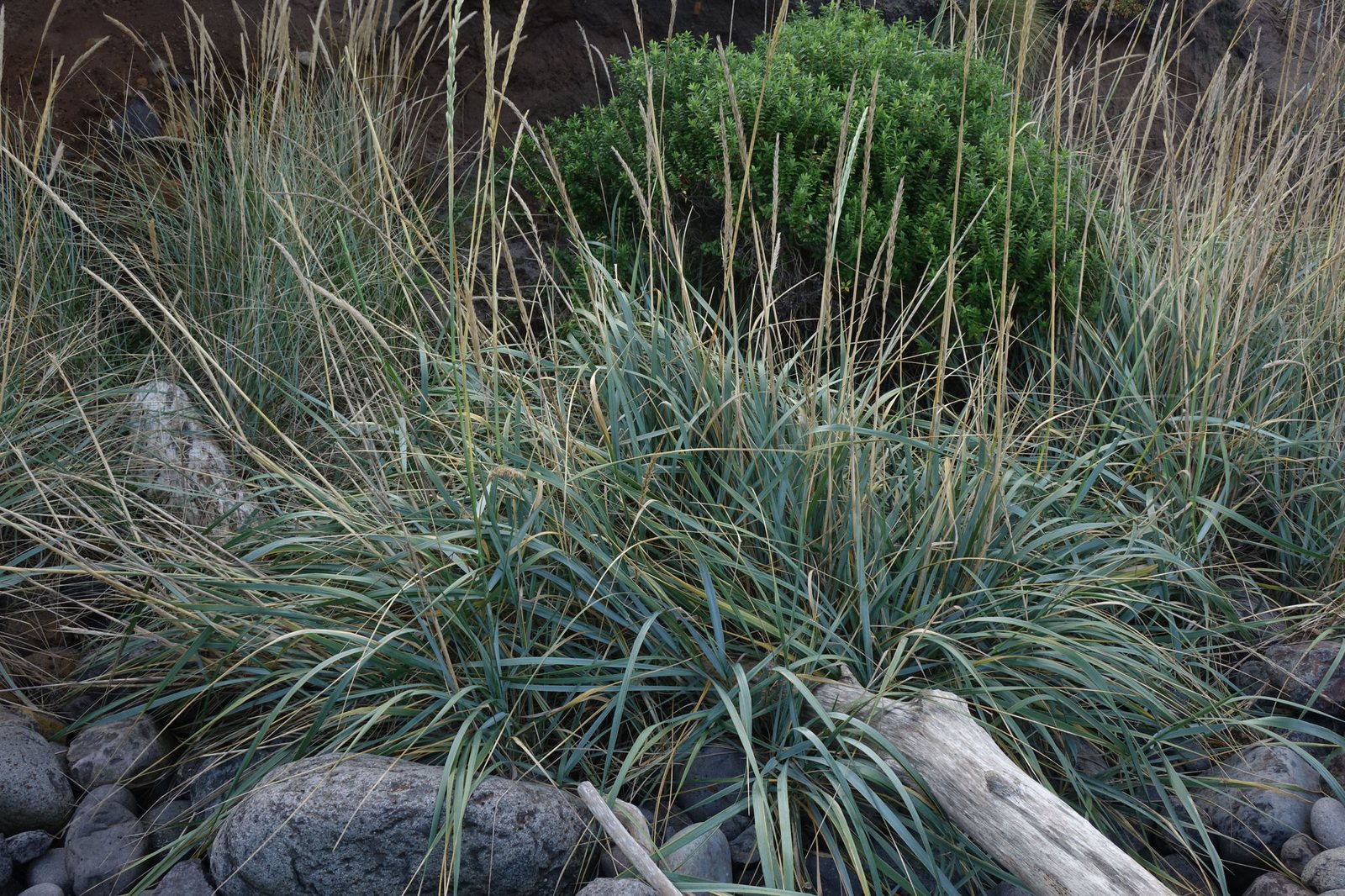
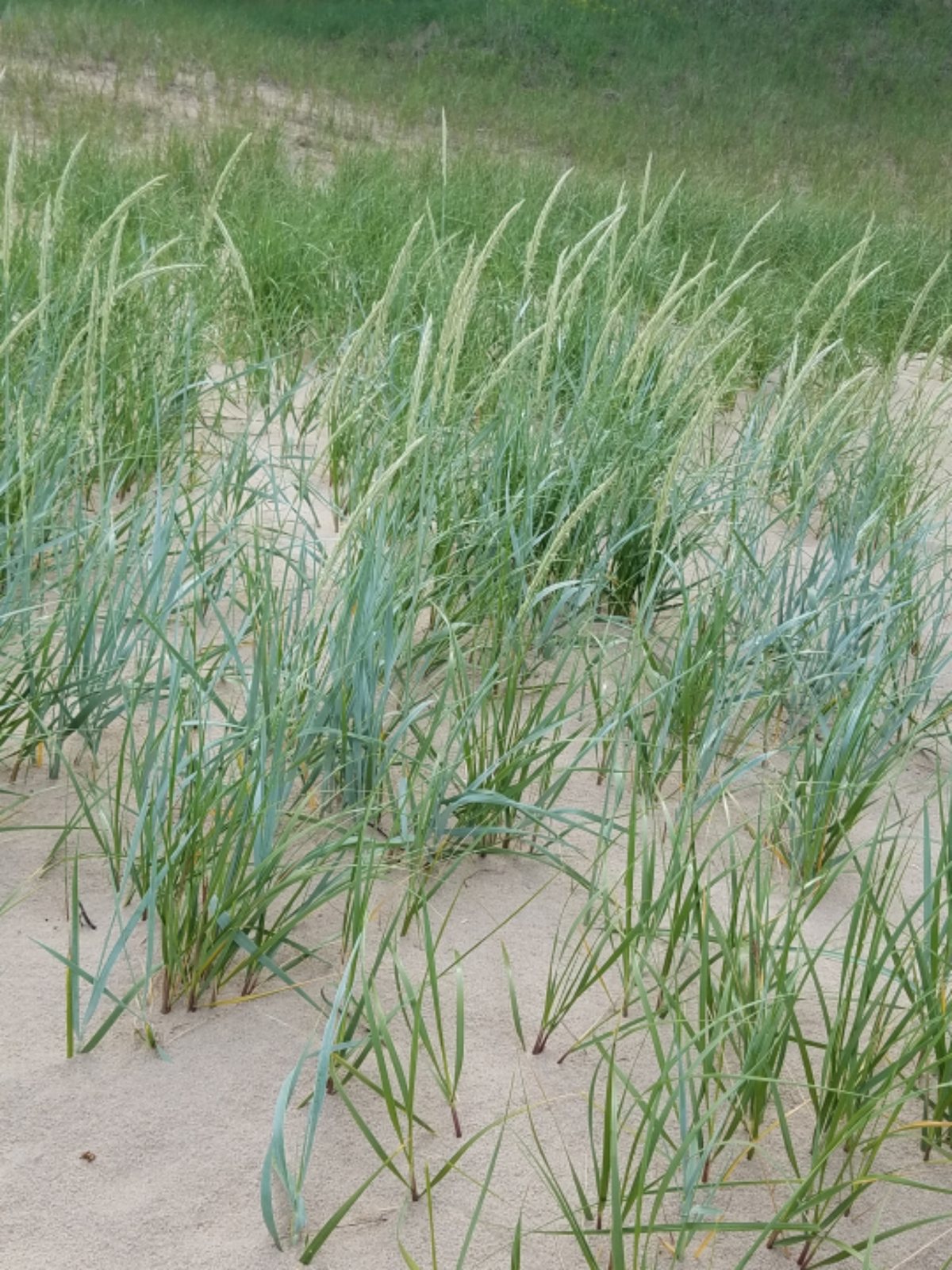
A cold-hardy perennial grass grown for its broad, steel-blue leaves and upright summer flower spikes. It tolerates coastal wind, salt spray and dry sandy ground, but its vigorous underground runners make it unsuitable for most mixed borders unless securely contained.
At a glance
- Sun
- Full sun gives the strongest blue colour; tolerates light shade.
- Water
- Water regularly during establishment, then only during prolonged dry spells. Containers need more frequent watering.
- Soil
- Well-drained soil, especially sand or gravel; tolerates poor, salty and alkaline soils. Avoid persistently waterlogged ground.
- Height
- Leaves 2-3 ft (0.6-0.9 m); flower stems 3-4 ft (0.9-1.2 m)
- Spread
- 3-6 ft (0.9-1.8 m) initially; spreads indefinitely by underground runners if uncontained
- Flowers
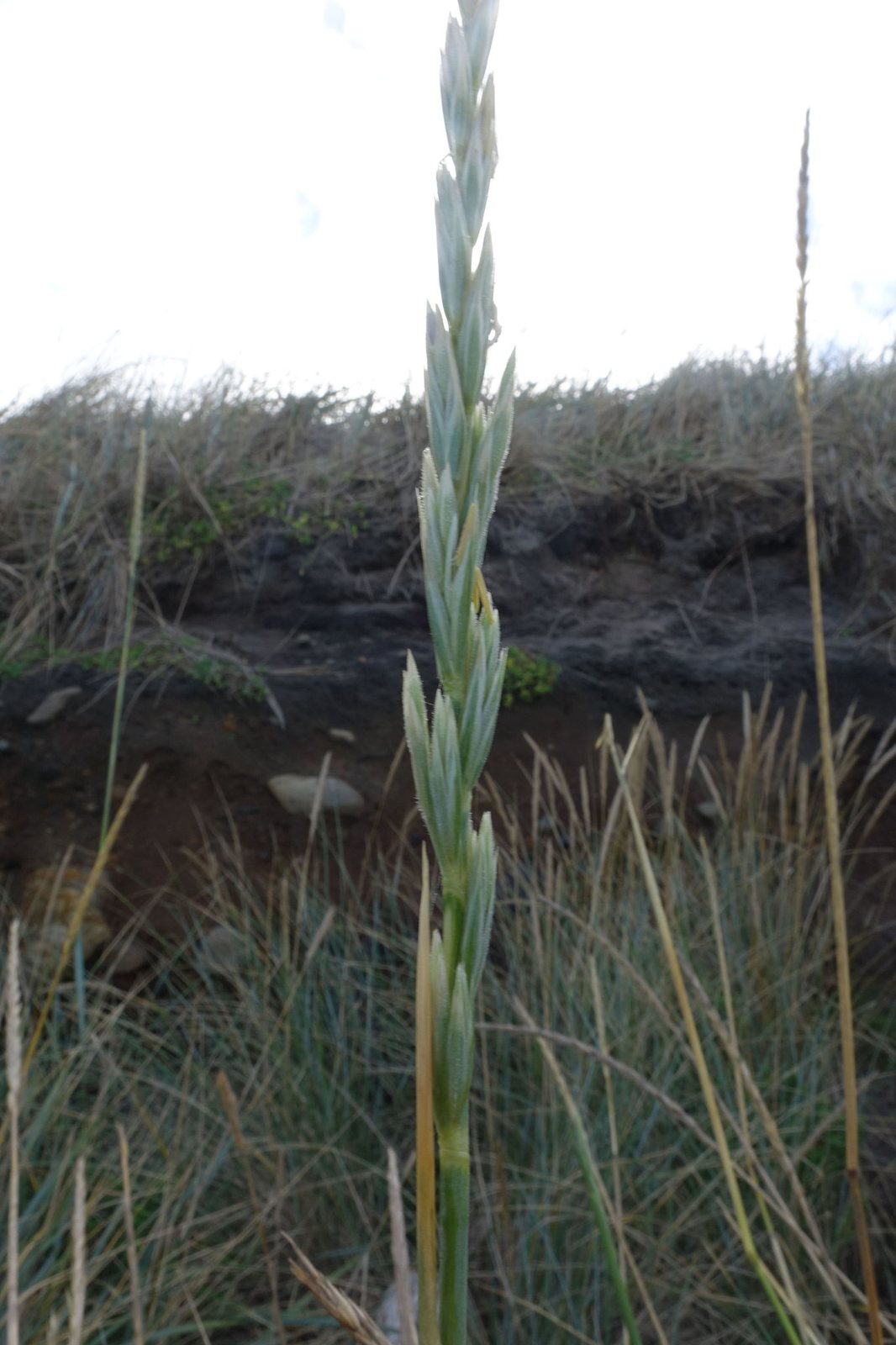
- Early to midsummer; dense, upright greenish flower spikes turn straw-coloured as they mature.
- Foliage
- Broad, stiff, pointed blue-grey leaves, often arching at the tips; usually die back in cold winters and may persist in mild climates.
- Growth
- Fast, with vigorous sideways spread once established
- Care needed
- High
The year at a glance
- Deer resistant
- Drought tolerant
- Cold hardy
- Heat tolerant
- Wildlife
| J | F | M | A | M | J | J | A | S | O | N | D | |
|---|---|---|---|---|---|---|---|---|---|---|---|---|
| Flowers | ||||||||||||
| Fruit | ||||||||||||
| Plant |
Northern hemisphere months. In Australia, shift them by six.
- Difficulty
- Hard
- Toughness
- Very tough
Will it suit your garden?
Pick your zone, country, light and whether you have pets.
Full sun is 6 or more hours of direct sun a day, part shade 3 to 6 hours, shade under 3.
How it grows
Planting day
1.1 ft (0.35 m)
After 1 year
2 ft (0.6 m)
After 2 years
2.5 ft (0.75 m)
full size
About 2 years to full size.
From a typical nursery size, at an average rate for this kind of plant. A rule of thumb, not a forecast.
Good to know
- Cats and dogs
- Safe
- Native to
- the UK
- Invasive in
- the US and Canada
- In the garden
- Spreads vigorously: plan to contain it.
- Growth rate
- Fast
Care
Jobs through the year
- WaterMar–May, Sep–Oct, every 21 days
- Established ground-grown plants need water only in prolonged drought; secure containers and new plants need more frequent watering.
- WaterJun–Aug, every 14 days
- Water established ground-grown plants only in prolonged drought; check recommended container plantings frequently and water when drying.
- PruneFeb–Mar
- Cut old foliage and stems to 10–15 cm before new growth.
- PruneMar–Oct, every 14 days
- Inspect container holes and surrounding ground; lift escaping runners with their entire attached rhizomes.
- DivideMar–Apr
- Divide congested plants into sturdy closed-bottom containers on paving and refresh the potting mix.
- DeadheadJun–Jul
- Remove unwanted flower spikes before seed matures; this does not control underground runners.
- Grow in a large, sturdy container on paving where escaping roots can be spotted; do not rely on a bottomless pot for containment.
- Water through the first growing season, allowing the surface soil to dry between waterings.
- Avoid routine feeding in the ground; rich soil encourages more vigorous growth.
- Inspect nearby soil and drainage holes regularly, and remove escaping runners with their attached roots.
- Divide congested container plants in spring and refresh the potting mix.
Pruning. Cut old foliage and stems to 4-6 in (10-15 cm) above ground in late winter or early spring, before fresh growth develops. Remove unwanted flower spikes before seed matures, although underground runners are the main means of spread.
Through the year
- Late winter
- Cut back weathered leaves and old flower stems before new shoots appear.
- Spring
- Plant or divide into secure containers; inspect existing plants for escaping runners.
- Late spring
- Water new plants during dry weather and remove shoots appearing outside their allotted space.
- Summer
- Check container moisture regularly and remove flower spikes before seed ripens if spread is a concern.
- Autumn
- Inspect drainage holes and surrounding ground for escaped roots; dispose of runners without dumping them in natural areas.
In the garden
- Use in large containers beside paving, where the blue foliage contrasts with dark walls or stone.
- Combine contained plants with sea holly and thrift for a coastal planting.
- Use as a bold foliage accent beside fine-textured grasses or low stonecrops, keeping its roots separate.
- Repeat matching containers along a sunny terrace for a strong architectural rhythm.
Garden styles it suits: Coastal, Architectural minimal, Contemporary minimal, Dry gravel garden, Scandinavian and Blues and silvers.
Plant it with: Sea holly, Thrift, Lavender, Yarrow, Stonecrop and Russian sage.
Wildlife: Dense foliage can shelter small invertebrates. Flowers are wind-pollinated and provide little value to nectar-seeking insects; do not use it as a substitute for locally native dune vegetation.
Problems to watch for
- Aggressive runners invade nearby planting: lift escaped growth and remove the full length of each rhizome; move the parent plant into secure containment.
- Root or crown rot in wet soil: improve drainage or replant in a free-draining container, discarding rotten sections.
- Rust can produce orange-brown pustules on leaves: remove badly affected foliage, improve airflow and avoid wetting the leaves when watering.
- Brown leaf tips in containers often indicate drying out or congested roots: water thoroughly and divide or repot in spring.
Safety
Not known to be toxic to cats, dogs, horses or people. Stiff leaf edges and dry seed heads may cause mechanical irritation if chewed or handled.
Where it spreads. Spreads aggressively by rhizomes in gardens in the United States, Canada, the United Kingdom and Australia. It is introduced and considered invasive in parts of the North American Great Lakes region, including Michigan, Wisconsin and Ontario, where it can spread into sandy shore habitats. It is native to coastal parts of northern Europe, including Britain.
Easily confused with
Blue fescue (Festuca glauca)
Forms small, compact tufts of very narrow, needle-like leaves rather than tall stands of broad leaves spreading by runners.
Magellan's blue grass (Elymus magellanicus)
Also has broad blue leaves, but forms a distinct tuft rather than sending out the long, vigorous rhizomes typical of blue lyme grass.
Marram grass (Ammophila arenaria)
Has narrower, tightly rolled, usually green to grey-green leaves rather than broad, relatively flat steel-blue blades.
The name
The species name arenarius means 'of sandy places' in Latin, referring to its coastal sand habitat.
Propagation. Divide in spring, keeping rooted sections with healthy shoots. Seed can also be sown in spring, but seedlings may vary in leaf colour; never discard divisions or root-bearing soil in natural areas.
Checked against open data
- Accepted botanical name
- Leymus arenarius
- In the US and Canada
- Introduced in Canada, Greenland and the lower 48 states.
- Native range
- Belarus, Belgium, Central European Rus, Denmark, Finland, France, Føroyar, Germany, Great Britain, Greece, Iceland and Ireland.
- Measured
- Soil pH 5.7 to 6.5. Average height 74 cm.
Sources: GBIF (CC BY 4.0), USDA PLANTS and Trefle (CC BY 4.0). The care and design notes are LandscapeGPT's own.
See it in your own yard.
Upload a photo of your yard and see it redesigned with plants that suit your climate, each checked against your zone.