Cedar sage
Salvia roemeriana. Family Lamiaceae. Perennial.
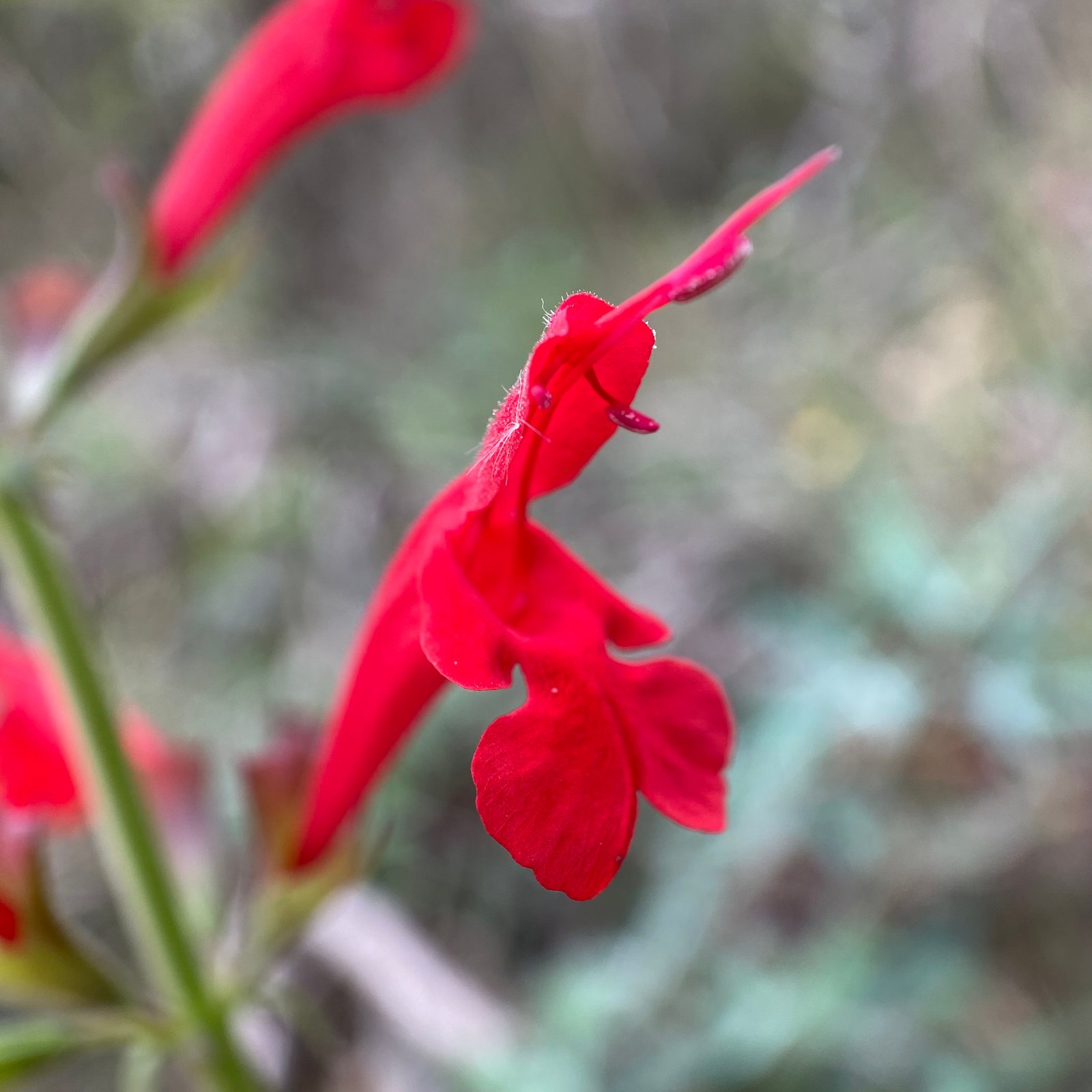
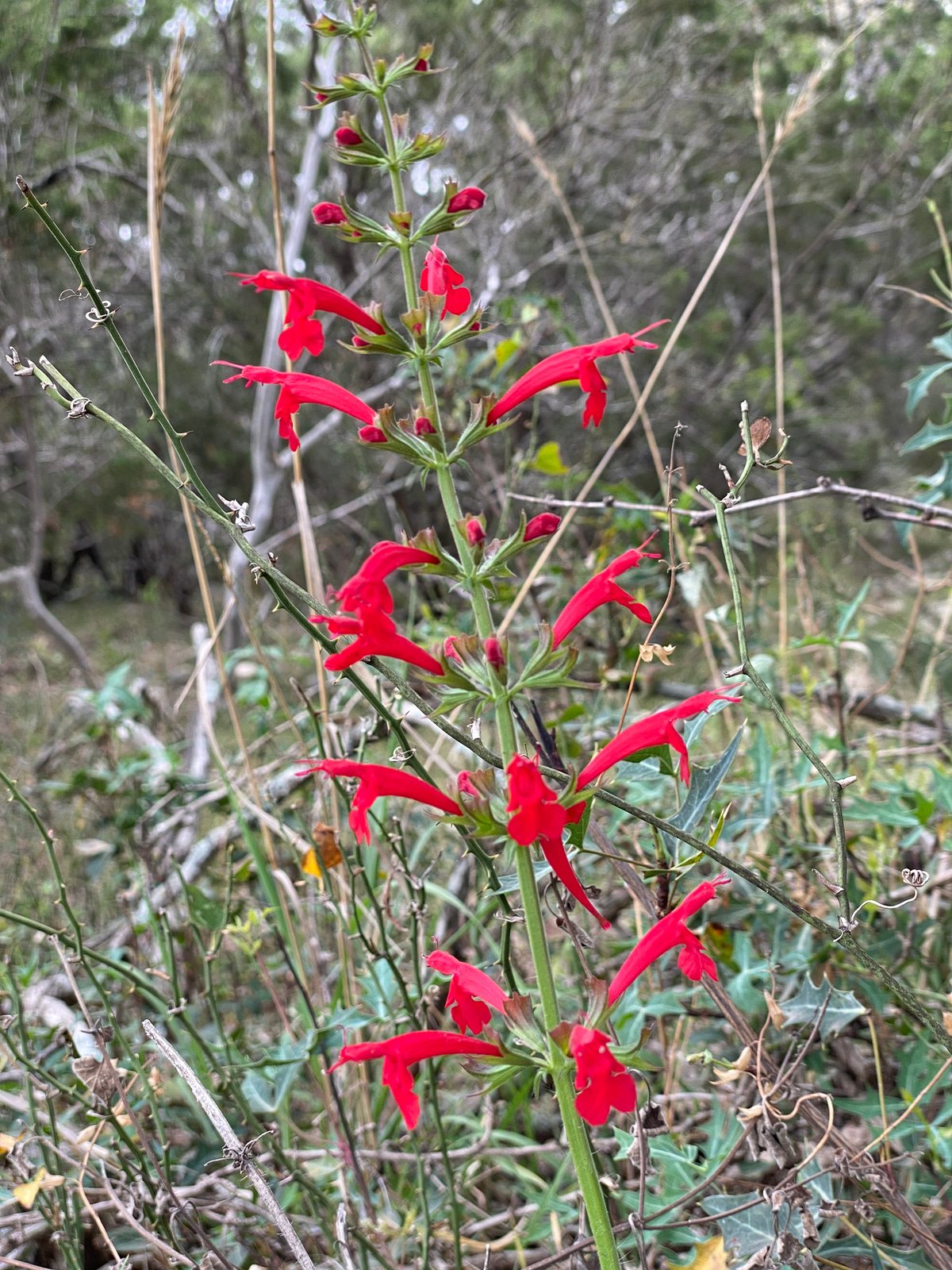
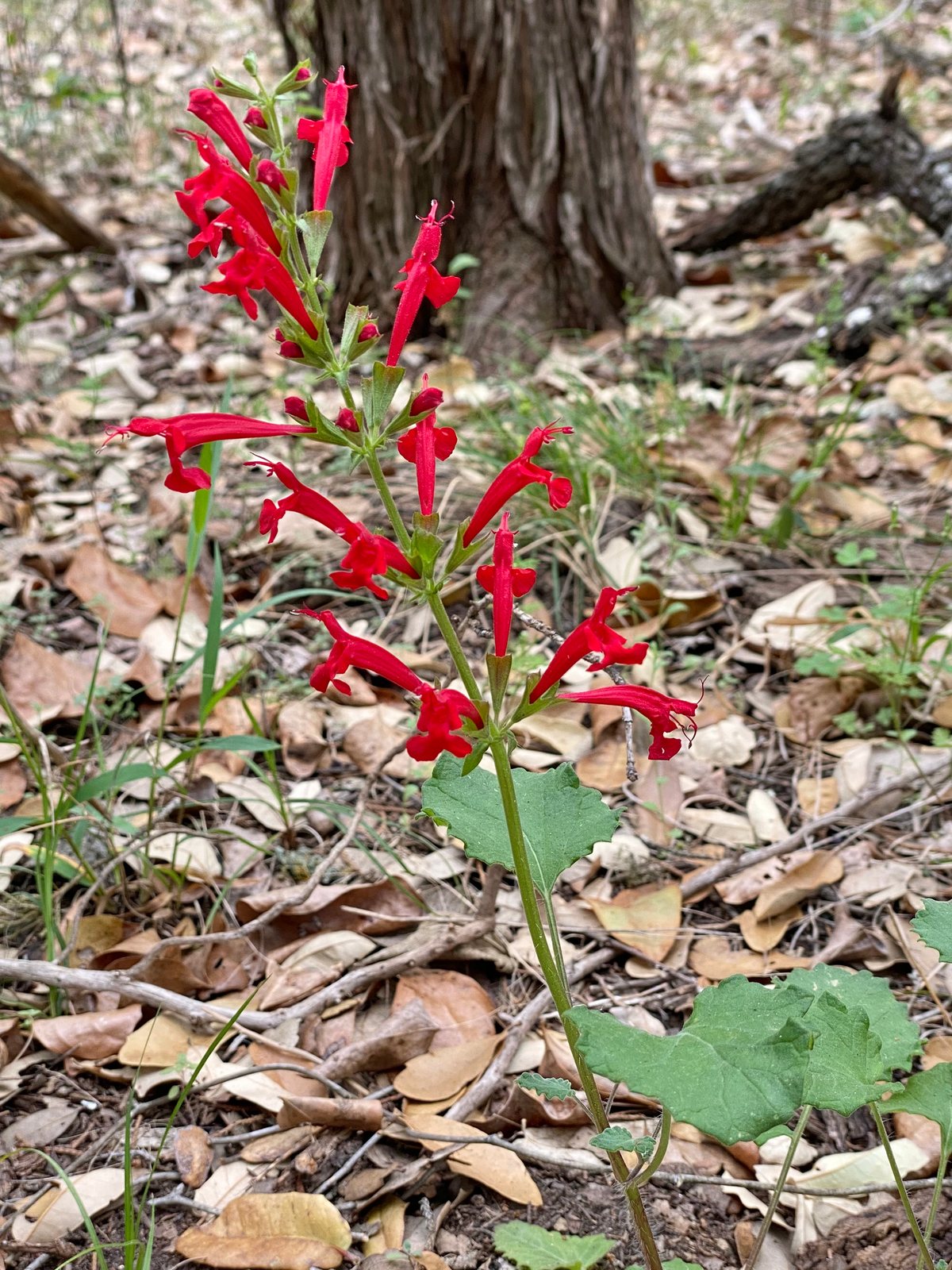
Cedar sage is a compact perennial native to Texas and northeastern Mexico, with bright red tubular flowers above soft, rounded leaves. Gardeners grow it for spring colour in dry, partly shaded places, especially beneath trees where many flowering plants struggle.
At a glance
- Sun
- Partial shade or bright, dappled shade; morning sun is suitable, but avoid strong afternoon sun in hot climates.
- Water
- Water regularly while establishing, then during prolonged dry spells. Established plants tolerate dry shade but flower better with occasional deep watering.
- Soil
- Well-drained soil, including stony limestone soils; tolerates neutral to alkaline conditions. Avoid heavy, persistently wet ground.
- Height
- 1-2 ft (0.3-0.6 m)
- Spread
- 1-2 ft (0.3-0.6 m)
- Flowers
- Scarlet-red tubular flowers in spring and early summer, sometimes repeating in autumn after rain.
- Foliage
- Soft, hairy green leaves with rounded to heart-shaped outlines and scalloped edges. Foliage may persist in mild winters but dies back in colder weather.
- Growth
- Moderate
- Care needed
- Low
The year at a glance
- Pollinators
- Deer resistant
- Drought tolerant
- Heat tolerant
- Low allergen
| J | F | M | A | M | J | J | A | S | O | N | D | |
|---|---|---|---|---|---|---|---|---|---|---|---|---|
| Flowers | ||||||||||||
| Fruit | ||||||||||||
| Plant |
Northern hemisphere months. In Australia, shift them by six.
- Difficulty
- Moderate
- Toughness
- Fairly tough
Will it suit your garden?
Pick your zone, country, light and whether you have pets.
Full sun is 6 or more hours of direct sun a day, part shade 3 to 6 hours, shade under 3.
How it grows
Planting day
1 ft (0.3 m)
After 1 year
1.1 ft (0.35 m)
After 2 years
1.3 ft (0.4 m)
After 3 years
1.5 ft (0.45 m)
full size
About 3 years to full size.
From a typical nursery size, at an average rate for this kind of plant. A rule of thumb, not a forecast.
Good to know
- Cats and dogs
- Safe
- Native to
- the US
- Growth rate
- Moderate
Care
Jobs through the year
- WaterApr–May, Sep–Oct, every 21 days
- Water established plants if the root zone is dry; water new plants more frequently.
- WaterJun–Aug, every 14 days
- Water deeply during prolonged drought, especially if plants remain wilted in the morning.
- PruneMar
- Remove dead stems back to healthy basal growth without damaging the crown.
- DeadheadMay–Jul, Sep, every 14 days
- Remove faded flower stems for possible repeat bloom, leaving a few if seedlings are wanted.
- MulchApr, Oct
- Retain a thin layer of leaf litter around plants but keep the crowns clear.
- ProtectJan–Mar, Nov–Dec
- Keep crowns well drained; in zone 6, overwinter backup plants in a frost-free cold greenhouse.
- Plant in partial shade with the crown at soil level.
- Water deeply during establishment, allowing the surface soil to dry between waterings.
- Water established plants during extended drought rather than keeping the soil constantly moist.
- Leave a light covering of leaf litter around plants, but keep wet mulch away from the crowns.
- Avoid routine feeding; use a light compost dressing only where growth is poor.
Pruning. Remove spent flower stems after the main flush to encourage further flowering, leaving some if you want seedlings. In late winter or early spring, cut dead stems back to healthy basal growth.
Through the year
- Late winter
- Remove dead stems and check that leaf litter is not smothering the crowns.
- Spring
- Plant after severe frosts have passed and water new plants thoroughly.
- Late spring
- Remove faded flower stems, or leave a few to set seed.
- Summer
- Check soil during prolonged drought and water deeply if plants remain wilted in the morning.
- Autumn
- Collect ripe seed from dry flower heads and move unwanted seedlings while conditions are mild.
- Winter
- Keep drainage clear and avoid watering dormant plants unless the soil is unusually dry.
In the garden
- Plant in loose groups beneath open-canopied trees for red flowers in dappled shade.
- Use along shaded paths where the low foliage and upright flowers can be seen closely.
- Tuck into well-drained limestone pockets in a shaded rock garden.
- Combine with sedges, columbines and coral bells for contrasting leaf shapes in a woodland border.
Garden styles it suits: Woodland, Wildlife garden, Pollinator garden, Texas Hill Country, Low-maintenance and Cottage garden.
Plant it with: Texas sedge, Texas columbine, Coral bells and Golden groundsel.
Wildlife: The tubular red flowers attract hummingbirds within their range, as well as butterflies and some bees. Deer often leave the aromatic foliage alone, but browsing is still possible.
Problems to watch for
- Crown or root rot in wet soil: improve drainage, keep mulch off the crown and reduce watering.
- Leaf scorch and persistent wilting in strong sun: move to afternoon shade and water deeply during drought.
- Slugs and snails on young growth: remove hiding places, hand-pick pests or use an approved iron-phosphate bait as directed.
- Unwanted seedlings: remove flower stems before seed ripens or pull seedlings while small.
Safety
Not known to be toxic to people, cats, dogs or horses. Species-specific safety information is limited, and no particular toxic part is established; treat it as an ornamental rather than a culinary sage.
Easily confused with
Tropical sage (Salvia coccinea)
Usually taller and more upright, with more pointed, triangular leaves and longer, more open flower spikes. Cedar sage has a lower habit and broader, rounder, scalloped leaves.
Autumn sage (Salvia greggii)
Forms a woody shrub with small, narrow to oval leaves. Cedar sage is herbaceous, with larger, soft, hairy leaves and distinctly scalloped edges.
The name
The common name refers to its habitat beneath junipers locally called cedars, while roemeriana honours the German geologist Ferdinand Roemer.
Propagation. Grow from seed sown in a freely draining seed mix, or take softwood cuttings in spring or early summer. It may self-seed where conditions suit it; transplant small seedlings with their roots intact.
Checked against open data
- Accepted botanical name
- Salvia roemeriana
- In the US and Canada
- Native in the lower 48 states.
- Native range
- Mexico Northeast and Texas.
Sources: GBIF (CC BY 4.0), USDA PLANTS and Trefle (CC BY 4.0). The care and design notes are LandscapeGPT's own.
See it in your own yard.
Upload a photo of your yard and see it redesigned with plants that suit your climate, each checked against your zone.