Celeriac
Apium graveolens var. rapaceum. Family Apiaceae. Annual.
Also called Celery root, Knob celery, Turnip-rooted celery.
Celeriac is a biennial vegetable grown as an annual for its swollen stem base, which has firm, pale flesh and a celery flavour. It needs a long growing season, rich soil and steady moisture to produce good-sized roots for autumn and winter cooking.
At a glance
- Sun
- Full sun; light afternoon shade is useful in hot climates.
- Water
- Keep the soil consistently moist but not waterlogged; drought produces small, tough roots.
- Soil
- Deep, fertile, moisture-retentive but well-drained soil, ideally with a pH of 6.0-7.5.
- Height
- 1-2 ft (0.3-0.6 m)
- Spread
- 1-1.5 ft (0.3-0.45 m)
- Foliage
- Upright clusters of dark green, divided leaves on grooved stalks, with a strong celery scent when crushed.
- Growth
- Slow to establish, then moderate; needs a long season to mature.
- Care needed
- Medium
The year at a glance
- Low allergen
- Edible
| J | F | M | A | M | J | J | A | S | O | N | D | |
|---|---|---|---|---|---|---|---|---|---|---|---|---|
| Fruit | ||||||||||||
| Plant |
Northern hemisphere months. In Australia, shift them by six.
- Difficulty
- Moderate
- Toughness
- Needs looking after
Will it suit your garden?
Pick your zone, country, light and whether you have pets.
Full sun is 6 or more hours of direct sun a day, part shade 3 to 6 hours, shade under 3.
How it grows
Planting day
0.5 ft (0.15 m)
After 1 year
1.5 ft (0.45 m)
full size
Full size in one season.
From a typical nursery size, at an average rate for this kind of plant. A rule of thumb, not a forecast.
Good to know
- Cats and dogs
- Safe
- Growth rate
- Slow
Care
Jobs through the year
- WaterMay, Sep–Nov, every 7 days
- Water established crops if rain is insufficient; keep new transplants continuously moist.
- WaterJun–Aug, every 3 days
- Water deeply during dry weather; never let developing roots dry out.
- FeedJun–Aug, every 28 days
- Use balanced vegetable feed at the label rate, especially on poor soil.
- MulchMay–Jun
- Mulch after planting to retain moisture, leaving the crown and swollen base exposed.
- PruneJun–Nov
- Remove yellowing or damaged outer leaves only; retain healthy foliage.
- ProtectMay–Jun
- Protect transplants from slugs and leaf miners; avoid prolonged cold exposure.
- HarvestSep–Nov, every 7 days
- Lift useful-sized swollen bases as needed; lift remaining roots before the ground freezes hard.
- Work well-rotted compost into the bed before planting.
- Space plants 12-18 in (30-45 cm) apart, keeping the crown at soil level.
- Water deeply whenever the soil begins to dry; do not let developing roots suffer drought.
- Mulch around plants to conserve moisture, leaving the crown uncovered.
- Feed with a balanced vegetable fertiliser according to the label, especially on poor soil.
- Keep weeds down by hand or with shallow hoeing to avoid damaging roots.
Pruning. Remove yellowing or damaged outer leaves as needed, but retain healthy foliage to feed the developing root. Do not earth up or blanch the swollen base.
Harvest
Lift the swollen bases from autumn onwards, usually about 3-5 months after transplanting, once they are roughly 3-5 in (8-13 cm) across; smaller roots are also edible. Loosen the soil with a fork, lift carefully, then trim off the leaves and fine roots. Plants tolerate light frosts, but lift before the ground freezes hard; in mild climates, leave them in the bed and harvest as needed.
Through the year
- Late winter
- In cool climates, surface-sow seed indoors about 10-12 weeks before the expected last frost.
- Early spring
- Prick seedlings into individual pots and keep them warm, bright and evenly moist.
- Late spring
- Harden off and transplant once hard frosts have passed and prolonged cold weather is unlikely.
- Summer
- Water regularly, mulch and remove weeds while the swollen bases develop.
- Late summer
- In warm, frost-light regions, sow for a crop grown through the cooler months rather than summer heat.
- Autumn
- Begin harvesting roots as they reach a useful size; remove yellowing foliage.
- Late autumn
- In cold regions, lift remaining roots before hard freezes and store them cool, humid and frost-free.
In the garden
- Plant in orderly rows in a kitchen garden, where the leafy tops give structure through summer.
- Use in raised vegetable beds with rich soil and reliable irrigation.
- Combine with lettuce and beetroot in a potager for contrasting leaf shapes and colours.
- Grow in an accessible edible bed where the exposed swollen bases make crop development easy to follow.
Garden styles it suits: Potager (kitchen garden), Edible landscape, Homestead, Cottage garden, Farmhouse and Family-friendly.
Plant it with: Lettuce, Beetroot, Leeks, Onions, Kale and Dwarf French beans.
Wildlife: If left to flower in its second year, the small white flower clusters attract hoverflies and other small beneficial insects. Crops harvested in their first year provide little floral food.
Problems to watch for
- Slugs and snails damage seedlings and young foliage: inspect after dark, remove hiding places and use locally approved controls if needed.
- Celery leaf miner causes pale or brown blotches in leaves: remove affected leaves promptly and protect young plants with insect mesh.
- Septoria leaf spot causes brown spots and declining foliage: use healthy seed, rotate crops, remove infected debris and water the soil rather than the leaves.
- Premature flowering or small, woody roots follow prolonged seedling chilling or drought: keep young plants warm and maintain even moisture after planting.
Safety
The swollen base, leaves and stalks are edible for people, but celery allergy can cause severe reactions, including anaphylaxis. Sap on the skin followed by sunlight can cause irritation or blistering in susceptible people. Celeriac is not known to be toxic to cats, dogs or horses in ordinary food amounts; large quantities may cause digestive upset.
Easily confused with
Celery (Apium graveolens var. dulce)
Celery develops thick, fleshy leaf stalks rather than the large, rounded swollen base of celeriac.
Turnip (Brassica rapa subsp. rapa)
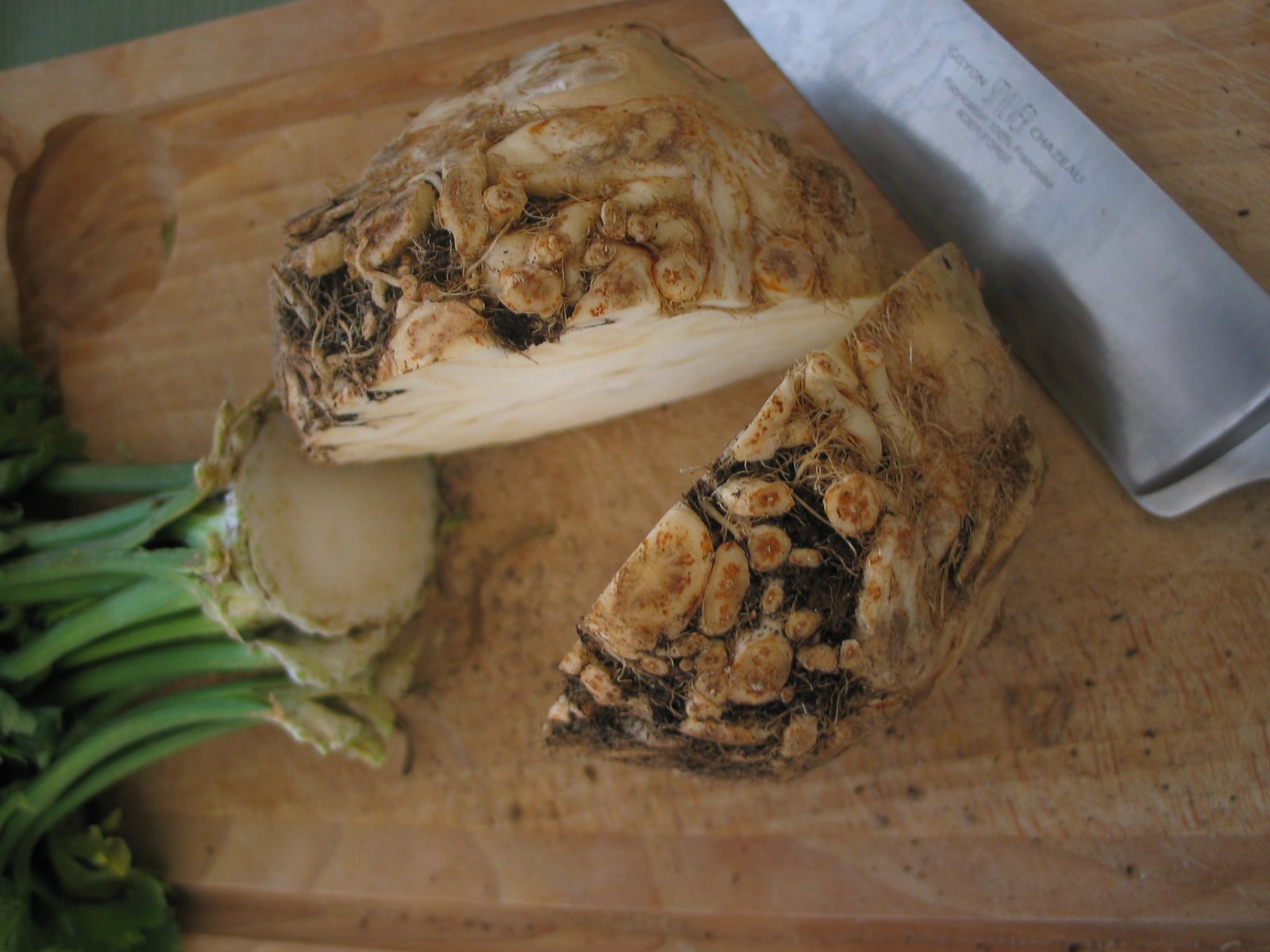
Turnips have broad, often rough leaves and a smoother swollen root; celeriac has divided, celery-scented leaves and a knobbly base covered with root scars.
The name
The name celeriac derives from celery, while the botanical epithet rapaceum means turnip-like, referring to its swollen base.
Propagation. Grow from seed, surface-sown or barely covered because light aids germination. Keep at about 65-70°F (18-21°C) and consistently moist; germination commonly takes 2-3 weeks and can be uneven. Allow roughly 5-7 months from sowing to harvest, depending on variety and conditions.
Checked against open data
- Accepted botanical name
- Apium graveolens dulce Apium graveolens var. rapaceum is an older name for Apium graveolens dulce.
Sources: GBIF (CC BY 4.0). The care and design notes are LandscapeGPT's own.
See it in your own yard.
Upload a photo of your yard and see it redesigned with plants that suit your climate, each checked against your zone.