Chilean jasmine
Mandevilla laxa. Family Apocynaceae. Climber.
Also called Chilean jasmine vine.
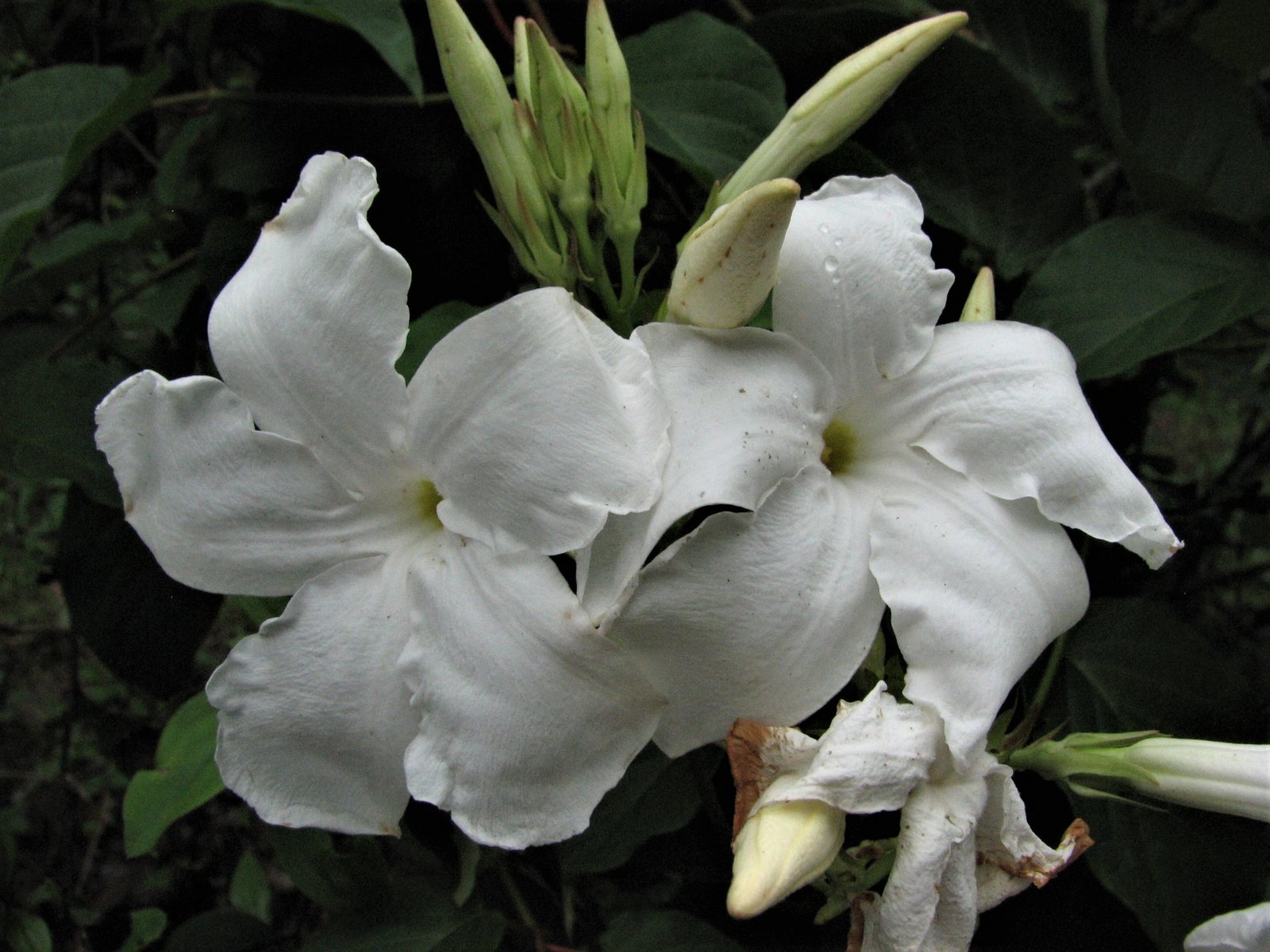
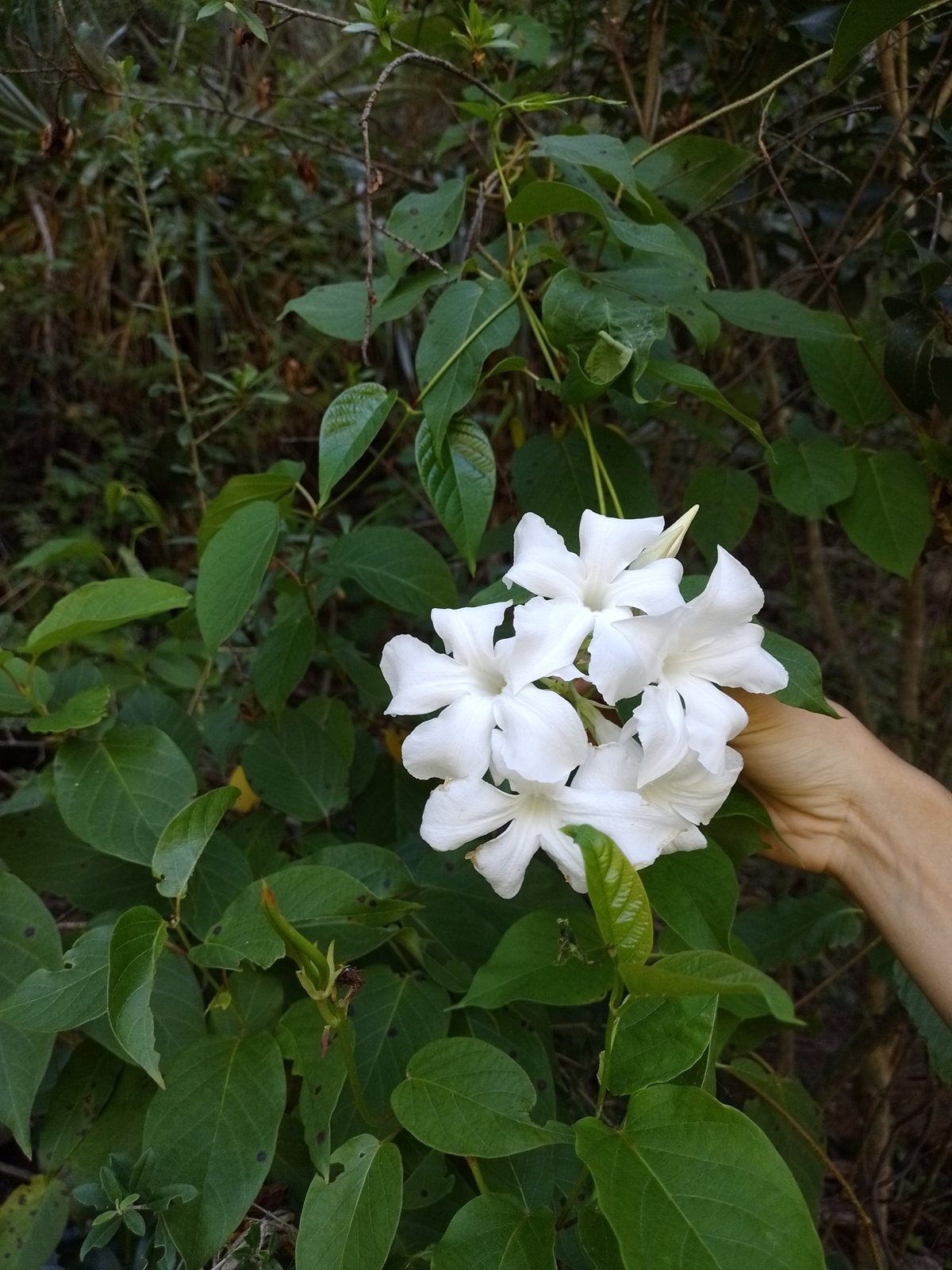
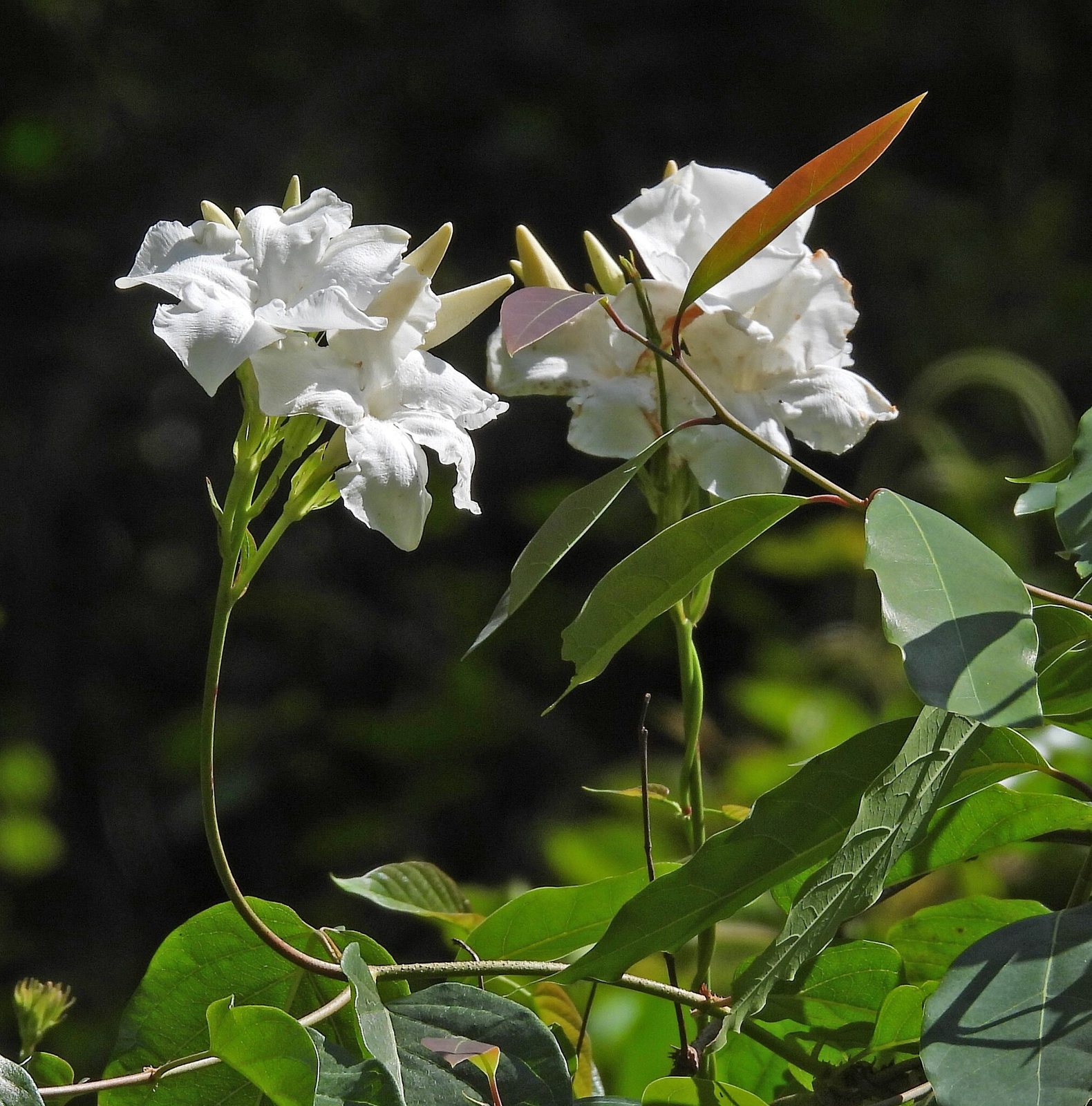
Chilean jasmine is a woody, twining climber grown for clusters of fragrant white trumpet flowers in summer. Despite its common name, it is not a true jasmine. Give it a sunny, sheltered support; in colder regions, grow it in a container and overwinter it under cover.
At a glance
- Sun
- Full sun to light partial shade; afternoon shade helps in very hot climates.
- Water
- Water regularly during active growth, letting the surface soil dry between waterings. Keep much drier while dormant, but do not let container roots dry out completely.
- Soil
- Fertile, well-drained soil; avoid ground that stays wet in winter. Use a freely draining potting mix for containers.
- Height
- 10-20 ft (3-6 m)
- Spread
- 5-8 ft (1.5-2.4 m)
- Flowers
- Summer into early autumn; fragrant white trumpet-shaped flowers in loose clusters, often opening from pink-tinged buds.
- Foliage
- Opposite, green, oval to heart-shaped leaves. Usually deciduous, especially in cool climates.
- Growth
- Fast in warm weather once established.
- Care needed
- Medium
The year at a glance
- Pollinators
- Heat tolerant
- Low allergen
- Fragrant
| J | F | M | A | M | J | J | A | S | O | N | D | |
|---|---|---|---|---|---|---|---|---|---|---|---|---|
| Flowers | ||||||||||||
| Plant |
Northern hemisphere months. In Australia, shift them by six.
- Difficulty
- Hard
- Toughness
- Needs looking after
Will it suit your garden?
Pick your zone, country, light and whether you have pets.
Full sun is 6 or more hours of direct sun a day, part shade 3 to 6 hours, shade under 3.
How it grows
Planting day
2 ft (0.6 m)
After 1 year
3 ft (1.1 m)
After 2 years
5 ft (1.5 m)
After 3 years
6 ft (1.8 m)
full size
About 3 years to full size.
From a typical nursery size, at an average rate for this kind of plant. A rule of thumb, not a forecast.
Good to know
- Cats and dogs
- Mildly toxic: may upset a stomach
- Growth rate
- Fast
Care
Jobs through the year
- WaterMay, Sep, every 7 days
- For established outdoor plants, water when surface soil dries; young plants and pots need more frequent checks.
- WaterJun–Aug, every 5 days
- Water established outdoor roots deeply in dry weather; skip if soil remains moist.
- WaterJan–Apr, Oct–Dec, every 21 days
- For frost-free overwintering pots only, check compost and water sparingly before roots become completely dry.
- FeedMay–Aug, every 14 days
- Feed container plants with flowering-plant fertilizer at label strength; rich garden soil needs no routine feed.
- PruneMar
- Remove dead stems and shorten tangled or overlong shoots to healthy buds before strong growth.
- MulchOct
- Mulch outdoor roots generously without covering stems; mulch alone is unreliable protection in zones 6–7.
- ProtectJan–Apr, Oct–Dec
- In zones 6–7, grow in a movable container and overwinter bright, cool and frost-free before hard frost.
- ProtectMay–Jun
- Harden off after frost risk passes and tie young shoots onto a secure climbing support.
- Provide a trellis, wires or an open framework, and tie in young shoots until they begin twining.
- Water deeply during dry spells, especially while plants are establishing or flowering.
- Feed container plants every two weeks during active growth with a flowering-plant fertiliser at the label rate.
- Mulch the root area in autumn in colder gardens, keeping mulch away from the stems.
- Move containers into a bright, cool, frost-free place before hard frosts; reduce watering after leaf fall.
Pruning. In late winter or early spring, remove dead or frost-damaged stems and shorten crowded or overlong shoots to a healthy pair of buds. Flowers form on new growth, so prune before vigorous growth begins.
Through the year
- Late winter
- Check overwintering containers and water sparingly when the compost is becoming dry.
- Early spring
- Prune damaged or tangled stems and check that supports are secure.
- Spring
- Plant after the risk of hard frost has passed; gradually acclimatise overwintered plants to outdoor conditions.
- Late spring
- Tie in new shoots and begin feeding container plants once growth is strong.
- Summer
- Water during dry weather and guide long shoots along their supports.
- Autumn
- Stop feeding as growth slows; mulch outdoor roots or move containers under cover before hard frost.
In the garden
- Train over a pergola beside a seating area where the summer fragrance can be enjoyed.
- Grow on wires against a sunny, sheltered wall to soften brickwork or fencing.
- Use a large container and tall obelisk on a patio where winter protection is practical.
- Combine with silver foliage and blue flowers in a sunny Mediterranean-style border.
- Train around an entrance or courtyard arch for white flowers at eye level.
Garden styles it suits: Mediterranean, Modern courtyard, Romantic rose garden, Sensory garden, White garden and Evening garden.
Plant it with: Lavender, Catmint, Salvia, Agapanthus and Rosemary.
Wildlife: The flowers can attract nectar-feeding insects. It is not a native host plant in the United States, the United Kingdom, Canada or Australia.
Problems to watch for
- Frost damage: exposed stems may die back near the colder end of its range; protect the root area and remove dead growth after winter.
- Waterlogged roots: yellowing leaves and decline can follow persistently wet soil; improve drainage and avoid leaving pots standing in water.
- Red spider mites: fine webbing and mottled leaves are most likely under warm, dry cover; rinse leaf undersides and use predatory mites or a labelled treatment if needed.
- Mealybugs and scale insects: inspect stems and leaf joints, isolate affected containers, and remove small infestations by hand or use a suitable labelled treatment.
Safety
The milky sap can irritate skin and eyes. Treat all parts as potentially harmful if eaten by people, cats, dogs or horses; ingestion may cause stomach upset. Species-specific evidence on poisoning severity, particularly in horses, is limited, so keep it away from grazing animals and discourage pets and children from chewing it.
Easily confused with
Star jasmine (Trachelospermum jasminoides)
Star jasmine has leathery, evergreen leaves and smaller flowers with narrow, twisted, pinwheel-like petals; Chilean jasmine has broader trumpet flowers and usually loses its leaves.
Common jasmine (Jasminum officinale)
Common jasmine has divided leaves made up of several leaflets; Chilean jasmine has simple, undivided leaves and milky sap.
Pink mandevilla (Mandevilla sanderi)
Pink mandevilla usually has glossy, leathery evergreen leaves and pink flowers, although cultivated forms vary in colour. Chilean jasmine has softer leaves, strongly fragrant white flowers and greater cold tolerance.
The name
Mandevilla honours the British diplomat and gardener Henry John Mandeville, while laxa means loose, referring to the loosely arranged flower clusters.
Propagation. Take softwood cuttings in late spring or semi-ripe cuttings in summer, using a free-draining medium and gentle warmth. Layering a low shoot is another option; wear gloves when handling cut stems because of the milky sap.
Checked against open data
- Accepted botanical name
- Mandevilla laxa
- Native range
- Argentina Northeast, Argentina Northwest, Bolivia and Peru.
Sources: GBIF (CC BY 4.0) and Trefle (CC BY 4.0). The care and design notes are LandscapeGPT's own.
See it in your own yard.
Upload a photo of your yard and see it redesigned with plants that suit your climate, each checked against your zone.