Chinese chestnut
Castanea mollissima. Family Fagaceae. Tree.
Also called Chinese sweet chestnut.
Chinese chestnut is a broad, spreading deciduous tree grown for edible nuts, summer shade and yellow autumn foliage. It is more resistant to chestnut blight than American chestnut, but not immune. Allow room for two genetically different trees if you want dependable nut crops.
At a glance
- Sun
- Full sun; tolerates light shade, but crops less heavily.
- Water
- Moderate; water deeply during dry spells while establishing and while nuts are filling. Avoid waterlogged ground.
- Soil
- Deep, well-drained, acidic to slightly acidic soil, ideally pH 5.0-6.5. Avoid chalky soil, compacted ground and sites that stay wet.
- Height
- 40-60 ft (12-18 m)
- Spread
- 40-60 ft (12-18 m)
- Flowers
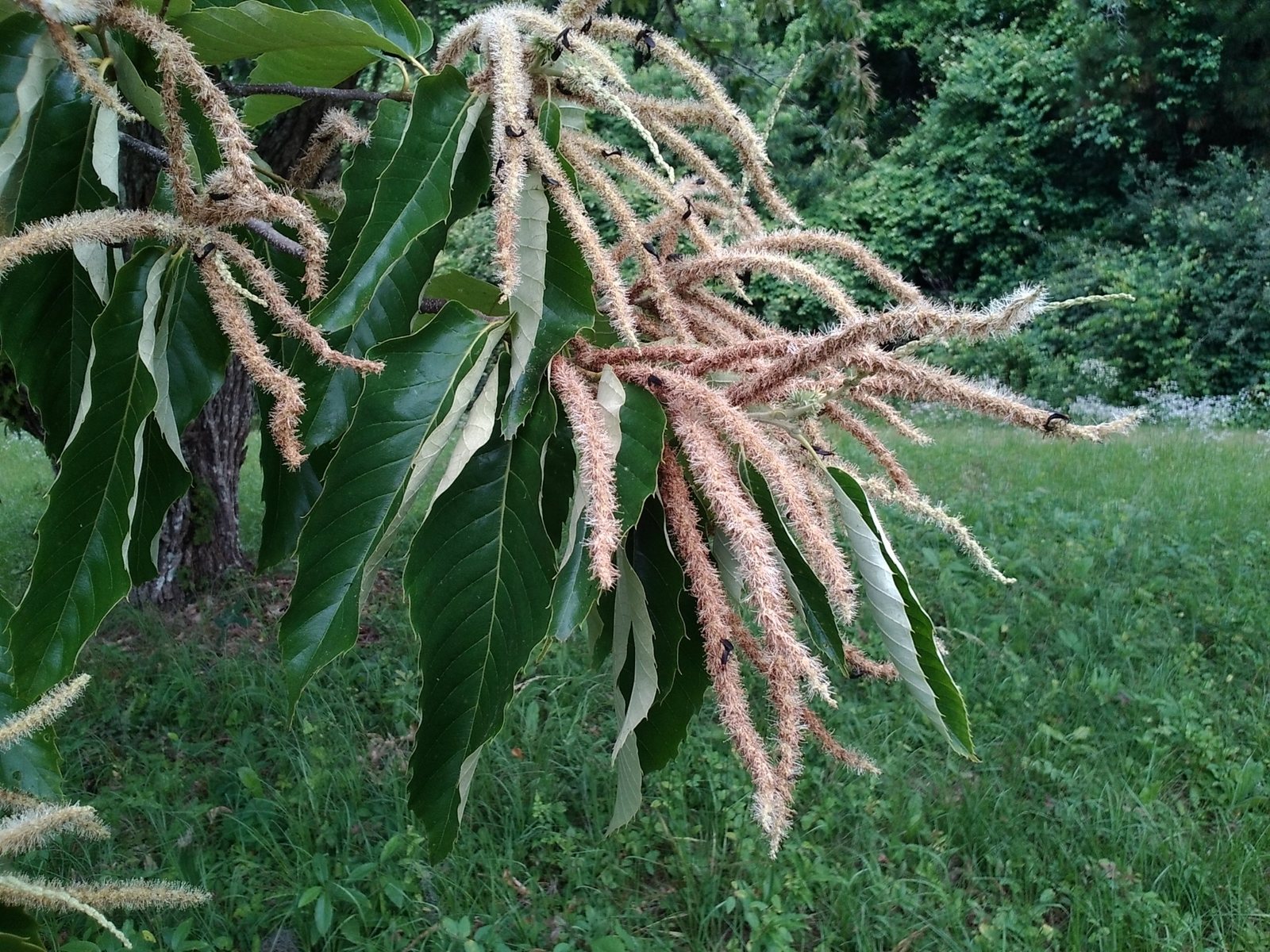
- Late spring to early summer; long, creamy-white male catkins and small female flowers. The flowers have a strong scent that some people dislike.
- Foliage
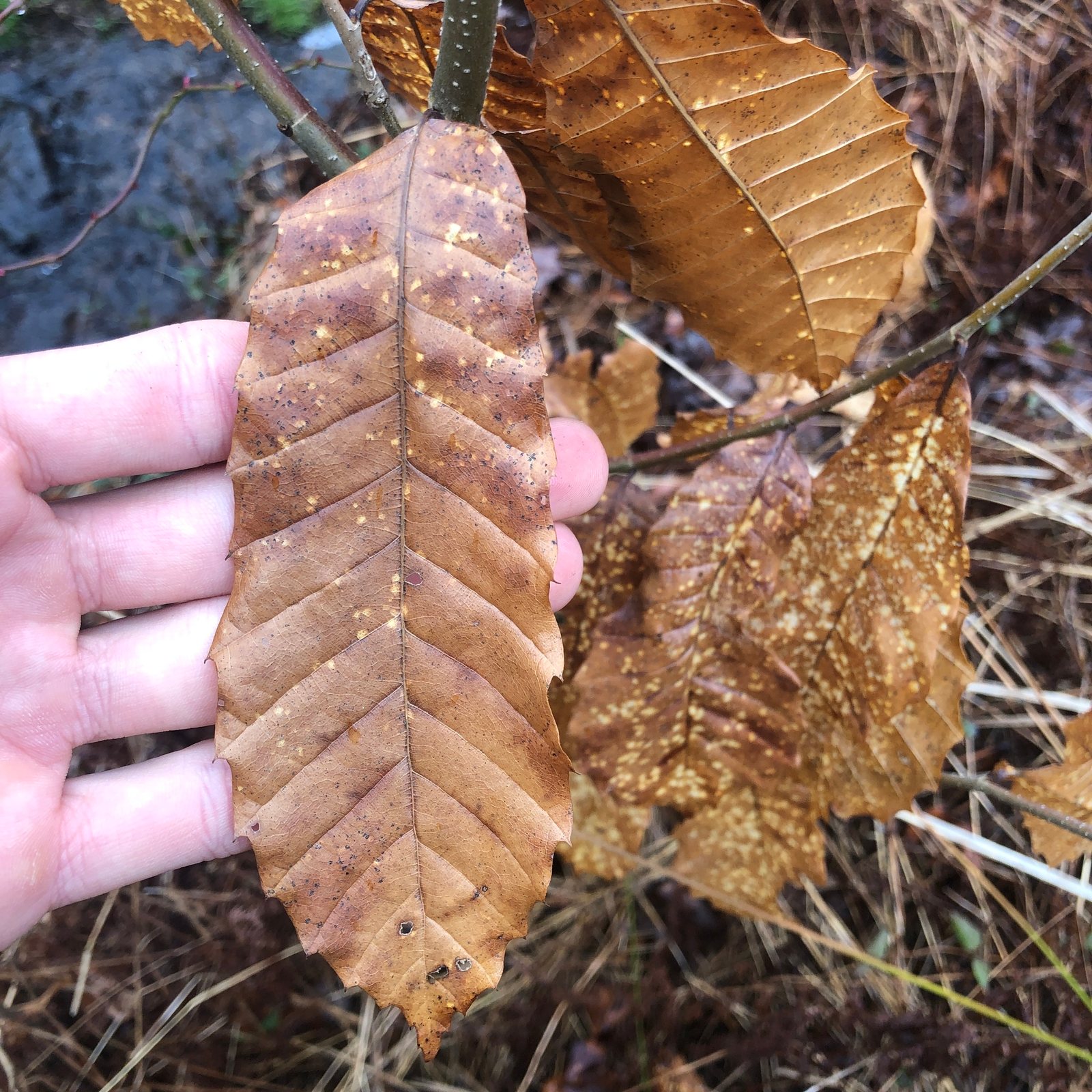
- Glossy, oblong green leaves with sharply toothed edges and softly hairy undersides; usually yellow to bronze in autumn.
- Growth
- Moderate, faster on fertile, well-drained soil with adequate moisture.
- Care needed
- Medium
The year at a glance
- Pollinators
- Disease resistant
- Wildlife
- Edible
| J | F | M | A | M | J | J | A | S | O | N | D | |
|---|---|---|---|---|---|---|---|---|---|---|---|---|
| Flowers | ||||||||||||
| Fruit | ||||||||||||
| Plant |
Northern hemisphere months. In Australia, shift them by six.
- Difficulty
- Moderate
- Toughness
- Fairly tough
Will it suit your garden?
Pick your zone, country, light and whether you have pets.
Full sun is 6 or more hours of direct sun a day, part shade 3 to 6 hours, shade under 3.
How it grows
Planting day
7 ft (2 m)
After 1 year
9 ft (2.8 m)
After 2 years
12 ft (3.6 m)
After 3 years
15 ft (4.4 m)
After 5 years
20 ft (6.1 m)
About 16 years to full size.
From a typical nursery size, at an average rate for this kind of plant. A rule of thumb, not a forecast.
Good to know
- Cats and dogs
- Safe
- Growth rate
- Fast
Care
Jobs through the year
- WaterApr–May, Oct, every 14 days
- Water established trees only when soil is dry; water young trees more frequently for two years.
- WaterJun–Sep, every 7 days
- Check established trees and soak the root zone during dry spells, especially while nuts fill.
- PruneFeb–Mar
- Train a central leader in young trees; otherwise remove only dead, damaged or crossing branches.
- MulchMar–Apr
- Maintain a grass-free ring with 5–8 cm of organic mulch, clear of the trunk.
- FeedApr
- Apply nutrients only if a soil test shows a deficiency; avoid heavy nitrogen.
- HarvestSep–Oct
- Wear thick gloves to gather released nuts; refrigerate promptly and clear leftover nuts and burrs.
- Plant two genetically different Chinese chestnuts with overlapping flowering times, ideally within 100 ft (30 m) of each other; two trees of the same grafted cultivar do not provide suitable cross-pollination.
- Water deeply through the first two growing seasons, then during prolonged drought, especially as nuts develop.
- Keep a grass-free area around young trees and apply 2-3 in (5-8 cm) of organic mulch, clear of the trunk.
- Use a soil test before feeding; avoid heavy nitrogen applications that encourage soft growth rather than cropping.
- Choose an open site away from paving and play areas, where falling prickly burrs can be collected easily.
Pruning. Prune in late winter while dormant, choosing a strong central leader and well-spaced main branches when young. Once established, remove dead, damaged or crossing branches and avoid topping or unnecessary large cuts.
Harvest
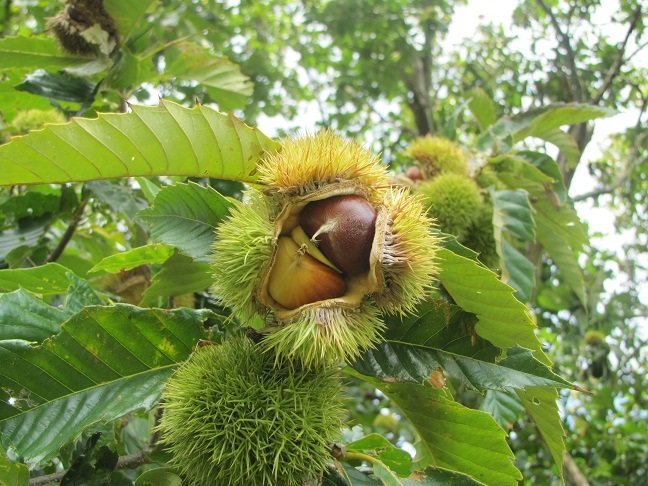
Collect nuts promptly in autumn as the prickly burrs split and release ripe nuts onto the ground; wear thick gloves and gather daily before wildlife does. Grafted trees often give a worthwhile crop about 3-5 years after planting, while seedlings commonly take 5-8 years or longer; refrigerate fresh nuts promptly because they are perishable.
Through the year
- Late winter
- Prune young trees for structure and remove dead or damaged wood.
- Early spring
- Plant while dormant if the ground is workable; check drainage and provide a compatible pollination partner.
- Spring
- Refresh mulch, remove competing grass and check new growth for galls or shoot dieback.
- Late spring to early summer
- Check that both trees flower at overlapping times; expect catkin litter and a strong floral scent.
- Summer
- Water during extended dry weather, particularly while nuts are filling.
- Autumn
- Gather fallen nuts daily, refrigerate them promptly and clear empty burrs from paths and lawns.
In the garden
- Use as a large shade tree in an edible landscape, leaving its broad crown room to develop.
- Plant in a spacious home orchard with a compatible chestnut pollination partner.
- Place at the sunny edge of a food forest, keeping smaller fruiting plants beyond its eventual shade.
- Use as a specimen in a large informal lawn, away from seating areas and paths where burrs would be troublesome.
Garden styles it suits: Backyard orchard, Food forest, Edible landscape, Homestead, Grand estate and Autumn colour.
Plant it with: Blueberry, Serviceberry, Daffodil and Wild strawberry.
Wildlife: The flowers provide pollen for insects, and the nuts feed squirrels, rodents, deer and other wildlife. Wildlife may take much of the crop unless nuts are collected promptly.
Problems to watch for
- Chestnut blight: Chinese chestnut has useful resistance but can still develop bark cankers and dieback. Buy healthy stock, remove affected branches where practical and seek local advice for trunk cankers.
- Phytophthora root rot: wet soil can cause declining growth, wilting and tree death. Prevent it with excellent drainage; do not plant chestnuts in persistently wet ground.
- Chestnut weevils: larvae develop inside the nuts. Gather nuts daily, remove leftover nuts and burrs, and ask your local extension or plant-health service about locally approved treatment if infestations recur.
- Poor nut set or empty burrs: usually linked to inadequate cross-pollination, although drought and unsuitable flowering weather also contribute. Add a genetically different tree with overlapping bloom and maintain moisture during dry spells.
Safety
The edible kernels are not known to be toxic to people, cats, dogs or horses; they are different from poisonous horse-chestnuts. Shells and prickly burrs can cause choking, digestive obstruction or physical injury. Leaves and bark contain tannins and should not be offered as livestock fodder; species-specific toxicity information for these parts is limited.
Easily confused with
Sweet chestnut (Castanea sativa)
Also has edible nuts in densely spiny burrs, but its leaves are usually longer and lack the persistently soft, hairy undersides typical of Chinese chestnut.
American chestnut (Castanea dentata)
Usually has narrower, largely hairless leaves with prominent hooked teeth. Chinese chestnut generally has broader leaves, hairy undersides and a more spreading habit; hybrids can be difficult to identify.
Horse-chestnut (Aesculus hippocastanum)
Has hand-shaped leaves made up of separate leaflets and leathery husks with relatively few spines. Its shiny conkers are poisonous and must not be eaten.
The name
Castanea is the Latin name for chestnut, and mollissima means 'very soft', referring to the soft hairs on the young shoots and leaf undersides.
Propagation. Sow fresh nuts after a period of cold, moist stratification, protecting them from rodents and never allowing them to dry out. Seedlings vary in nut quality and growth; named selections are propagated by grafting onto compatible chestnut rootstocks.
Checked against open data
- Accepted botanical name
- Castanea mollissima
- In the US and Canada
- Introduced in the lower 48 states.
- Native range
- China North-Central, China South-Central, China Southeast and Korea.
- Measured
- Soil pH 5 to 7.5. Average height 1350 cm.
Sources: GBIF (CC BY 4.0), USDA PLANTS and Trefle (CC BY 4.0). The care and design notes are LandscapeGPT's own.
See it in your own yard.
Upload a photo of your yard and see it redesigned with plants that suit your climate, each checked against your zone.