Chinese meadow rue
Thalictrum delavayi. Family Ranunculaceae. Perennial.
Also called Delavay's meadow rue.
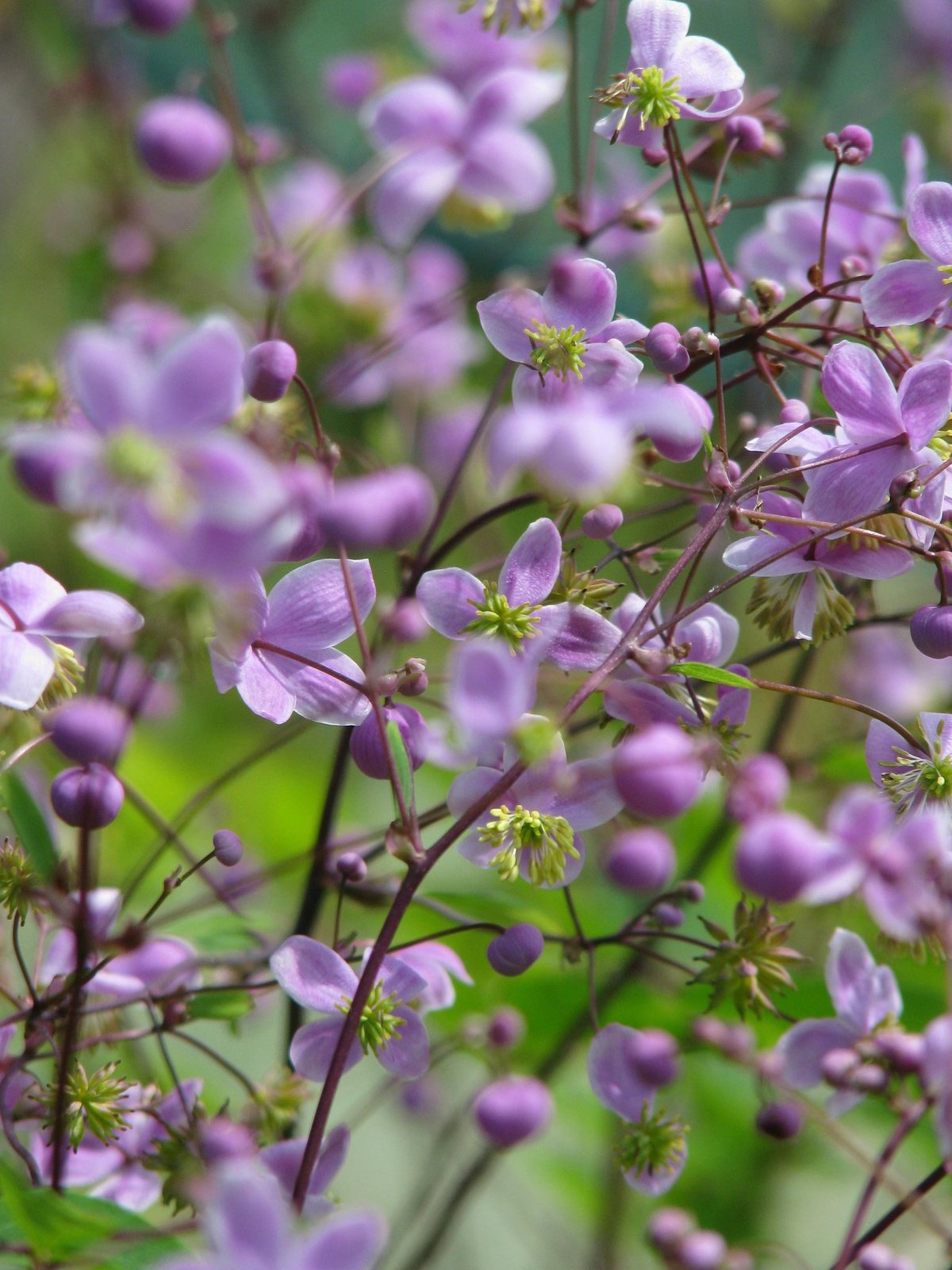
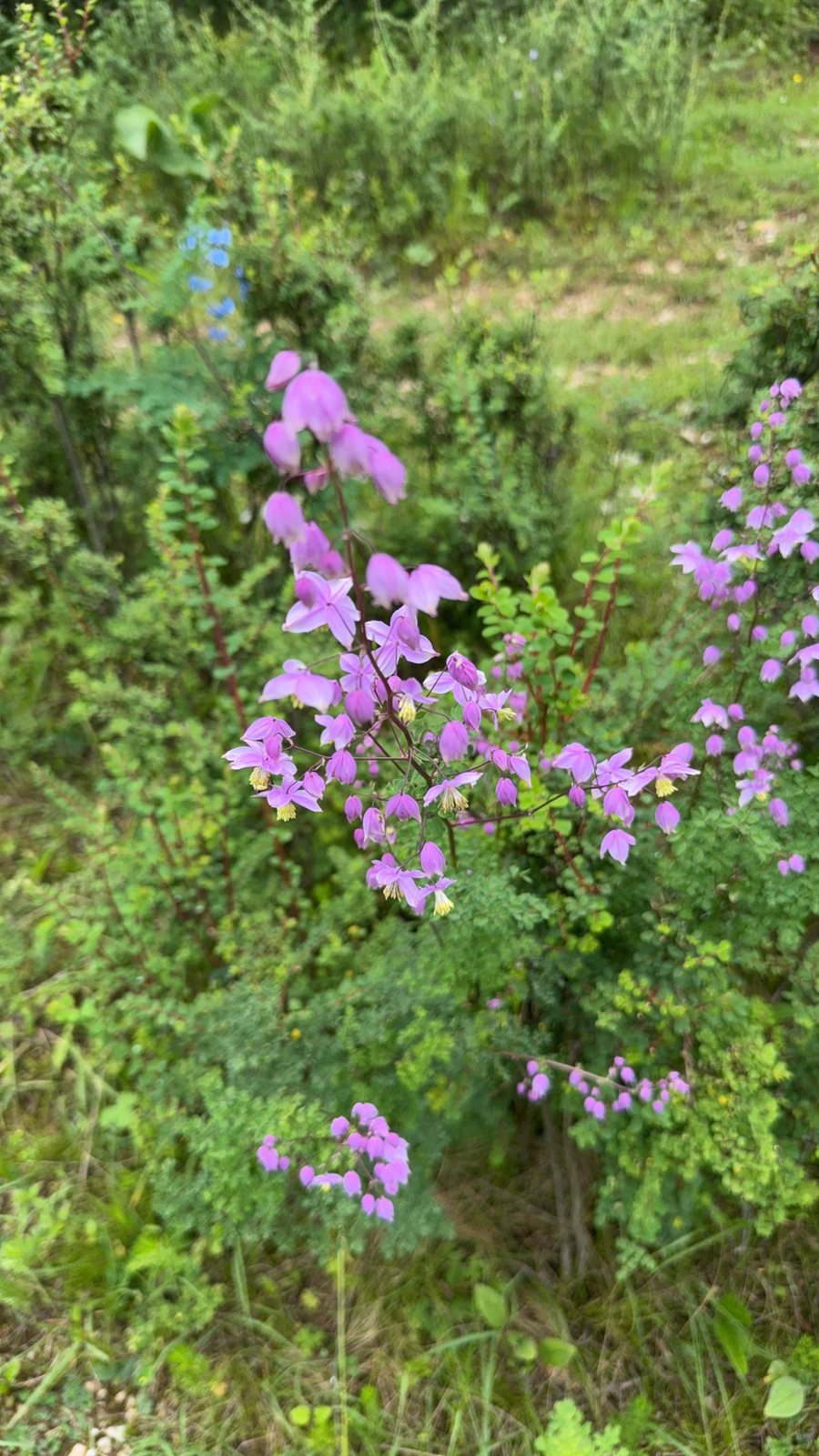
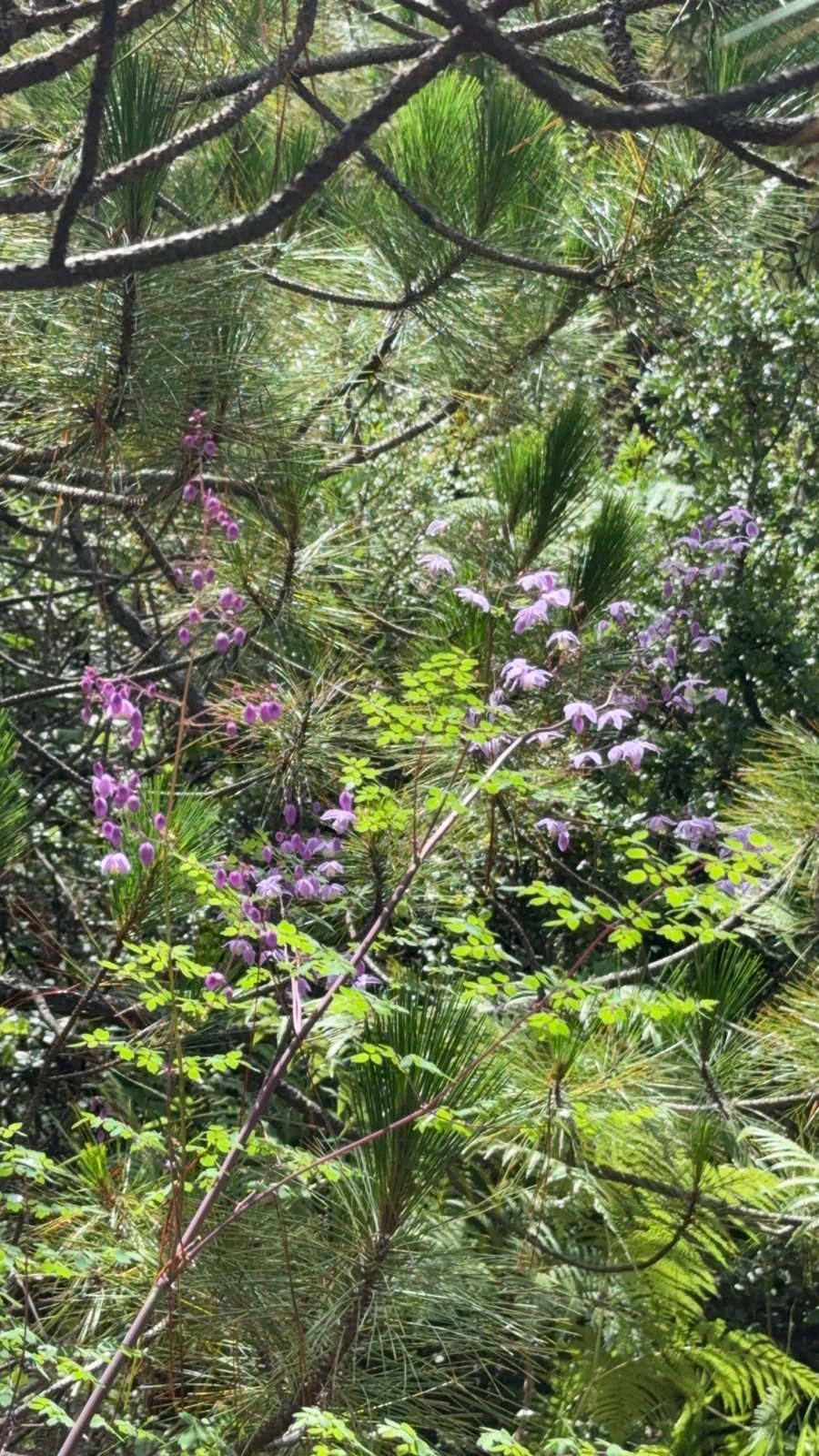
Chinese meadow rue is a deciduous perennial with finely divided leaves and tall, branching stems carrying clouds of small lilac flowers. Gardeners grow it for its airy height and delicate texture in moist borders and lightly shaded woodland gardens. It performs best where summers are not excessively hot or dry.
At a glance
- Sun
- Partial shade, especially afternoon shade in warmer climates; full sun is suitable where summers are cool and the soil stays moist.
- Water
- Keep the soil evenly moist during active growth, watering deeply during dry spells. Avoid both prolonged drought and waterlogged winter soil.
- Soil
- Humus-rich, moisture-retentive but well-drained soil; tolerates acidic, neutral and mildly alkaline conditions.
- Height
- 3-5 ft (0.9-1.5 m)
- Spread
- 1-2 ft (0.3-0.6 m)
- Flowers
- Mid- to late summer, sometimes into early autumn; small lilac-purple flowers with prominent pale yellow stamens.
- Foliage
- Fine, divided green to blue-green leaves with small, rounded leaflets resembling those of maidenhair fern; dies back in winter.
- Growth
- Moderate; usually takes two or three growing seasons to form a substantial clump.
- Care needed
- Medium
The year at a glance
- Pollinators
- Deer resistant
| J | F | M | A | M | J | J | A | S | O | N | D | |
|---|---|---|---|---|---|---|---|---|---|---|---|---|
| Flowers | ||||||||||||
| Plant |
Northern hemisphere months. In Australia, shift them by six.
- Difficulty
- Moderate
- Toughness
- Fairly tough
Will it suit your garden?
Pick your zone, country, light and whether you have pets.
Full sun is 6 or more hours of direct sun a day, part shade 3 to 6 hours, shade under 3.
How it grows
Planting day
1 ft (0.3 m)
After 1 year
2 ft (0.6 m)
After 2 years
3 ft (0.9 m)
After 3 years
4 ft (1.2 m)
full size
About 3 years to full size.
From a typical nursery size, at an average rate for this kind of plant. A rule of thumb, not a forecast.
Good to know
- Cats and dogs
- Toxic
- Growth rate
- Moderate
Care
Jobs through the year
- WaterApr–May, Sep, every 7 days
- Water established clumps when soil begins to dry; water new plants more frequently.
- WaterJun–Aug, every 4 days
- Check soil and water deeply as needed to maintain even moisture without waterlogging.
- MulchMar–Apr
- Apply garden compost and a moisture-conserving mulch, keeping emerging shoots clear.
- PruneFeb–Mar
- Cut remaining dead stems to ground level before new growth begins.
- DivideMar–Apr
- Divide established clumps only when necessary; frequent disturbance delays establishment.
- DeadheadAug–Sep
- Remove spent flower heads if you want to limit self-seeding.
- ProtectMar–May
- Protect emerging shoots from slugs and install discreet supports before stems grow tall.
- Water deeply when the soil begins to dry during spring and summer.
- Apply a thin layer of garden compost around the clump in spring; rich soil rarely needs additional fertiliser.
- Mulch to conserve moisture, keeping mulch clear of the emerging shoots.
- Install discreet supports in spring if the site is windy or the stems tend to lean.
- Divide established clumps in early spring only when needed; frequent disturbance can slow establishment.
Pruning. Cut dead stems to ground level in late autumn or late winter, before new shoots emerge. Remove spent flower heads after flowering if you want to limit self-seeding.
Through the year
- Late winter
- Cut down any remaining dead stems and mark the clump so emerging shoots are not disturbed.
- Early spring
- Plant container-grown plants or divide established clumps as new growth begins.
- Spring
- Add compost and moisture-conserving mulch, and position supports before stems grow tall.
- Summer
- Water during dry spells and loosely tie leaning stems to supports.
- Late summer
- Remove fading flower heads to reduce seedlings, or leave some to collect seed.
- Autumn
- Plant while the soil is still warm where winters are mild and drainage is good.
In the garden
- Place toward the middle or back of a moist border, where its fine stems allow views of plants behind it.
- Combine with hostas and ferns in light woodland shade for a contrast between delicate and broad foliage.
- Thread through pink and purple summer borders with astrantias and astilbes for a soft, layered effect.
- Plant in sheltered groups near a path or seating area where the small flowers can be seen closely.
Garden styles it suits: Woodland, Cottage garden, Romantic rose garden, New perennial (prairie), Blues and silvers and Pastel border.
Plant it with: Hostas, Japanese painted fern, Astilbes, Astrantias, Hardy geraniums and Japanese anemones.
Wildlife: The flowers provide pollen for visiting bees and other insects. It is not a native plant in the United States, the United Kingdom, Canada or Australia.
Problems to watch for
- Dry soil can cause scorched leaves and early dieback; water deeply, mulch and provide afternoon shade.
- Tall stems may flop in exposed sites; use early supports or choose a position sheltered from strong winds.
- Slugs and snails may damage emerging shoots; check young growth and use barriers, hand-picking or locally approved controls.
- Powdery mildew may develop in dry, crowded conditions; maintain soil moisture and improve airflow around the clump.
Safety
Species-specific toxicity information for people, cats, dogs and horses is limited. Meadow rues contain alkaloids, so treat all parts as potentially harmful if eaten rather than as safe for pets or grazing animals; the likely severity of poisoning from this species is not well established.
Easily confused with
Columbine meadow rue (Thalictrum aquilegiifolium)
Usually flowers earlier, in late spring or early summer, with dense, fluffy clusters dominated by stamens rather than the more open sprays of visibly lilac-sepalled flowers.
Yellow meadow rue (Thalictrum flavum)
Has dense clusters of pale yellow flowers rather than loose sprays of lilac flowers; its foliage is generally coarser.
Columbine (Aquilegia vulgaris)
Has similar divided leaves but much larger, distinctly spurred flowers, rather than numerous tiny flowers on airy branching stems.
The name
The epithet delavayi honours the French missionary and plant collector Jean Marie Delavay, who collected plants in China.
Propagation. Divide established clumps carefully in early spring, retaining healthy roots and growing points. Sow fresh seed in pots outdoors and allow natural winter chilling; germination can be slow and irregular, and seedlings may take several years to flower. Named cultivars may not come true from seed.
Checked against open data
- Accepted botanical name
- Thalictrum delavayi
- Native range
- China South-Central, Myanmar and Tibet.
Sources: GBIF (CC BY 4.0) and Trefle (CC BY 4.0). The care and design notes are LandscapeGPT's own.
See it in your own yard.
Upload a photo of your yard and see it redesigned with plants that suit your climate, each checked against your zone.