Chinese trumpet vine
Campsis grandiflora. Family Bignoniaceae. Climber.
Also called Chinese trumpet creeper.
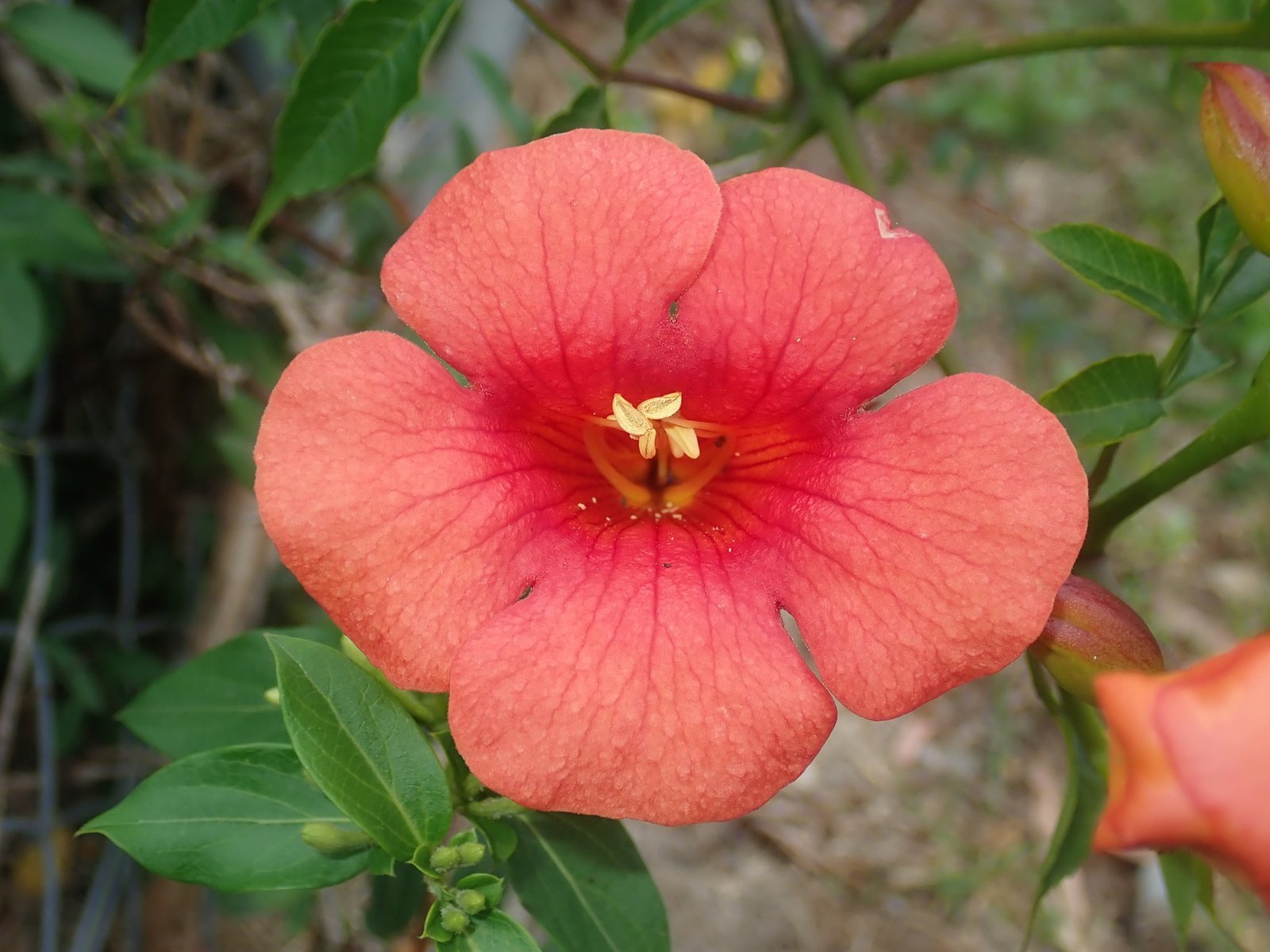
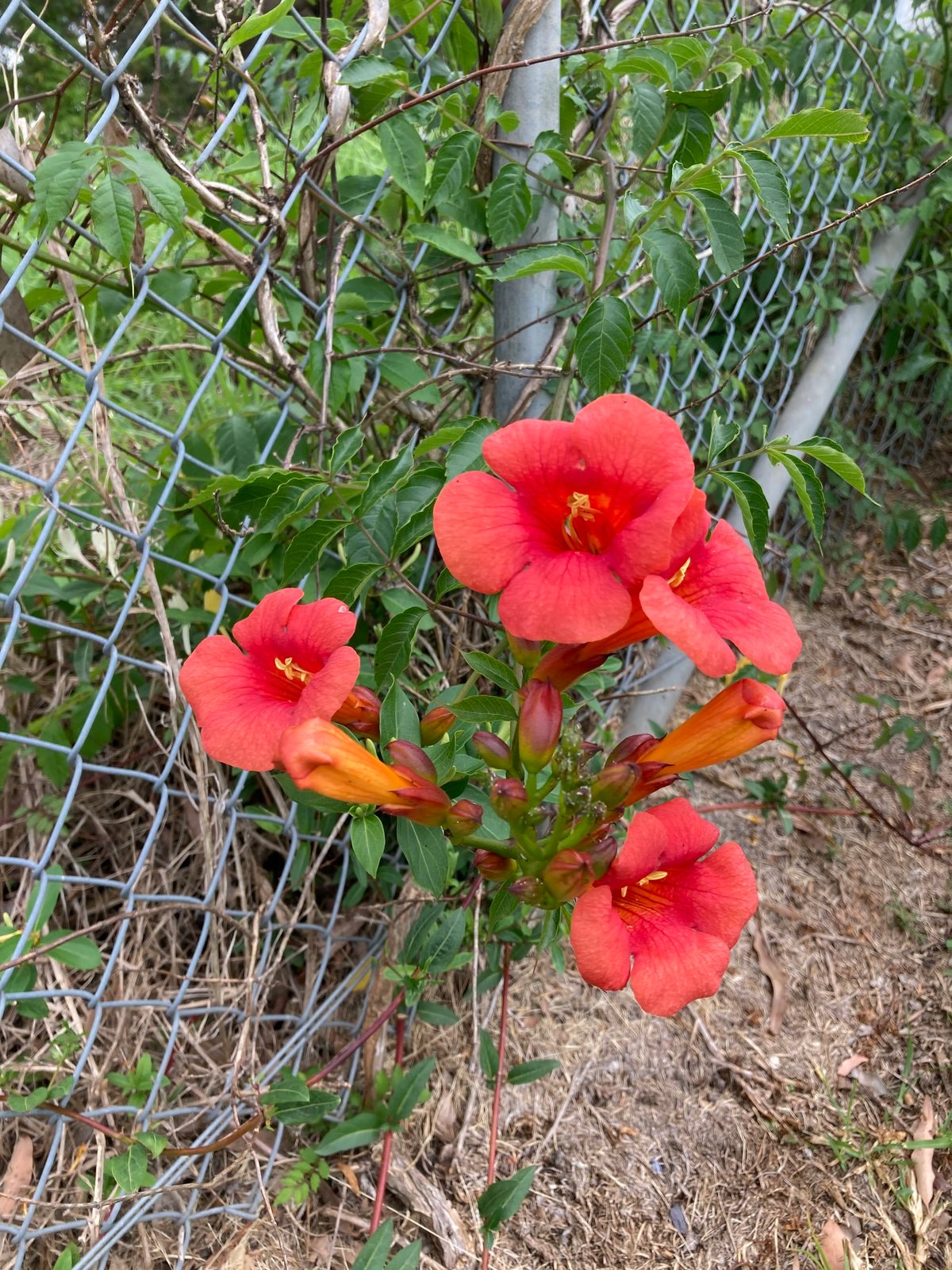
A vigorous deciduous climber grown for large, flared orange to orange-red trumpet flowers in summer. It needs a warm, sunny position and a strong support; it is less cold-hardy and less firmly self-clinging than American trumpet vine.
At a glance
- Sun
- Full sun; a sheltered, sun-warmed wall improves flowering in cool climates.
- Water
- Water regularly while establishing, then during prolonged dry spells. Avoid persistently wet roots.
- Soil
- Well-drained, moderately fertile soil; tolerates a range of soil textures and pH levels.
- Height
- 20-30 ft (6-9 m)
- Spread
- 6-10 ft (1.8-3 m), depending on training
- Flowers
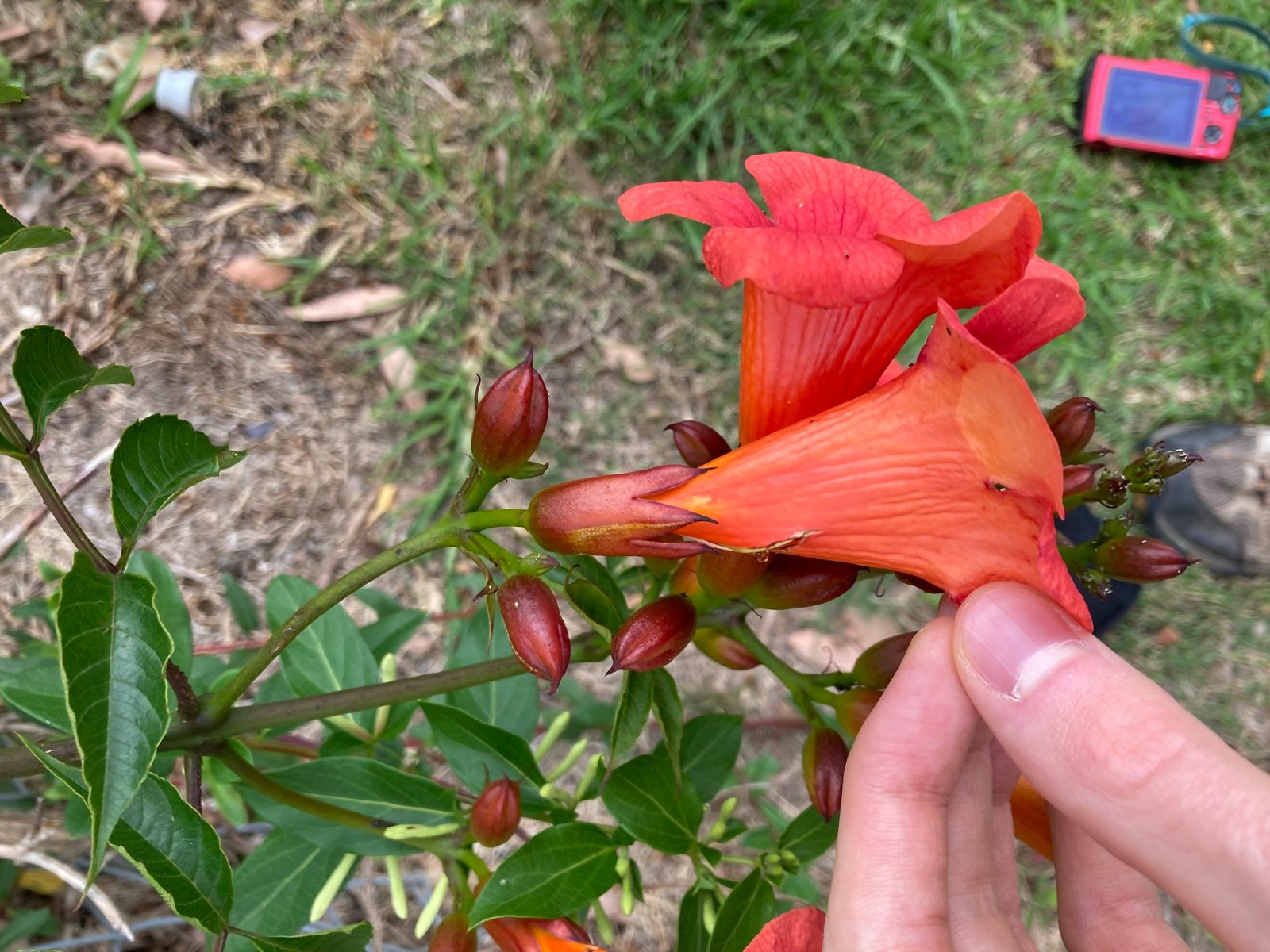
- Summer into early autumn; large orange to orange-red trumpets with yellowish throats.
- Foliage
- Opposite, pinnate leaves with toothed green leaflets; bare stems in winter.
- Growth
- Fast once established
- Care needed
- Medium
The year at a glance
- Pollinators
- Deer resistant
- Drought tolerant
- Heat tolerant
- Wildlife
- Low allergen
| J | F | M | A | M | J | J | A | S | O | N | D | |
|---|---|---|---|---|---|---|---|---|---|---|---|---|
| Flowers | ||||||||||||
| Fruit | ||||||||||||
| Plant |
Northern hemisphere months. In Australia, shift them by six.
- Difficulty
- Moderate
- Toughness
- Fairly tough
Will it suit your garden?
Pick your zone, country, light and whether you have pets.
Full sun is 6 or more hours of direct sun a day, part shade 3 to 6 hours, shade under 3.
How it grows
Planting day
2 ft (0.6 m)
After 1 year
3 ft (1.1 m)
After 2 years
5 ft (1.5 m)
After 3 years
6 ft (1.8 m)
full size
About 3 years to full size.
From a typical nursery size, at an average rate for this kind of plant. A rule of thumb, not a forecast.
Good to know
- Cats and dogs
- Safe
- Growth rate
- Fast
Care
Jobs through the year
- WaterApr–May, Sep–Oct, every 14 days
- Water established plants only if soil is dry; water more regularly for the first two years.
- WaterJun–Aug, every 7 days
- Check established plants and water deeply during prolonged drought; avoid saturated soil.
- PruneFeb–Mar
- Shorten last year's side shoots to two or three buds and remove dead or crowded wood.
- PruneMay–Sep, every 30 days
- Remove unwanted suckers and redirect shoots away from gutters and vulnerable masonry.
- MulchApr–May
- Mulch the root area without covering the main stems.
- ProtectJan–Mar, Nov–Dec
- Marginal in zone 6; use a warm sheltered wall and insulate young plants' root zones.
- ProtectApr–Sep, every 30 days
- Tie new growth to a substantial framework and loosen constricting ties.
- Provide a substantial trellis, pergola or wire framework, and tie in young stems.
- Water deeply during dry weather for the first two growing seasons.
- Mulch the root area in spring, keeping mulch clear of the main stems.
- Avoid high-nitrogen fertilisers, which encourage leafy growth at the expense of flowers.
- Remove unwanted root suckers promptly and keep shoots away from gutters, roofs and vulnerable masonry.
Pruning. In late winter or early spring, shorten the previous year's side shoots to two or three buds from a permanent framework; flowers develop on new growth. Remove dead, damaged and overcrowded stems, and tie retained shoots securely to the support.
Through the year
- Late winter
- Prune side shoots back to two or three buds and inspect the support.
- Spring
- Plant in a warm, sheltered position once the soil is workable and severe frost has passed.
- Late spring
- Mulch, water new plants and tie young shoots into the framework.
- Summer
- Water during prolonged drought and redirect shoots before they reach gutters or roof spaces.
- Early autumn
- Remove unwanted suckers and check ties for rubbing or constriction.
- Late autumn
- Protect the root area of young plants with mulch where winters approach its hardiness limit.
In the garden
- Train against a sunny brick or stone wall for summer colour and shelter from cold winds.
- Cover a substantial pergola with overhead foliage and hanging clusters of trumpet flowers.
- Use on a freestanding trellis behind a hot-coloured border of salvias, crocosmias and ornamental grasses.
- Train as a broad wall feature in a courtyard where its winter framework can remain visible.
Garden styles it suits: Chinese scholar garden, Modern courtyard, Mediterranean, Cottage garden, Hot border and Tropical.
Plant it with: Lavender, Catmint, Crocosmia, Salvia, Agapanthus and Feather reed grass.
Wildlife: The flowers attract nectar-feeding insects and, in North America, hummingbirds. Dense established growth can provide cover for small birds.
Problems to watch for
- Poor flowering: provide more sun and summer warmth, avoid high-nitrogen feed, and allow young plants time to establish.
- Aphids on soft shoots: wash off small colonies with water and encourage natural predators.
- Root rot in wet soil: improve drainage before planting and avoid frequent watering of established plants.
- Frost-damaged shoots: choose a sheltered site and cut back dead growth after new buds reveal the surviving wood.
Safety
Sap may irritate human skin, so wear gloves when pruning. Species-specific evidence of poisoning in cats, dogs and horses is limited; serious toxicity is not well established, but do not allow pets or children to chew the plant.
Easily confused with
American trumpet vine (Campsis radicans)
Usually has narrower, more tubular flowers, more abundant aerial attachment roots and hair beneath the leaves, especially along the veins.
Hybrid trumpet vine (Campsis × tagliabuana)
A hybrid of the Chinese and American species, with intermediate flower shape and climbing characteristics. Garden plants can be difficult to identify confidently without a reliable label.
The name
Campsis comes from a Greek word meaning bending, referring to the curved stamens, while grandiflora means large-flowered.
Propagation. Layer a low-growing stem in spring, or take semi-ripe cuttings in summer. Root cuttings can be taken during dormancy.
Checked against open data
- Accepted botanical name
- Campsis grandiflora
- Native range
- China North-Central, China Southeast and Japan.
- Measured
- Average height 450 cm.
Sources: GBIF (CC BY 4.0) and Trefle (CC BY 4.0). The care and design notes are LandscapeGPT's own.
See it in your own yard.
Upload a photo of your yard and see it redesigned with plants that suit your climate, each checked against your zone.