Clustered mountain mint
Pycnanthemum muticum. Family Lamiaceae. Perennial.
Also called Short-toothed mountain mint, Blunt mountain mint.
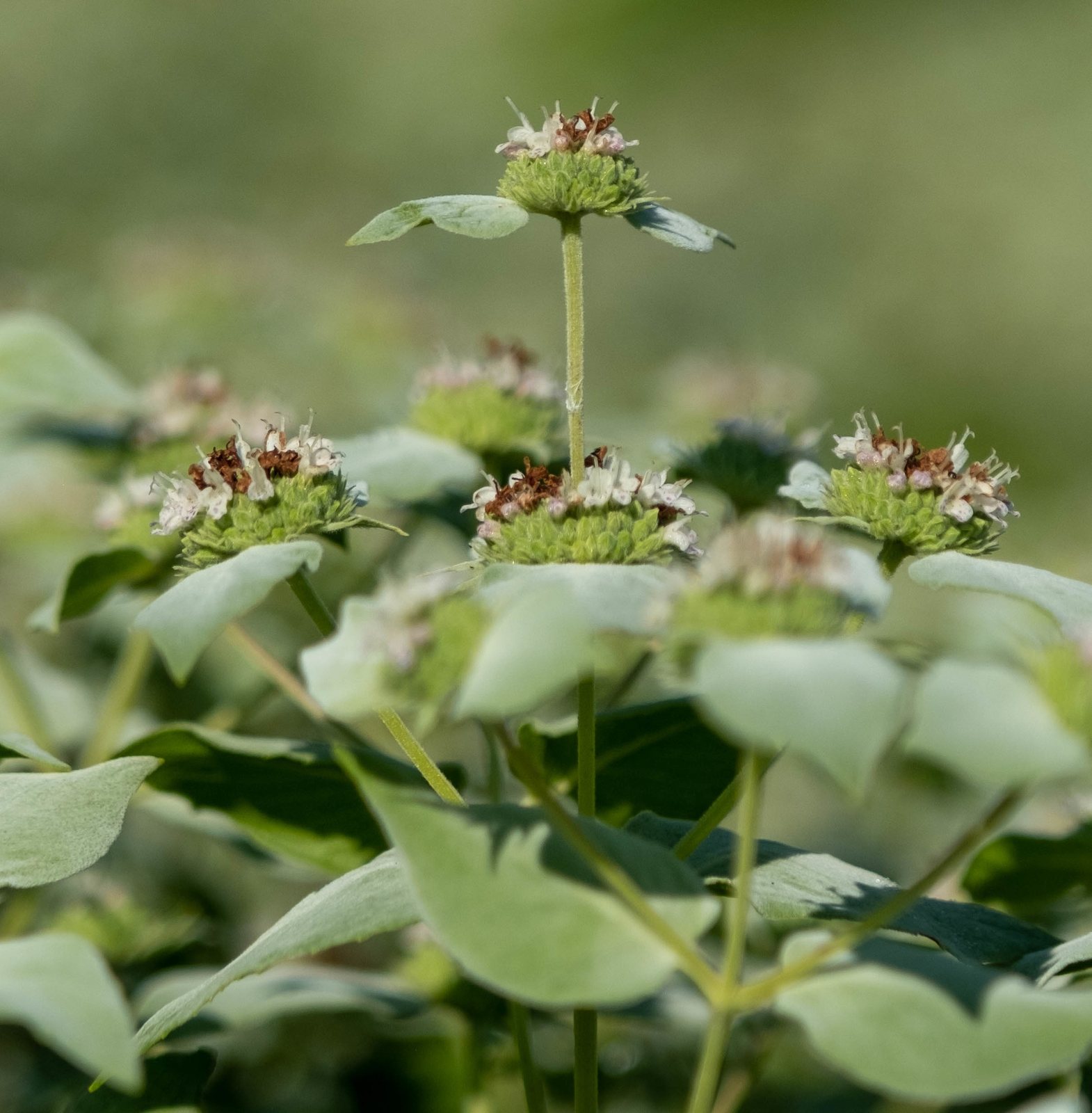
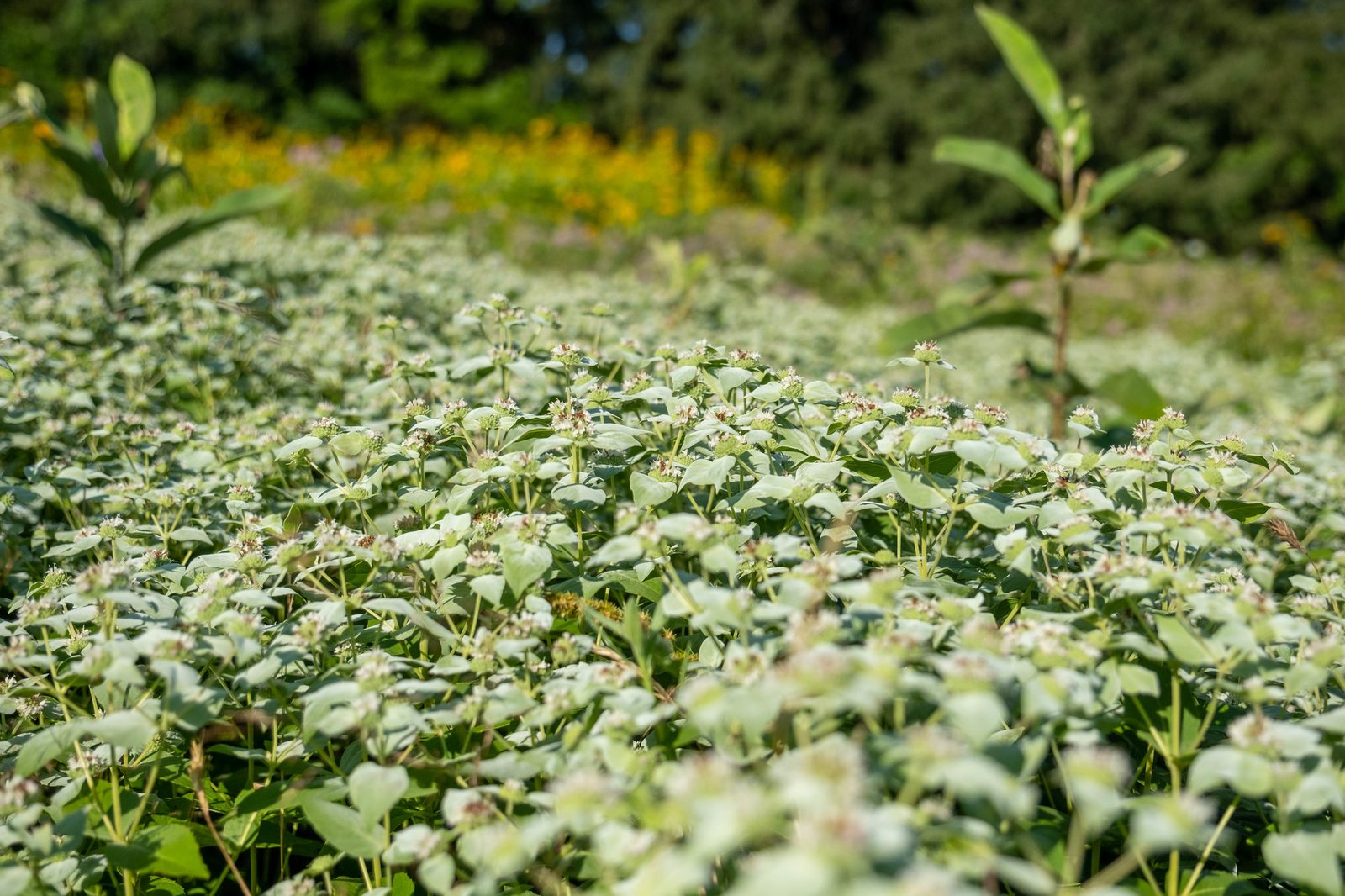
Clustered mountain mint is a spreading herbaceous perennial native to the eastern United States, grown for its silvery flower bracts, mint-scented leaves and exceptional attraction to pollinating insects. Its small summer flowers are understated, but the pale bracts make a lasting display among grasses and other perennials. Give it room to form a patch rather than placing it beside small, slow-growing plants.
At a glance
- Sun
- Full sun to partial shade; flowering and upright growth are best with at least 6 hours of sun.
- Water
- Moderate; keep evenly moist while establishing. Established plants tolerate short dry spells, but prolonged drought can scorch leaves and reduce flowering.
- Soil
- Average, well-drained soil that retains some moisture; tolerates clay if it is not persistently waterlogged.
- Height
- 2-3 ft (0.6-0.9 m)
- Spread
- 2-3 ft (0.6-0.9 m) initially, expanding farther through underground stems
- Flowers
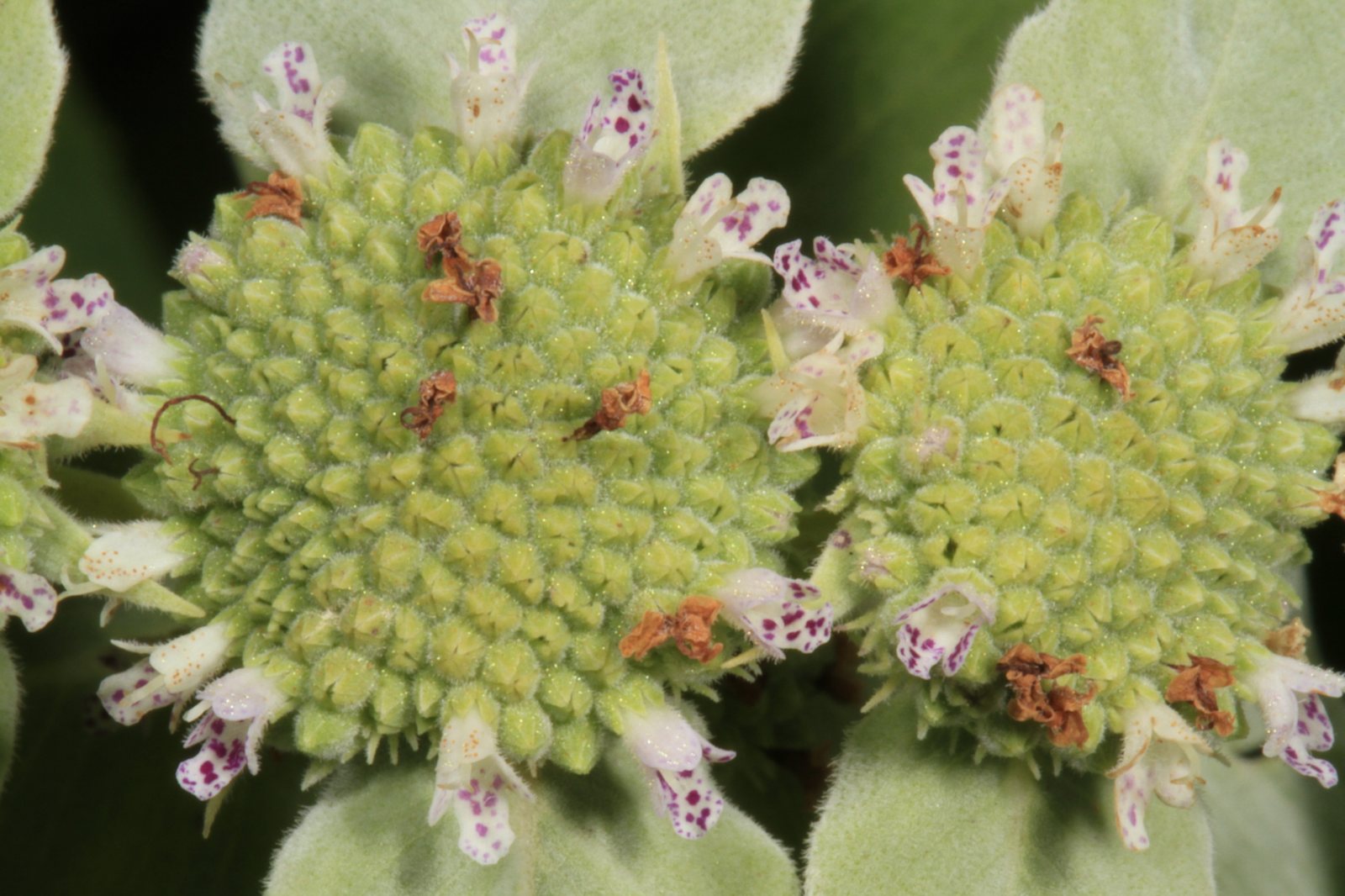
- Mid- to late summer; tiny white to pale pink flowers, often purple-spotted, in dense clusters surrounded by conspicuous silvery-white bracts.
- Foliage
- Opposite, broad, pointed green leaves with shallow teeth and a strong mint scent when crushed; upper leaves and bracts become silvery around flowering time.
- Growth
- Moderate to fast once established, forming an expanding colony.
- Care needed
- Low
The year at a glance
- Pollinators
- Deer resistant
- Cold hardy
- Wildlife
- Low allergen
- Fragrant
| J | F | M | A | M | J | J | A | S | O | N | D | |
|---|---|---|---|---|---|---|---|---|---|---|---|---|
| Flowers | ||||||||||||
| Fruit | ||||||||||||
| Plant |
Northern hemisphere months. In Australia, shift them by six.
- Difficulty
- Easy
- Toughness
- Very tough
Will it suit your garden?
Pick your zone, country, light and whether you have pets.
Full sun is 6 or more hours of direct sun a day, part shade 3 to 6 hours, shade under 3.
How it grows
Planting day
1 ft (0.3 m)
After 1 year
1.6 ft (0.49 m)
After 2 years
2.2 ft (0.68 m)
After 3 years
2.5 ft (0.75 m)
full size
About 2 years to full size.
From a typical nursery size, at an average rate for this kind of plant. A rule of thumb, not a forecast.
Good to know
- Cats and dogs
- Safe
- Native to
- the US
- In the garden
- Spreads vigorously: plan to contain it.
- Growth rate
- Fast
Care
Jobs through the year
- WaterApr–May, Sep–Oct, every 14 days
- Water established plants deeply if soil is drying; keep new plants evenly moist.
- WaterJun–Aug, every 7 days
- Water established plants during dry weather; new plants need more frequent moisture checks.
- FeedMar–Apr
- Apply a thin compost dressing; avoid rich feeding.
- MulchApr–May
- Apply a light organic mulch, keeping emerging shoots clear.
- PruneFeb–Mar
- Cut old stems to a few inches above ground; save some hollow stems for insects.
- PruneApr–May
- Dig out unwanted shoots with their connecting underground stems.
- DivideMar–Apr
- Divide congested or oversized clumps every three to four years.
- Water deeply during the first growing season whenever the soil begins to dry.
- Apply a thin layer of compost in spring; avoid heavy feeding, which encourages floppy growth.
- Mulch lightly to conserve moisture, keeping mulch away from emerging shoots.
- Remove unwanted shoots and their underground stems in spring to keep the patch within bounds.
- Divide congested or oversized clumps in spring every few years.
Pruning. Leave stems standing through winter where practical, then cut them to a few inches above the ground in late winter or early spring before new growth develops. Deadheading is optional and is not needed to prolong the silvery-bract display.
Through the year
- Late winter
- Cut down old stems before new shoots emerge; retain some hollow stems loosely in a sheltered corner for insects.
- Spring
- Plant or divide clumps, water them in thoroughly and apply a thin layer of compost.
- Late spring
- Lift wandering shoots with their underground stems to define the edge of the patch.
- Summer
- Water during prolonged dry weather, especially in the first year.
- Late summer
- Leave flowering stems intact for bees, butterflies and other flower-visiting insects.
- Autumn
- Leave seedheads and stems standing for winter structure where they remain upright.
In the garden
- Plant in generous drifts through a sunny pollinator border, where the silvery bracts link stronger flower colours.
- Combine with upright grasses and coneflowers in meadow-style planting for contrasting textures.
- Use at a sunny woodland edge with enough moisture and space for a loose colony.
- Place beside dark-leaved or purple-flowered perennials to make the pale bracts stand out.
Garden styles it suits: Native meadow, New perennial (prairie), Wildlife garden, Pollinator garden, Cottage garden and Sensory garden.
Plant it with: Purple coneflower, Black-eyed Susan, Little bluestem, Switchgrass, Blazing star and New England aster.
Wildlife: Flowers attract a wide range of native bees, honeybees, butterflies, hoverflies and beneficial wasps. The aromatic foliage is usually avoided by deer and rabbits, although browsing is still possible.
Problems to watch for
- Unwanted spread: underground stems can crowd neighbouring plants; lift out runners and divide the patch in spring.
- Floppy stems: excessive shade or rich feeding encourages weak growth; move to a sunnier position and stop fertilising.
- Leaf scorch or premature leaf drop in drought: water deeply and mulch lightly to reduce soil drying.
- Poor growth in waterlogged soil: improve drainage or move the plant to a site that does not stay saturated.
Safety
Not known to be toxic to people, cats, dogs or horses, but species-specific safety information is limited. Do not assume that the leaves or concentrated oils are safe to eat simply because they smell minty; it is best treated as an ornamental.
Where it spreads. Can spread aggressively by underground stems in moist, fertile garden beds, including within its native eastern United States range. This is chiefly a garden-containment issue; it is not widely recognised as a listed invasive species in the United States, United Kingdom, Canada or Australia.
Easily confused with
Hoary mountain mint (Pycnanthemum incanum)
Usually has longer, more obviously toothed leaves with conspicuously pale, hairy undersides; clustered mountain mint has broader, shorter-toothed leaves and a more compact look.
Virginia mountain mint (Pycnanthemum virginianum)
Has much narrower, lance-shaped leaves and lacks the broad, showy silvery bracts characteristic of clustered mountain mint.
Narrowleaf mountain mint (Pycnanthemum tenuifolium)
Has very slender, almost threadlike leaves, giving the whole plant a finer texture than clustered mountain mint.
The name
Pycnanthemum comes from Greek words meaning 'dense flower', referring to the clustered flower heads, while muticum means blunt or without a sharp point.
Propagation. Divide established clumps in spring, keeping roots and shoots on each piece. Root softwood cuttings in late spring or early summer; seed is another option, but seedlings may vary where related mountain mints grow nearby.
Checked against open data
- Accepted botanical name
- Pycnanthemum muticum
- In the US and Canada
- Native in the lower 48 states.
- Native range
- Alabama, Arkansas, Connecticut, Delaware, District of Columbia, Florida, Georgia, Illinois, Kentucky, Maryland, Masachusettes and Michigan.
Sources: GBIF (CC BY 4.0), USDA PLANTS and Trefle (CC BY 4.0). The care and design notes are LandscapeGPT's own.
See it in your own yard.
Upload a photo of your yard and see it redesigned with plants that suit your climate, each checked against your zone.