Coast banksia
Banksia integrifolia. Family Proteaceae. Tree.
Also called Coastal banksia, White honeysuckle.
Coast banksia is an evergreen Australian tree grown for its pale yellow flower spikes, silver-backed leaves and tolerance of coastal wind and salt spray. It suits spacious gardens in mild climates, where its nectar-rich flowers provide food for birds through the cooler months.
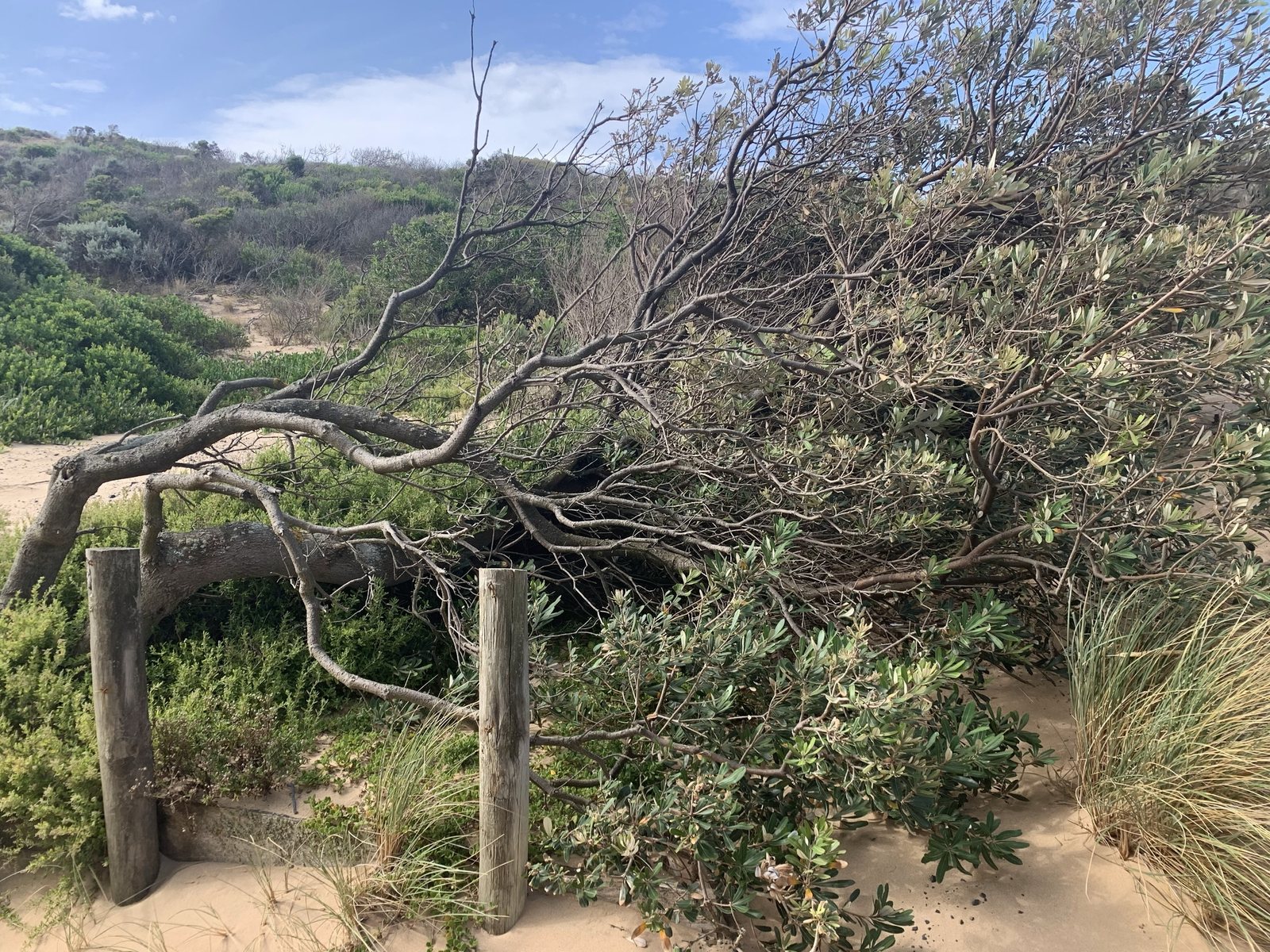
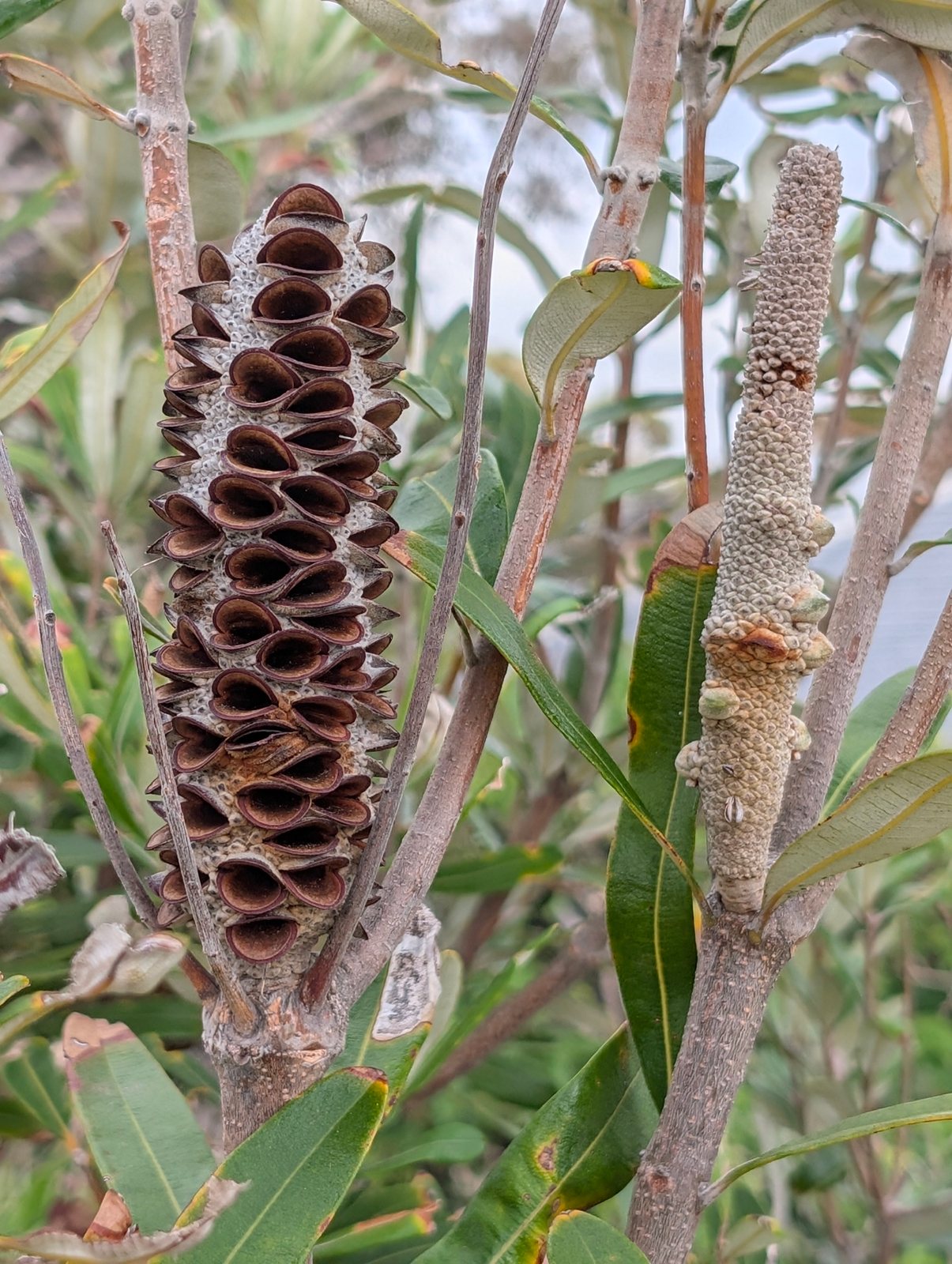
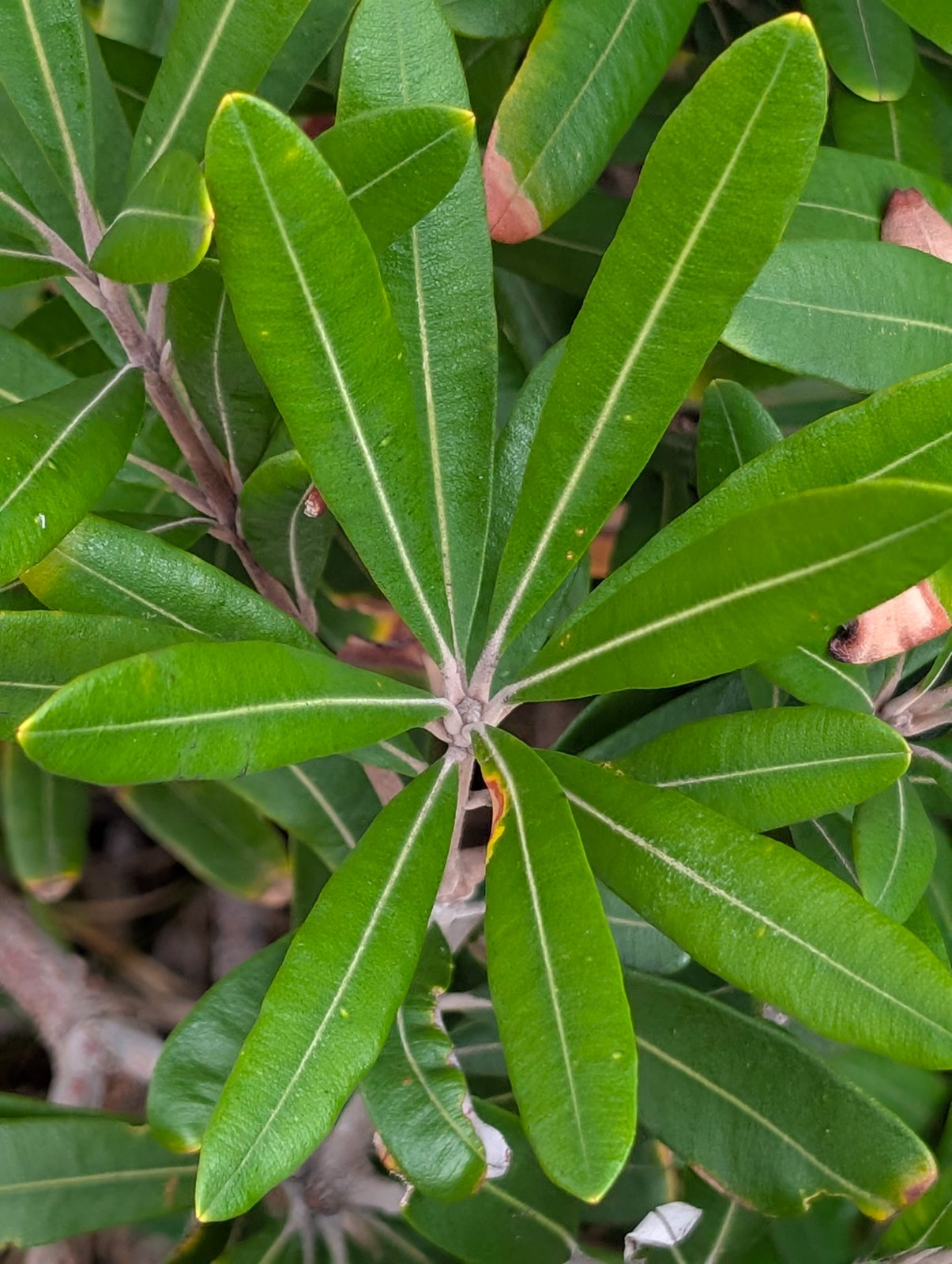
At a glance
- Sun
- Full sun; tolerates light shade but flowers less freely.
- Water
- Water regularly while establishing. Once established, it tolerates dry spells, although occasional deep watering helps during prolonged drought.
- Soil
- Well-drained sandy or loamy soil, preferably acidic to neutral; tolerates mildly alkaline coastal soils. Avoid waterlogged ground and phosphorus-rich fertilizers.
- Height
- 30-60 ft (9-18 m)
- Spread
- 15-30 ft (4.5-9 m)
- Flowers
- Pale yellow cylindrical flower spikes, mainly from autumn through spring; scattered flowers may appear at other times.
- Foliage
- Evergreen. Leathery, narrow green leaves with conspicuously white undersides. Adult leaves usually have smooth edges; young growth can have toothed edges.
- Growth
- Moderate to fast in suitable conditions.
- Care needed
- Low
The year at a glance
- Pollinators
- Drought tolerant
- Heat tolerant
- Wildlife
- Low allergen
| J | F | M | A | M | J | J | A | S | O | N | D | |
|---|---|---|---|---|---|---|---|---|---|---|---|---|
| Flowers | ||||||||||||
| Fruit | ||||||||||||
| Plant |
Northern hemisphere months. In Australia, shift them by six.
- Difficulty
- Hard
- Toughness
- Needs looking after
Will it suit your garden?
Pick your zone, country, light and whether you have pets.
Full sun is 6 or more hours of direct sun a day, part shade 3 to 6 hours, shade under 3.
How it grows
Planting day
7 ft (2 m)
After 1 year
9 ft (2.7 m)
After 2 years
11 ft (3.4 m)
After 3 years
14 ft (4.2 m)
After 5 years
18 ft (5.6 m)
About 16 years to full size.
From a typical nursery size, at an average rate for this kind of plant. A rule of thumb, not a forecast.
Good to know
- Cats and dogs
- Safe
- Native to
- Australia
- Growth rate
- Fast
Care
Jobs through the year
- WaterApr–May, Sep–Oct, every 21 days
- For established ground trees in mild sites, water only if dry; water more during the first two summers.
- WaterJun–Aug, every 14 days
- Water established ground trees deeply in prolonged drought; young trees and containers need more.
- WaterJan–Mar, Nov–Dec, every 14 days
- Water sheltered containers only as the mix dries, keeping drainage unobstructed.
- FeedApr–May
- Usually leave unfed; use low-phosphorus native-plant fertiliser only for poor growth.
- MulchMay, Nov
- Refresh coarse organic mulch over the root zone, clear of the trunk.
- PruneMay–Jun
- Lightly shape young trees after flowering; avoid heavy cuts into leafless wood.
- ProtectJan–Apr, Oct–Dec
- Not hardy outdoors in zones 6–7; container specimens require large, bright, frost-free winter shelter.
- Water deeply during dry weather for the first two summers, allowing the surface soil to dry between waterings.
- Apply a broad layer of coarse organic mulch, keeping it clear of the trunk.
- Usually leave established trees unfed; if growth is poor, use a low-phosphorus fertilizer labelled for Australian native plants.
- Choose a freely draining site rather than trying to improve persistently wet ground with a small amended planting hole.
- Protect young trees from hard frost; stake only if necessary and remove supports once the roots hold the tree securely.
Pruning. Lightly prune young trees after the main flowering flush to encourage branching and establish a sound framework. Remove dead or crossing branches as needed, and avoid heavy cutting into old, leafless wood.
Through the year
- Spring
- Plant in frost-prone districts once hard frosts have passed, and water the root ball thoroughly.
- Late spring
- Lightly shape young trees after their main flowering flush.
- Summer
- Check young trees during dry spells and water deeply when the root zone begins to dry.
- Autumn
- Plant in mild, frost-free districts while the soil is warm and seasonal rain is returning.
- Late autumn
- Refresh mulch without piling it against the trunk, and check that winter rain can drain away.
- Winter
- Protect recently planted trees during forecast hard frosts and leave flower spikes for visiting birds.
In the garden
- Use as a specimen tree where wind can reveal the silver leaf undersides.
- Plant in a loose coastal shelter belt with coastal rosemary and mat rush.
- Combine with kangaroo paws and native grasses in a sunny Australian-native garden.
- Use as the upper layer of a wildlife garden, allowing room for its mature canopy.
Garden styles it suits: Coastal, Australian native, Wildlife garden, Low-maintenance, Architectural minimal and Mediterranean.
Plant it with: Coastal rosemary, Spiny-headed mat rush, Kangaroo paw and Coastal tussock grass.
Wildlife: Flowers feed nectar-eating birds, including honeyeaters in Australia, as well as bees and other insects. Mature trees provide shelter, and cockatoos may open the woody seed-bearing cones.
Problems to watch for
- Root rot in wet soil: improve drainage before planting, avoid frequent shallow watering and do not plant where water stands after rain.
- Phosphorus toxicity, causing leaf damage and poor growth: stop high-phosphorus feeding and avoid manure-rich planting mixes and bone meal.
- Yellow leaves on strongly alkaline soil: check soil pH and drainage; use an appropriate iron treatment if deficiency is confirmed, but choose a better site if symptoms persist.
- Frost damage to young growth: protect small trees with horticultural fleece and wait until spring growth begins before removing damaged shoots.
Safety
Not known to be toxic to people, cats, dogs or horses, although species-specific poisoning information is limited. No part is established as poisonous; the hard cones and woody material can still cause injury or digestive trouble if chewed or swallowed.
Where it spreads. Can self-seed beyond gardens and is an environmental weed in parts of New Zealand, including coastal areas of the North Island, and parts of southwestern Western Australia outside its native range. Check local guidance before planting near dunes or native vegetation.
Easily confused with
Old man banksia (Banksia serrata)
Has broader leaves with strongly saw-toothed edges even when mature, and develops thick, rough, corky bark.
Silver banksia (Banksia marginata)
Usually has much smaller, shorter leaves, often with a blunt or notched tip; coast banksia has longer leaves commonly arranged in conspicuous whorls.
Swamp banksia (Banksia robur)
Has very broad, heavily veined leaves with toothed edges and flower spikes that open greenish-blue before turning yellow-brown.
The name
Banksia honours botanist Sir Joseph Banks, while integrifolia means whole-leaved, referring to the usually smooth edges of the adult leaves.
Propagation. Raise from seed sown in a freely draining seed mix; smoke treatment is not normally required. Semi-ripe cuttings are possible but less reliable than seed.
Checked against open data
- Accepted botanical name
- Banksia integrifolia
- Native range
- New South Wales, Queensland, South Australia and Victoria.
- Measured
- Average height 550 cm.
Sources: GBIF (CC BY 4.0) and Trefle (CC BY 4.0). The care and design notes are LandscapeGPT's own.
See it in your own yard.
Upload a photo of your yard and see it redesigned with plants that suit your climate, each checked against your zone.