Common daisy
Bellis perennis. Family Asteraceae. Perennial.
Also called English daisy, Lawn daisy.
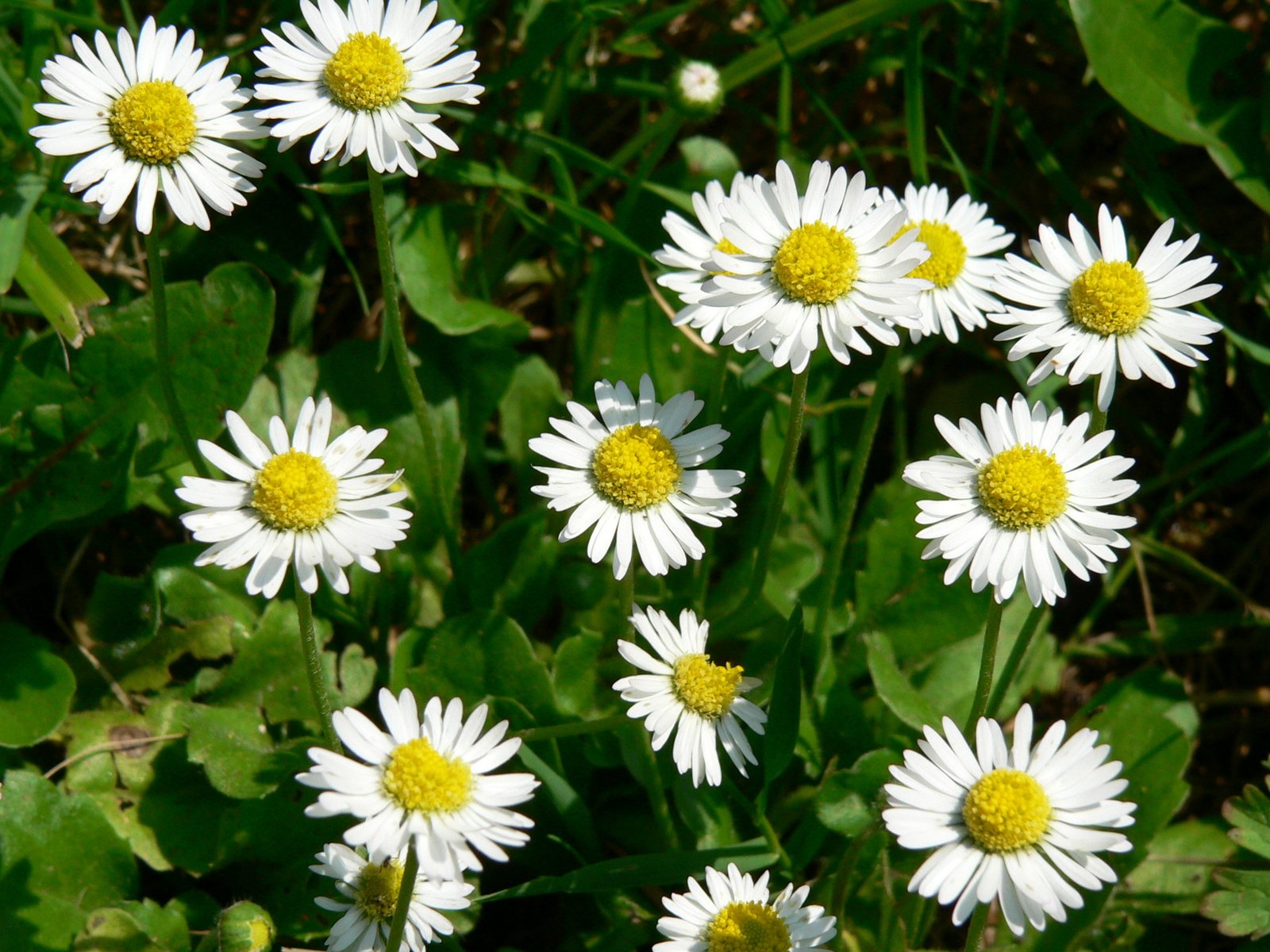
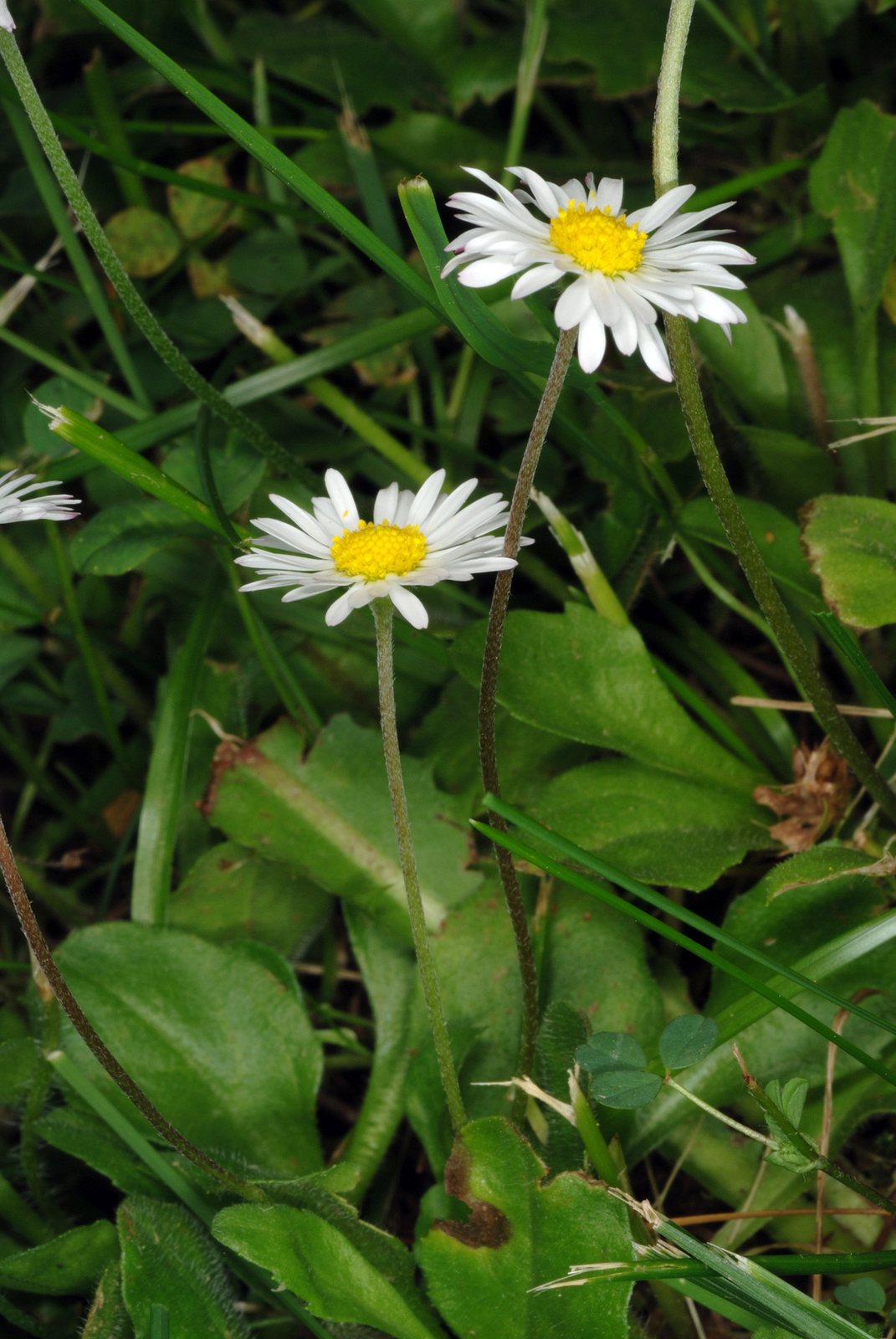
Bellis perennis is a low, rosette-forming perennial with small white daisies, often pink beneath, surrounding yellow centres. Gardeners grow it in flowering lawns, along path edges and as cool-season bedding; cultivated forms also have pink, red or double flowers. It prefers cool weather and may be short-lived in hot summers.
At a glance
- Sun
- Full sun to partial shade; afternoon shade helps where summers are hot.
- Water
- Moderate; keep the soil evenly moist while establishing, then water during prolonged dry spells.
- Soil
- Moist, well-drained soil; tolerates clay and a broad pH range, but dislikes prolonged waterlogging.
- Height
- 0.25-0.5 ft (0.08-0.15 m)
- Spread
- 0.5-0.75 ft (0.15-0.23 m), with colonies spreading farther through seed and short creeping stems
- Flowers
- Mainly spring to early summer, with scattered flowers in mild weather; white with yellow centres in the species, often flushed pink. Bedding cultivars may be pink, red or white.
- Foliage
- Evergreen. Low rosettes of green, spoon-shaped leaves with slightly toothed edges.
- Growth
- Moderate
- Care needed
- Low
The year at a glance
- Pollinators
- Cold hardy
- Low allergen
| J | F | M | A | M | J | J | A | S | O | N | D | |
|---|---|---|---|---|---|---|---|---|---|---|---|---|
| Flowers | ||||||||||||
| Plant |
Northern hemisphere months. In Australia, shift them by six.
- Difficulty
- Easy
- Toughness
- Fairly tough
Will it suit your garden?
Pick your zone, country, light and whether you have pets.
Full sun is 6 or more hours of direct sun a day, part shade 3 to 6 hours, shade under 3.
How it grows
Planting day
0.4 ft (0.12 m)
full size
About 3 years to full size.
From a typical nursery size, at an average rate for this kind of plant. A rule of thumb, not a forecast.
Good to know
- Cats and dogs
- Mildly toxic: may upset a stomach
- Native to
- the UK
- In the garden
- Spreads vigorously: plan to contain it.
- Growth rate
- Moderate
Care
Jobs through the year
- WaterMar–May, Sep–Oct, every 14 days
- Water established plants during prolonged dry spells; keep new plants evenly moist.
- WaterJun–Aug, every 7 days
- Water when soil dries during rainless weather, especially in summer heat.
- MulchMar
- Apply a light compost dressing without covering central rosettes.
- PruneMar
- Trim away dead or damaged leaves without hard pruning.
- DivideMar–Apr, Sep
- Divide crowded clumps and replant promptly into moist soil.
- DeadheadMar–Jun, every 7 days
- Remove faded flower stems at the base to prolong bloom and limit seedlings.
- ProtectJan–Feb, Nov–Dec
- Clear wet leaf litter from rosettes to reduce smothering and crown rot.
- Water new plants regularly until rooted, and established plants when the soil becomes dry during prolonged rainless weather.
- Avoid heavy feeding; a light spring dressing of compost is usually enough.
- Keep mulch away from the central rosettes to reduce crown rot.
- Divide crowded clumps in spring or early autumn and replant promptly.
- Remove spent flowers before seed ripens if you want to limit spread.
- In a flowering lawn, leave longer intervals between mowing so flowers can open.
Pruning. Remove faded flower stems at the base to prolong the display and reduce self-seeding. Trim away dead or damaged leaves in early spring; no hard pruning is needed.
Through the year
- Early spring
- Remove damaged leaves, divide crowded clumps and apply a light dressing of compost.
- Spring
- Plant young plants and water regularly while their roots establish.
- Late spring
- Deadhead bedding plants, or delay mowing flowering lawns to leave flowers for insects.
- Summer
- Water during extended dry spells and remove unwanted seedlings before they establish.
- Late summer
- Sow seed for plants to flower the following spring; keep the seed surface moist.
- Early autumn
- Plant out young rosettes or divide established clumps while the soil remains warm.
- Winter
- Keep pots draining freely and clear wet leaf litter from the crowns.
In the garden
- Allow single-flowered plants through a lightly used lawn for a low, informal spring display.
- Edge cottage-garden paths with small clumps beside forget-me-nots and primroses.
- Use compact bedding forms in cool-season containers with violas and small spring bulbs.
- Plant beneath tulips or daffodils to cover bare soil without hiding the bulbs.
Garden styles it suits: Cottage garden, English country, Traditional, Wildflower, Pollinator garden and Pastel border.
Plant it with: Primroses, Forget-me-nots, Violas, Grape hyacinths, Daffodils and Tulips.
Wildlife: Single flowers provide accessible pollen and nectar for small bees, hoverflies and other insects. Very double bedding forms offer much less accessible food.
Problems to watch for
- Slugs and snails can damage young leaves and flowers; check plants after dark, remove pests and reduce nearby damp hiding places.
- Powdery mildew can coat crowded leaves; improve spacing, water at soil level and remove badly affected foliage.
- Crown or root rot develops in waterlogged soil; improve drainage and keep soil or mulch off the crowns.
- Hot, dry summers can stop flowering or kill plants; provide afternoon shade and moisture, or replace short-lived bedding plants in autumn.
Safety
Not known to cause serious poisoning in people, cats, dogs or horses, but it should not be treated as pet food. Eating plant material may cause stomach upset, and handling it can cause dermatitis in people sensitive to the daisy family.
Where it spreads. Can spread persistently through lawns and borders by seed and short creeping stems, including within its native UK range. It is naturalised and can become a troublesome lawn or pasture weed in temperate North America, including the Pacific Northwest and parts of Canada, and in southeastern Australia, including Victoria and Tasmania.
Easily confused with
Oxeye daisy (Leucanthemum vulgare)
Much taller, with larger flowers and leafy upright stems; common daisy carries small flowers on short, leafless stalks above basal rosettes.
Mexican fleabane (Erigeron karvinskianus)
Forms a loose, branching mound with narrow leaves and many fine-rayed flowers that age pink; common daisy has compact spoon-leaved rosettes.
Lawn chamomile (Chamaemelum nobile)
Has finely divided, aromatic foliage rather than broad spoon-shaped leaves, and its flowers develop more prominent yellow centres.
The name
Bellis comes from the Latin for beautiful, perennis means perennial, and daisy derives from 'day's eye', referring to the flowers opening in daylight.
Propagation. Sow seed on the surface of moist seed compost in spring or late summer and press it in lightly. Divide established clumps in spring or early autumn; seedlings of named bedding cultivars may not match the parent.
Checked against open data
- Accepted botanical name
- Bellis perennis
- In the US and Canada
- Introduced in Alaska, Canada, Hawaii and the lower 48 states.
- Native range
- Albania, Austria, Baleares, Baltic States, Belarus, Belgium, Bulgaria, Central European Rus, Corse, Cyprus, Czechoslovakia and Denmark.
- Measured
- Soil pH 5.5 to 6.5. Average height 7 cm.
Sources: GBIF (CC BY 4.0), USDA PLANTS and Trefle (CC BY 4.0). The care and design notes are LandscapeGPT's own.
See it in your own yard.
Upload a photo of your yard and see it redesigned with plants that suit your climate, each checked against your zone.