Common tussock grass
Poa labillardierei. Family Poaceae. Ornamental grass.
Also called Tussock grass, Silver tussock grass.
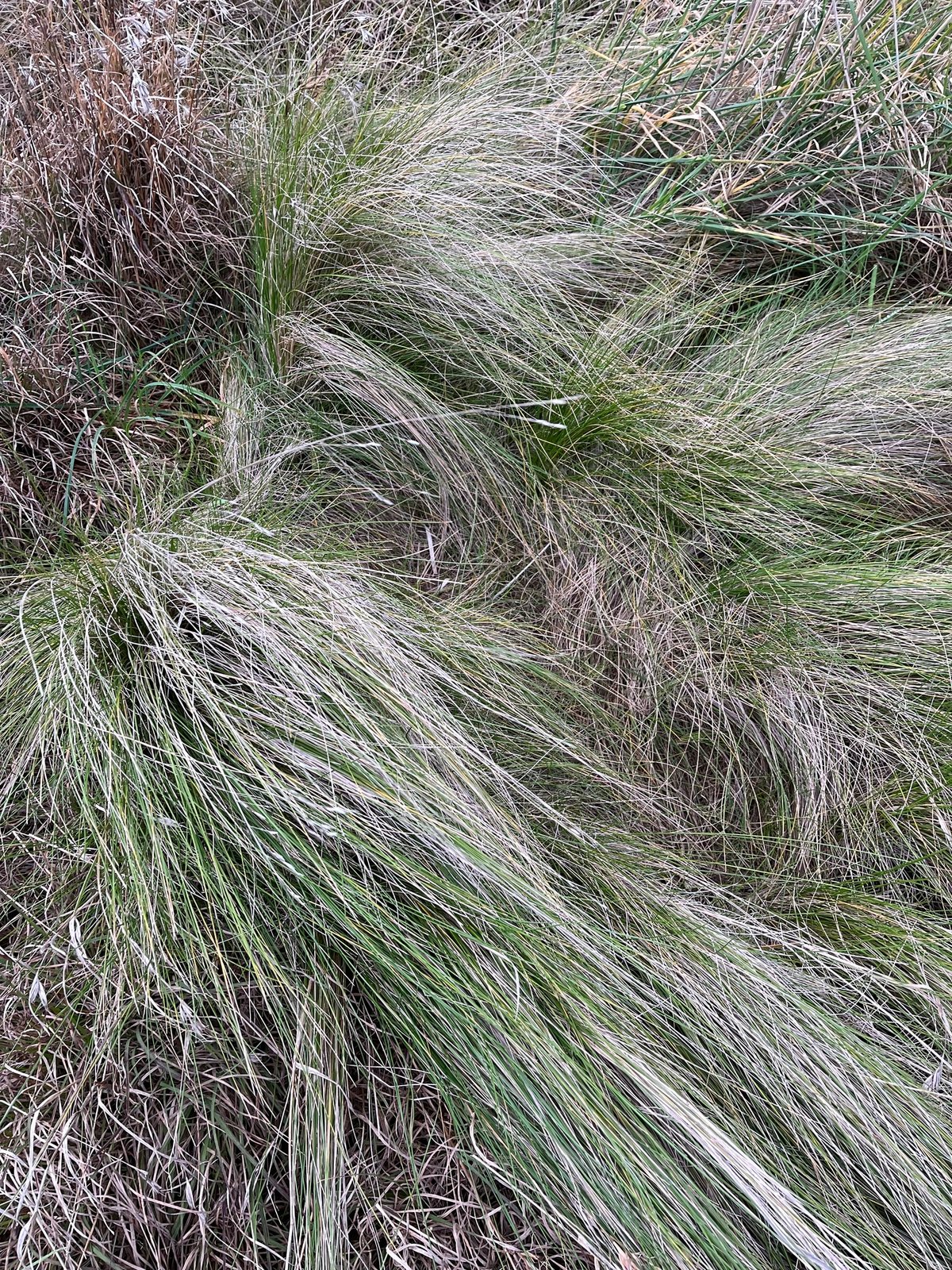
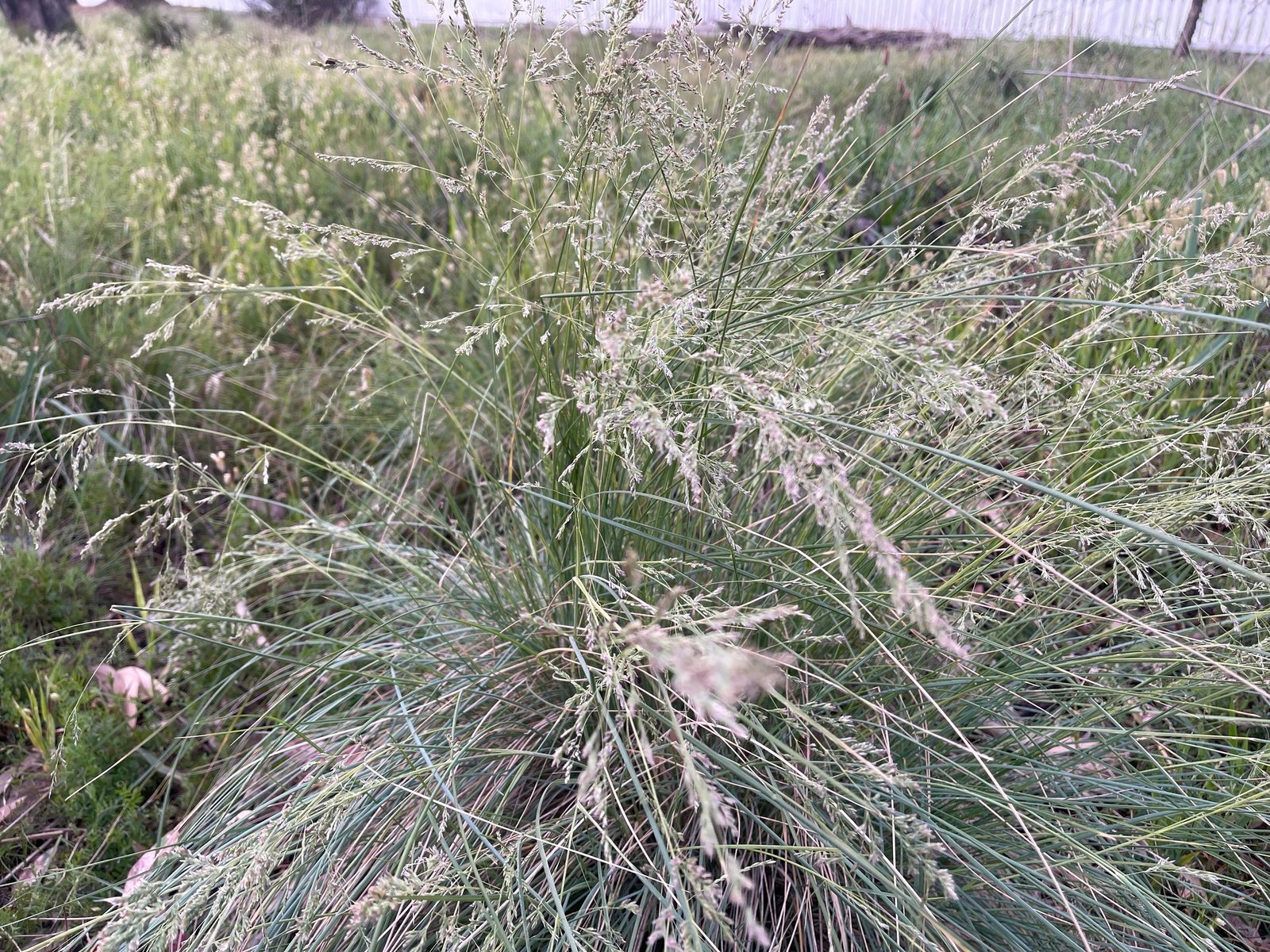
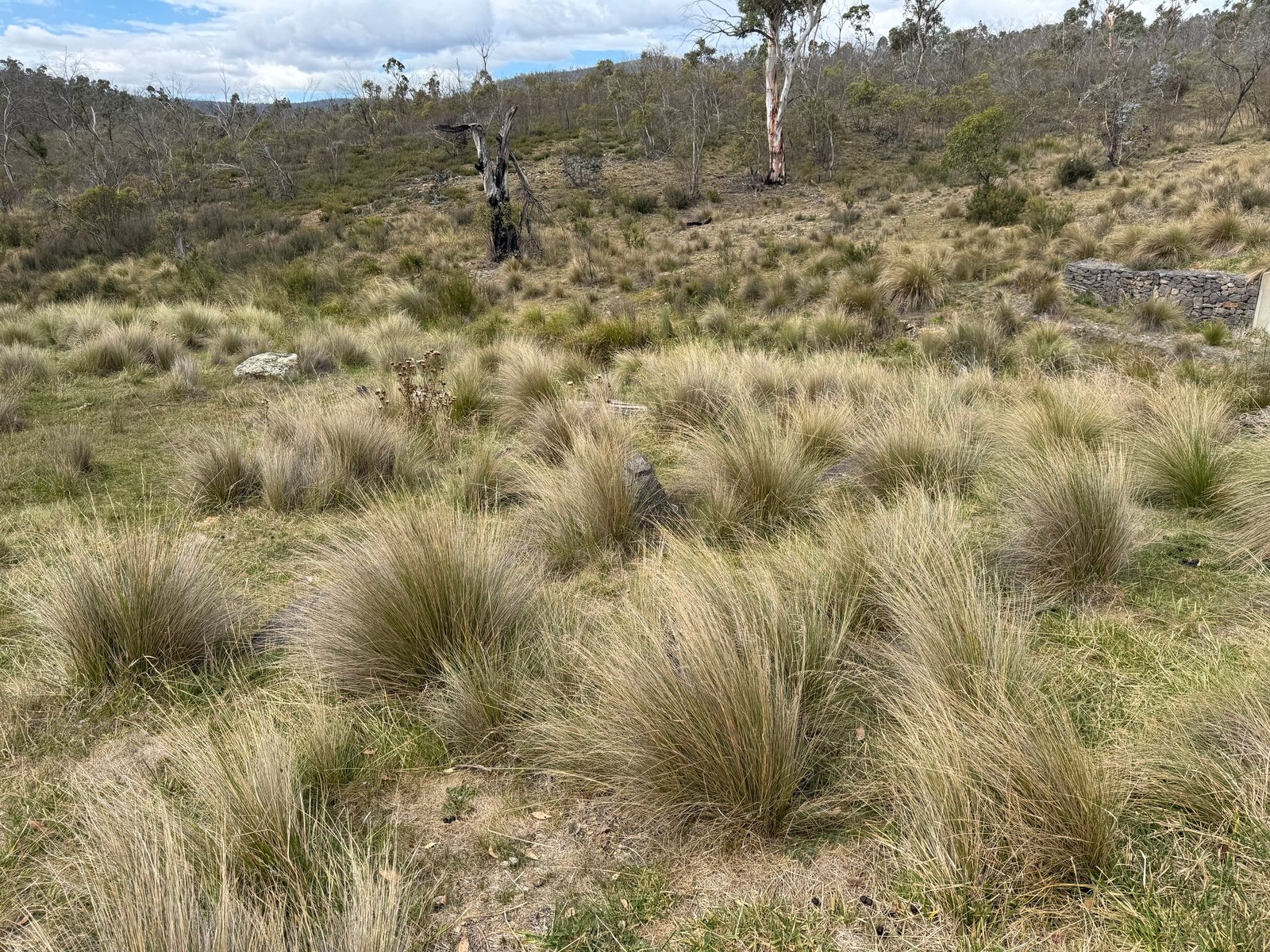
Poa labillardierei is an Australian perennial grass forming large, arching tussocks beneath loose sprays of summer flowers. Gardeners grow it for its flowing texture, year-round foliage and usefulness in naturalistic borders and mass plantings.
At a glance
- Sun
- Full sun to partial shade; clumps are usually denser in sun.
- Water
- Water regularly during establishment. Established plants tolerate dry spells, but occasional deep watering keeps them looking better during prolonged drought.
- Soil
- Adaptable to sandy, loamy or clay soils with reasonable drainage; tolerates seasonal moisture but not persistently stagnant, waterlogged ground.
- Height
- 3-4 ft (0.9-1.2 m), including flower stems
- Spread
- 2-3 ft (0.6-0.9 m)
- Flowers
- Late spring through summer; airy green to purplish-brown flower panicles fade to straw-coloured seedheads.
- Foliage
- Evergreen. Long, narrow, arching leaves, green to grey-green, with older straw-coloured leaves collecting around the base.
- Growth
- Moderate to fast
- Care needed
- Low
The year at a glance
- Deer resistant
- Drought tolerant
- Heat tolerant
- Wildlife
| J | F | M | A | M | J | J | A | S | O | N | D | |
|---|---|---|---|---|---|---|---|---|---|---|---|---|
| Flowers | ||||||||||||
| Fruit | ||||||||||||
| Plant |
Northern hemisphere months. In Australia, shift them by six.
- Difficulty
- Moderate
- Toughness
- Fairly tough
Will it suit your garden?
Pick your zone, country, light and whether you have pets.
Full sun is 6 or more hours of direct sun a day, part shade 3 to 6 hours, shade under 3.
How it grows
Planting day
1.1 ft (0.35 m)
After 1 year
2.3 ft (0.7 m)
After 2 years
3 ft (1.1 m)
full size
About 2 years to full size.
From a typical nursery size, at an average rate for this kind of plant. A rule of thumb, not a forecast.
Good to know
- Cats and dogs
- Safe
- Native to
- Australia
- Growth rate
- Fast
Care
Jobs through the year
- WaterApr–May, Sep–Oct, every 21 days
- Water established tussocks only during extended dry weather; new plants need more frequent watering.
- WaterJun–Aug, every 14 days
- Deep-water during prolonged drought, especially if leaves are drying extensively.
- PruneMar–Apr
- Comb out dead leaves and old stems; cut to 15–20 cm only when renovation is needed.
- DivideApr–May
- Divide congested or hollow-centred clumps and replant vigorous outer sections.
- MulchMay
- Lightly mulch new plants, keeping material away from crowns.
- DeadheadJul–Sep
- Remove seed heads before shedding only if seedlings are unwanted.
- ProtectJan–Apr, Oct–Dec
- Not reliably hardy in zones 6–7; overwinter container plants in a bright, frost-free place.
- Water deeply through the first growing season, allowing the soil surface to dry between waterings.
- Leave enough space for the mature tussock rather than crowding it against paths or smaller plants.
- Use little or no fertiliser; rich feeding can produce loose, floppy growth.
- Apply a light mulch around new plants, keeping it clear of the crown.
- Divide congested or hollow-centred clumps in spring and water the divisions until established.
Pruning. In late winter or early spring, comb or rake out dead leaves and remove old flower stems. If a clump needs complete renewal, cut it to about 6-8 in (15-20 cm) above ground as new growth begins, rather than shearing it repeatedly.
Through the year
- Spring
- Plant or divide clumps once the soil is workable; water thoroughly.
- Late spring
- Check moisture around new plants and remove weeds before the tussocks fill out.
- Summer
- Deep-water during prolonged drought if leaves are drying extensively.
- Autumn
- Leave sound foliage and seedheads for structure, or remove seedheads before seed drops if seedlings are unwanted.
- Late winter
- Remove accumulated dead foliage; renovate untidy clumps as spring growth starts.
In the garden
- Plant in broad drifts beneath open-canopied trees for a soft, grassy understorey.
- Repeat clumps through perennial borders to link flowering plants with a consistent texture.
- Use on banks and broad slopes where established roots help hold surface soil.
- Set beside rocks, gravel or simple paving to contrast arching leaves with firm edges.
Garden styles it suits: Australian native, Native meadow, New perennial (prairie), Coastal, Low-maintenance and Modern rustic.
Plant it with: Flax lily, Lomandra, Billy buttons and Yarrow.
Wildlife: Dense tussocks shelter insects and other small animals, and seed-eating birds may visit the seedheads. The flowers are wind-pollinated rather than a nectar source for bees.
Problems to watch for
- Crown rot in stagnant, waterlogged soil: improve drainage or move the plant to a better-drained position.
- Floppy growth in deep shade or heavily fertilised soil: provide more light and stop unnecessary feeding.
- A dead or hollow centre in an old tussock: divide it in spring, keeping vigorous outer sections.
- Unwanted seedlings in open soil: remove flower stems before seeds ripen and pull seedlings while small.
Safety
Not known to be toxic to cats, dogs, horses or people; no part is recognised as poisonous. Dry grass material can still cause mechanical irritation if chewed or lodged in sensitive tissues.
Easily confused with
Blue tussock grass (Poa sieberiana)
Usually forms smaller tussocks with finer, more bristle-like, often blue-grey leaves. Common tussock grass generally makes a larger, more arching mound; flowering material may be needed for certain identification.
Coast tussock grass (Poa poiformis)
Often has a stiffer, more upright habit and blue-green foliage, particularly in exposed coastal settings. The species overlap in appearance, so leaf colour alone is not a reliable distinction.
The name
Poa comes from the Greek word for grass, while labillardierei honours the French botanist Jacques-Julien Houtou de Labillardière.
Propagation. Divide established clumps in spring, retaining rooted sections with healthy shoots. Alternatively, sow seed in spring in a well-drained seed compost and keep evenly moist; seedlings may differ in size and foliage colour.
Checked against open data
- Accepted botanical name
- Poa labillardierei
- Native range
- New South Wales, Queensland, South Australia, Tasmania and Victoria.
- Measured
- Average height 69 cm.
Sources: GBIF (CC BY 4.0) and Trefle (CC BY 4.0). The care and design notes are LandscapeGPT's own.
See it in your own yard.
Upload a photo of your yard and see it redesigned with plants that suit your climate, each checked against your zone.