Cusick's camas
Camassia cusickii. Family Asparagaceae. Bulb.
Also called Cusick's camassia, Wild hyacinth.
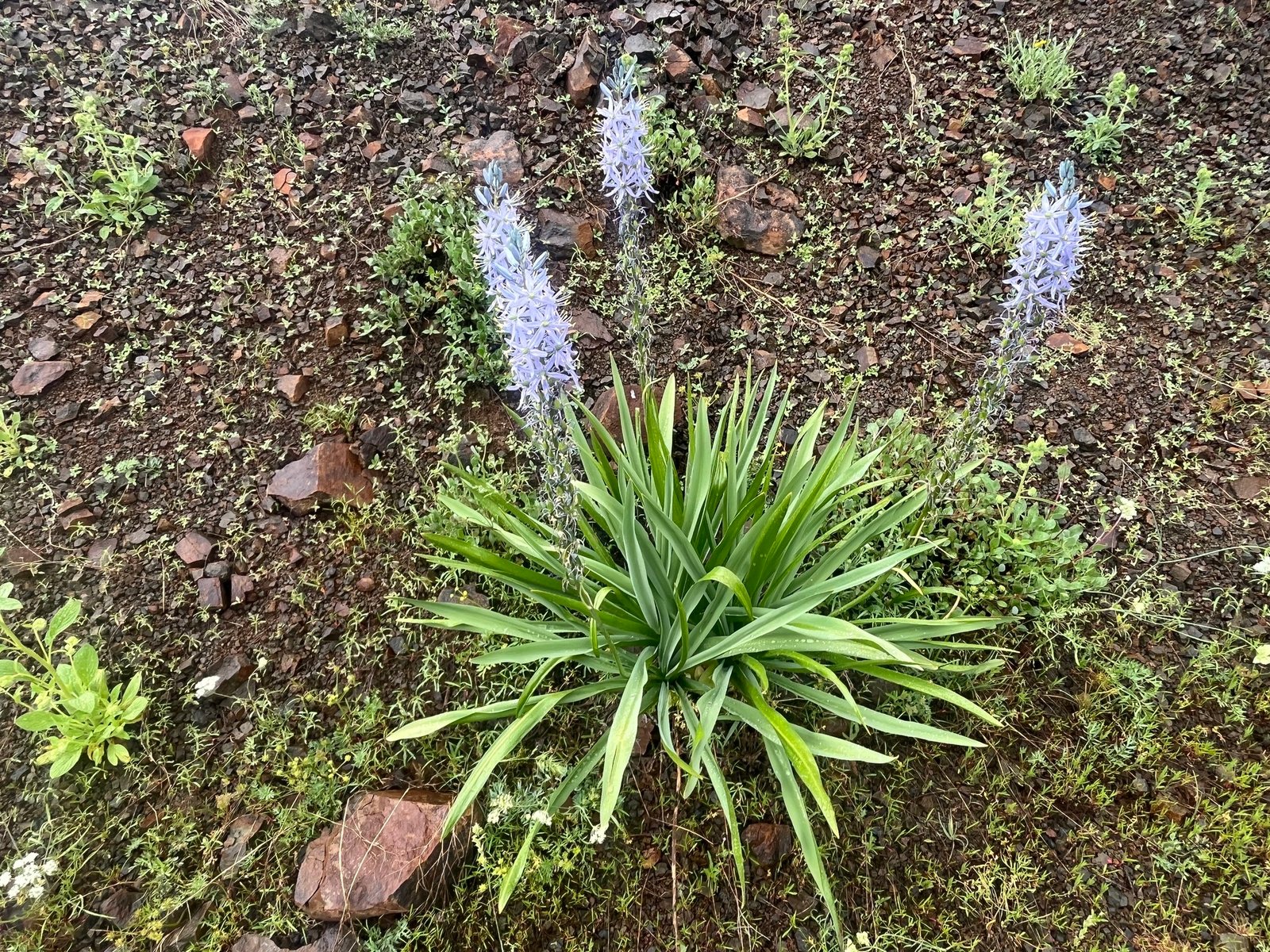
Cusick's camas is a hardy bulb from the northwestern United States, grown for tall spikes of pale blue, star-shaped flowers in late spring. It suits borders and meadow-style planting where the soil stays moist during spring growth, then becomes drier as the leaves die back in summer.
At a glance
- Sun
- Full sun or partial shade; flowering is best with plenty of spring light.
- Water
- Keep the soil moist during spring growth and flowering. Reduce watering once the leaves yellow; avoid waterlogged soil, especially during summer dormancy.
- Soil
- Fertile, humus-rich soil that retains spring moisture but drains freely. Tolerates clay if it does not remain waterlogged.
- Height
- 2-3 ft (0.6-0.9 m)
- Spread
- 1-2 ft (0.3-0.6 m) per established clump
- Flowers
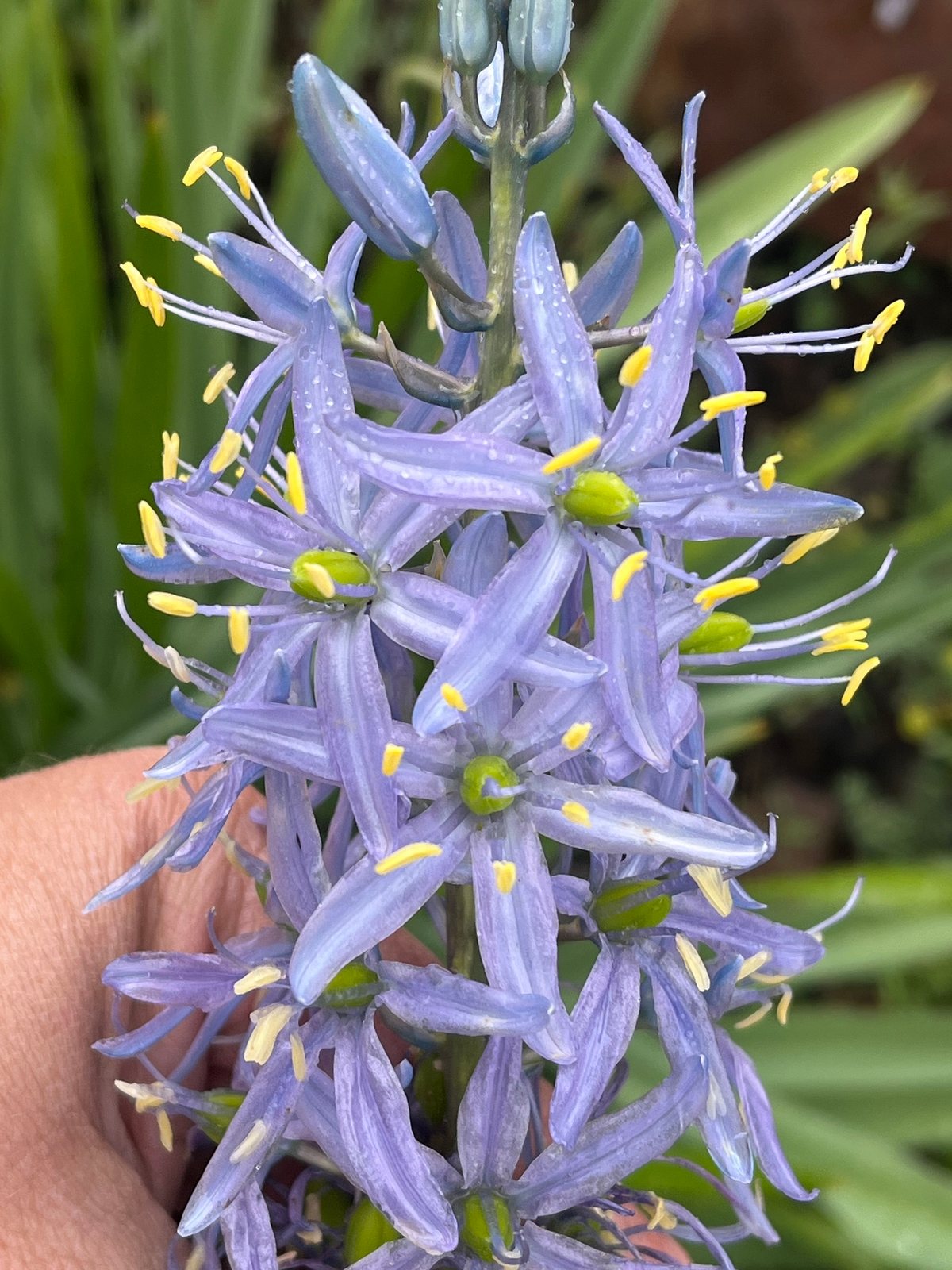
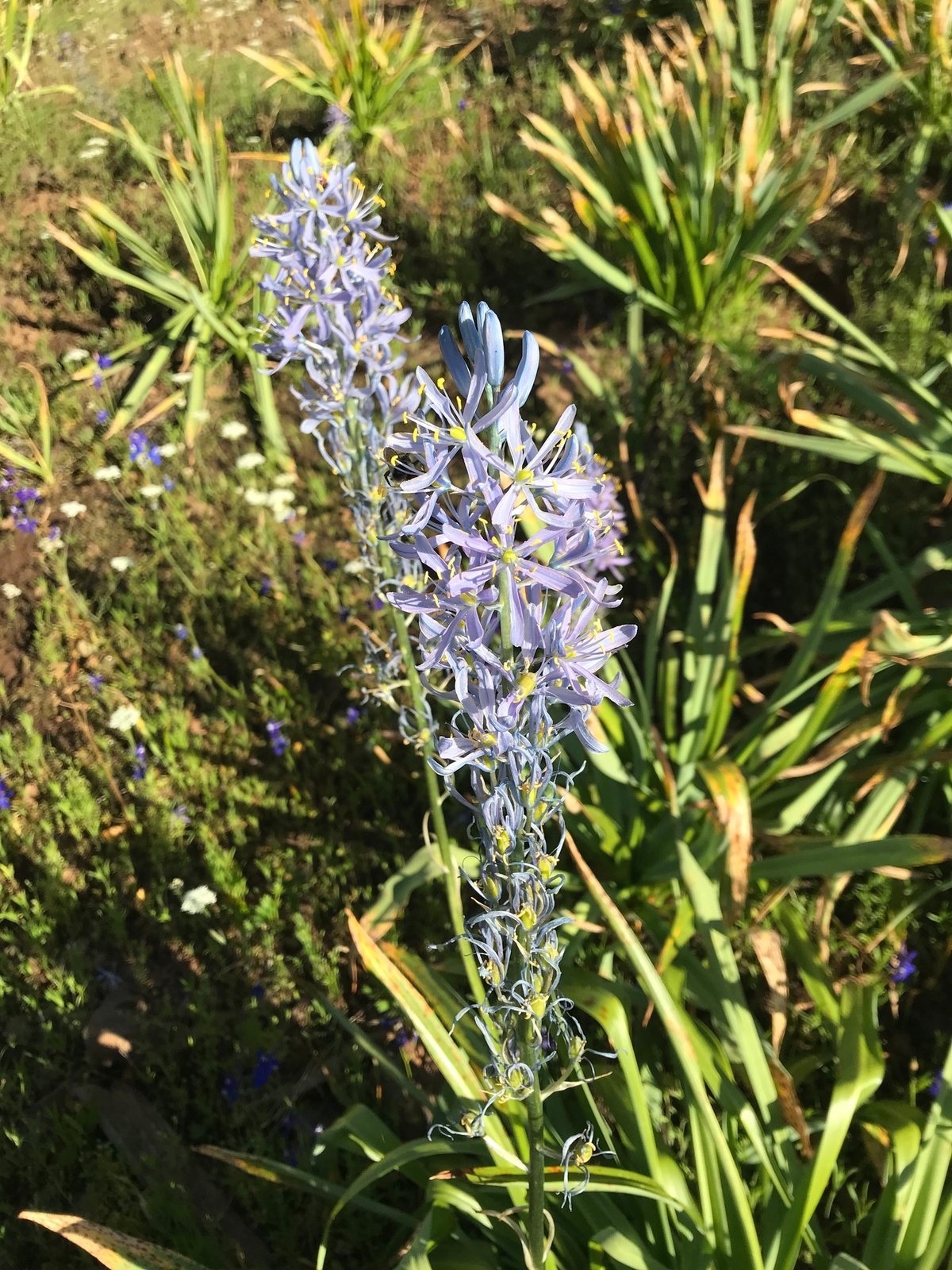
- Late spring to early summer; pale powder-blue, star-shaped flowers open progressively up upright spikes.
- Foliage
- Broad, strap-shaped, blue-green leaves emerge in spring and yellow and disappear after flowering.
- Growth
- Moderate; clumps enlarge gradually through bulb offsets.
- Care needed
- Low
The year at a glance
- Pollinators
- Deer resistant
- Cold hardy
- Low allergen
| J | F | M | A | M | J | J | A | S | O | N | D | |
|---|---|---|---|---|---|---|---|---|---|---|---|---|
| Flowers | ||||||||||||
| Fruit | ||||||||||||
| Plant |
Northern hemisphere months. In Australia, shift them by six.
- Difficulty
- Easy
- Toughness
- Very tough
Will it suit your garden?
Pick your zone, country, light and whether you have pets.
Full sun is 6 or more hours of direct sun a day, part shade 3 to 6 hours, shade under 3.
How it grows
Planting day
0.5 ft (0.15 m)
After 1 year
2.5 ft (0.75 m)
full size
About 1 years to full size.
From a typical nursery size, at an average rate for this kind of plant. A rule of thumb, not a forecast.
Good to know
- Cats and dogs
- Safe
- Native to
- the US
- Growth rate
- Moderate
Care
Jobs through the year
- WaterMar–Apr, every 14 days
- Water established clumps during dry spells, keeping spring soil moist but not saturated.
- WaterMay–Jun, every 7 days
- Water if rainfall is insufficient while leaves are green; reduce and stop as they yellow.
- MulchMar
- Top-dress around emerging shoots with a thin layer of garden compost.
- ProtectMar–Apr, every 7 days
- Inspect emerging leaves for slugs and snails and remove pests.
- DeadheadJun
- Remove faded spikes unless seed heads or self-sowing are wanted.
- PruneJul
- Clear foliage or mow surrounding grass only after leaves have fully withered.
- DivideAug–Sep
- Lift congested clumps during dormancy and replant bulbs immediately.
- Plant bulbs in autumn about 4-6 in (10-15 cm) deep and 6-8 in (15-20 cm) apart.
- Water during dry spring weather while leaves and flower stems are growing.
- Apply a thin layer of garden compost around emerging shoots in spring; rich soil needs little additional feeding.
- Allow the foliage to yellow naturally, and avoid routine summer watering after it dies back.
- Divide crowded clumps during summer dormancy, replanting the bulbs promptly.
Pruning. Remove spent flower stems after flowering if you do not want seedlings. Leave all green foliage intact, then remove it once it has yellowed and withered.
Through the year
- Autumn
- Plant bulbs in groups in moisture-retentive, well-drained soil.
- Early spring
- Apply a light compost dressing and check emerging shoots for slug damage.
- Spring
- Water during prolonged dry spells while the plants are actively growing.
- Late spring
- Enjoy the flowers; remove faded spikes unless you want seed.
- Summer
- Let the leaves die back before clearing them or mowing surrounding grass.
- Late summer
- Lift and divide congested clumps while dormant, then replant immediately.
In the garden
- Plant in repeated groups through a mixed border for pale blue vertical accents before summer perennials reach full height.
- Naturalise in meadow grass that can remain uncut until the camas foliage has died back.
- Use at the sunny edge of deciduous trees, where bulbs receive spring light before the canopy closes.
- Pair with later-growing perennials to conceal yellowing foliage and fill the summer gap.
Garden styles it suits: Cottage garden, English country, Wildflower, New perennial (prairie), Blues and silvers and Pacific Northwest woodland.
Plant it with: Hardy geraniums, Lady's mantle, Peonies, Siberian irises, Daffodils and Astrantias.
Wildlife: The flowers provide pollen and nectar for bees and other visiting insects.
Problems to watch for
- Slugs and snails can damage emerging leaves: check young shoots during damp weather and use wildlife-conscious slug controls where necessary.
- Bulb rot in waterlogged soil: improve drainage or move bulbs to a site without standing winter or summer water.
- Poor flowering in deep shade or overcrowded clumps: move to a brighter position and divide during dormancy.
- Reduced flowering after early mowing or leaf removal: leave foliage intact until it has completely yellowed.
Safety
Not known to be toxic to people, cats, dogs or horses, although species-specific animal safety information is limited. Do not treat the bulbs as food: edible camas can be confused with highly poisonous death camas, and this species is grown as an ornamental.
Easily confused with
Common camas (Camassia quamash)
Usually shorter, with narrower leaves and deeper blue flowers; Cusick's camas typically has broader, blue-green foliage and paler blue blooms.
Large camas (Camassia leichtlinii)
Often taller, with more evenly symmetrical flowers. Its spent flower segments characteristically twist together over the developing fruit; those of Cusick's camas do not.
Meadow death camas (Toxicoscordion venenosum)
Has cream to greenish-white flowers rather than pale blue ones. Leaves and bulbs alone are not safe identification features; death camas is highly poisonous.
The name
Camassia comes from a North American Indigenous name for camas, and cusickii honours the American botanist William Cusick.
Propagation. Separate bulb offsets from established clumps during summer dormancy and replant promptly. Seed can be sown fresh in an outdoor pot and exposed to winter cold; seedlings take several years to flower.
Checked against open data
- Accepted botanical name
- Camassia cusickii
- In the US and Canada
- Native in the lower 48 states.
- Native range
- Idaho and Oregon.
Sources: GBIF (CC BY 4.0), USDA PLANTS and Trefle (CC BY 4.0). The care and design notes are LandscapeGPT's own.
See it in your own yard.
Upload a photo of your yard and see it redesigned with plants that suit your climate, each checked against your zone.