Darwin's barberry
Berberis darwinii. Family Berberidaceae. Shrub.
Also called Darwin barberry.
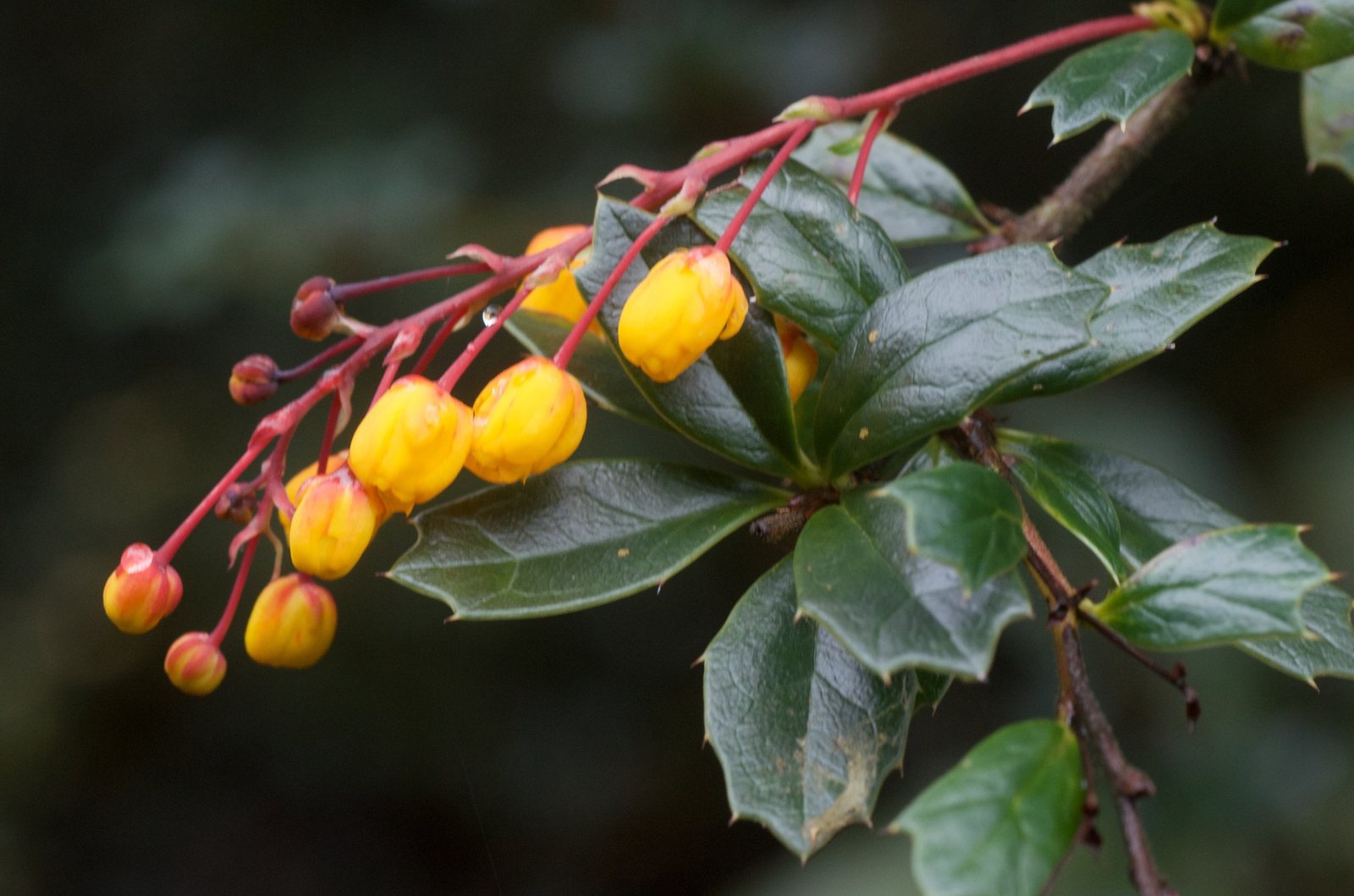
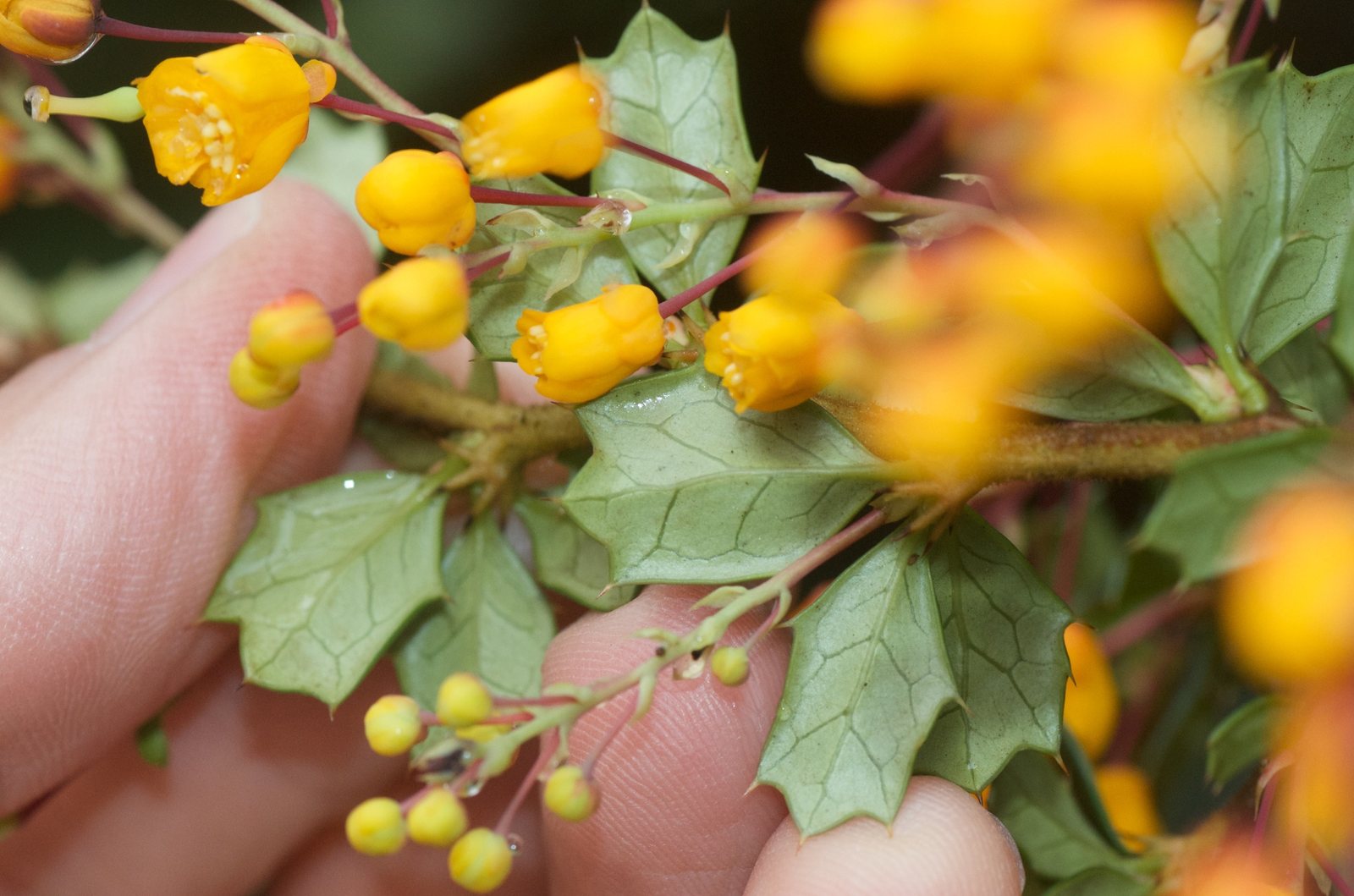
Darwin's barberry is a dense, spiny evergreen shrub with small, glossy leaves and clusters of orange flowers in spring, followed by blue-black berries. Gardeners grow it for informal hedges, screening and early flowers, but its bird-spread seeds make it unsuitable where it is invasive.
At a glance
- Sun
- Full sun to partial shade; flowering is usually strongest in sun.
- Water
- Water regularly while establishing; established plants tolerate short dry spells but grow best with some moisture during prolonged drought.
- Soil
- Well-drained soil, from mildly acidic to alkaline; tolerates clay if it does not remain waterlogged.
- Height
- 6-10 ft (1.8-3 m)
- Spread
- 6-10 ft (1.8-3 m)
- Flowers
- Golden-orange to deep orange flower clusters in spring, usually March-May in the Northern Hemisphere and August-October in the Southern Hemisphere.
- Foliage
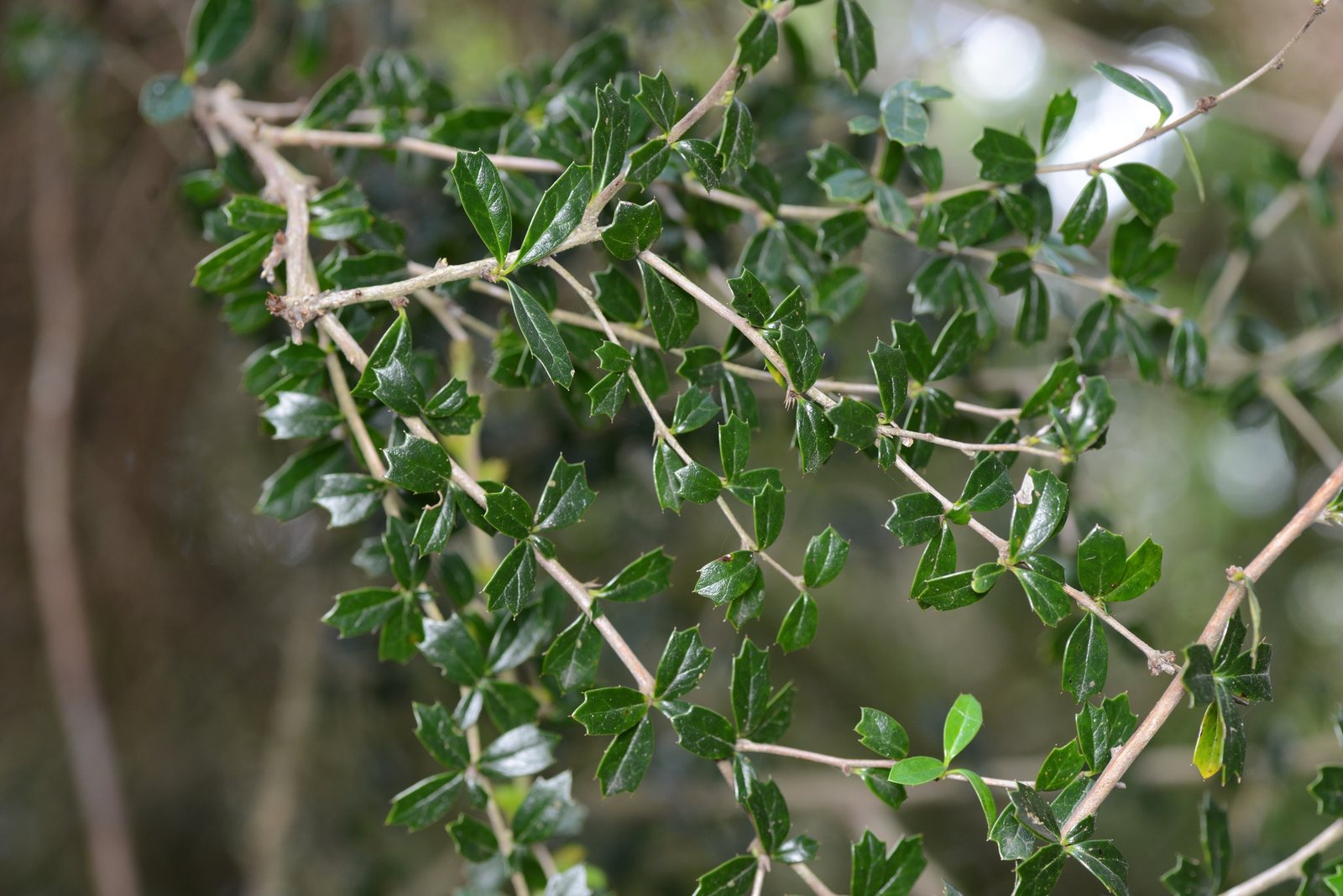
- Evergreen. Small, glossy, dark green leaves with sharp, holly-like teeth; dense branching and spiny stems.
- Growth
- Moderate
- Care needed
- Low
The year at a glance
- Pollinators
- Deer resistant
- Drought tolerant
- Heat tolerant
- Wildlife
- Low allergen
| J | F | M | A | M | J | J | A | S | O | N | D | |
|---|---|---|---|---|---|---|---|---|---|---|---|---|
| Flowers | ||||||||||||
| Fruit | ||||||||||||
| Plant |
Northern hemisphere months. In Australia, shift them by six.
- Difficulty
- Easy
- Toughness
- Very tough
Will it suit your garden?
Pick your zone, country, light and whether you have pets.
Full sun is 6 or more hours of direct sun a day, part shade 3 to 6 hours, shade under 3.
How it grows
Planting day
1.6 ft (0.5 m)
After 1 year
2.9 ft (0.88 m)
After 2 years
4 ft (1.3 m)
After 3 years
5 ft (1.6 m)
After 5 years
8 ft (2.4 m)
full size
About 5 years to full size.
From a typical nursery size, at an average rate for this kind of plant. A rule of thumb, not a forecast.
Good to know
- Cats and dogs
- Mildly toxic: may upset a stomach
- Invasive in
- the UK and Australia
- Growth rate
- Moderate
Care
Jobs through the year
- WaterApr–May, Sep–Oct, every 14 days
- Check established shrubs and water deeply only if soil is dry; water more often during the first two years.
- WaterJun–Aug, every 10 days
- Water established shrubs during prolonged dry spells; skip when rain keeps soil moist.
- MulchMar–Apr
- Apply 5–8 cm of organic mulch, keeping it clear of stems.
- FeedMar–Apr
- Apply a light balanced feed only if growth is weak.
- PruneMay–Jun
- After flowering, remove damaged or crowded stems and shorten unwanted shoots; wear thick gloves.
- ProtectJan–Feb, Nov–Dec
- In colder gardens, shelter young shrubs from drying winds and severe frost; zone 6 sites may be too cold.
- ProtectApr–Oct, every 30 days
- Remove bird-sown seedlings and follow local invasive-plant restrictions.
- Water deeply during dry spells for the first two growing seasons.
- Apply a 2-3 in (5-8 cm) organic mulch in spring, keeping it clear of the stems.
- Feed only if growth is weak; a light spring application of a balanced fertiliser is usually sufficient.
- Wear thick gloves and long sleeves when handling the spiny branches.
- Check beneath nearby trees and hedges for bird-sown seedlings and remove them promptly.
Pruning. Prune just after flowering, shortening unwanted shoots and removing dead, damaged or crossing branches. For an overgrown shrub, remove some of the oldest stems at the base over two or three years rather than shearing it hard every season.
Through the year
- Early spring
- Check for winter damage and remove dead branches once healthy growth is easy to identify.
- Spring
- Mulch over moist soil and water newly planted shrubs during dry weather.
- Late spring
- Prune after flowering if shaping or thinning is needed.
- Summer
- Water young plants during prolonged dry spells and pull out unwanted seedlings.
- Late summer
- Take semi-ripe cuttings from healthy, non-flowering shoots.
- Autumn
- Plant in mild areas while the soil is workable, but only where local invasive-plant guidance permits.
In the garden
- Use as a dense informal boundary hedge where its spines will not obstruct public paths.
- Place at the back of a mixed shrub border for an evergreen framework and spring colour.
- Combine with spring-flowering shrubs and bulbs in a woodland-edge planting.
- Use as a flowering screen in a sheltered coastal garden, away from direct exposure to severe salt-laden winds.
Garden styles it suits: English country, Cottage garden, Woodland, Native hedgerow, Low-maintenance and Pacific Northwest woodland.
Plant it with: Camellia, Viburnum, Daffodil, Hellebore, Hardy geranium and Hart's-tongue fern.
Wildlife: Spring flowers attract bees and other pollinating insects. Birds eat the berries and shelter in the dense branches, but they also carry seeds into surrounding land.
Problems to watch for
- Waterlogged soil can cause root rot and dieback: improve drainage or move the shrub to a better-drained position.
- Powdery mildew can mark leaves in dry, crowded conditions: water during drought and thin congested growth to improve airflow.
- Aphids sometimes cluster on young shoots: wash off small colonies with water and encourage natural predators.
- Cold, drying winds can scorch evergreen leaves: choose a sheltered site and avoid pruning damaged growth until spring.
Safety
Not generally listed as toxic to people, cats, dogs or horses, although species-specific veterinary information is limited. Avoid eating roots, bark or leaves, which contain alkaloids and may cause stomach upset. The sharp spines are a significant handling hazard.
Where it spreads. Invasive in New Zealand and locally invasive in the United Kingdom and Ireland. It is also an environmental weed in parts of southeastern Australia, including Tasmania and Victoria, and escapes cultivation in the Pacific Northwest of the United States. Birds disperse its seeds into woodland and scrub; check local restrictions before planting.
Easily confused with
Juliana's barberry (Berberis julianae)
Has much longer, narrow, sharply toothed leaves and yellow rather than orange flowers.
Holly-leaved barberry (Berberis aquifolium)
Has compound leaves made up of several broad, holly-like leaflets and upright clusters of yellow flowers; Darwin's barberry has small, simple leaves.
Stenophylla barberry (Berberis × stenophylla)
Has narrower, mostly smooth-edged leaves and more slender, arching branches; its flowers are usually golden yellow. It is a hybrid with Darwin's barberry as one parent.
The name
The species name darwinii honours Charles Darwin, who collected the plant in South America during the voyage of HMS Beagle.
Propagation. Take semi-ripe cuttings in late summer. Seed can also be sown fresh outdoors, but germination may be slow and seedlings can spread beyond the garden; avoid seed propagation in regions where it is invasive.
Checked against open data
- Accepted botanical name
- Berberis darwinii
- In the US and Canada
- Introduced in the lower 48 states.
- Native range
- Argentina South, Chile Central and Chile South.
- Measured
- Average height 100 cm.
Sources: GBIF (CC BY 4.0), USDA PLANTS and Trefle (CC BY 4.0). The care and design notes are LandscapeGPT's own.
See it in your own yard.
Upload a photo of your yard and see it redesigned with plants that suit your climate, each checked against your zone.