Dragon's Blood sedum
Sedum spurium 'Dragon's Blood'. Family Crassulaceae. Groundcover.
Also called Dragon's Blood stonecrop, Sedum spurium 'Schorbuser Blut', Phedimus spurius 'Dragon's Blood'.
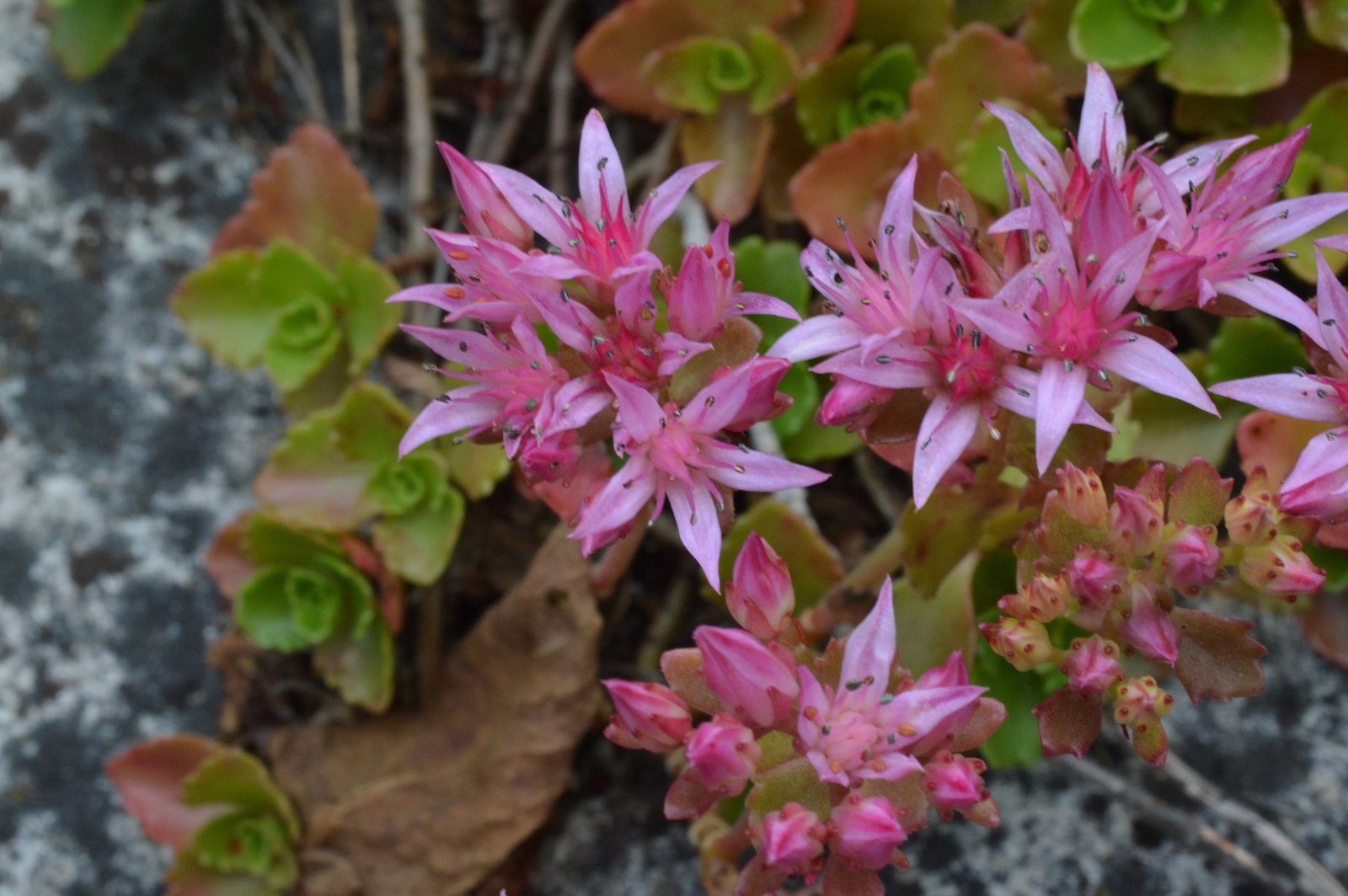
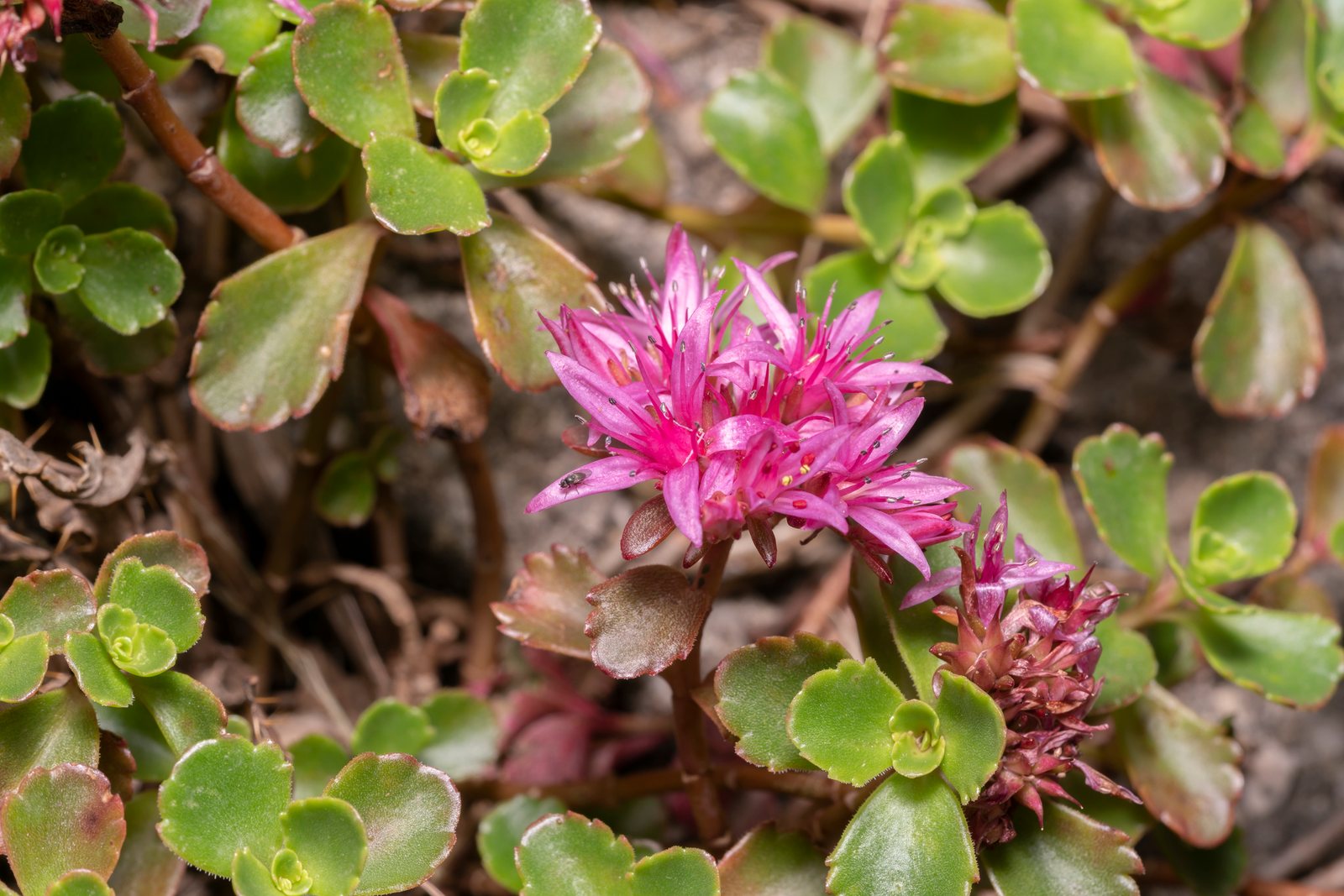
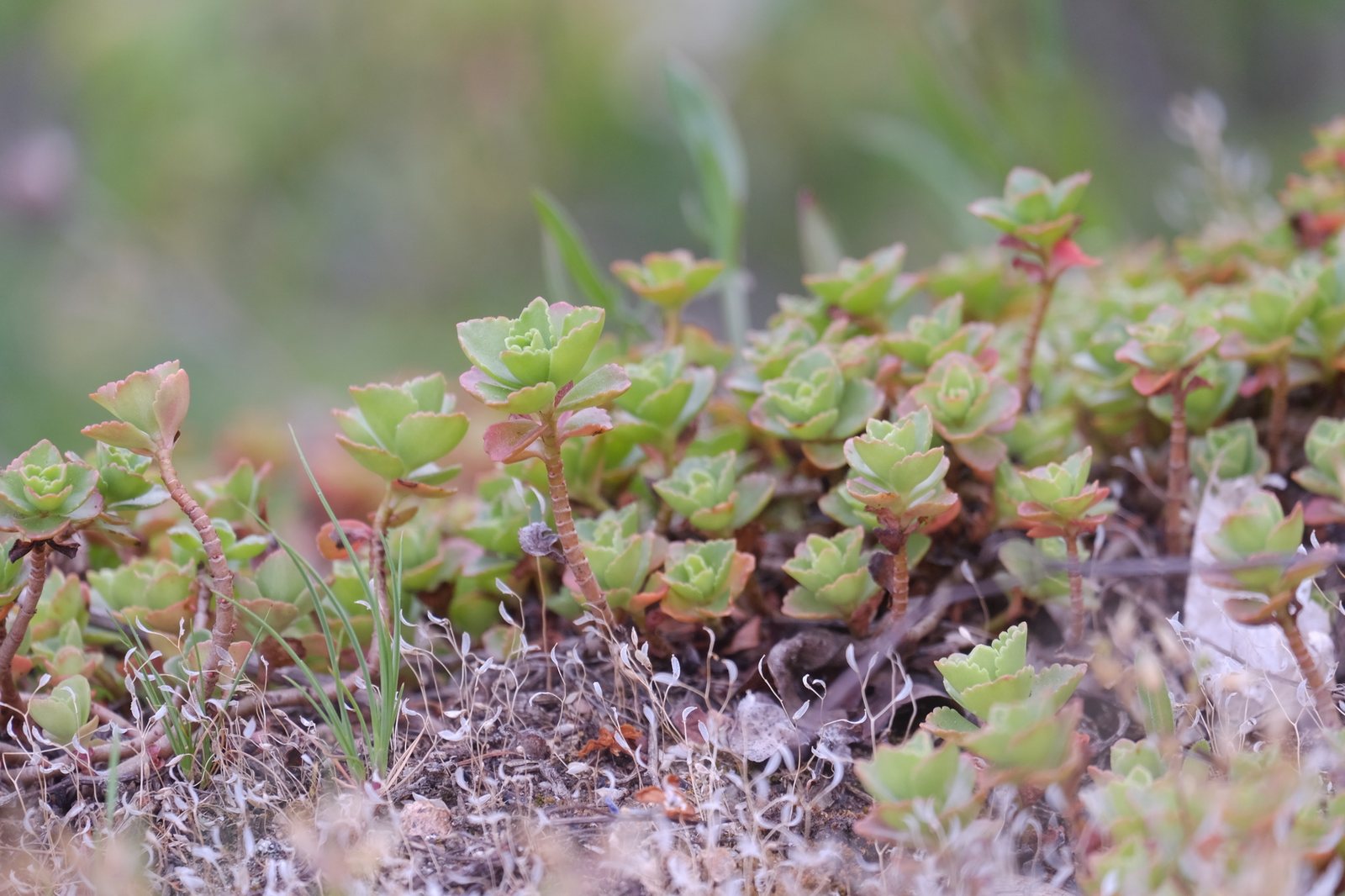
Dragon's Blood sedum is a low, spreading succulent perennial with fleshy leaves that turn burgundy-red in strong sun and cool weather. Gardeners grow it as a drought-tolerant carpet for sunny borders, rock gardens and containers, with clusters of pink-red flowers in summer.
At a glance
- Sun
- Full sun for the strongest red colouring; tolerates light partial shade but becomes greener and less compact.
- Water
- Water regularly while establishing, allowing the soil to dry between waterings. Established plants need occasional watering during prolonged drought; containers need checking more often.
- Soil
- Well-drained sandy, gravelly or stony soil; tolerates poor soil. Avoid heavy soil that stays wet, especially in winter.
- Height
- 0.25-0.5 ft (0.08-0.15 m)
- Spread
- 1-2 ft (0.3-0.6 m), eventually wider where stems can root
- Flowers
- Clusters of small, star-shaped pink-red flowers in summer.
- Foliage
- Evergreen. Small, fleshy, rounded leaves with scalloped edges, arranged in opposite pairs. Green to bronze-red during growth, often deepening to burgundy in cool weather.
- Growth
- Moderate to fast in suitable conditions.
- Care needed
- Low
The year at a glance
- Pollinators
- Drought tolerant
- Cold hardy
- Heat tolerant
- Low allergen
| J | F | M | A | M | J | J | A | S | O | N | D | |
|---|---|---|---|---|---|---|---|---|---|---|---|---|
| Flowers | ||||||||||||
| Plant |
Northern hemisphere months. In Australia, shift them by six.
- Difficulty
- Easy
- Toughness
- Very tough
Will it suit your garden?
Pick your zone, country, light and whether you have pets.
Full sun is 6 or more hours of direct sun a day, part shade 3 to 6 hours, shade under 3.
How it grows
Planting day
0.1 ft (0.03 m)
After 1 year
0.2 ft (0.07 m)
After 2 years
0.4 ft (0.12 m)
full size
About 2 years to full size.
From a typical nursery size, at an average rate for this kind of plant. A rule of thumb, not a forecast.
Good to know
- Cats and dogs
- Safe
- Growth rate
- Fast
Care
Jobs through the year
- WaterApr–May, Sep, every 28 days
- Water established mats only during unusually prolonged drought; new plants need watering whenever roots dry.
- WaterJun–Aug, every 21 days
- Water established mats only if prolonged drought leaves soil very dry; allow drying between waterings.
- PruneMar–Apr
- Remove dead or rotten growth and trim or lift stems spreading beyond their allotted area.
- DivideApr–May
- Divide only congested patches and replant healthy rooted pieces in freely draining soil.
- DeadheadAug–Sep
- Clip faded flower stems if a tidy foliage carpet is wanted.
- ProtectOct–Nov
- Clear fallen leaves and keep thick organic mulch off the mat to prevent winter rot.
- Water new plants when the root zone dries; avoid keeping the soil constantly moist.
- Use a gritty, free-draining potting mix in containers with drainage holes.
- Feed sparingly, if at all; rich soil and heavy feeding encourage loose growth.
- Keep fallen leaves and thick organic mulch off the mat to reduce winter rot.
- Lift rooted stems that spread into neighbouring plants, and divide congested patches in spring.
Pruning. Trim back straying stems in spring or after flowering to keep the mat within bounds. Remove dead or rotten growth in spring; spent flower stems can be clipped off once flowering ends.
Through the year
- Early spring
- Clear fallen leaves and remove winter-damaged or rotten stems.
- Spring
- Plant or divide into free-draining soil, watering until roots establish.
- Early summer
- Check spreading edges and lift stems rooting beyond the intended area.
- Summer
- Water containers when the mix dries; water established ground plantings only during extended dry spells.
- Late summer
- Clip off faded flower stems if a tidy foliage carpet is wanted.
- Autumn
- Remove accumulated leaves and check that containers drain freely before wetter weather.
In the garden
- Edge sunny gravel paths with a low burgundy carpet that contrasts with pale stone.
- Plant between rocks or over a low retaining-wall edge, where trailing stems soften hard surfaces.
- Combine with blue fescue and compact lavender in a dry border for contrasting leaf colour and texture.
- Use in shallow, well-drained containers alongside small sempervivums.
Garden styles it suits: Dry gravel garden, Desert / xeriscape, Alpine rock garden, Low-maintenance, Small-space and Pollinator garden.
Plant it with: Blue fescue, English lavender, Creeping thyme, Sempervivum, Rock rose and Dwarf bearded iris.
Wildlife: The open summer flowers provide nectar and pollen for bees and other insects. The low mat offers some shelter for small invertebrates.
Problems to watch for
- Root and crown rot in wet soil: improve drainage, reduce watering and replant healthy pieces away from rotting material.
- Vine weevil larvae in containers: inspect roots if plants loosen or wilt, and use an appropriate biological control where available.
- Slugs and snails on soft new growth: remove hiding places and hand-pick pests.
- Loose, green growth with weak colouring: move to a sunnier position and avoid heavy feeding.
Safety
Not known to be toxic to cats, dogs, horses or people; no part is recognised as seriously poisonous. It is not a food plant, and eating substantial quantities may cause stomach upset.
Easily confused with
White stonecrop (Sedum album)
Has small, rounded to cylindrical leaves rather than broad, flattened, scalloped leaves, and usually bears white flowers.
Goldmoss stonecrop (Sedum acre)
Has tiny, pointed, tightly packed leaves and yellow flowers, rather than broad opposite leaves and pink-red flowers.
The name
The name 'Dragon's Blood' refers to the plant's blood-red foliage colouring, especially noticeable in strong sun and cool weather.
Propagation. Divide rooted mats in spring or early summer, or root short stem cuttings in a gritty mix. Stems touching the ground often root naturally. Seed-grown plants may not retain the cultivar's colouring.
Checked against open data
- Accepted botanical name
- Sedum spurium
- In the US and Canada
- Introduced in Canada and the lower 48 states.
Sources: GBIF (CC BY 4.0) and USDA PLANTS. The care and design notes are LandscapeGPT's own.
See it in your own yard.
Upload a photo of your yard and see it redesigned with plants that suit your climate, each checked against your zone.