Dusty miller
Jacobaea maritima. Family Asteraceae. Perennial.
Also called Silver ragwort, Silver dust, Senecio cineraria.
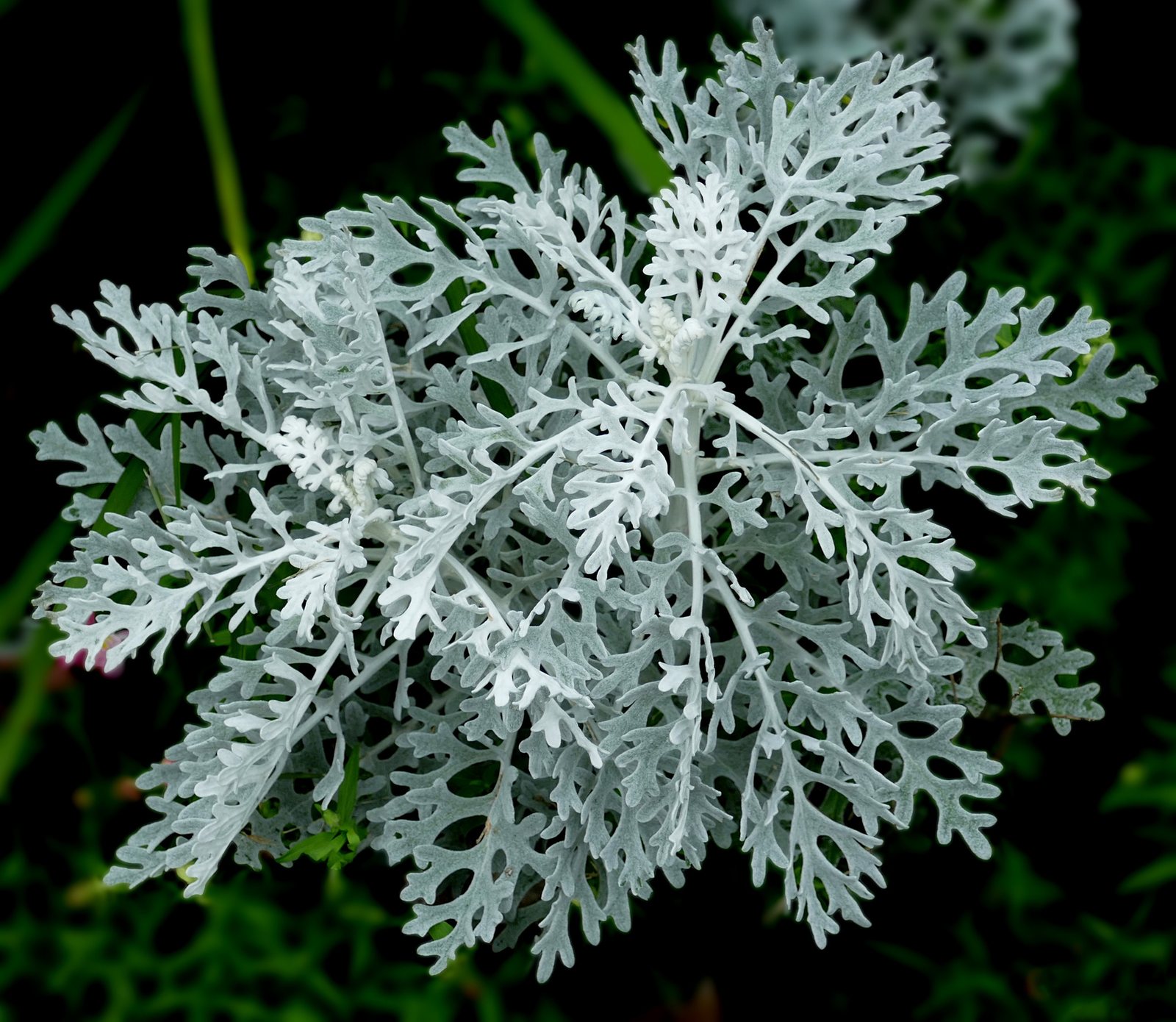
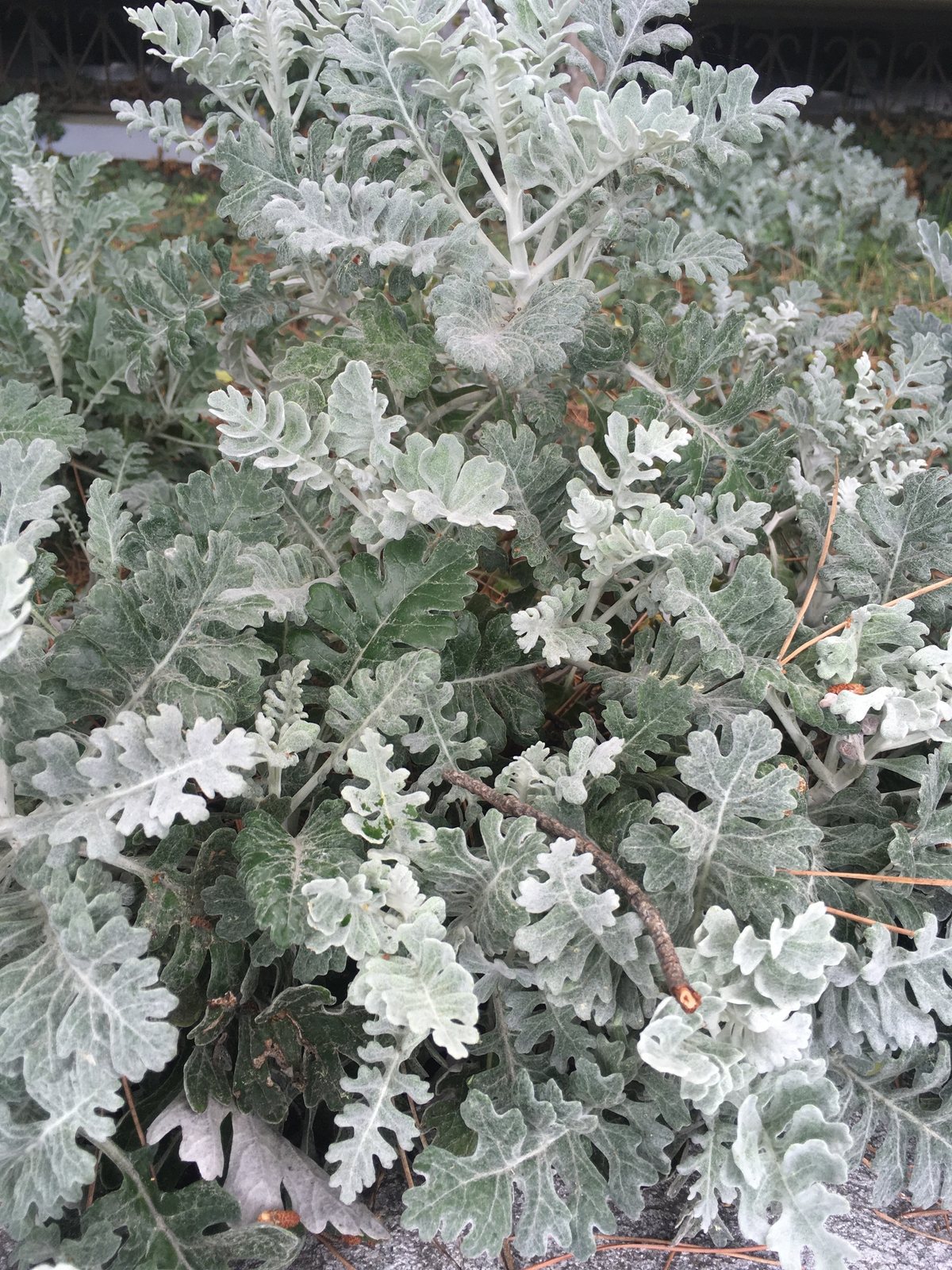
Dusty miller is a short-lived, evergreen perennial grown for its finely divided, silver-white leaves. It provides contrast beside green foliage and colourful flowers, especially in sunny borders and containers. It is usually grown as an annual where winters are cold, and needs excellent drainage to survive outdoors in milder areas.
At a glance
- Sun
- Full sun for the brightest silver foliage and compact growth; tolerates light shade.
- Water
- Water regularly while establishing, then allow the soil to dry between waterings. Established plants tolerate dry spells but dislike persistently wet roots.
- Soil
- Well-drained sandy, gritty or loamy soil; tolerates poor soil and coastal conditions. Avoid heavy, waterlogged ground.
- Height
- 1-2 ft (0.3-0.6 m), sometimes taller in flower
- Spread
- 1-2 ft (0.3-0.6 m)
- Flowers
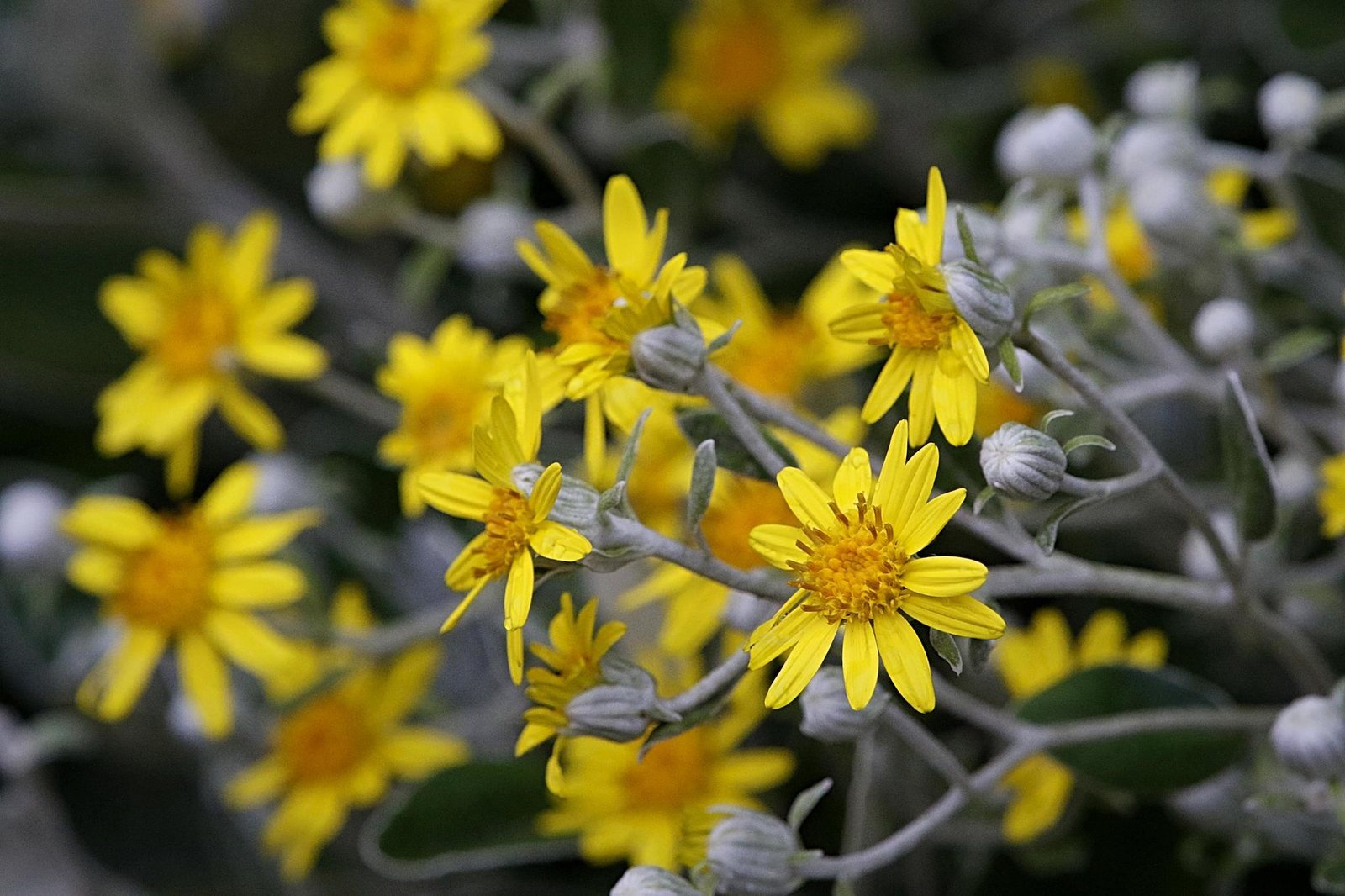
- Small yellow daisy-like flowers in summer, usually on plants that have overwintered.
- Foliage
- Evergreen. Deeply lobed leaves covered in dense white hairs, giving a soft, silver-white appearance; leaf shape varies among cultivars.
- Growth
- Moderate
- Care needed
- Low
The year at a glance
- Deer resistant
- Drought tolerant
- Heat tolerant
| J | F | M | A | M | J | J | A | S | O | N | D | |
|---|---|---|---|---|---|---|---|---|---|---|---|---|
| Plant |
Northern hemisphere months. In Australia, shift them by six.
- Difficulty
- Easy
- Toughness
- Fairly tough
Will it suit your garden?
Pick your zone, country, light and whether you have pets.
Full sun is 6 or more hours of direct sun a day, part shade 3 to 6 hours, shade under 3.
How it grows
Planting day
1 ft (0.3 m)
After 1 year
1.1 ft (0.35 m)
After 2 years
1.3 ft (0.4 m)
After 3 years
1.5 ft (0.45 m)
full size
About 3 years to full size.
From a typical nursery size, at an average rate for this kind of plant. A rule of thumb, not a forecast.
Good to know
- Cats and dogs
- Toxic
- Invasive in
- Australia
- Growth rate
- Moderate
Care
Jobs through the year
- WaterMay–Jun, Sep, every 14 days
- Water established plants only when soil has dried; new transplants need more frequent checks.
- WaterJul–Aug, every 10 days
- Water deeply if soil is dry and rain is absent; avoid keeping roots constantly moist.
- PruneMay–Jun
- Pinch young shoot tips for bushy growth; trim winter damage on surviving plants.
- DeadheadJun–Aug
- Remove flower stems if they appear to maintain a foliage display.
- ProtectMay–Jun
- Check young transplants for slugs and snails and protect if necessary.
- ProtectJan–Mar, Oct–Dec
- Usually grown as an annual here; move plants into bright frost-free shelter if keeping them over winter.
- Plant out after the risk of frost has passed unless establishing it as a perennial in a reliably mild climate.
- Water at soil level and let the surface dry before watering again.
- Use containers with drainage holes and a free-draining potting mix.
- Feed sparingly; rich soil and heavy feeding encourage loose, floppy growth.
- Keep mulch away from the crown; gravel is useful around plants in damp climates.
Pruning. Pinch young shoot tips in spring to encourage bushy growth, and remove flower stems if foliage is your priority. After winter, trim damaged stems back to healthy leafy growth; avoid cutting hard into bare old wood.
Through the year
- Late winter
- Sow seed indoors in bright conditions, allowing roughly 10-12 weeks before planting out.
- Spring
- Trim winter damage from surviving plants once severe frost is unlikely.
- Late spring
- Harden off young plants and plant out after frost, spacing them about 1-1.5 ft (0.3-0.45 m) apart.
- Summer
- Water new plants during dry spells and remove unwanted flower stems.
- Late summer
- Take non-flowering shoot cuttings if you want replacement plants.
- Autumn
- Remove frost-killed annual plantings; in mild areas, clear wet debris from around overwintering crowns.
In the garden
- Edge sunny paths or formal beds with a low ribbon of silver foliage.
- Pair with purple salvia or verbena to sharpen flower colour and provide contrast.
- Use in containers with pelargoniums and other sun-loving plants that prefer drying slightly between waterings.
- Repeat through gravel or coastal gardens to link green foliage with pale stone.
- Combine with white flowers for a pale border that remains visible at dusk.
Garden styles it suits: Mediterranean, Coastal, Dry gravel garden, Formal, White garden and Moon garden.
Plant it with: Lavender, Salvia, Verbena, Pelargonium, Santolina and Gaura.
Wildlife: The yellow flowers provide nectar and pollen for visiting insects if left in place. Plants grown solely for foliage offer relatively little food for pollinators.
Problems to watch for
- Root and crown rot in wet soil: improve drainage, reduce watering and replace badly rotted plants.
- Aphids on young shoots: wash off with water or use insecticidal soap according to the label.
- Slugs and snails damaging young plants: check after dark, remove by hand and protect new transplants.
- Leggy growth in shade or rich soil: move to a sunnier position, reduce feeding and pinch young tips.
Safety
Toxic if eaten by people, cats, dogs and horses. All parts contain pyrrolizidine alkaloids, which can cause serious liver damage, particularly with repeated ingestion; dried material can remain toxic. Keep clippings out of animal feed and seek medical or veterinary advice after ingestion.
Where it spreads. An environmental weed in parts of coastal southern Australia, including Victoria and South Australia, where garden escapes can establish in dunes and coastal vegetation. Check local weed guidance before planting near natural coastal habitats.
Easily confused with
Silver knapweed (Centaurea cineraria)
Also has divided silver leaves, but produces purple thistle-like flower heads rather than yellow daisies.
Beach wormwood (Artemisia stelleriana)
Usually spreads lower and wider, has aromatic foliage when rubbed, and bears small, inconspicuous flower heads rather than obvious yellow daisies.
Angel wings (Senecio candidans)
Has much larger, broad, mostly undivided silver-white leaves rather than dusty miller's deeply cut foliage.
The name
The common name refers to the flour-dusted appearance of the leaves, while maritima means 'of the sea', reflecting its coastal origins.
Propagation. Grow from seed sown indoors before spring planting, pressing seed onto the surface of the seed mix. Take non-flowering softwood or semi-ripe cuttings in summer to preserve a particular cultivar.
Checked against open data
- Accepted botanical name
- Jacobaea maritima
- Native range
- Algeria, Corse, East Aegean Is., France, Greece, Italy, Morocco, Sardegna, Sicilia, Spain, Tunisia and Turkey.
Sources: GBIF (CC BY 4.0) and Trefle (CC BY 4.0). The care and design notes are LandscapeGPT's own.
See it in your own yard.
Upload a photo of your yard and see it redesigned with plants that suit your climate, each checked against your zone.