Dwarf cattail
Typha minima. Family Typhaceae. Perennial.
Also called Miniature cattail, Dwarf bulrush, Least bulrush.
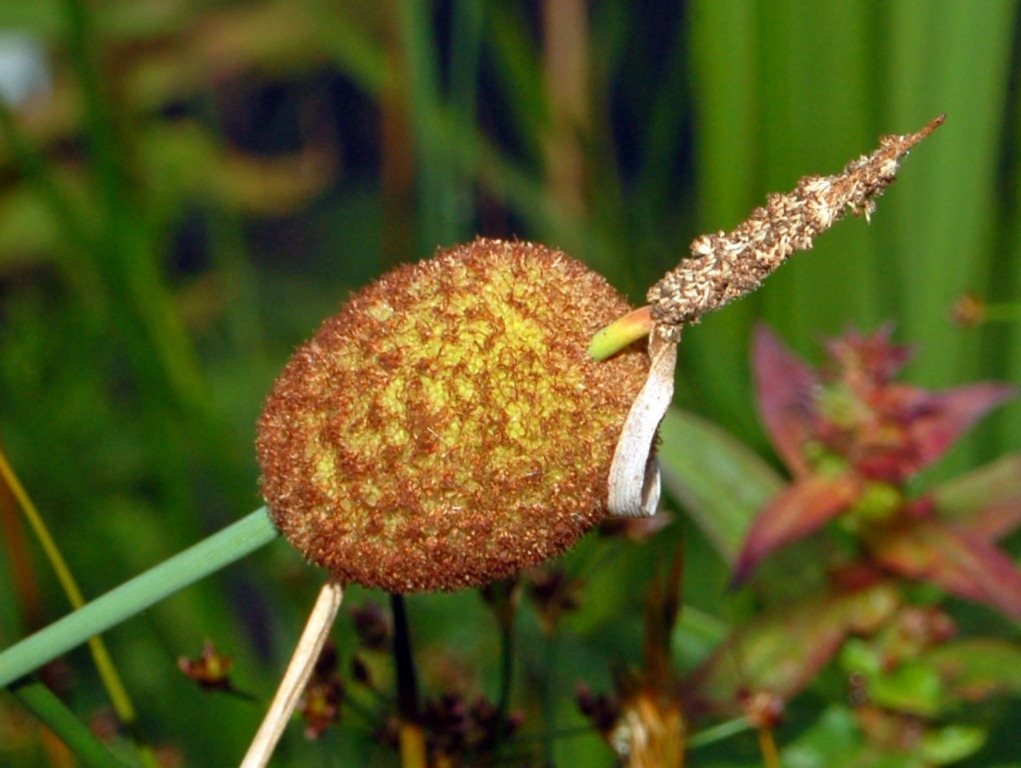
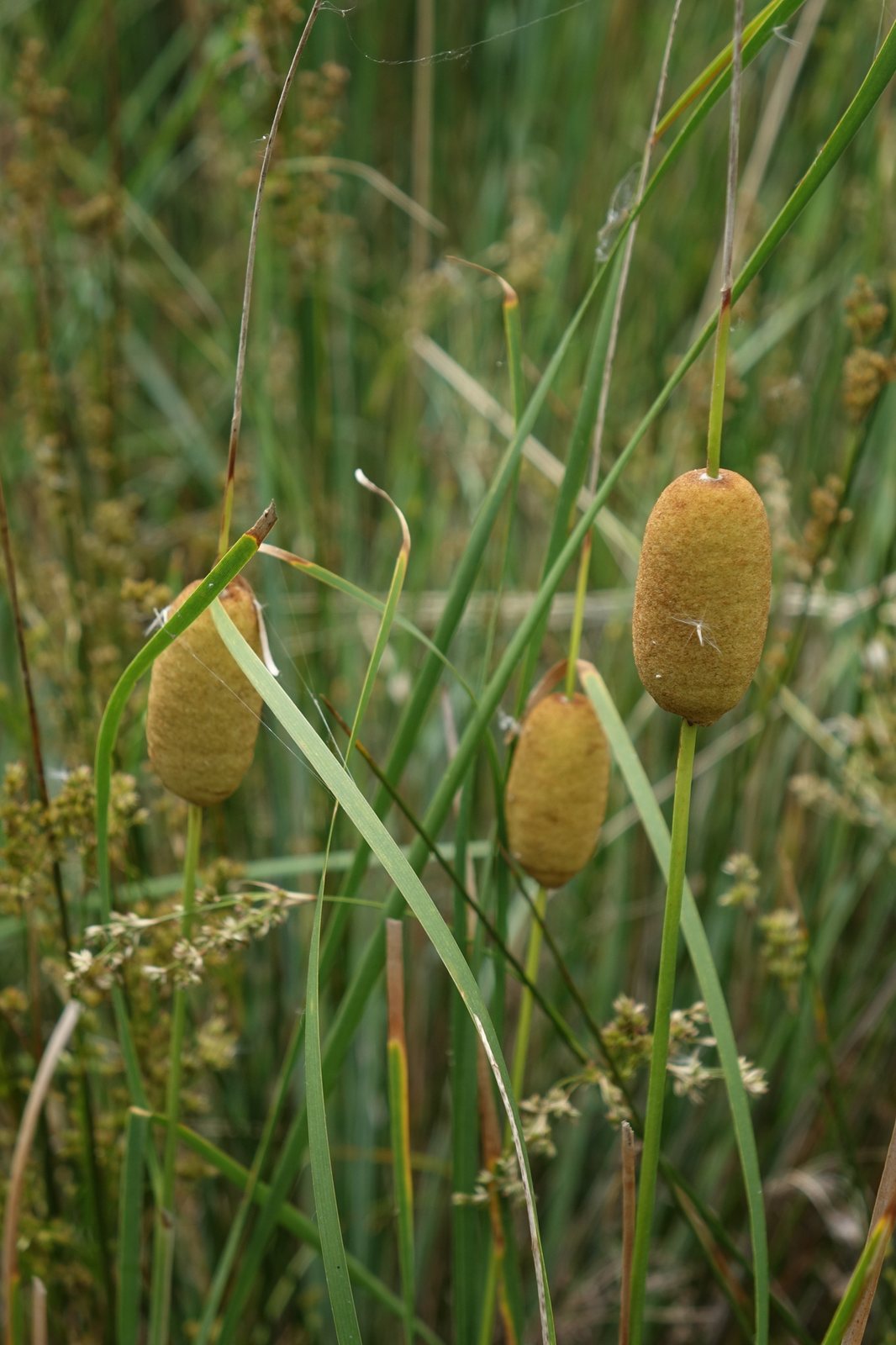
Dwarf cattail is a small, deciduous pond-edge perennial with narrow, upright leaves and short, rounded brown seed heads. Gardeners grow it for the shape of a cattail without the height and bulk of larger species, especially in small ponds and water containers.
At a glance
- Sun
- Full sun; tolerates light partial shade but may produce fewer flower heads.
- Water
- Keep the roots constantly wet. Grow in saturated mud or shallow water, with the crown no more than about 4 in (10 cm) below the water surface.
- Soil
- Loamy or clay-based aquatic soil that stays waterlogged; tolerates a range of soil pH.
- Height
- 1-2 ft (0.3-0.6 m)
- Spread
- 1-2 ft (0.3-0.6 m), extending farther over time through rhizomes
- Flowers
- Late spring to summer; tiny flowers form compact spikes, with the female portion developing into a rounded brown head.
- Foliage
- Very narrow, upright green leaves form a fine-textured clump and die back for winter.
- Growth
- Moderate; forms an expanding colony where conditions suit it.
- Care needed
- Low
The year at a glance
- Heat tolerant
- Wildlife
| J | F | M | A | M | J | J | A | S | O | N | D | |
|---|---|---|---|---|---|---|---|---|---|---|---|---|
| Flowers | ||||||||||||
| Fruit | ||||||||||||
| Plant |
Northern hemisphere months. In Australia, shift them by six.
- Difficulty
- Easy
- Toughness
- Fairly tough
Will it suit your garden?
Pick your zone, country, light and whether you have pets.
Full sun is 6 or more hours of direct sun a day, part shade 3 to 6 hours, shade under 3.
How it grows
Planting day
1 ft (0.3 m)
After 1 year
1.1 ft (0.35 m)
After 2 years
1.3 ft (0.4 m)
After 3 years
1.5 ft (0.45 m)
full size
About 3 years to full size.
From a typical nursery size, at an average rate for this kind of plant. A rule of thumb, not a forecast.
Good to know
- Cats and dogs
- Safe
- Growth rate
- Moderate
Care
Jobs through the year
- WaterMar–May, Sep–Oct, every 7 days
- Check water levels and top up to keep roots constantly wet, with the crown no more than 10 cm deep.
- WaterJun–Aug, every 2 days
- Check and restore water levels; check small water containers daily during hot weather.
- WaterJan–Feb, Nov–Dec, every 14 days
- Check that overwintering roots remain wet; top up only if water levels have fallen.
- PruneFeb–Mar
- Cut dead leaves and old seed stems just above the crown before shoots emerge.
- DivideApr–May
- Divide crowded baskets every two or three years and replant vigorous sections in aquatic loam.
- PruneMay–Jun
- Remove shoots escaping the aquatic basket to contain the colony.
- ProtectJan–Feb, Nov–Dec
- Insulate or shelter exposed water containers so roots do not freeze solid; avoid deep submersion.
- Plant in a sturdy aquatic basket filled with loam-based aquatic soil to make its spread easier to manage.
- Set the crown in saturated soil or beneath up to 4 in (10 cm) of water.
- Check water levels during hot weather; never allow the root ball to dry out.
- Avoid routine feeding in ponds, where extra nutrients can encourage algae.
- Divide crowded baskets in spring, usually every two or three years.
- In cold regions, protect container-grown roots from freezing solid without placing the crown in deep water.
Pruning. In late winter or early spring, cut dead leaves and stems back just above the crown before new growth starts. Leave seed heads standing through winter if you want their structure, or remove them before they shed seed.
Through the year
- Late winter
- Remove dead foliage and old seed heads before fresh shoots appear.
- Spring
- Plant or divide clumps and reset baskets at a shallow water depth.
- Late spring
- Check for new shoots escaping the basket and remove unwanted growth.
- Summer
- Maintain the water level and check small water containers frequently during hot spells.
- Autumn
- Remove fallen leaves from around the clump and decide whether to retain the brown heads for winter.
- Late autumn
- Protect exposed water containers in cold climates so the root ball does not freeze solid.
In the garden
- Plant in a small pond's shallow margin for upright stems that remain in scale with the water.
- Use in a water bowl or trough as a vertical accent beside a dwarf water lily.
- Repeat contained clumps along a formal pond edge for a simple, rhythmic outline.
- Combine with marsh marigolds and water forget-me-nots for contrasting leaf shapes and seasonal flowers.
Garden styles it suits: Bog garden, Modern, Japanese, Wildlife garden, Small-space and Winter interest.
Plant it with: Marsh marigold, Water forget-me-not, Dwarf water lily and Japanese iris.
Wildlife: The stems provide perches and shelter for small aquatic invertebrates. Birds may use the fluffy seed material in nests; the wind-pollinated flowers offer little value to nectar-feeding insects.
Problems to watch for
- Weak growth in deep water: raise the basket so the crown is in saturated soil or only shallowly submerged.
- Browning or collapsing leaves during dry weather: restore the water level promptly and keep the roots continuously wet.
- Crowded, declining basket: divide in spring and replant vigorous outer sections in fresh aquatic soil.
- Aphids on young shoots: rinse them off with water; avoid insecticides near ponds and aquatic wildlife.
Safety
Not known to be toxic to people, cats, dogs or horses. It is grown as an ornamental, not as a food plant; avoid eating material from ponds because it may carry pollutants or pathogens.
Easily confused with
Graceful cattail (Typha laxmannii)
Usually much taller, with broader leaves and a longer, more cylindrical brown head rather than the small, rounded head of dwarf cattail.
Lesser bulrush (Typha angustifolia)
Grows several feet tall and has long, dark brown cylindrical heads. Despite its common name, it is much larger and more vigorous than dwarf cattail.
The name
The species name minima means 'smallest', referring to its unusually small size among cattails.
Propagation. Divide rhizomes in spring as growth begins, keeping roots and at least one healthy growing point on each piece. Replant immediately and keep continuously wet; seed propagation is possible but division is simpler.
Checked against open data
- Accepted botanical name
- Typha minima
- Native range
- Afghanistan, Albania, Altay, Austria, China North-Central, China South-Central, China Southeast, Czechoslovakia, France, Germany, Greece and Hungary.
- Measured
- Average height 65 cm.
Sources: GBIF (CC BY 4.0) and Trefle (CC BY 4.0). The care and design notes are LandscapeGPT's own.
See it in your own yard.
Upload a photo of your yard and see it redesigned with plants that suit your climate, each checked against your zone.