Egyptian walking onion
Allium × proliferum. Family Amaryllidaceae. Bulb.
Also called Walking onion, Tree onion, Topsetting onion, Perennial onion.
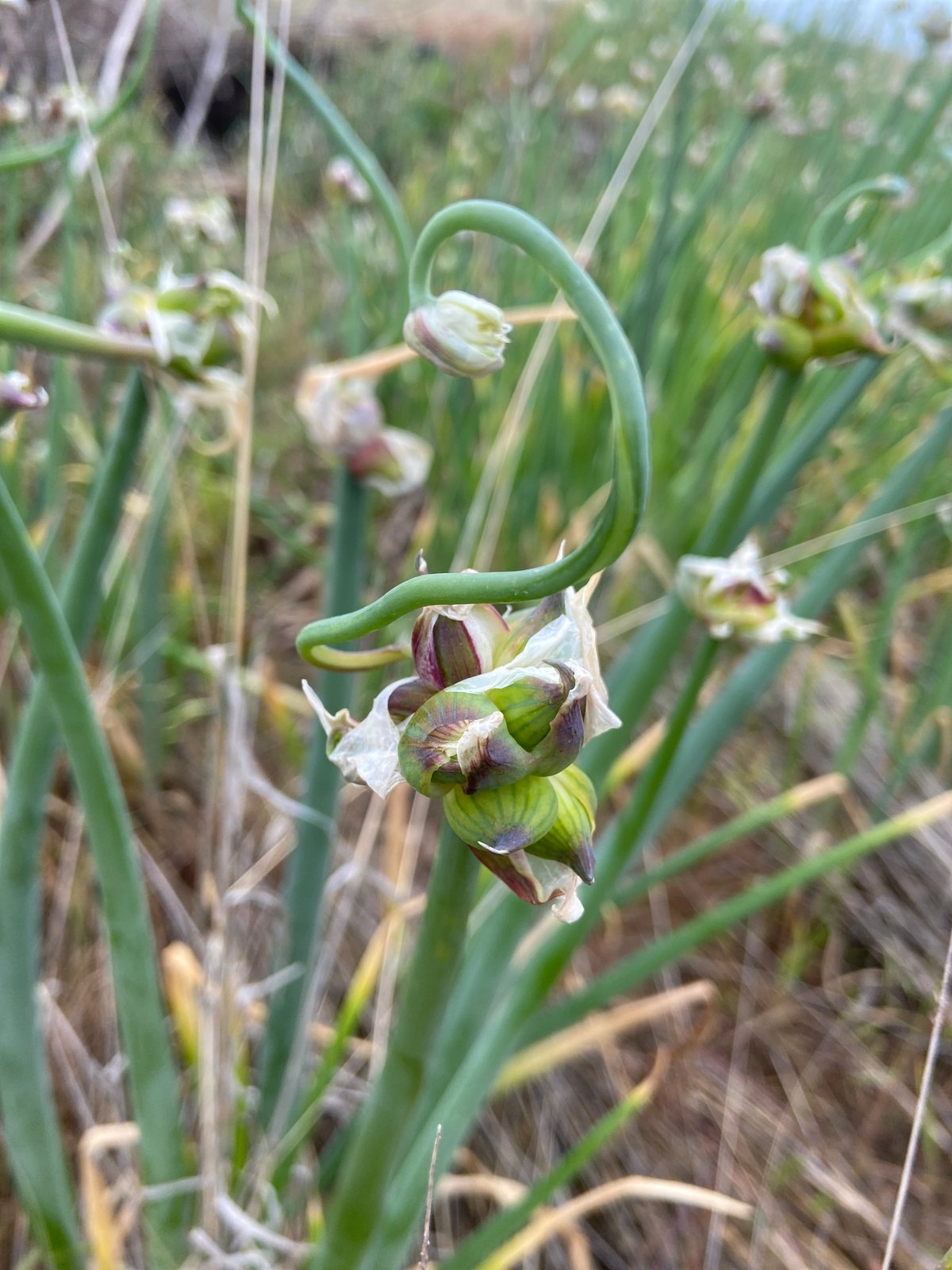
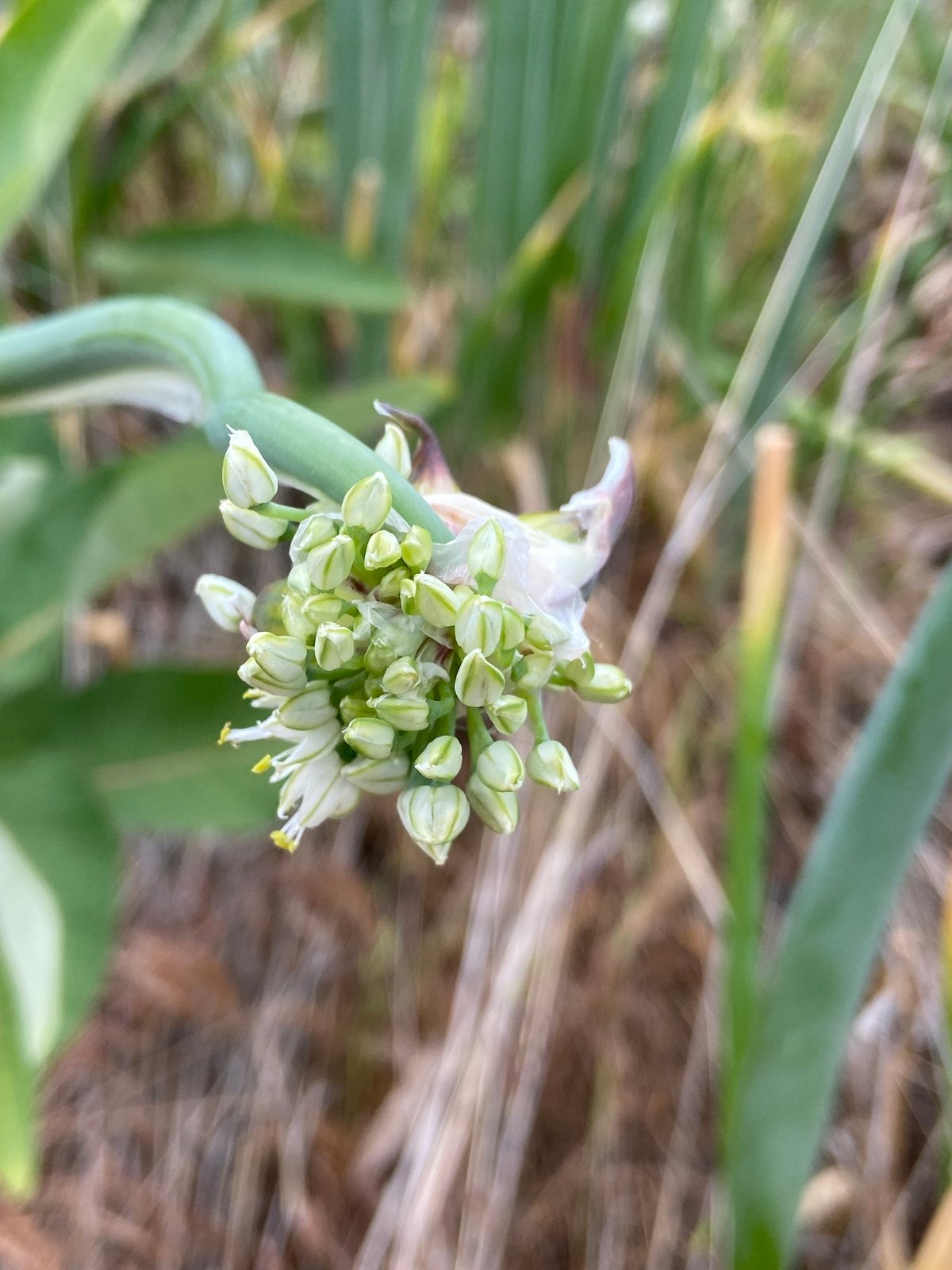
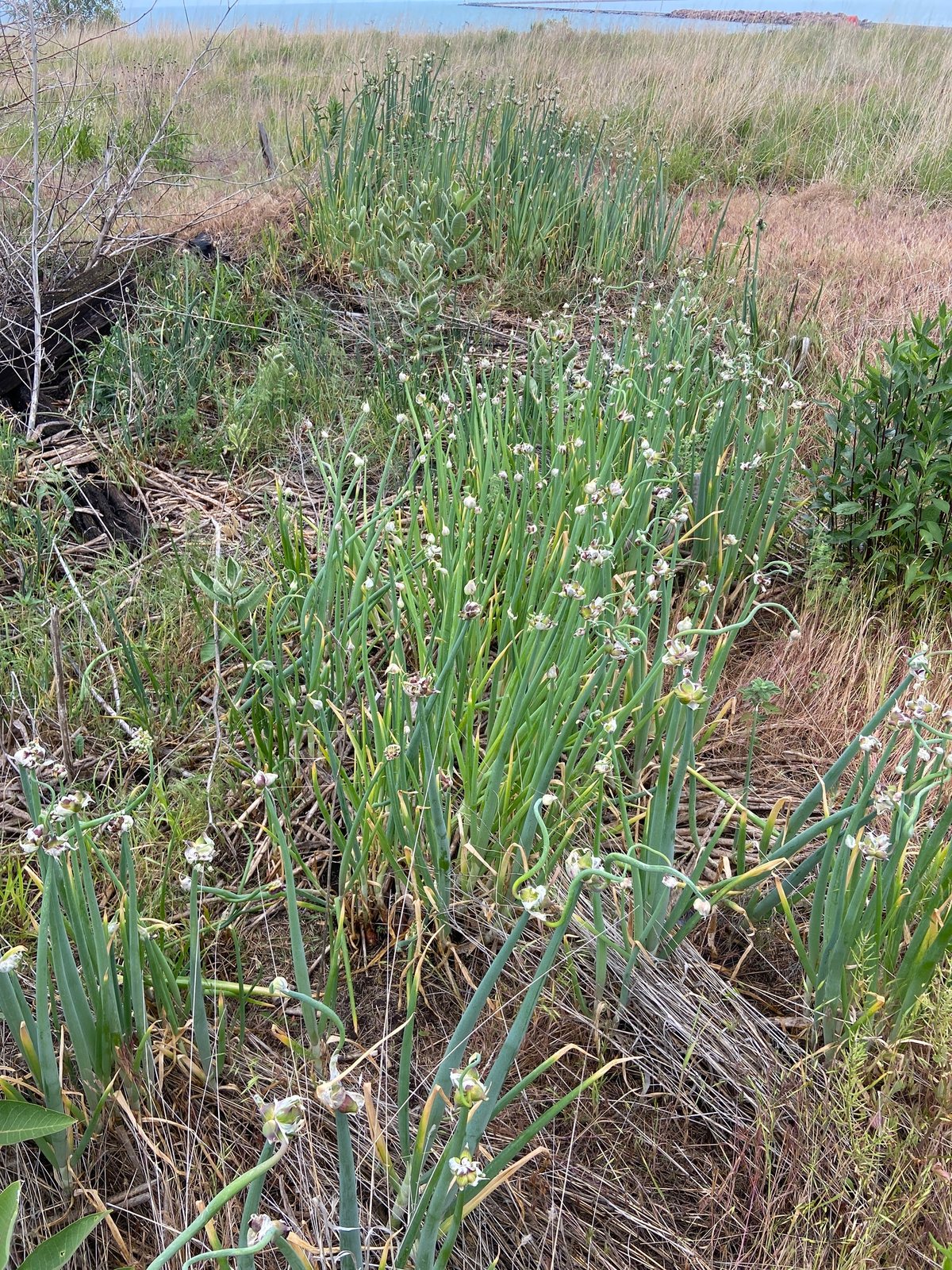
Egyptian walking onion is a perennial edible onion grown for its hollow green leaves, small underground bulbs and clusters of aerial bulbils. As the tall stems bend under the bulbils' weight, they touch the ground and root, gradually moving the patch across the garden.
At a glance
- Sun
- Full sun; tolerates light partial shade, but produces fewer bulbils.
- Water
- Water during establishment and prolonged dry spells. Avoid soil that stays wet, especially in winter.
- Soil
- Fertile, well-drained soil, preferably near neutral; raised beds help where soil is heavy or winter drainage is poor.
- Height
- 2-3 ft (0.6-0.9 m)
- Spread
- 1-2 ft (0.3-0.6 m) per clump; an unmanaged patch spreads farther as bulbils root.
- Flowers
- Small whitish flowers may appear in summer among the aerial bulbils; flowers are often sparse or absent.
- Foliage
- Upright, hollow, tubular green to blue-green leaves with a strong onion scent. Leaves may persist in mild winters but die back in severe cold or during summer dormancy.
- Growth
- Moderate to fast once established.
- Care needed
- Low
The year at a glance
- Deer resistant
- Drought tolerant
- Cold hardy
- Heat tolerant
- Low allergen
- Edible
| J | F | M | A | M | J | J | A | S | O | N | D | |
|---|---|---|---|---|---|---|---|---|---|---|---|---|
| Flowers | ||||||||||||
| Fruit | ||||||||||||
| Plant |
Northern hemisphere months. In Australia, shift them by six.
- Difficulty
- Easy
- Toughness
- Very tough
Will it suit your garden?
Pick your zone, country, light and whether you have pets.
Full sun is 6 or more hours of direct sun a day, part shade 3 to 6 hours, shade under 3.
How it grows
Planting day
0.5 ft (0.15 m)
After 1 year
2.5 ft (0.75 m)
full size
Full size in one season.
From a typical nursery size, at an average rate for this kind of plant. A rule of thumb, not a forecast.
Good to know
- Cats and dogs
- Toxic
- In the garden
- Spreads vigorously: plan to contain it.
- Growth rate
- Fast
Care
Jobs through the year
- WaterMar–May, Sep–Oct, every 14 days
- Water established clumps only during dry spells; water newly planted bulbs more often until rooted.
- WaterJun–Aug, every 10 days
- Deep-water established plants during extended dry weather; avoid persistently wet soil.
- FeedMar–Apr
- Top-dress with compost and avoid heavy nitrogen feeding.
- MulchApr
- Apply a light weed-suppressing mulch, keeping bulb necks clear.
- PruneMar
- Remove dead overwintered foliage without damaging new shoots.
- PruneAug–Sep
- Remove collapsed leaves and harvested bulbil stems; retain stems only where spreading is wanted.
- DivideSep–Oct
- Divide crowded clumps every two to three years and replant in well-drained soil.
- HarvestApr–Jun, every 14 days
- Snip a few leaves from established clumps, leaving plenty for continued growth.
- HarvestJul–Sep, every 7 days
- Pick firm, papery bulbils before stems fall; reserve some for planting.
- HarvestAug–Oct
- Lift surplus underground bulbs, leaving enough in place for next year's crop.
- ProtectNov
- Clear drainage channels so dormant bulbs do not sit in winter water.
- Space bulbs or rooted divisions 12-18 in (30-45 cm) apart in well-drained soil.
- Water newly planted bulbs regularly until rooted, then water during extended dry weather.
- Top-dress with compost in spring; avoid heavy nitrogen feeding.
- Use a light mulch to suppress weeds, keeping it away from the bulb necks.
- Harvest unwanted aerial bulbils before stems fall, and divide crowded clumps every two or three years.
Pruning. Remove yellow or collapsed leaves as they die back. Cut down spent bulbil-bearing stems after harvesting, or leave selected stems to bend and root where you want new plants.
Harvest
Snip a few green leaves once plants are well established, leaving plenty to sustain each clump. Pick aerial bulbils in mid- to late summer when they are firm and their skins become papery; lift underground bulbs in late summer or autumn, leaving some in place for next year's crop.
Through the year
- Early spring
- Remove dead foliage, weed the patch and top-dress with compost.
- Spring
- Plant rooted divisions and begin light harvesting of established plants' green leaves.
- Early summer
- Water during dry spells and check leaves for thrips or rust.
- Late summer
- Harvest firm aerial bulbils before stems collapse, reserving some for planting.
- Autumn
- Plant bulbils, divide crowded clumps and lift surplus underground bulbs.
- Winter
- Keep drainage channels clear and avoid watering dormant plants in wet soil.
In the garden
- Plant in a permanent corner of the vegetable garden where the clump can expand without disturbing annual crops.
- Use beside parsley and chives in a kitchen garden for contrasting leaf shapes and easy harvesting.
- Repeat small clumps through a potager, using the tall stems and bulbil clusters as seasonal accents.
- Grow in a deep container near the kitchen to keep wandering bulbils within reach.
Garden styles it suits: Potager (kitchen garden), Cottage garden, Edible landscape, Homestead, Farmhouse and Low-maintenance.
Plant it with: Parsley, Chives, Lettuce, Swiss chard, Beetroot and Calendula.
Wildlife: Occasional flowers can attract bees and other small insects, but this onion often produces mostly bulbils and is not a dependable nectar plant.
Problems to watch for
- Bulb rot in waterlogged soil: improve drainage or move healthy bulbs to a raised bed; discard soft, rotting bulbs.
- Onion thrips cause silvery streaks and distorted leaves: keep plants adequately watered, remove badly damaged foliage and avoid overcrowding.
- Allium rust causes orange pustules on leaves: remove affected foliage, improve airflow and avoid wetting leaves when watering.
- Unwanted spread from fallen bulbils: harvest the clusters before stems bend to the ground and pull surplus seedlings or rooted bulbils promptly.
Safety
All parts are edible to people in normal culinary amounts, though they can cause digestive upset or allergic reactions. All parts are toxic to cats, dogs and horses, raw or cooked; eating them can damage red blood cells and cause serious anaemia. Keep pets and livestock from eating the plants or harvested bulbs.
Easily confused with
Welsh onion (Allium fistulosum)
It also forms clumps of hollow leaves, but normally carries rounded flower heads rather than clusters of aerial bulbils.
Garden onion (Allium cepa)
It usually forms a larger underground bulb and, when flowering, a rounded head of flowers rather than the walking onion's conspicuous bulbil clusters.
Wild garlic (Allium vineale)
This weedy onion can also carry aerial bulbils, but has much narrower leaves that are often grooved and small, compact bulbil heads.
The name
“Walking onion” describes the way its bulbil-laden stems bend to the ground and establish new plants, while “proliferum” refers to its prolific production of offsets.
Propagation. Separate and plant aerial bulbils in late summer or autumn, setting their bases into the soil with the tips just covered. Divide established underground bulb clusters in spring or autumn. Seed is rarely produced and is not the usual propagation method.
Checked against open data
- Accepted botanical name
- Allium proliferum
Sources: GBIF (CC BY 4.0). The care and design notes are LandscapeGPT's own.
See it in your own yard.
Upload a photo of your yard and see it redesigned with plants that suit your climate, each checked against your zone.