Elephant's ears
Bergenia cordifolia. Family Saxifragaceae. Perennial.
Also called Heart-leaved bergenia, Heartleaf bergenia, Pigsqueak.
Bergenia cordifolia is a clump-forming perennial grown for its broad, leathery leaves and clusters of pink spring flowers. Its foliage provides year-round ground cover in milder climates and often turns bronze or reddish purple in cold weather. It tolerates some dry shade once established, but flowers best with adequate moisture and some sun.
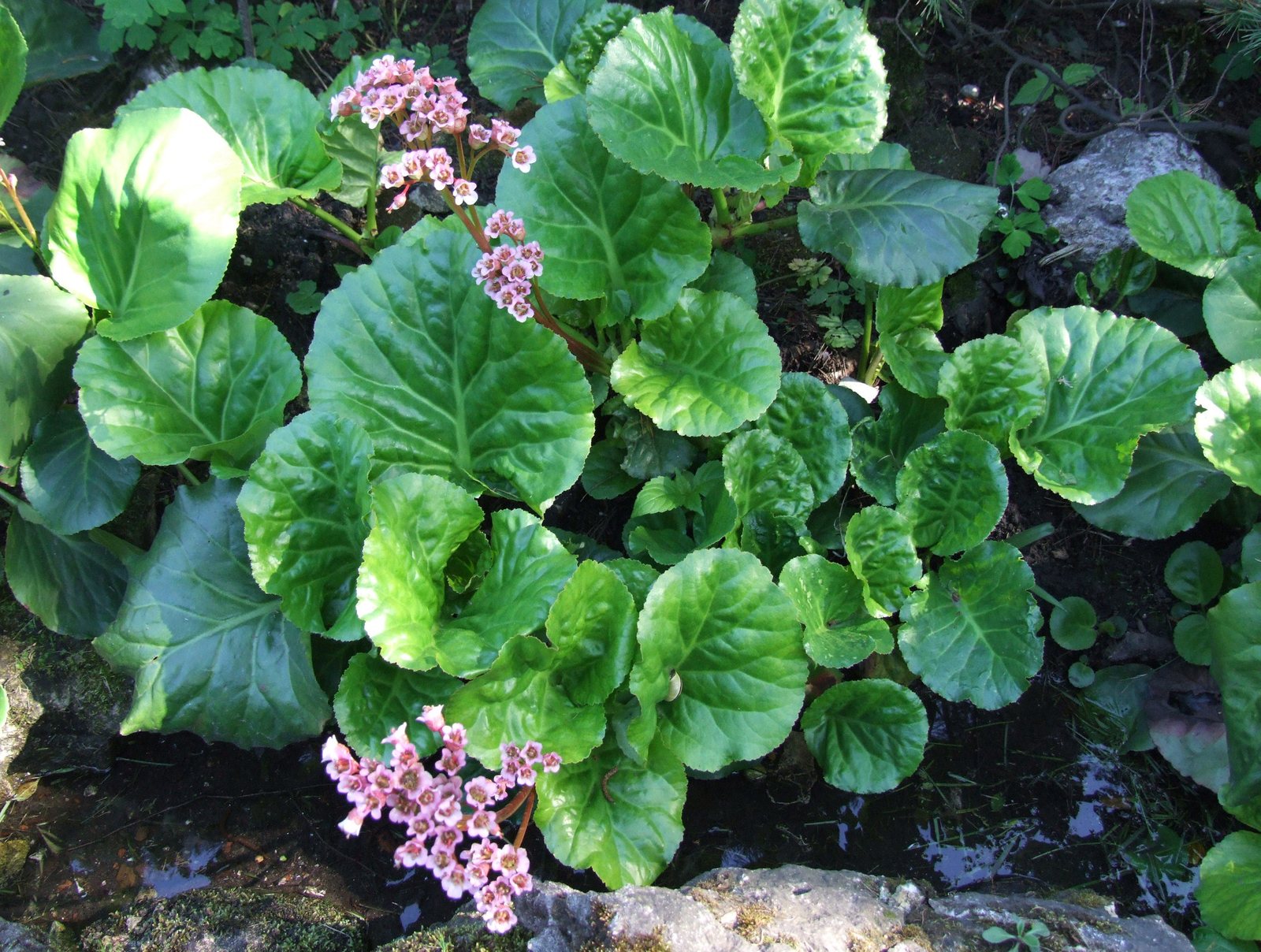
At a glance
- Sun
- Partial shade is ideal; full sun suits cool climates if the soil stays moist. Provide afternoon shade in hot summers.
- Water
- Water regularly during the first growing season. Once established, water during prolonged dry spells; avoid persistently soggy soil.
- Soil
- Humus-rich, well-drained soil; tolerates clay if drainage is adequate and grows in acidic, neutral or alkaline conditions.
- Height
- 1-2 ft (0.3-0.6 m), including flower stems
- Spread
- 1-2 ft (0.3-0.6 m), gradually widening through creeping rhizomes
- Flowers
- Clusters of pink to rose-pink flowers on stout stems in early to mid-spring, sometimes beginning in late winter in mild climates.
- Foliage
- Evergreen. Large, rounded to heart-shaped, glossy green leaves with thick, leathery surfaces. Cold weather can bring bronze, red or purple colouring; exposed leaves may scorch or die back in severe winters.
- Growth
- Slow to moderate
- Care needed
- Low
The year at a glance
- Pollinators
- Deer resistant
- Drought tolerant
- Cold hardy
- Wildlife
- Low allergen
| J | F | M | A | M | J | J | A | S | O | N | D | |
|---|---|---|---|---|---|---|---|---|---|---|---|---|
| Flowers | ||||||||||||
| Plant |
Northern hemisphere months. In Australia, shift them by six.
- Difficulty
- Easy
- Toughness
- Very tough
Will it suit your garden?
Pick your zone, country, light and whether you have pets.
Full sun is 6 or more hours of direct sun a day, part shade 3 to 6 hours, shade under 3.
How it grows
Planting day
1 ft (0.3 m)
After 1 year
1.1 ft (0.34 m)
After 2 years
1.2 ft (0.38 m)
After 3 years
1.4 ft (0.42 m)
After 5 years
1.5 ft (0.45 m)
full size
About 4 years to full size.
From a typical nursery size, at an average rate for this kind of plant. A rule of thumb, not a forecast.
Good to know
- Cats and dogs
- Safe
- Growth rate
- Slow
Care
Jobs through the year
- WaterApr–May, Sep–Oct, every 14 days
- Water established clumps only if soil is dry; water new plants more often.
- WaterJun–Aug, every 7 days
- Water deeply during prolonged dry spells; avoid soggy soil.
- FeedMar–Apr
- Top-dress with a thin layer of compost, keeping crowns clear.
- MulchApr
- Apply light organic mulch without covering surface rhizomes.
- PruneFeb–Mar
- Remove damaged or badly spotted leaves without harming emerging flower shoots.
- DeadheadApr–May
- Cut spent flower stems off at their bases.
- DivideMay–Jun
- Divide congested or bare-centred clumps after flowering every three to five years.
- ProtectJun–Aug
- Provide afternoon shade if strong sun scorches leaves.
- ProtectOct–Nov
- Clear smothering fallen leaves and ensure water drains away from crowns.
- Water newly planted clumps when the upper soil begins to dry; do not leave them standing in water.
- Apply a thin layer of compost in spring, keeping it away from the crowns.
- Use a light organic mulch to conserve moisture without burying the surface rhizomes.
- Divide congested or bare-centred clumps every three to five years, preferably after flowering.
- Protect plants from strong afternoon sun where summers are hot.
Pruning. In late winter or early spring, cut off torn, blackened or badly spotted leaves at their bases without damaging emerging flower shoots. Remove spent flower stems at the base after flowering.
Through the year
- Late winter
- Remove winter-damaged leaves, taking care around developing flower stems.
- Spring
- Top-dress with compost and water new plants during dry weather.
- Late spring
- Cut down finished flower stems; divide overcrowded clumps after flowering.
- Summer
- Water during prolonged drought and check for leaf scorch in exposed positions.
- Early autumn
- Plant new clumps while the soil is workable and moisture is more reliable.
- Late autumn
- Keep fallen leaves from smothering the crowns and check that water drains freely.
In the garden
- Plant along partially shaded paths, where the broad leaves make a firm, low edging.
- Use in groups beneath deciduous trees with snowdrops and hellebores for late-winter and spring interest.
- Pair with ferns and fine-leaved sedges to contrast bold foliage with lighter textures.
- Use at the front of mixed borders to cover bare soil and retain structure through winter.
Garden styles it suits: Woodland, Cottage garden, Arts and Crafts, Low-maintenance, Winter interest and Modern courtyard.
Plant it with: Hellebores, Snowdrops, Siberian bugloss, Japanese painted fern, Japanese forest grass and Epimedium.
Wildlife: Flowers provide pollen and nectar for early-season bees when weather permits them to forage. Dense clumps offer shelter for small garden invertebrates.
Problems to watch for
- Slugs and snails can chew young leaves and flowers: remove hiding places, hand-pick at dusk or use an approved iron-based bait according to its label.
- Vine weevil larvae can damage roots and rhizomes, especially in containers: inspect declining plants and use suitable biological nematodes when soil temperatures allow.
- Fungal leaf spots cause brown or dark patches: remove badly affected leaves, improve airflow and avoid routinely wetting the foliage.
- Crown or rhizome rot develops in waterlogged soil: improve drainage and replant healthy sections with crowns at soil level rather than buried.
Safety
Not known to be toxic to cats, dogs, horses or people. No part is recognised as a significant poisoning hazard, but it is not a food plant and eating garden foliage may cause stomach upset.
Easily confused with
Fringed bergenia (Bergenia ciliata)
Has conspicuously hairy leaves, especially along their edges, rather than the smooth, glossy leaves of heart-leaved bergenia. It is more likely to lose its foliage in winter.
Elephant ear (Colocasia esculenta)
A tender, tuber-forming plant with much larger, arrow- or shield-shaped leaves on long stalks. It does not produce bergenia's upright clusters of pink spring flowers.
The name
Bergenia honours the German physician and botanist Karl August von Bergen, cordifolia means heart-leaved, and elephant's ears refers to the broad leaves.
Propagation. Divide clumps after flowering or in early autumn, retaining healthy roots and at least one growing point on each section. Rhizome sections with viable buds can also be rooted; seed-grown plants may vary from the parent.
Checked against open data
- Accepted botanical name
- Bergenia crassifolia Bergenia cordifolia is an older name for Bergenia crassifolia.
- Native range
- Altay, Amur, Buryatiya, Chita, Irkutsk, Kazakhstan, Khabarovsk, Korea, Krasnoyarsk, Mongolia, Primorye and Tuva.
- Measured
- Average height 40 cm.
Sources: GBIF (CC BY 4.0) and Trefle (CC BY 4.0). The care and design notes are LandscapeGPT's own.
See it in your own yard.
Upload a photo of your yard and see it redesigned with plants that suit your climate, each checked against your zone.