Featherleaf rodgersia
Rodgersia pinnata. Family Saxifragaceae. Perennial.
Also called Feather-leaved rodgersia, Rodgersia.
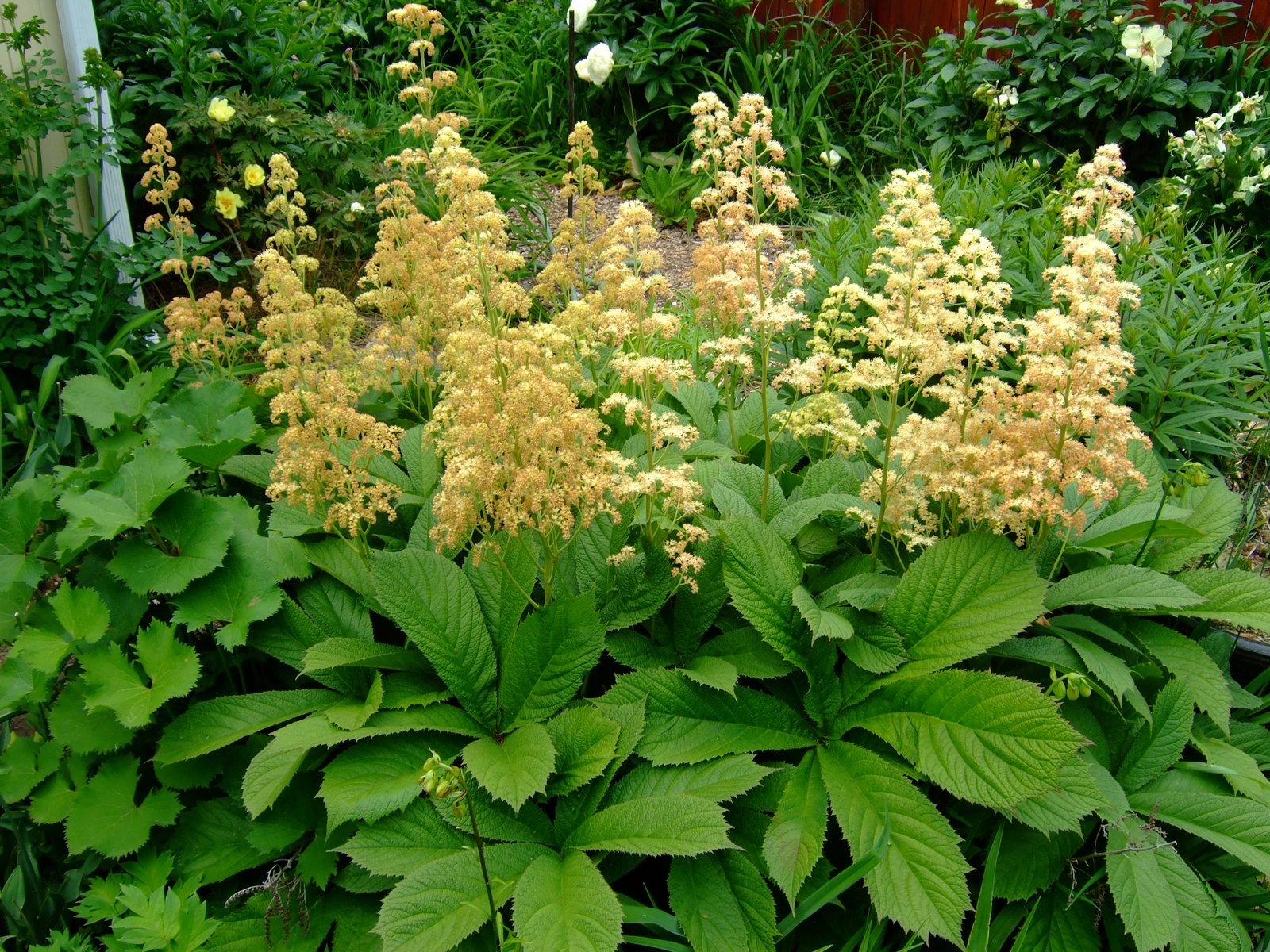
Featherleaf rodgersia is a large, clump-forming perennial grown for its bold, divided leaves and airy summer flower plumes. It gives damp, partly shaded borders a lush appearance, but needs dependable soil moisture and protection from drying winds.
At a glance
- Sun
- Partial shade or dappled shade; tolerates more sun in cool climates if the soil stays moist. Avoid hot afternoon sun.
- Water
- Keep the root zone consistently moist, especially during spring growth and summer heat. Do not let it dry out, but avoid stagnant, waterlogged soil.
- Soil
- Deep, humus-rich, moisture-retentive soil that drains excess water; slightly acidic to neutral soil is ideal.
- Height
- 3-5 ft (0.9-1.5 m), including flower stems
- Spread
- 2-3 ft (0.6-0.9 m), gradually wider with age
- Flowers
- Early to midsummer; branched plumes of small creamy-white to pink flowers, with colour varying among plants and cultivars.
- Foliage
- Large, textured leaves divided into toothed leaflets along a short central stalk. Young growth is often bronze-tinted, becoming green in summer; autumn colour can include bronze and red.
- Growth
- Slow to moderate; takes several years to form a substantial clump.
- Care needed
- Medium
The year at a glance
- Pollinators
- Deer resistant
- Wildlife
- Low allergen
| J | F | M | A | M | J | J | A | S | O | N | D | |
|---|---|---|---|---|---|---|---|---|---|---|---|---|
| Flowers | ||||||||||||
| Fruit | ||||||||||||
| Plant |
Northern hemisphere months. In Australia, shift them by six.
- Difficulty
- Moderate
- Toughness
- Needs looking after
Will it suit your garden?
Pick your zone, country, light and whether you have pets.
Full sun is 6 or more hours of direct sun a day, part shade 3 to 6 hours, shade under 3.
How it grows
Planting day
1 ft (0.3 m)
After 1 year
1.7 ft (0.53 m)
After 2 years
2.5 ft (0.76 m)
After 3 years
3 ft (0.99 m)
After 5 years
4 ft (1.2 m)
full size
About 4 years to full size.
From a typical nursery size, at an average rate for this kind of plant. A rule of thumb, not a forecast.
Good to know
- Cats and dogs
- Safe
- Growth rate
- Slow
Care
Jobs through the year
- WaterMar–May, Sep–Oct, every 7 days
- In dry weather, water established clumps deeply to maintain moist soil; water new plants more often.
- WaterJun–Aug, every 3 days
- During dry spells, water before roots dry out, but skip watering if soil remains thoroughly moist.
- MulchMar–Apr
- Apply leaf mould or garden compost around the clump without covering emerging shoots.
- FeedApr
- Only on poor soil, apply balanced slow-release fertilizer at the labelled rate.
- PruneFeb
- Cut dead leaves and stems to ground level before new growth emerges.
- DivideMar–Apr
- Divide established clumps only when crowded or when more plants are wanted.
- ProtectApr–May
- Cover emerging leaves with fleece when late frost is forecast and protect shoots from slugs.
- Water deeply during dry spells so the root zone never dries out completely.
- Mulch each spring with leaf mould or garden compost, keeping it clear of emerging shoots.
- In poor soil, apply a balanced, slow-release fertiliser in spring at the labelled rate.
- Choose a sheltered position to reduce wind damage and leaf scorch.
- Divide established clumps in early spring only when crowded or when you want more plants.
Pruning. Remove faded flower stems after flowering if you do not want seedheads. Cut dead leaves and stems to ground level in late autumn or late winter, before new shoots emerge.
Through the year
- Late winter
- Cut away any remaining dead stems and leaves before new growth appears.
- Early spring
- Plant or divide while dormant or just starting into growth; water thoroughly.
- Spring
- Apply compost or leaf mould and watch emerging shoots for slugs and snails.
- Late spring
- Protect tender new leaves with fleece if a late frost is forecast.
- Summer
- Water during dry weather and check for scorched leaf edges.
- Late summer
- Remove spent flower stems, or leave them for their seedhead structure.
- Autumn
- Replenish mulch where needed and leave healthy fading foliage until it dies back.
In the garden
- Plant beside a pond or stream on moist ground above the standing water.
- Use in the middle or back of a shaded border, where the large leaves contrast with ferns and fine grasses.
- Group with astilbes and hostas for layered foliage and overlapping summer flowers.
- Use as a bold foliage accent in a sheltered woodland courtyard with reliable irrigation.
Garden styles it suits: Woodland, Bog garden, English country, Architectural minimal, Japanese and Blues and silvers.
Plant it with: Hostas, Astilbes, Japanese painted fern, Siberian iris, Ligularia and Japanese forest grass.
Wildlife: The small flowers attract bees and other visiting insects. Dense summer foliage provides shelter for small garden creatures.
Problems to watch for
- Slugs and snails can eat emerging shoots; inspect at dusk, remove them by hand and use iron-phosphate bait according to the label if needed.
- Brown, crisp leaf edges usually indicate dry soil, hot sun or drying wind; water deeply, renew mulch and provide afternoon shade or shelter.
- Late frosts can blacken new leaves; cover emerging growth with fleece when frost is forecast and remove damaged tissue once the risk has passed.
- Persistent winter waterlogging can cause crown or root rot; improve drainage or move the plant to moist ground that does not remain flooded.
Safety
Not known to be toxic to people, cats, dogs or horses. No particular part is recognised as poisonous, but species-specific information is limited; it is not an edible plant.
Easily confused with
Chestnut-leaved rodgersia (Rodgersia aesculifolia)
Its leaflets radiate from one point like a horse-chestnut leaf; featherleaf rodgersia has leaflets arranged along a short central stalk.
Fingerleaf rodgersia (Rodgersia podophylla)
Usually has five broad leaflets with conspicuously lobed tips, rather than the more elongated, mainly unlobed leaflets of featherleaf rodgersia.
Astilbe (Astilbe spp.)
Has similar flower plumes but generally much smaller leaflets on more finely divided, fernlike leaves.
The name
Rodgersia honours the American naval officer John Rodgers, while pinnata refers to the featherlike arrangement of the leaflets.
Propagation. Divide established rhizomatous clumps in early spring, keeping strong buds and roots on each division. Seed can be sown fresh in pots in a sheltered cold frame, but seedlings develop slowly and named cultivars do not reliably come true from seed.
Checked against open data
- Accepted botanical name
- Rodgersia pinnata
- Native range
- China South-Central and Myanmar.
Sources: GBIF (CC BY 4.0) and Trefle (CC BY 4.0). The care and design notes are LandscapeGPT's own.
See it in your own yard.
Upload a photo of your yard and see it redesigned with plants that suit your climate, each checked against your zone.