Firecracker plant
Russelia equisetiformis. Family Plantaginaceae. Shrub.
Also called Coral plant, Coral fountain, Fountainbush.
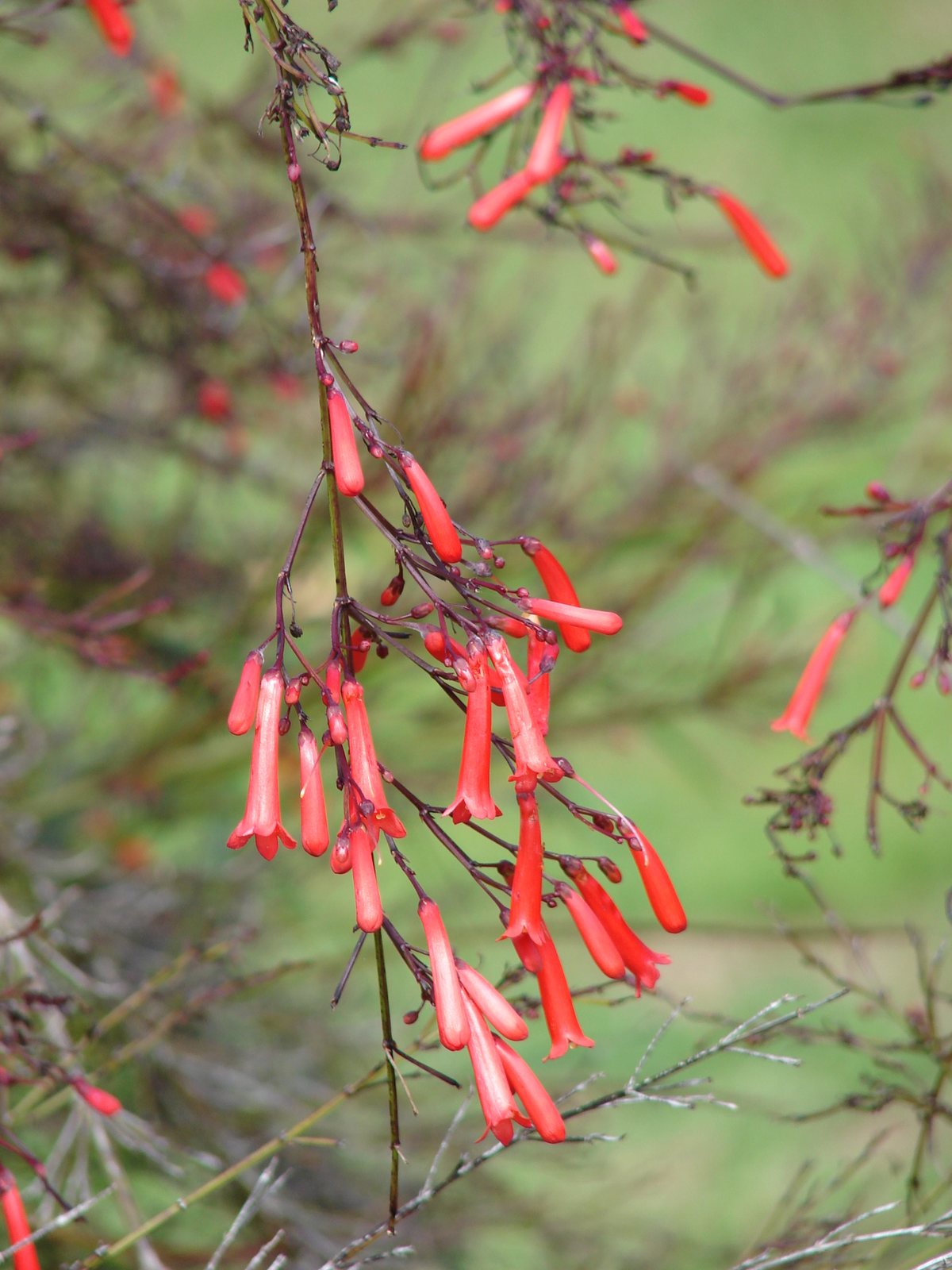
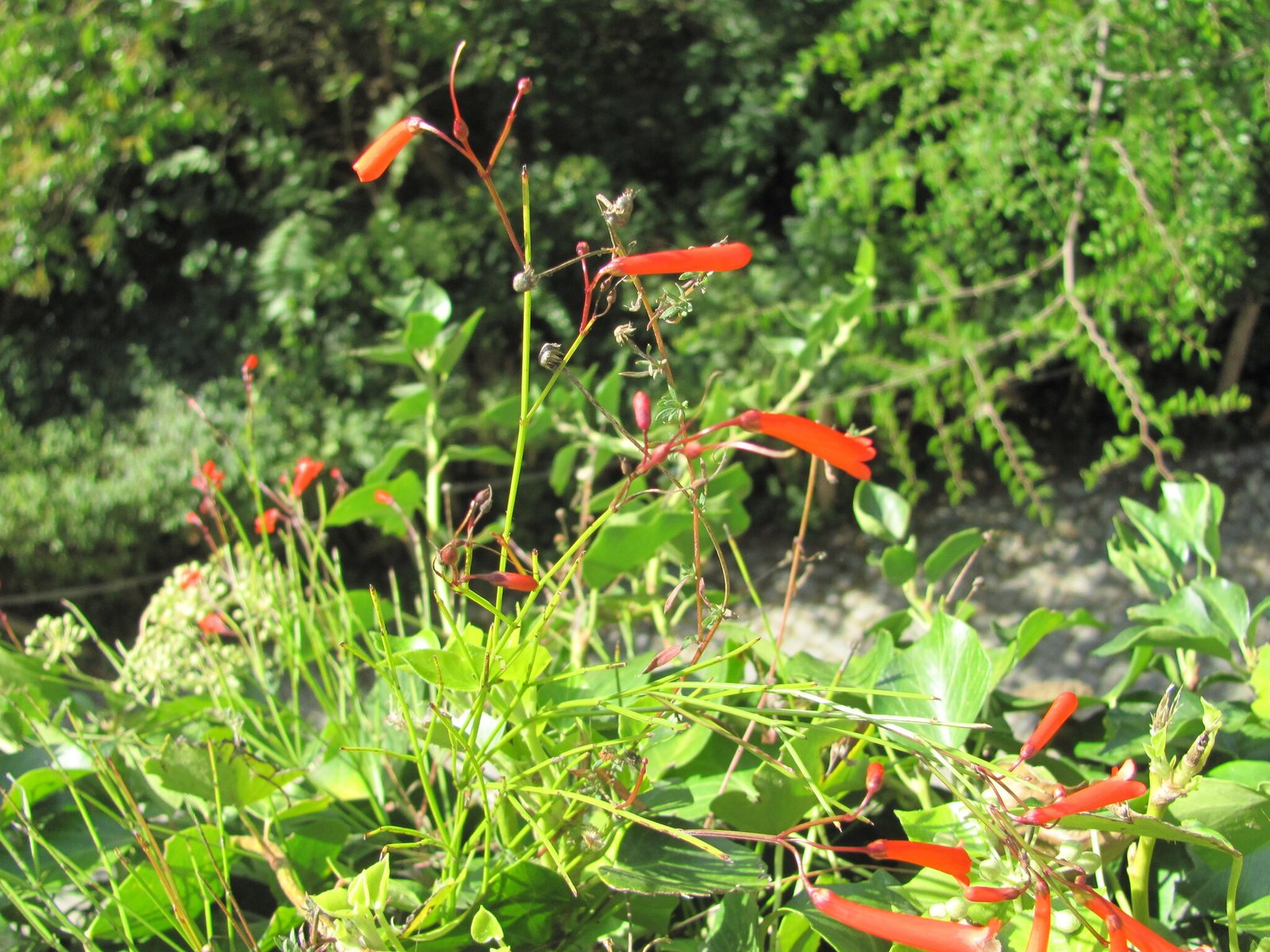
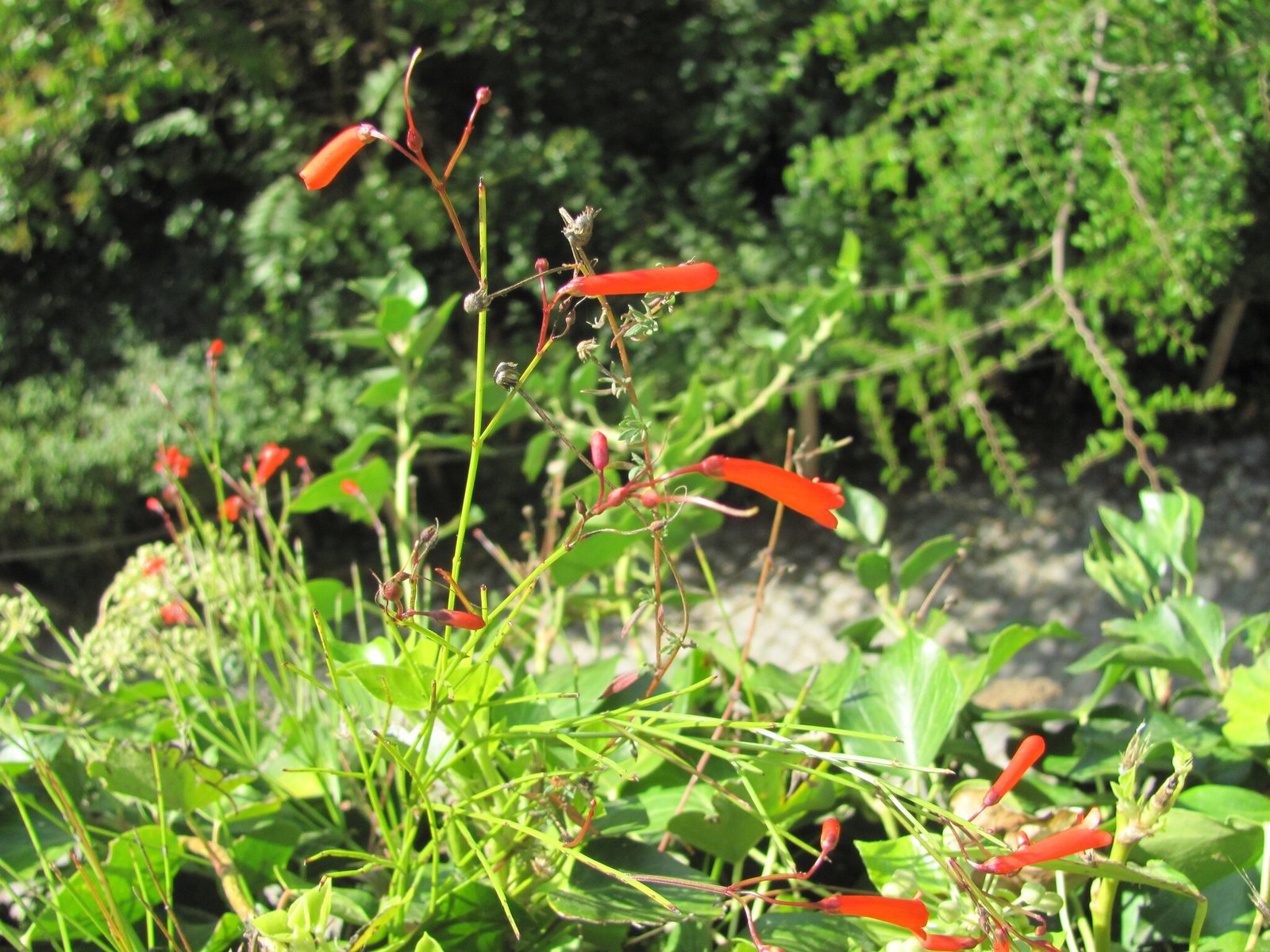
Firecracker plant is a frost-tender Mexican shrub with arching green stems and masses of slender red flowers. Gardeners grow it to spill over walls, soften sunny borders or cascade from large containers. In most of the United Kingdom and Canada, and colder parts of the United States and Australia, it needs frost-free winter shelter.
At a glance
- Sun
- Full sun for the most flowers; tolerates light partial shade.
- Water
- Water regularly while establishing, then let the soil surface dry between thorough waterings. Established plants tolerate short dry spells, but flower better with occasional deep watering.
- Soil
- Well-drained sandy or loamy soil; tolerates relatively poor soil but struggles in waterlogged ground. Use a free-draining potting mix in containers.
- Height
- 3-5 ft (0.9-1.5 m)
- Spread
- 3-6 ft (0.9-1.8 m)
- Flowers
- Clusters of narrow, tubular scarlet-red flowers from late spring through autumn; potentially year-round in frost-free climates.
- Foliage
- Evergreen. Fine, green, rush-like stems carry tiny scale-like leaves; more obvious narrow leaves may appear on young growth.
- Growth
- Fast in warm weather.
- Care needed
- Low
The year at a glance
- Pollinators
- Drought tolerant
- Heat tolerant
- Low allergen
| J | F | M | A | M | J | J | A | S | O | N | D | |
|---|---|---|---|---|---|---|---|---|---|---|---|---|
| Flowers | ||||||||||||
| Plant |
Northern hemisphere months. In Australia, shift them by six.
- Difficulty
- Moderate
- Toughness
- Fairly tough
Will it suit your garden?
Pick your zone, country, light and whether you have pets.
Full sun is 6 or more hours of direct sun a day, part shade 3 to 6 hours, shade under 3.
How it grows
Planting day
1.6 ft (0.5 m)
After 1 year
2.3 ft (0.72 m)
After 2 years
3 ft (0.93 m)
After 3 years
4 ft (1.1 m)
After 5 years
4 ft (1.2 m)
full size
About 3 years to full size.
From a typical nursery size, at an average rate for this kind of plant. A rule of thumb, not a forecast.
Good to know
- Cats and dogs
- Safe
- Invasive in
- Australia
- In the garden
- Spreads vigorously: plan to contain it.
- Growth rate
- Fast
Care
Jobs through the year
- WaterApr–May, Sep–Oct, every 14 days
- Water established ground plants if dry; young plants and containers need more frequent checks.
- WaterJun–Aug, every 7 days
- Water deeply if soil has dried; let the surface dry between waterings.
- WaterJan–Mar, Nov–Dec, every 21 days
- Check sheltered pots and water sparingly, preventing complete root-ball drying.
- FeedApr–May
- Apply one light dose of balanced fertiliser as active growth resumes.
- PruneApr–May
- Remove dead stems, shorten overlong shoots and thin older stems at the base; do not shear.
- MulchMay
- Mulch around outdoor plants to conserve moisture, keeping the crown clear.
- ProtectSep–Oct
- Grow in movable pots locally and bring into bright, frost-free shelter before frost.
- ProtectMay–Jun
- After frost risk passes, gradually acclimatise sheltered plants to outdoor sun.
- Water deeply during the first growing season, allowing the surface soil to dry between waterings.
- Check containers frequently in hot weather; never leave pots standing in water.
- Apply a light dose of balanced fertiliser in spring; avoid heavy feeding that encourages stems at the expense of flowers.
- Mulch around garden plants to conserve moisture, keeping mulch clear of the crown.
- Move containers into bright, frost-free shelter before the first frost and water sparingly through winter.
Pruning. In spring, remove dead or frost-damaged stems and shorten overlong growth to a healthy shoot. Thin older stems at the base rather than shearing the whole plant into a tight mound, which spoils its arching shape.
Through the year
- Early spring
- Check for winter damage and remove dead stems once the risk of severe frost has passed.
- Spring
- Feed lightly and repot container plants if roots have filled the pot.
- Late spring
- Plant outdoors or move overwintered pots outside after frost, gradually acclimatising them to direct sun.
- Summer
- Water containers as needed and trim stems that obstruct paths or trail onto neighbouring plants.
- Late summer
- Take stem cuttings if you want replacement plants for the following year.
- Autumn
- Bring pots under frost-free cover before frost; in frost-free gardens, remove unwanted rooted stems.
- Winter
- Keep sheltered plants in bright light and water only enough to prevent the root ball drying out completely.
In the garden
- Plant above a retaining wall so the flowering stems cascade over the edge.
- Use a large raised container beside a sunny terrace, allowing room for its fountain-shaped growth.
- Combine with blue-flowered salvias and agapanthus for contrasting flower colour and form.
- Place among aloes and other bold-leaved plants to provide a fine-textured contrast in a warm, well-drained border.
Garden styles it suits: Mediterranean, Modern tropical, Modern courtyard, Coastal, Pollinator garden and Hot border.
Plant it with: Salvia, Agapanthus, Aloe, Society garlic and Rosemary.
Wildlife: The tubular flowers provide nectar for hummingbirds where they occur and attract butterflies and some other nectar-feeding insects.
Problems to watch for
- Frost damage: stems blacken or die back after freezing. Shelter container plants before frost and wait until spring to assess and cut back damaged growth.
- Root rot: yellowing and collapse can follow prolonged wet soil. Improve drainage, reduce watering and avoid water-filled saucers.
- Spider mites: fine webbing and dull or stippled growth are most likely in hot, dry conditions or under cover. Rinse stems thoroughly and use insecticidal soap labelled for the pest if needed.
- Poor flowering: deep shade or excessive nitrogen encourages leafy growth. Move to a sunnier position and reduce feeding.
Safety
Not known to be toxic to cats, dogs, horses or people. Reliable information on ingestion of specific parts is limited, so do not treat the flowers, leaves or stems as edible.
Where it spreads. Regarded as an environmental weed in parts of Queensland and New South Wales, Australia. Arching stems can root where they touch soil and form spreading clumps; avoid planting near bushland in affected areas and check local guidance.
Easily confused with
Cigar plant (Cuphea ignea)
Also has small tubular orange-red flowers, but these usually have pale, dark-tipped mouths. Its stems carry obvious oval leaves rather than the firecracker plant's largely bare, rush-like growth.
Field horsetail (Equisetum arvense)
Has distinctly jointed stems and whorls of slender branches, but never produces red flowers. It spreads by underground rhizomes rather than forming a flowering, arching shrub.
The name
The species name equisetiformis means horsetail-shaped, referring to its slender stems, while firecracker plant describes its bright red tubular flowers.
Propagation. Take softwood or semi-ripe stem cuttings during warm weather and root them in a moist, free-draining medium. Rooted layers can also be detached and potted; do not discard living stems in garden waste near natural areas.
Checked against open data
- Accepted botanical name
- Russelia equisetiformis
- In the US and Canada
- Introduced in the lower 48 states, Pacific Basin, Puerto Rico and US Virgin Islands.
- Native range
- Mexico Central, Mexico Gulf, Mexico Northeast, Mexico Northwest, Mexico Southeast and Mexico Southwest.
Sources: GBIF (CC BY 4.0), USDA PLANTS and Trefle (CC BY 4.0). The care and design notes are LandscapeGPT's own.
See it in your own yard.
Upload a photo of your yard and see it redesigned with plants that suit your climate, each checked against your zone.