Foxtail lily
Eremurus stenophyllus. Family Asphodelaceae. Perennial.
Also called Narrow-leaved foxtail lily, Desert candle.
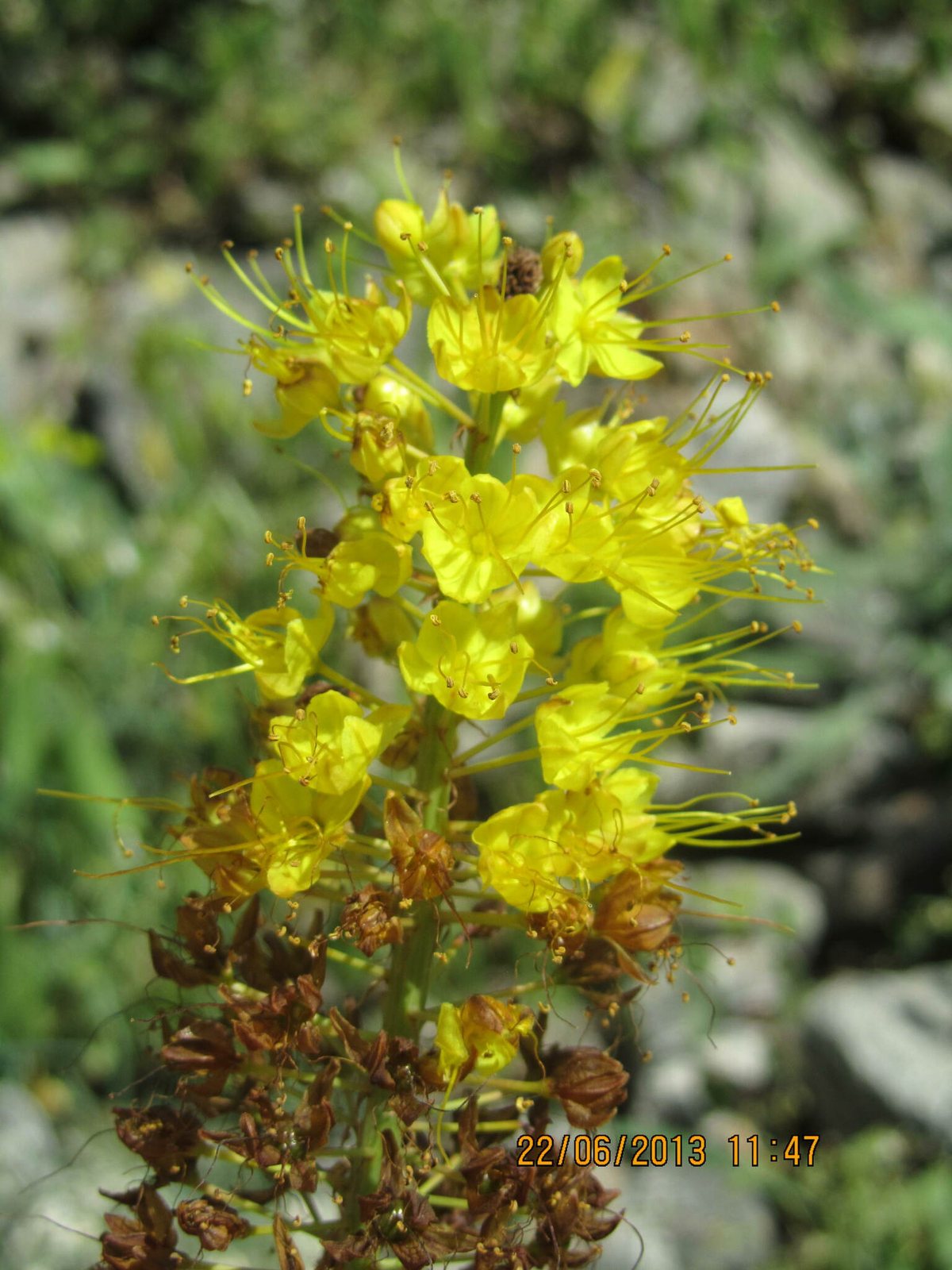
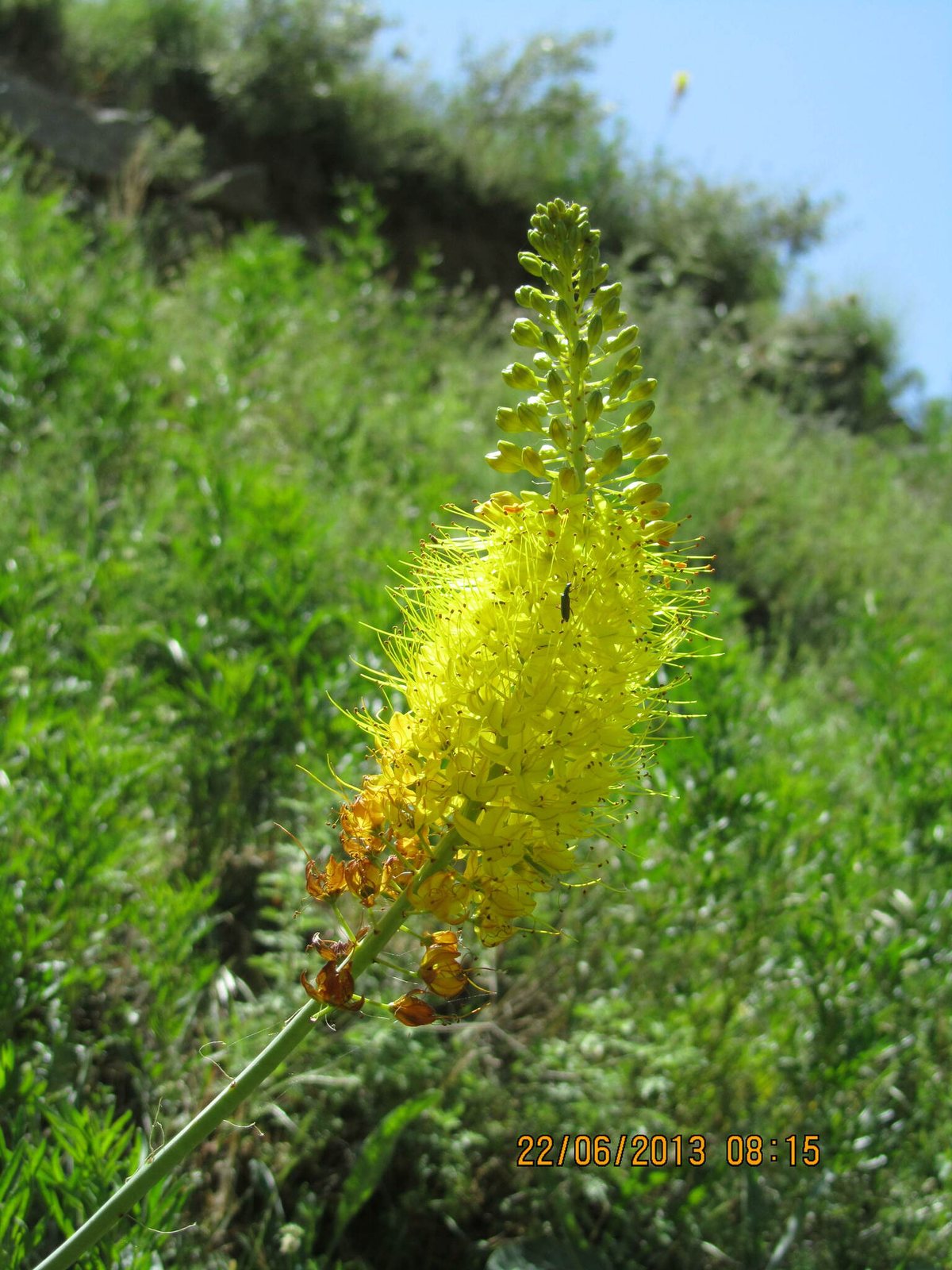
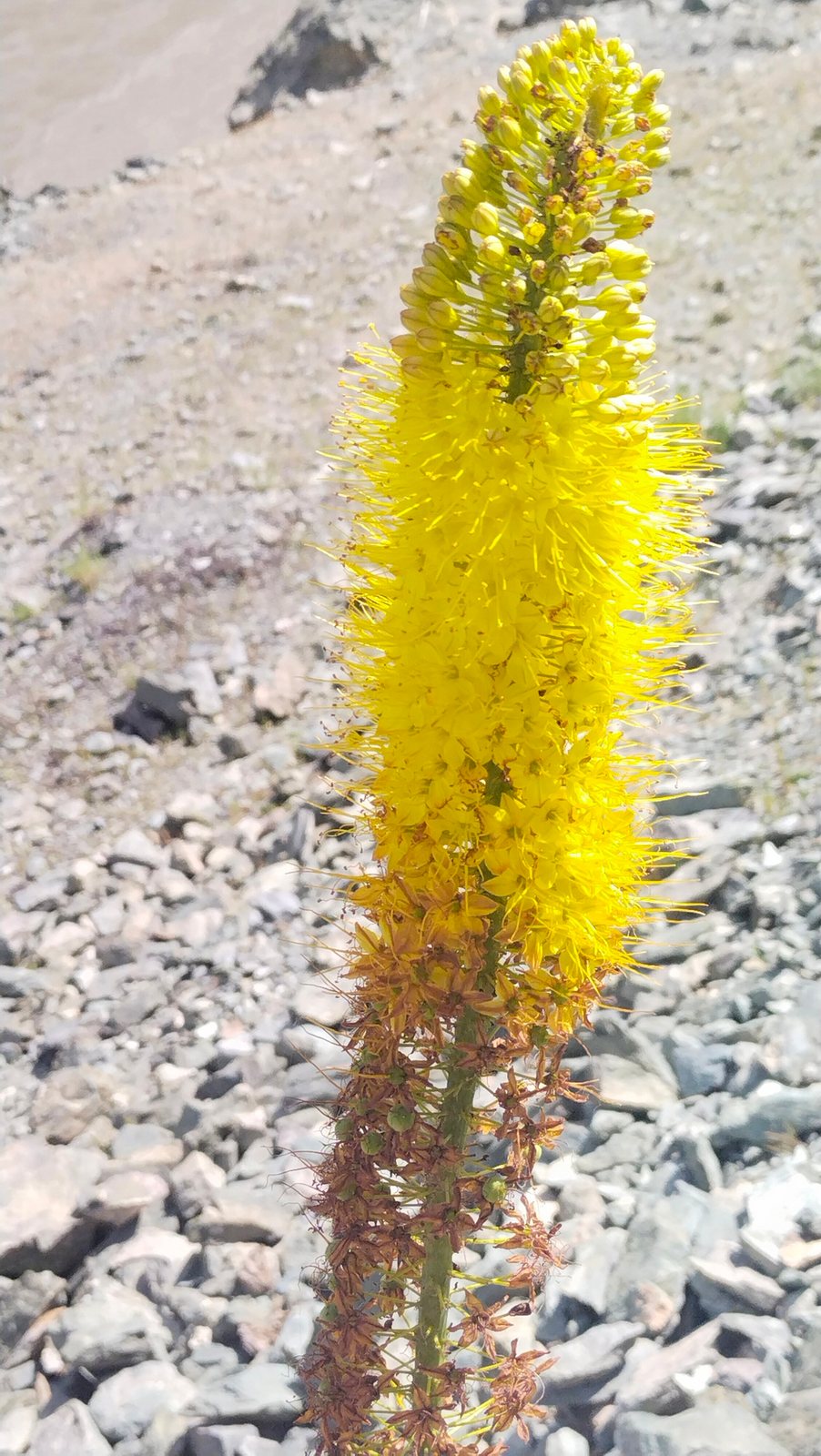
Foxtail lily is a summer-dormant perennial with narrow leaves and upright spikes packed with small yellow flowers. Gardeners grow it for height and strong vertical accents in sunny borders and gravel gardens. Its spreading, fleshy roots need excellent drainage, especially during winter and summer dormancy.
At a glance
- Sun
- Full sun in an open position sheltered from strong winds.
- Water
- Water during spring growth if rainfall is low, keeping the soil lightly moist but never saturated. Once the leaves die back, keep the dormant roots relatively dry.
- Soil
- Well-drained sandy or gritty loam, preferably neutral to alkaline. Improve drainage throughout the planting area or use a raised bed; a gravel pocket in heavy clay is not enough.
- Height
- 2-4 ft (0.6-1.2 m)
- Spread
- 1-2 ft (0.3-0.6 m)
- Flowers
- Late spring to early summer; dense spires of yellow flowers, often becoming orange-yellow as they age.
- Foliage
- Narrow, strap-shaped, blue-green leaves form a basal clump. They begin yellowing around flowering time and disappear during summer dormancy.
- Growth
- Moderate; newly planted roots may take a year or two to settle and flower well.
- Care needed
- Medium
The year at a glance
- Pollinators
- Low allergen
| J | F | M | A | M | J | J | A | S | O | N | D | |
|---|---|---|---|---|---|---|---|---|---|---|---|---|
| Flowers | ||||||||||||
| Fruit | ||||||||||||
| Plant |
Northern hemisphere months. In Australia, shift them by six.
- Difficulty
- Moderate
- Toughness
- Fairly tough
Will it suit your garden?
Pick your zone, country, light and whether you have pets.
Full sun is 6 or more hours of direct sun a day, part shade 3 to 6 hours, shade under 3.
How it grows
Planting day
1 ft (0.3 m)
After 1 year
1.6 ft (0.5 m)
After 2 years
2.3 ft (0.7 m)
After 3 years
3 ft (0.9 m)
full size
About 3 years to full size.
From a typical nursery size, at an average rate for this kind of plant. A rule of thumb, not a forecast.
Good to know
- Cats and dogs
- Safe
- Growth rate
- Moderate
Care
Jobs through the year
- WaterMar–Apr, every 14 days
- Water established plants during dry spring weather; keep soil lightly moist, not saturated.
- WaterMay–Jun, every 7 days
- Water during dry spells while leaves are green; stop once foliage dies back.
- FeedMar–Apr
- Apply one light dressing of balanced fertiliser as shoots emerge; avoid high nitrogen.
- MulchSep–Oct
- Use a thin gravel mulch around crowns rather than moisture-retentive organic material.
- ProtectJan–Feb, Nov–Dec
- Check drainage and shelter crowns from prolonged winter rain where necessary.
- ProtectMar–Apr
- Protect emerging shoots from sharp frosts with fleece and control damaging slugs.
- ProtectMay–Jun
- Support flower stems in exposed sites without piercing the brittle roots.
- DeadheadJun–Jul
- Cut faded spikes to the base unless retaining ornamental seed heads.
- PruneJul–Aug
- Remove fully dried foliage and mark dormant crowns to prevent accidental digging.
- Plant dormant roots in autumn, spreading the brittle roots carefully in a broad hole with the crown just below the soil surface.
- Water during dry spring weather, but avoid routine summer watering once the foliage has died back.
- Apply a light dressing of balanced fertiliser as shoots emerge in spring; avoid heavy nitrogen feeding.
- Use a thin gravel mulch around the crown rather than moisture-retentive organic mulch directly over it.
- Stake flower stems early if the site is exposed, taking care not to pierce the roots.
- Leave established clumps undisturbed unless they become crowded or need propagation.
Pruning. Cut spent flower stems down to the base unless you want seed. Let the leaves yellow and dry naturally before removing them; do not cut back green foliage.
Through the year
- Autumn
- Plant dormant roots in a sunny, freely drained bed, handling the fleshy roots carefully.
- Winter
- Check that water is draining away from the crowns; shelter the planting from prolonged winter rain if necessary.
- Early spring
- Watch emerging shoots for slug damage and protect them from severe late frosts.
- Spring
- Apply a light balanced feed and water during dry spells while leaves and flower stems develop.
- Late spring to early summer
- Support stems if needed and remove faded spikes unless saving seed.
- Summer
- Remove fully dried foliage, reduce watering and mark the dormant crowns so they are not accidentally dug up.
In the garden
- Plant in repeated groups through a sunny border to create a rhythm of slender yellow spires.
- Combine with purple salvias and catmint for contrasting flower shapes and colours.
- Use in a raised gravel bed where drainage suits its dormant roots and the stems stand out against low planting.
- Place behind low, drought-tolerant perennials that soften the gap left when its foliage dies back.
Garden styles it suits: Architectural minimal, Cottage garden, English country, Dry gravel garden, Mediterranean and Hot border.
Plant it with: Catmint, Perennial sage, Lavender, Yarrow, Bearded iris and Ornamental onions.
Wildlife: The open flowers provide nectar and pollen for bees and other visiting insects.
Problems to watch for
- Crown and root rot in wet soil: improve drainage across the whole bed or replant in a raised bed; keep dormant roots relatively dry.
- Slugs and snails eating emerging shoots: inspect regularly in spring and use barriers, hand removal or locally approved controls.
- Late frost damaging young growth: cover emerging shoots with horticultural fleece during sharp spring frosts.
- Poor flowering after planting or disturbance: allow time to establish, provide full sun and avoid repeated lifting or dividing.
Safety
Not known to be toxic to people, cats, dogs or horses. Species-specific safety information is limited, so do not treat the roots, leaves or flowers as food.
Easily confused with
Himalayan foxtail lily (Eremurus himalaicus)
Has white rather than yellow flowers and generally taller flower spikes.
Giant foxtail lily (Eremurus robustus)
Much larger overall, with broader leaves and tall spikes of pale pink flowers rather than compact yellow spires.
Red-hot poker (Kniphofia uvaria)
Has long tubular flowers crowded into a shorter, thicker head and persistent leafy clumps, rather than small star-shaped flowers along a long tapering spike.
The name
Eremurus comes from Greek words meaning 'desert' and 'tail', referring to the flower spikes, while stenophyllus means 'narrow-leaved'.
Propagation. Sow fresh seed in deep pots outdoors and allow exposure to winter cold; germination can be slow and seedlings take several years to flower. Established clumps can be divided during summer dormancy, keeping a sound crown and attached roots on each division, but damaged roots and disturbance can delay flowering.
Checked against open data
- Accepted botanical name
- Eremurus stenophyllus
- Native range
- Afghanistan, Iran, Kirgizstan, Pakistan, Tadzhikistan and Uzbekistan.
Sources: GBIF (CC BY 4.0) and Trefle (CC BY 4.0). The care and design notes are LandscapeGPT's own.
See it in your own yard.
Upload a photo of your yard and see it redesigned with plants that suit your climate, each checked against your zone.