Fuchsia 'Mrs Popple'
Fuchsia 'Mrs Popple'. Family Onagraceae. Shrub.
Also called Hardy fuchsia 'Mrs Popple'.
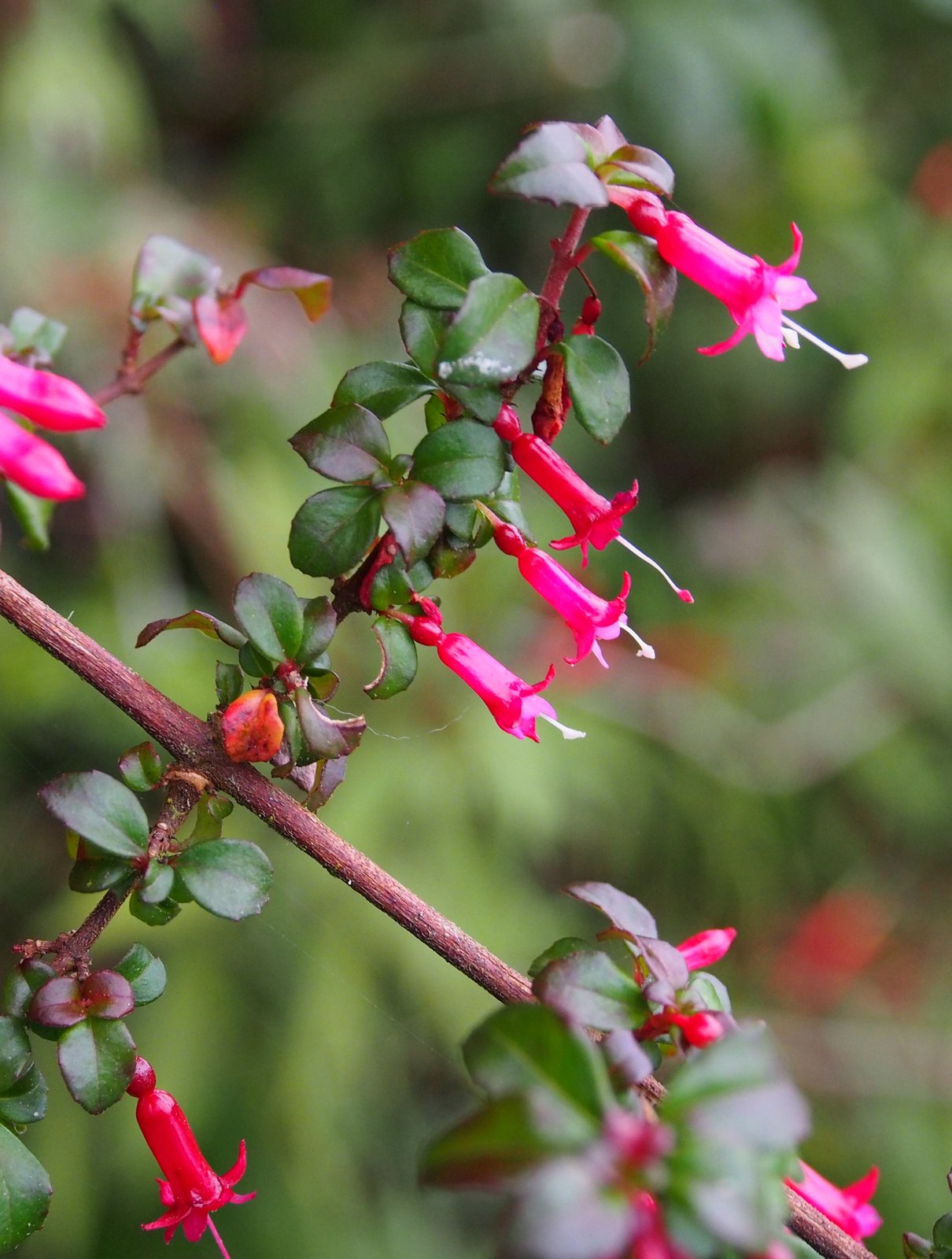
'Mrs Popple' is a bushy, deciduous fuchsia grown for its hanging flowers with scarlet sepals and violet-purple skirts. It flowers from summer into autumn and suits sheltered borders and large containers. In colder gardens, its stems may die back over winter and regrow from the base in spring.
At a glance
- Sun
- Partial shade, or full sun where summers are cool and the soil stays moist; protect from hot afternoon sun and drying winds.
- Water
- Keep evenly moist during growth without leaving the roots waterlogged; containers may need daily checks in warm weather.
- Soil
- Fertile, humus-rich, well-drained soil; tolerates slightly acidic, neutral or slightly alkaline conditions.
- Height
- 3-4 ft (0.9-1.2 m)
- Spread
- 3-4 ft (0.9-1.2 m)
- Flowers
- Summer to the first autumn frosts; dangling single flowers with scarlet tubes and sepals surrounding violet-purple petals.
- Foliage
- Small to medium-sized, pointed, toothed green leaves on slender, often reddish stems.
- Growth
- Moderate to fast once established
- Care needed
- Medium
The year at a glance
- Pollinators
- Wildlife
- Low allergen
| J | F | M | A | M | J | J | A | S | O | N | D | |
|---|---|---|---|---|---|---|---|---|---|---|---|---|
| Flowers | ||||||||||||
| Fruit | ||||||||||||
| Plant |
Northern hemisphere months. In Australia, shift them by six.
- Difficulty
- Moderate
- Toughness
- Needs looking after
Will it suit your garden?
Pick your zone, country, light and whether you have pets.
Full sun is 6 or more hours of direct sun a day, part shade 3 to 6 hours, shade under 3.
How it grows
Planting day
1.6 ft (0.5 m)
After 1 year
2.1 ft (0.64 m)
After 2 years
2.5 ft (0.78 m)
After 3 years
3 ft (0.91 m)
After 5 years
3 ft (1.1 m)
full size
About 4 years to full size.
From a typical nursery size, at an average rate for this kind of plant. A rule of thumb, not a forecast.
Good to know
- Cats and dogs
- Safe
- Growth rate
- Fast
Care
Jobs through the year
- WaterApr–May, Sep–Oct, every 7 days
- Water established plants if soil is drying; keep young plants consistently moist.
- WaterJun–Aug, every 4 days
- In dry weather, soak established roots before soil dries out; avoid waterlogging.
- FeedApr–May
- Apply a balanced fertilizer as spring growth begins.
- MulchMay
- Apply compost around the roots to retain moisture, clear of stems.
- PruneApr–May
- After severe frost risk passes and shoots appear, cut dead stems back to healthy growth.
- ProtectJan–Apr, Oct–Dec
- Use insulating crown mulch in mild gardens; in zones 6–7, overwinter frost-free in a container.
- Plant in spring in a sheltered position so the roots establish before winter.
- Water deeply during dry spells, especially in the first growing season.
- Apply a balanced fertiliser in spring; feed container plants regularly during active growth according to the product label.
- Mulch the root area with compost to conserve moisture, keeping it clear of the stems.
- In colder gardens, add a deeper insulating mulch over the crown in late autumn; protect containers from hard freezes.
Pruning. In spring, once new growth shows and severe frosts have passed, cut dead or frost-damaged stems back to healthy shoots or near ground level. Where stems survive winter, shorten them to a low framework and remove weak or crowded growth.
Through the year
- Spring
- Wait for buds or basal shoots to appear, then prune away winter-damaged stems.
- Late spring
- Plant new specimens after severe frost risk has passed; water thoroughly and mulch.
- Early summer
- Take softwood cuttings from healthy, non-flowering shoots.
- Summer
- Keep the root zone moist, feed container plants and inspect shoot tips for pests.
- Autumn
- Reduce feeding as growth slows and move vulnerable pots into frost-protected shelter.
- Late autumn
- Mulch the crown in colder locations and leave standing stems until spring.
In the garden
- Use in a sheltered mixed border for strong flower colour after many spring shrubs have finished.
- Combine with ferns and hostas in light shade, where the hanging flowers stand out against broad foliage.
- Grow in a large patio container positioned where the flowers can be viewed closely.
- Repeat through a cottage-style border with hardy geraniums and Japanese anemones for a long flowering season.
Garden styles it suits: Cottage garden, English country, Traditional, Romantic rose garden, Modern courtyard and Pacific Northwest woodland.
Plant it with: Hostas, Hardy geraniums, Japanese anemones, Heucheras, Lady ferns and Astilbes.
Wildlife: Flowers attract bumblebees and, where present, hummingbirds. Birds may eat the berries.
Problems to watch for
- Fuchsia gall mite causes swollen, distorted shoot tips and flowers. Remove affected growth promptly, dispose of it rather than composting it, and do not take cuttings from affected plants; severely affected plants may need replacing.
- Vine weevil larvae can eat roots, especially in containers, causing sudden wilting. Check the root ball and use an appropriate biological nematode treatment when soil temperatures suit the product.
- Fuchsia rust produces orange pustules beneath leaves. Remove affected leaves, clear fallen foliage and improve air circulation without exposing the plant to drying winds.
- Winter cold or waterlogged soil can kill stems or the crown. Provide drainage, shelter and winter mulch, and protect pots from prolonged freezing.
Safety
Not known to be toxic to people, cats, dogs or horses. Fuchsia flowers and ripe berries are generally considered edible, although this cultivar is grown as an ornamental; do not eat material treated with pesticides unsuitable for food crops.
Easily confused with
Hardy fuchsia (Fuchsia magellanica)
Usually has smaller, slimmer flowers and a more open, fine-textured habit; 'Mrs Popple' has larger flowers with a fuller purple skirt.
Fuchsia 'Riccartonii' (Fuchsia magellanica 'Riccartonii')
Has smaller, narrower red-and-purple flowers and generally a taller, more upright habit.
Fuchsia 'Dollar Princess' (Fuchsia 'Dollar Princess')
Has double purple flowers with a densely layered skirt, unlike the single flowers of 'Mrs Popple'.
The name
The genus Fuchsia honours the German physician and botanist Leonhart Fuchs.
Propagation. Take softwood cuttings in late spring or early summer, or semi-ripe cuttings later in summer. Root in a free-draining propagation mix with gentle humidity; seed will not reliably reproduce the cultivar.
Checked against open data
- Accepted botanical name
- Fuchsia
Sources: GBIF (CC BY 4.0). The care and design notes are LandscapeGPT's own.
See it in your own yard.
Upload a photo of your yard and see it redesigned with plants that suit your climate, each checked against your zone.