Fuyu persimmon
Diospyros kaki 'Fuyu'. Family Ebenaceae. Tree.
Also called Japanese persimmon 'Fuyu', Oriental persimmon 'Fuyu'.
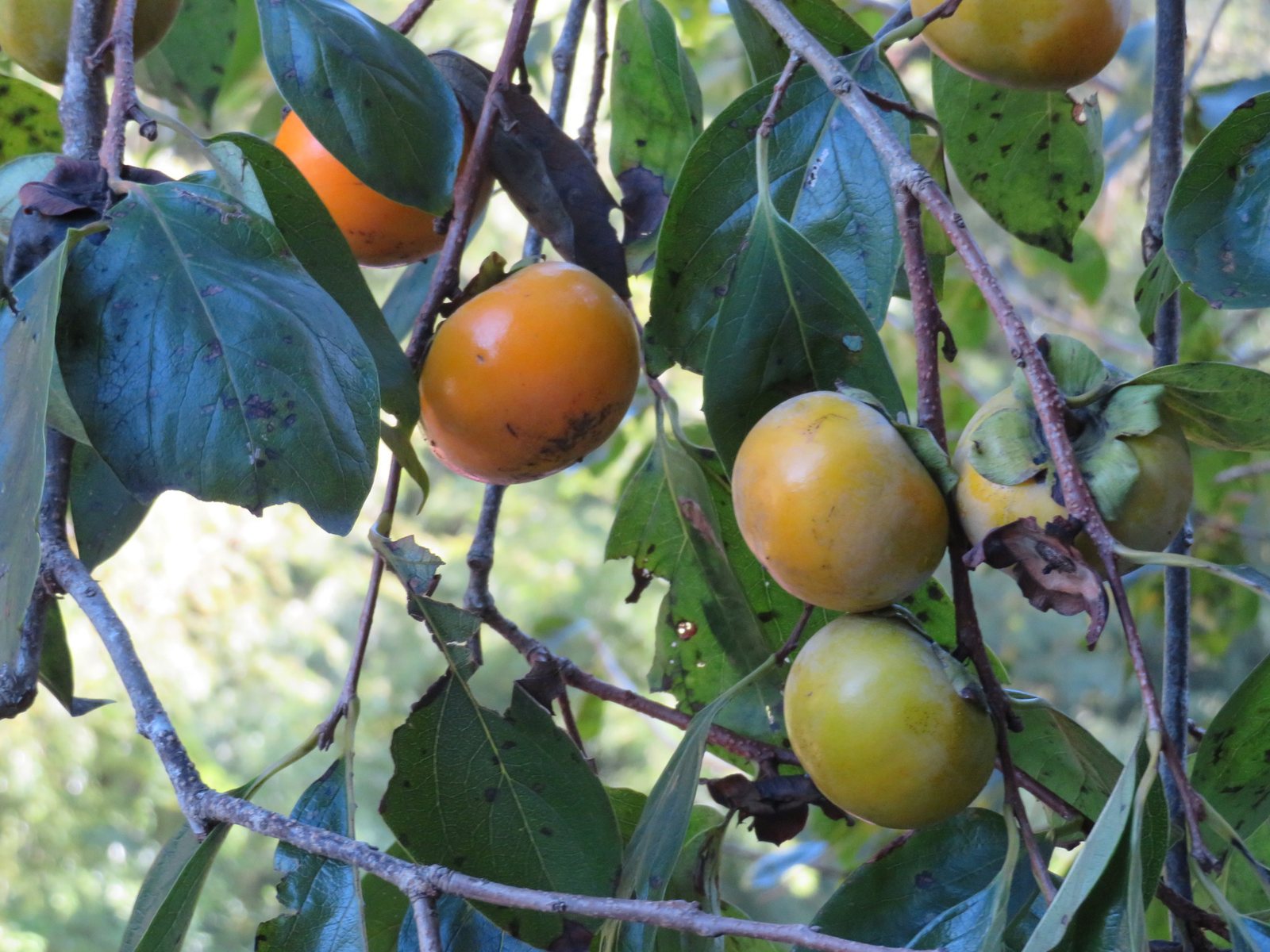
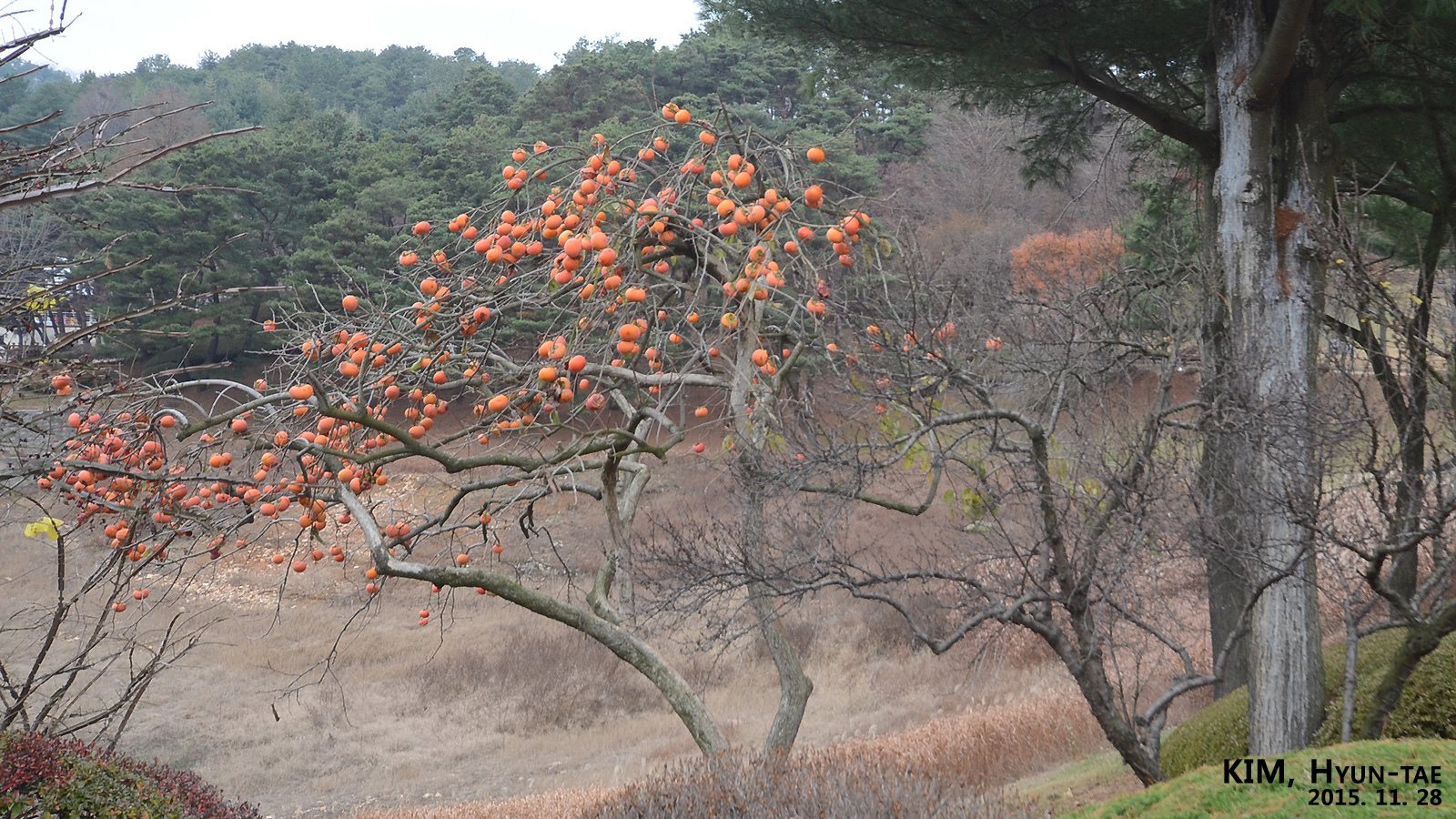
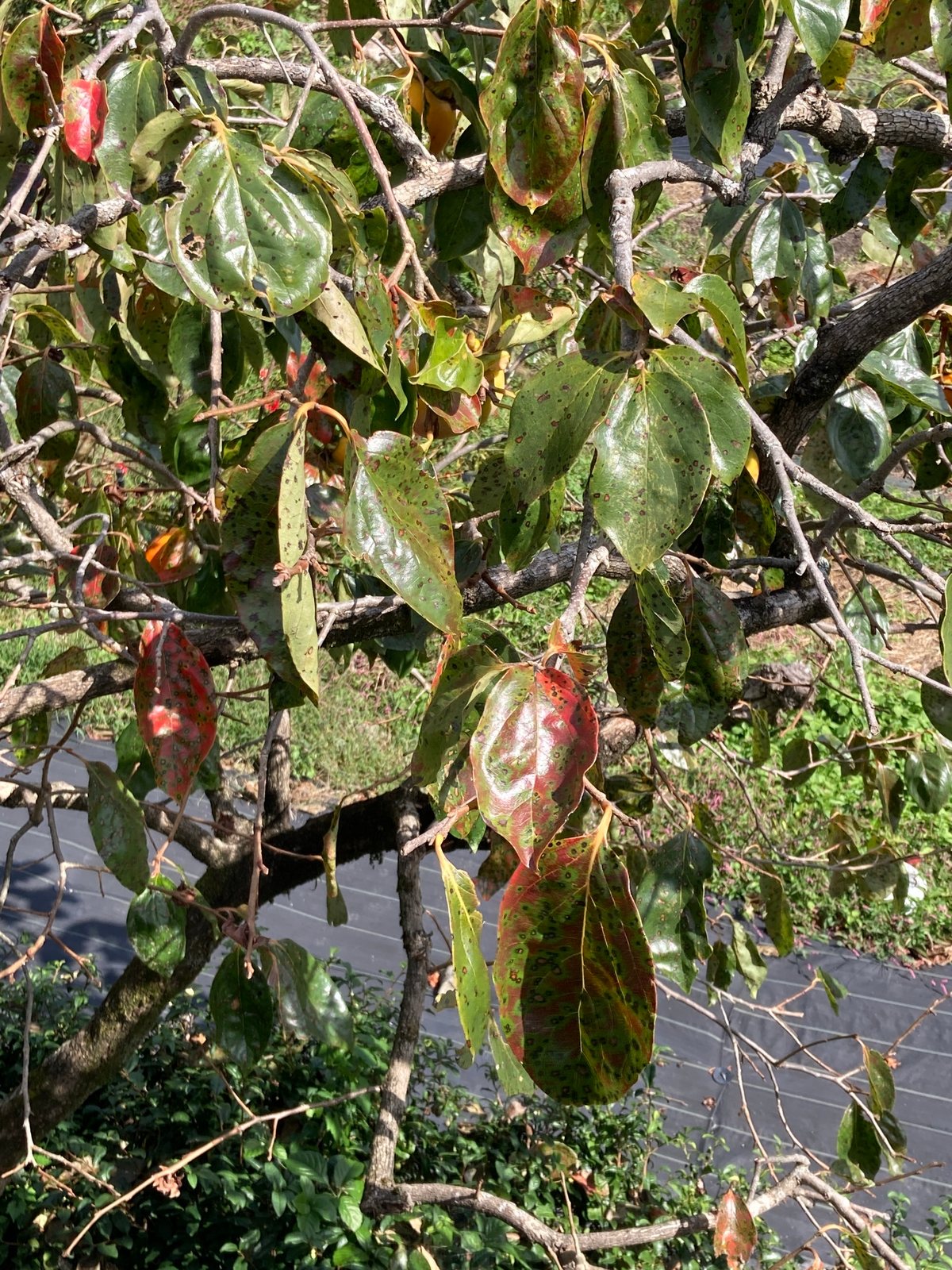
A deciduous fruit tree grown for its flattened orange persimmons, which can be eaten firm like an apple once fully coloured. Glossy leaves turn yellow, orange or red in autumn, often leaving fruit hanging on bare branches. It needs a warm growing season to ripen reliably; cool British summers and most Canadian climates limit cropping.
At a glance
- Sun
- Full sun in a warm position sheltered from strong winds and late spring frosts.
- Water
- Water deeply during dry spells, especially while establishing and as fruit develops; avoid waterlogged soil.
- Soil
- Deep, well-drained loam is ideal; tolerates clay if drainage is good. Slightly acidic to neutral soil is preferred.
- Height
- 15-25 ft (4.6-7.6 m)
- Spread
- 15-20 ft (4.6-6.1 m)
- Flowers
- Small, inconspicuous creamy-yellow flowers in late spring to early summer.
- Foliage
- Large, oval, glossy dark-green leaves with yellow, orange or red autumn colour.
- Growth
- Moderate; slower in cool climates or poor soil.
- Care needed
- Medium
The year at a glance
- Pollinators
- Heat tolerant
- Wildlife
- Low allergen
- Edible
| J | F | M | A | M | J | J | A | S | O | N | D | |
|---|---|---|---|---|---|---|---|---|---|---|---|---|
| Flowers | ||||||||||||
| Fruit | ||||||||||||
| Plant |
Northern hemisphere months. In Australia, shift them by six.
- Difficulty
- Moderate
- Toughness
- Fairly tough
Will it suit your garden?
Pick your zone, country, light and whether you have pets.
Full sun is 6 or more hours of direct sun a day, part shade 3 to 6 hours, shade under 3.
How it grows
Planting day
7 ft (2 m)
After 1 year
7 ft (2.2 m)
After 2 years
8 ft (2.3 m)
After 3 years
8 ft (2.5 m)
After 5 years
9 ft (2.8 m)
About 26 years to full size.
From a typical nursery size, at an average rate for this kind of plant. A rule of thumb, not a forecast.
Good to know
- Cats and dogs
- Safe
- Growth rate
- Slow
Care
Jobs through the year
- WaterApr–May, Sep–Oct, every 14 days
- Water established trees deeply if soil is dry; water more often during the first two seasons.
- WaterJun–Aug, every 7 days
- Water deeply during dry spells, maintaining even moisture as fruit develops; skip if soil remains moist.
- MulchApr
- Renew organic mulch over the root zone, keeping it clear of the trunk.
- FeedApr
- Apply a modest balanced feed only if growth is weak; avoid excess nitrogen.
- PruneMar
- After severe frosts, remove dead or crossing branches without routinely shortening healthy tips.
- PruneJun–Jul
- Thin overloaded fruit clusters after natural fruit drop to prevent branch breakage.
- ProtectMar–May
- Cover emerging growth with fleece when late frost is forecast.
- HarvestOct–Dec, every 7 days
- Cut fully orange fruit with its calyx attached before damaging freezes; firm fruit is edible.
- ProtectJan–Feb, Nov–Dec
- Insulate young trunks and guard against browsing; use a sheltered zone 7 site, not an exposed zone 6 garden.
- Water the root area deeply through the first two growing seasons and during prolonged summer drought.
- Apply organic mulch over the root zone, keeping it clear of the trunk.
- Use a modest spring feed only if growth is weak; excess nitrogen encourages leafy growth and fruit drop.
- Thin heavy fruit clusters after the natural early fruit drop to reduce branch breakage.
- Protect young trees from severe frost and shelter them from drying winds.
- One tree can set fruit without a pollinator; nearby compatible persimmons may increase seed formation.
Pruning. Prune lightly in late winter or early spring after the worst frosts, removing dead, crossing and poorly placed branches and developing a strong framework. Fruit forms on new shoots arising from the previous year's wood, so avoid routinely shortening all branch tips.
Harvest
Pick fully orange fruit in autumn to early winter, before a damaging freeze; 'Fuyu' is non-astringent and can be eaten while firm or allowed to soften. Cut the stalk with secateurs, leaving the leafy calyx attached, rather than pulling fruit from the branch. A grafted tree usually gives its first worthwhile crop about 3-5 years after planting, sometimes longer in cool conditions.
Through the year
- Late winter
- Plant while dormant where the ground is workable, and prune established trees lightly after severe frosts have passed.
- Spring
- Renew mulch, feed only if needed, and protect emerging shoots from forecast frost.
- Early summer
- Check fruit set and thin overloaded clusters once natural fruit drop slows.
- Summer
- Water during dry spells and inspect fruit-bearing branches for strain.
- Autumn
- Harvest fully coloured fruit and remove fallen or damaged fruit.
- Winter
- Protect young trunks from browsing animals and check tree ties for rubbing.
In the garden
- Use as a specimen in a sunny lawn or open border for autumn foliage and conspicuous orange fruit.
- Include in a small orchard or edible landscape with enough space to reach the canopy for harvesting.
- Place against the backdrop of a sheltered courtyard wall, allowing room for its spreading crown.
- Combine with low spring bulbs and groundcovers, keeping a mulched area around the trunk.
Garden styles it suits: Japanese, Backyard orchard, Edible landscape, Food forest, Autumn colour and Modern courtyard.
Plant it with: Chives, Thyme, Crocus, Strawberries and Yarrow.
Wildlife: Birds and mammals eat ripe fruit, sometimes before harvest. Flowers attract visiting insects, although 'Fuyu' can produce fruit without pollination.
Problems to watch for
- Poor ripening in cool summers: choose the warmest sheltered site; winter hardiness alone does not guarantee a crop.
- Fruit drop: maintain even soil moisture, avoid excessive nitrogen and allow for some natural early shedding.
- Scale insects and mealybugs: inspect stems and leaf undersides; remove small infestations by hand and use a locally approved horticultural oil when appropriate.
- Fruit fly in affected Australian regions: follow local monitoring advice, remove fallen fruit promptly and protect fruit with suitable insect-exclusion bags or netting.
Safety
Not generally known to be poisonous to people, cats or dogs, and ripe flesh is edible. Seeds and large pieces can cause choking or intestinal obstruction in pets. Persimmons, especially unripe fruit and seeds, can form digestive concretions called bezoars; this is a serious, potentially fatal risk for horses, so keep trees and fallen fruit out of paddocks. Excessive consumption of unripe fruit can also cause bezoars in people.
Easily confused with
Hachiya persimmon (Diospyros kaki 'Hachiya')
Fruit is usually elongated and acorn-shaped rather than flattened; it must become jelly-soft before eating because firm fruit is strongly astringent.
American persimmon (Diospyros virginiana)
Usually bears much smaller fruit and develops deeply blocky bark with age; its fruit generally needs to soften fully before eating.
The name
Diospyros comes from Greek words commonly interpreted as 'food of the gods', kaki is the Japanese name for persimmon, and Fuyu means 'winter' in Japanese.
Propagation. Usually propagated by grafting or budding onto compatible persimmon rootstock. Seedlings do not come true to 'Fuyu', and rooting cuttings is difficult.
Checked against open data
- Accepted botanical name
- Diospyros kaki
- Native range
- Assam, China North-Central, China South-Central, China Southeast, Hainan, Taiwan and Vietnam.
- Measured
- Average height 1200 cm.
Sources: GBIF (CC BY 4.0) and Trefle (CC BY 4.0). The care and design notes are LandscapeGPT's own.
See it in your own yard.
Upload a photo of your yard and see it redesigned with plants that suit your climate, each checked against your zone.