Giant sacaton
Sporobolus wrightii. Family Poaceae. Ornamental grass.
Also called Big sacaton, Wright's dropseed.
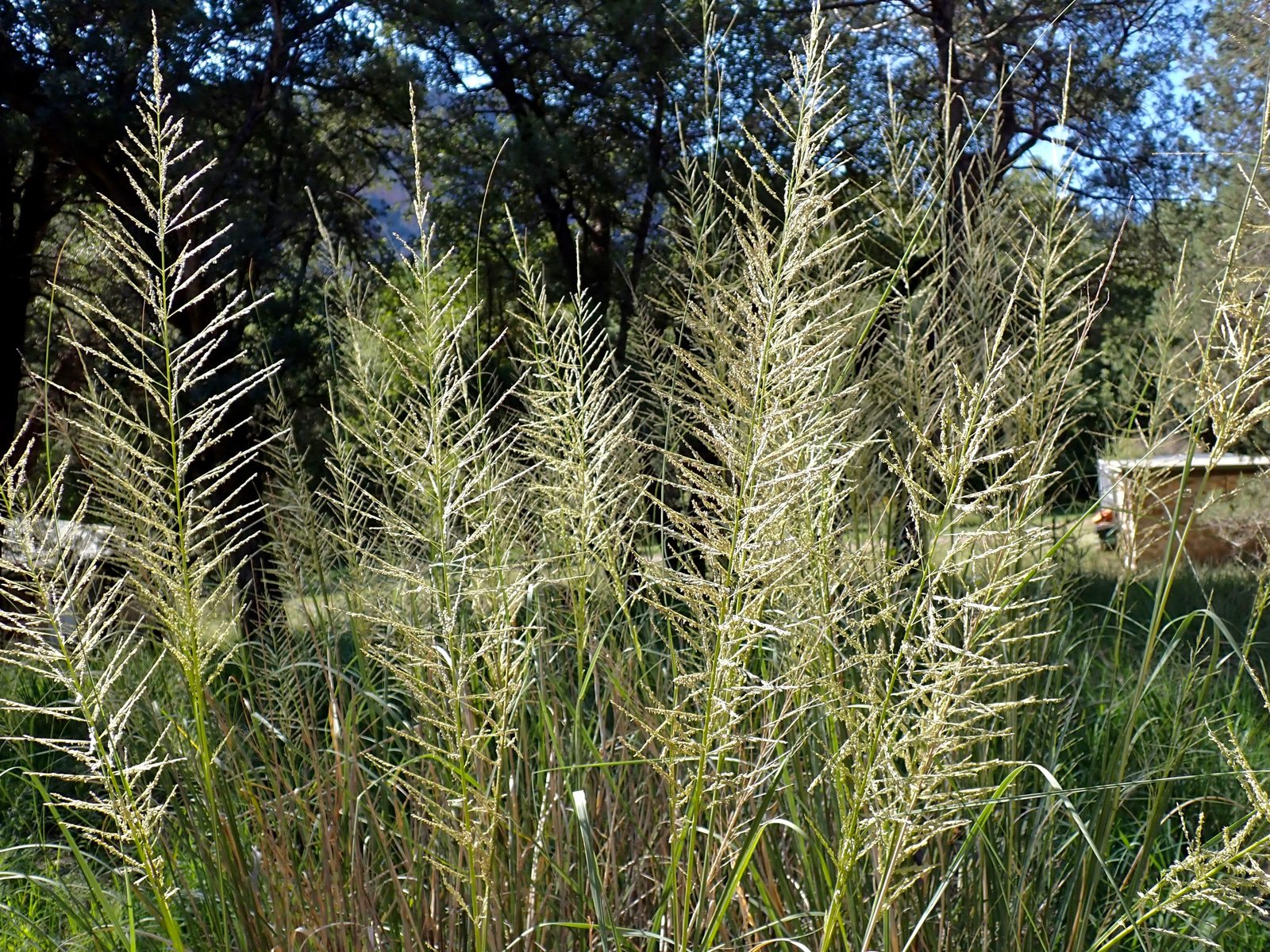
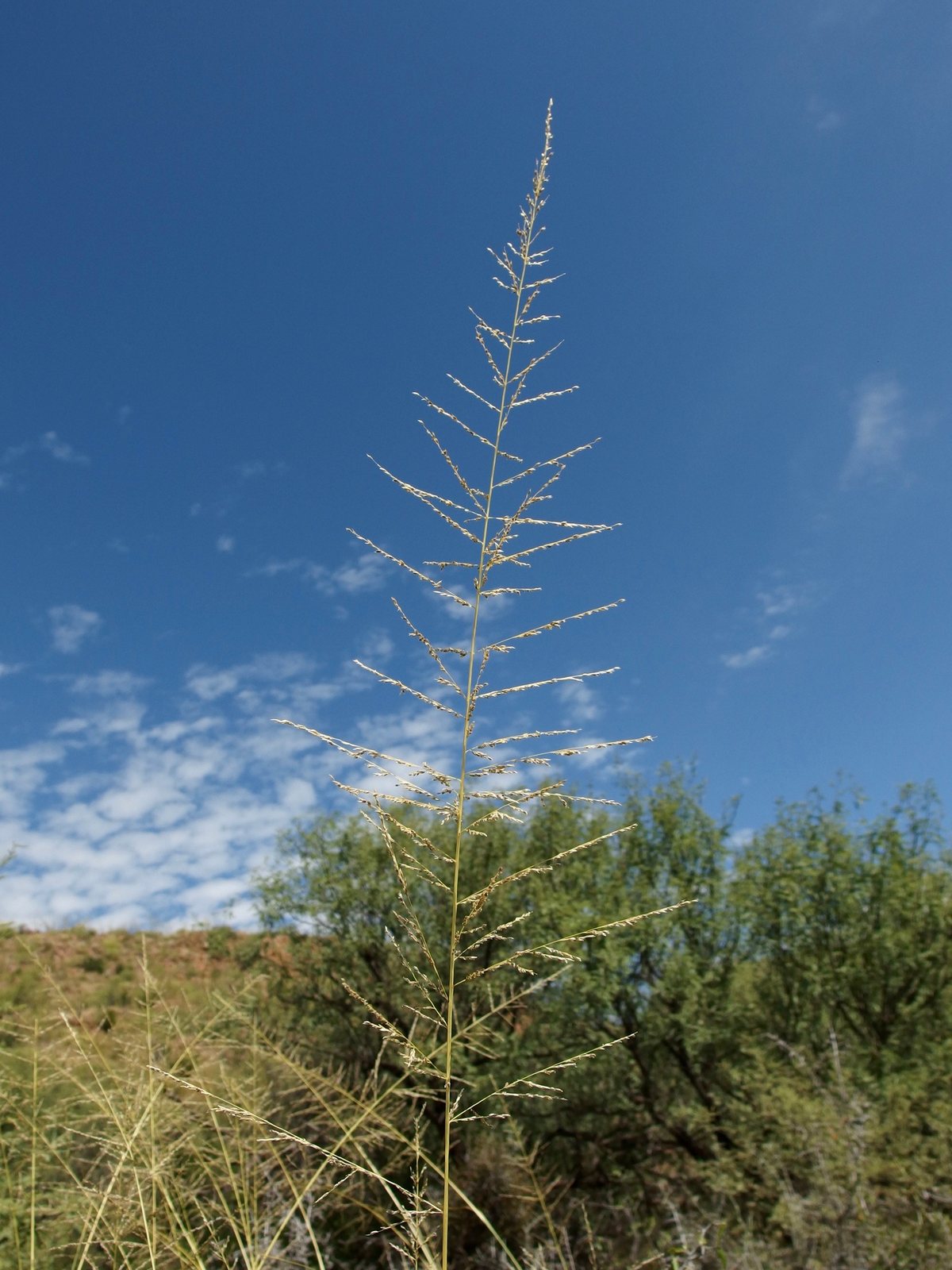
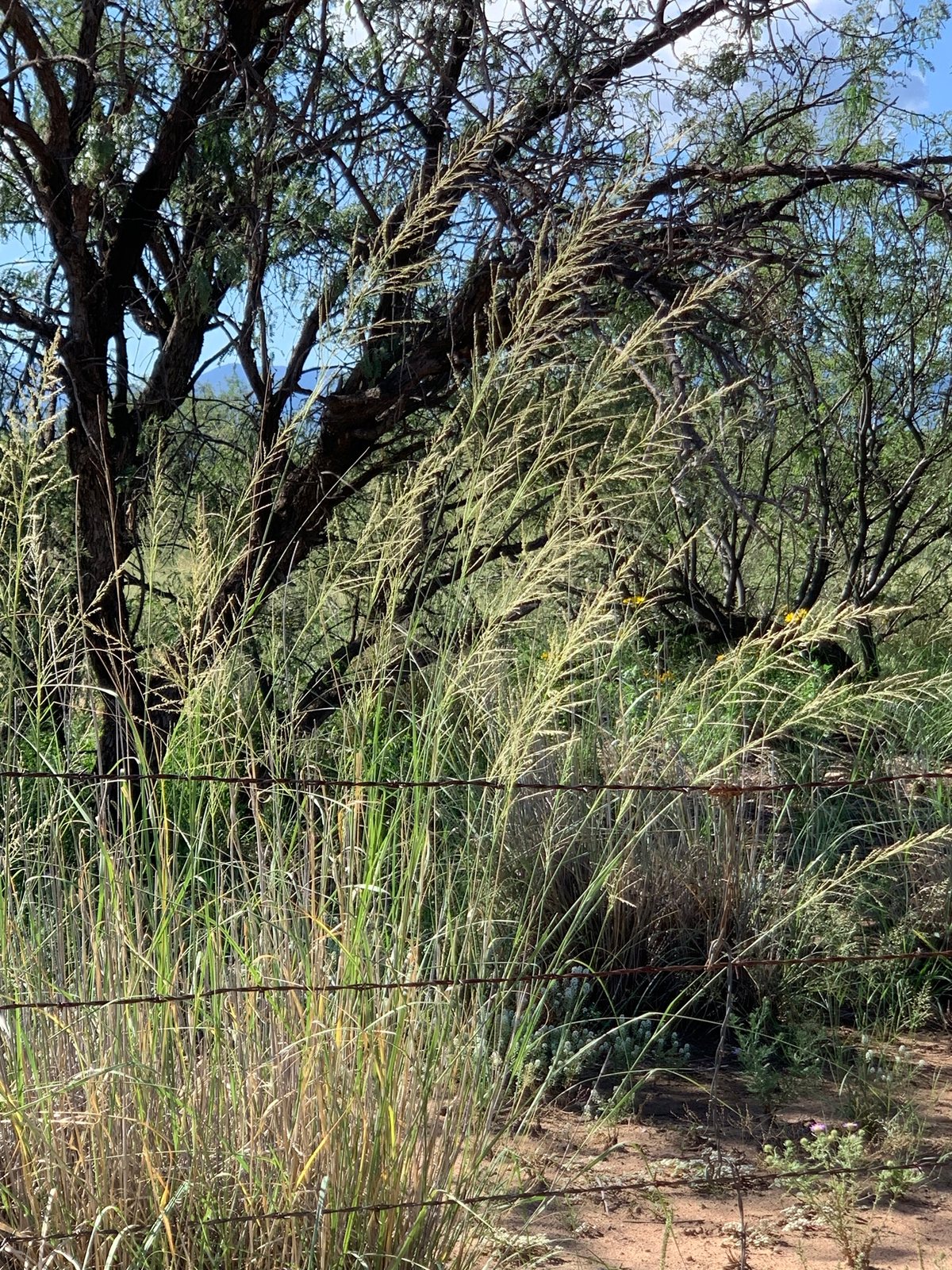
Giant sacaton is a large, warm-season bunchgrass native to the southwestern United States and northern Mexico. Gardeners grow it for its arching grey-green leaves, tall clouds of fine flowerheads and strong winter outline. Give it plenty of room and a warm, sunny position; it can be slow to start growing in spring.
At a glance
- Sun
- Full sun; flowering and upright growth are best in an open, warm position.
- Water
- Drought-tolerant once established. Water regularly during its first growing season, then deeply during prolonged dry spells if foliage begins to curl or brown.
- Soil
- Adaptable to sandy, loamy or clay soils, including alkaline and moderately saline ground. Tolerates periodic flooding, but avoid persistently waterlogged soil, particularly in winter.
- Height
- 6-8 ft (1.8-2.4 m), including flower stems
- Spread
- 3-5 ft (0.9-1.5 m)
- Flowers
- Late summer to autumn; large, airy flowerheads with pinkish-purple tones, fading to pale tan.
- Foliage
- Long, narrow, arching grey-green leaves form a substantial clump and turn straw-coloured in autumn. Some foliage may remain green in frost-free conditions.
- Growth
- Moderate to fast in warm weather; slower in cool-summer climates.
- Care needed
- Low
The year at a glance
- Deer resistant
- Drought tolerant
- Heat tolerant
- Wildlife
| J | F | M | A | M | J | J | A | S | O | N | D | |
|---|---|---|---|---|---|---|---|---|---|---|---|---|
| Flowers | ||||||||||||
| Fruit | ||||||||||||
| Plant |
Northern hemisphere months. In Australia, shift them by six.
- Difficulty
- Easy
- Toughness
- Very tough
Will it suit your garden?
Pick your zone, country, light and whether you have pets.
Full sun is 6 or more hours of direct sun a day, part shade 3 to 6 hours, shade under 3.
How it grows
Planting day
1.1 ft (0.35 m)
After 1 year
3 ft (1.1 m)
After 2 years
6 ft (1.8 m)
After 3 years
7 ft (2.1 m)
full size
About 3 years to full size.
From a typical nursery size, at an average rate for this kind of plant. A rule of thumb, not a forecast.
Good to know
- Cats and dogs
- Safe
- Growth rate
- Moderate
Care
Jobs through the year
- WaterApr–May, Sep, every 21 days
- Water established ground plants only during prolonged drought; water new plants regularly through their first season.
- WaterJun–Aug, every 14 days
- Water deeply only in prolonged drought or if leaves curl or brown; let the surface dry between soakings.
- PruneFeb–Mar
- Cut old stems to 15–30 cm before new shoots lengthen; wear gloves and long sleeves.
- DivideApr–May
- Divide only oversized or dead-centred clumps as soil warms, replanting vigorous outer sections.
- Water deeply through the first growing season, allowing the soil surface to dry between waterings.
- Leave 3-5 ft (0.9-1.5 m) between plants so mature clumps have room to expand.
- Avoid routine feeding; rich soil and heavy nitrogen applications can encourage floppy growth.
- Keep mulch away from the crown, especially where winters are wet.
- Divide in spring only when a clump becomes too large or develops a dead centre.
Pruning. Leave the dry stems standing through winter, then cut the whole clump to 6-12 in (15-30 cm) above ground in late winter or early spring, before new shoots lengthen. Wear gloves and long sleeves when handling the coarse leaves.
Through the year
- Late winter
- Cut back old leaves and flower stems before new growth begins.
- Spring
- Plant or divide once the soil is warming; do not mistake its late emergence for winter damage.
- Late spring
- Check new plantings for moisture and remove weeds around the developing clumps.
- Summer
- Water young plants deeply during dry weather; established clumps usually need little supplementary water.
- Autumn
- Leave the ripening seedheads and dry foliage for wildlife and winter structure.
In the garden
- Use as a tall focal point in a sunny gravel garden, with lower drought-tolerant plants around its base.
- Plant in broad groups at the back of a large border for a light, moving screen.
- Combine with late-flowering perennials so their flowers show through its airy seedheads.
- Use beside paths or terraces where there is enough setback for its wide, arching leaves.
Garden styles it suits: Southwestern, Desert / xeriscape, New perennial (prairie), Architectural minimal, Dry gravel garden and Winter interest.
Plant it with: Red yucca, Autumn sage, Purple coneflower, Gaura, Little bluestem and Threadleaf coreopsis.
Wildlife: Seedheads provide food for seed-eating birds, and the dense clumps offer shelter for insects and small animals. Flowers are wind-pollinated rather than a nectar source for bees.
Problems to watch for
- Crown rot in persistently wet winter soil: improve drainage or move the plant to a raised position.
- Floppy stems in shade or overly rich soil: provide full sun and stop nitrogen feeding.
- Poor growth or sparse flowering in cool summers: choose the warmest sunny position available; flowering may remain limited in cool maritime gardens.
- Dead centre in an old clump: divide in spring and replant vigorous outer sections.
Safety
Not known to be toxic to people, cats, dogs or horses. No part is recognised as poisonous; coarse leaves can scratch skin, so wear gloves when cutting or dividing.
Easily confused with
Alkali sacaton (Sporobolus airoides)
Usually smaller, commonly 2-4 ft (0.6-1.2 m) tall, with a finer, less imposing clump and airy pinkish flowerheads.
Prairie dropseed (Sporobolus heterolepis)
Forms much smaller, finely textured mounds, usually reaching only 2-3 ft (0.6-0.9 m) in flower; its flowers often have a distinctive scent.
Pampas grass (Cortaderia selloana)
Has dense, fluffy white or pink plumes rather than giant sacaton's open, finely branched flowerheads, and much sharper leaf edges.
The name
Sporobolus means 'seed thrower', referring to the release of ripe seeds, and wrightii honours the American botanical collector Charles Wright.
Propagation. Sow seed in spring with warmth, covering it only lightly, or divide established clumps in spring as growth starts. Large clumps are tough to split, so use a sharp spade and replant divisions promptly.
Checked against open data
- Accepted botanical name
- Sporobolus wrightii
- Native range
- Arizona, California, Mexico Central, Mexico Northeast, Mexico Northwest, New Mexico, Oklahoma, South Carolina, Texas and Utah.
- Measured
- Soil pH 5.6 to 8.
Sources: GBIF (CC BY 4.0) and Trefle (CC BY 4.0). The care and design notes are LandscapeGPT's own.
See it in your own yard.
Upload a photo of your yard and see it redesigned with plants that suit your climate, each checked against your zone.