Golden chain tree
Laburnum × watereri. Family Fabaceae. Tree.
Also called Waterer's laburnum, Hybrid laburnum, Golden rain tree.
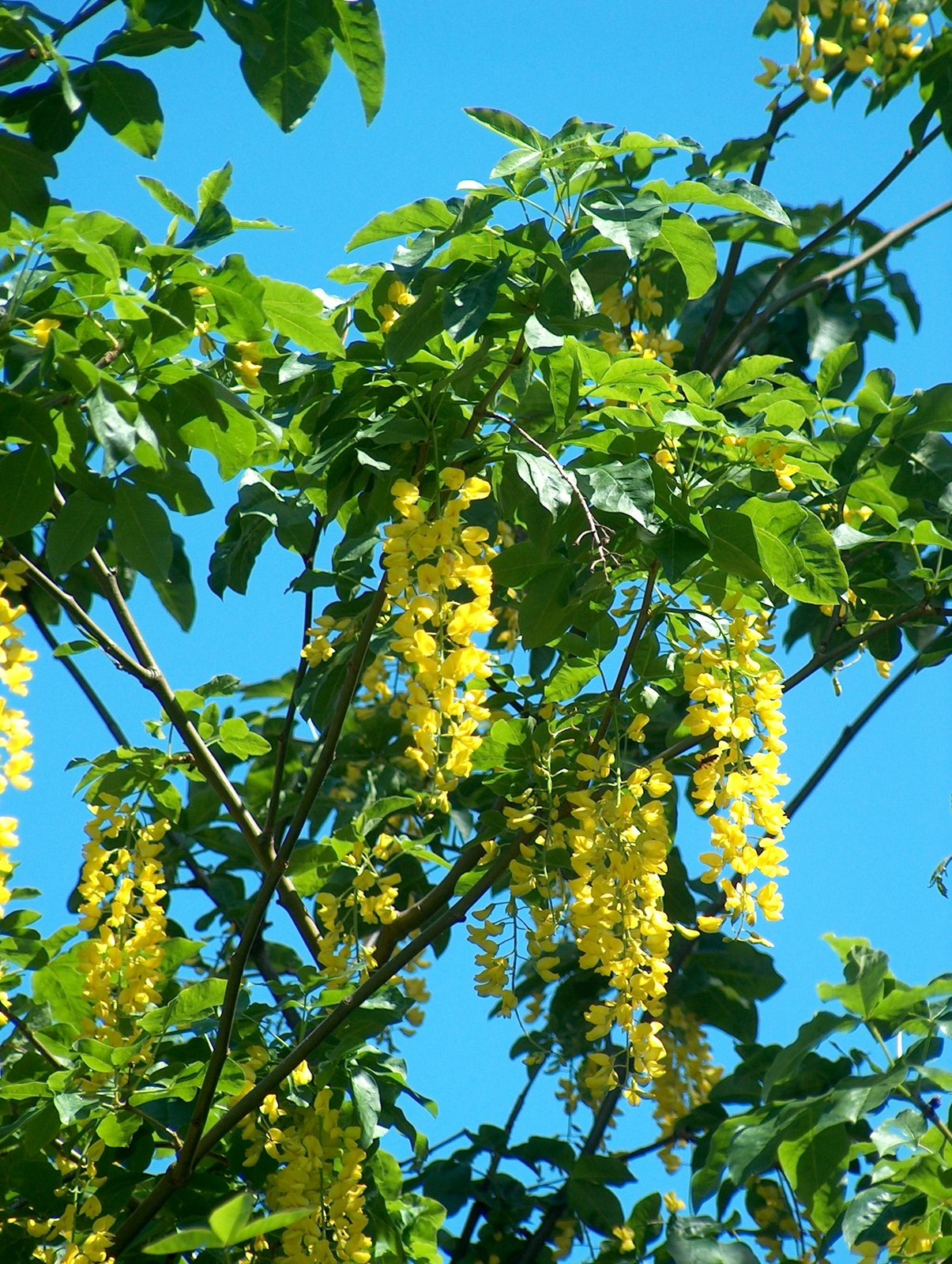
A small deciduous tree grown for long, hanging clusters of yellow flowers in late spring. It suits cool-temperate gardens and can be trained over an arch, but struggles in prolonged heat and humidity. All parts are poisonous, so avoid planting where children or animals might eat the seeds or foliage.
At a glance
- Sun
- Full sun for the best flowering; tolerates light partial shade.
- Water
- Water regularly while establishing, then during prolonged dry spells. Keep the root zone moist but never waterlogged.
- Soil
- Well-drained soil, including chalky and alkaline soils; tolerates moderately acidic conditions. Avoid persistently wet ground.
- Height
- 15-25 ft (4.5-7.6 m)
- Spread
- 15-25 ft (4.5-7.6 m)
- Flowers
- Late spring to early summer; fragrant, golden-yellow pea flowers in long, dangling clusters.
- Foliage
- Green leaves divided into three oval leaflets; autumn colour is usually modest.
- Growth
- Moderate
- Care needed
- Medium
The year at a glance
- Pollinators
- Wildlife
- Low allergen
- Fragrant
| J | F | M | A | M | J | J | A | S | O | N | D | |
|---|---|---|---|---|---|---|---|---|---|---|---|---|
| Flowers | ||||||||||||
| Fruit | ||||||||||||
| Plant |
Northern hemisphere months. In Australia, shift them by six.
- Difficulty
- Moderate
- Toughness
- Fairly tough
Will it suit your garden?
Pick your zone, country, light and whether you have pets.
Full sun is 6 or more hours of direct sun a day, part shade 3 to 6 hours, shade under 3.
How it grows
Planting day
7 ft (2 m)
After 1 year
7 ft (2.2 m)
After 2 years
8 ft (2.4 m)
After 3 years
9 ft (2.6 m)
After 5 years
10 ft (3 m)
About 20 years to full size.
From a typical nursery size, at an average rate for this kind of plant. A rule of thumb, not a forecast.
Good to know
- Cats and dogs
- Toxic
- Growth rate
- Moderate
Care
Jobs through the year
- WaterApr–May, Sep–Oct, every 14 days
- Deep-water established trees during dry spells; young trees need more regular moisture.
- WaterJun–Aug, every 7 days
- Water deeply only when soil is drying; never leave roots waterlogged.
- MulchMar–Apr
- Apply 5–8 cm of organic mulch, leaving the trunk clear.
- PruneAug
- Remove damaged or crossing branches and rootstock shoots sparingly; avoid large cuts.
- ProtectJun–Jul
- Remove accessible developing pods where ingestion is a concern; all parts remain poisonous.
- ProtectJan–Feb, Oct–Dec
- Collect fallen poisonous pods where children or animals have access.
- Plant in a sheltered position away from persistent strong winds and poorly drained ground.
- Water deeply during dry weather for the first two growing seasons.
- Apply a 2-3 in (5-8 cm) layer of organic mulch in spring, keeping it clear of the trunk.
- Avoid routine high-nitrogen feeding, which encourages leafy growth rather than flowers.
- Stake only if needed for stability, and remove the stake once the roots hold the tree firmly.
- Remove accessible seed pods before they mature where accidental ingestion is a concern; this does not make the tree safe.
Pruning. Prune sparingly in late summer, removing dead, damaged or crossing branches and unwanted shoots below any graft union. Train young trees gradually and avoid hard pruning or large cuts, which heal poorly.
Through the year
- Autumn
- Plant while the soil is workable and not waterlogged; in very cold regions, wait until spring.
- Early spring
- Check tree ties and apply mulch without piling it against the trunk.
- Late spring
- Water young trees during dry spells and inspect new shoots for aphids.
- Early summer
- Remove developing pods if reducing access to poisonous seeds is important.
- Late summer
- Carry out light corrective pruning and tie trained branches loosely to their supports.
- Winter
- Check supports after storms and collect fallen pods where children or animals have access.
In the garden
- Use as a small specimen tree against a dark evergreen background to make the yellow flowers stand out.
- Train young plants over a strong arch or pergola for a hanging curtain of spring flowers.
- Place behind a mixed border with purple alliums and hardy geraniums for contrasting spring colour.
- Use as a spring focal point in a courtyard with enough room for the mature crown and roots.
Garden styles it suits: English country, Cottage garden, Romantic rose garden, Formal, Traditional and Arts and Crafts.
Plant it with: Ornamental alliums, Hardy geraniums, Peonies, Hellebores and Woodland forget-me-nots.
Wildlife: Flowers provide pollen for bees, especially bumblebees. The branching crown offers shelter and potential nesting sites for small birds.
Problems to watch for
- Aphids can curl young leaves and leave sticky honeydew; tolerate small colonies or wash them off with water, preserving natural predators.
- Leaf miners make pale trails or blotches in leaves; damage is usually cosmetic, so collect fallen leaves rather than routinely spraying.
- Powdery mildew can coat leaves in dry, crowded conditions; improve airflow and water the root zone during drought.
- Root rot and dieback can follow waterlogging; correct drainage and avoid overwatering, replacing severely affected trees in a better-drained position.
Safety
Highly toxic to people, cats, dogs and horses. All parts contain poisonous alkaloids, particularly the seeds and pods; ingestion can cause severe vomiting, neurological symptoms, breathing problems and potentially death. Seek urgent medical or veterinary advice after suspected ingestion.
Easily confused with
Golden rain tree (Koelreuteria paniculata)
Has large leaves with many leaflets, upright branched clusters of small yellow flowers in summer, and inflated, papery seed capsules rather than bean-like pods.
Chinese wisteria (Wisteria sinensis)
A twining woody climber with many leaflets per leaf and usually lilac, purple or white hanging flowers; laburnum has three leaflets and yellow flowers.
The name
The common name refers to the long, dangling yellow flower clusters, which resemble golden chains.
Propagation. Named cultivars are usually grafted or budded by nurseries; layering is also possible. Seed-grown plants vary and will not reliably reproduce the parent or a named cultivar. Seeds are highly poisonous.
Checked against open data
- Accepted botanical name
- Laburnum watereri
Sources: GBIF (CC BY 4.0). The care and design notes are LandscapeGPT's own.
See it in your own yard.
Upload a photo of your yard and see it redesigned with plants that suit your climate, each checked against your zone.