Golden clematis
Clematis tangutica. Family Ranunculaceae. Climber.
Also called Yellow clematis, Tangut clematis.
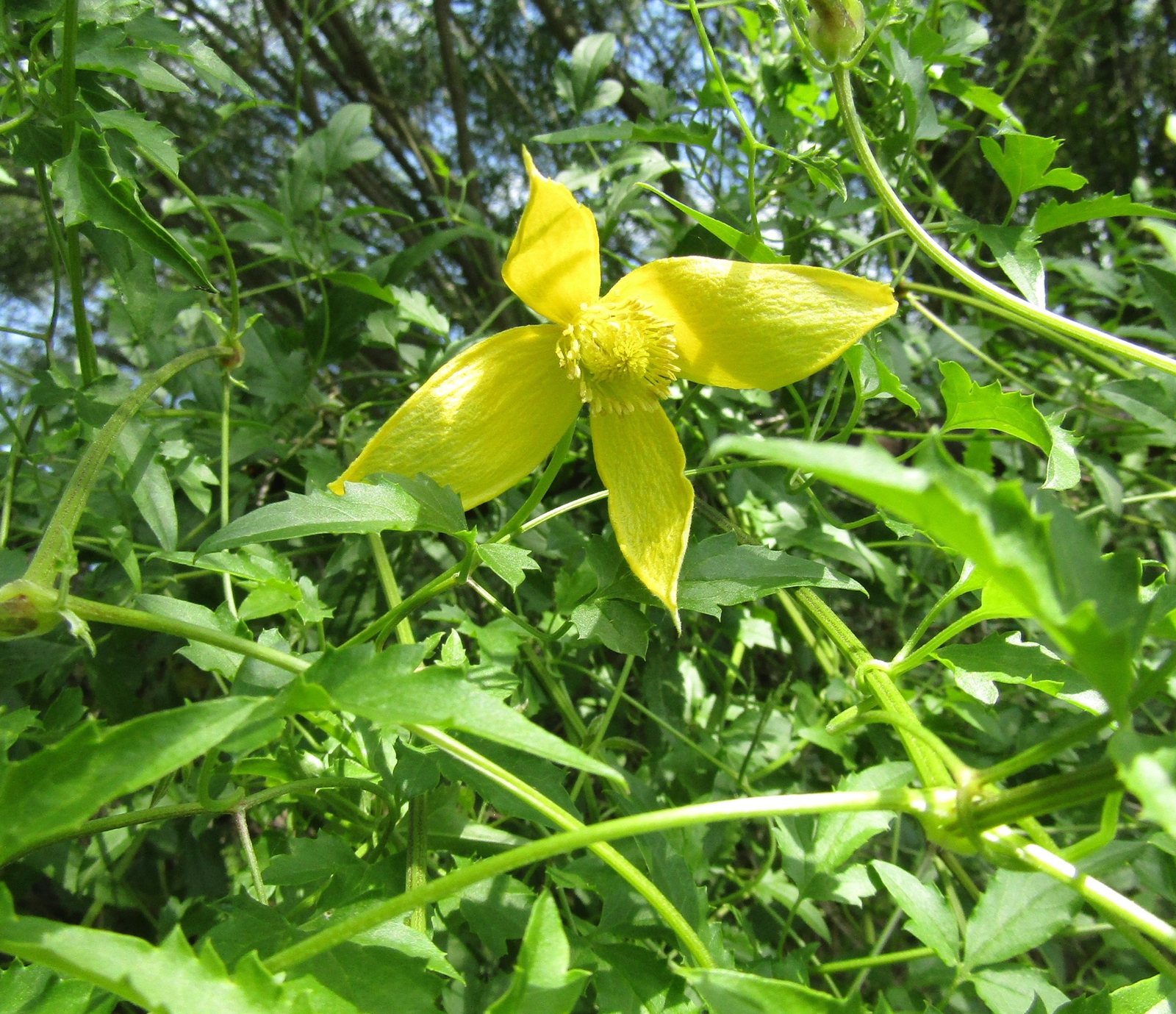
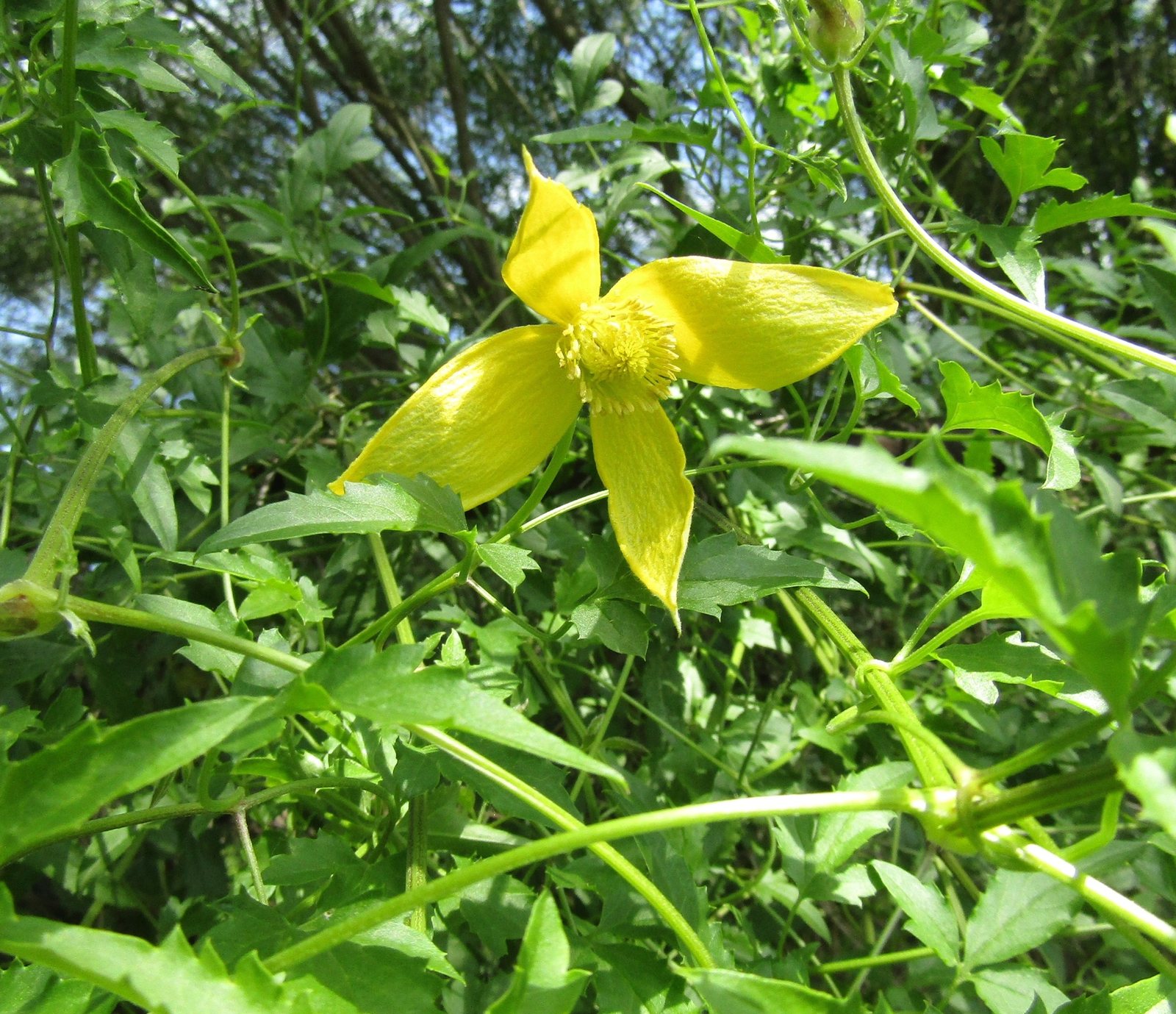
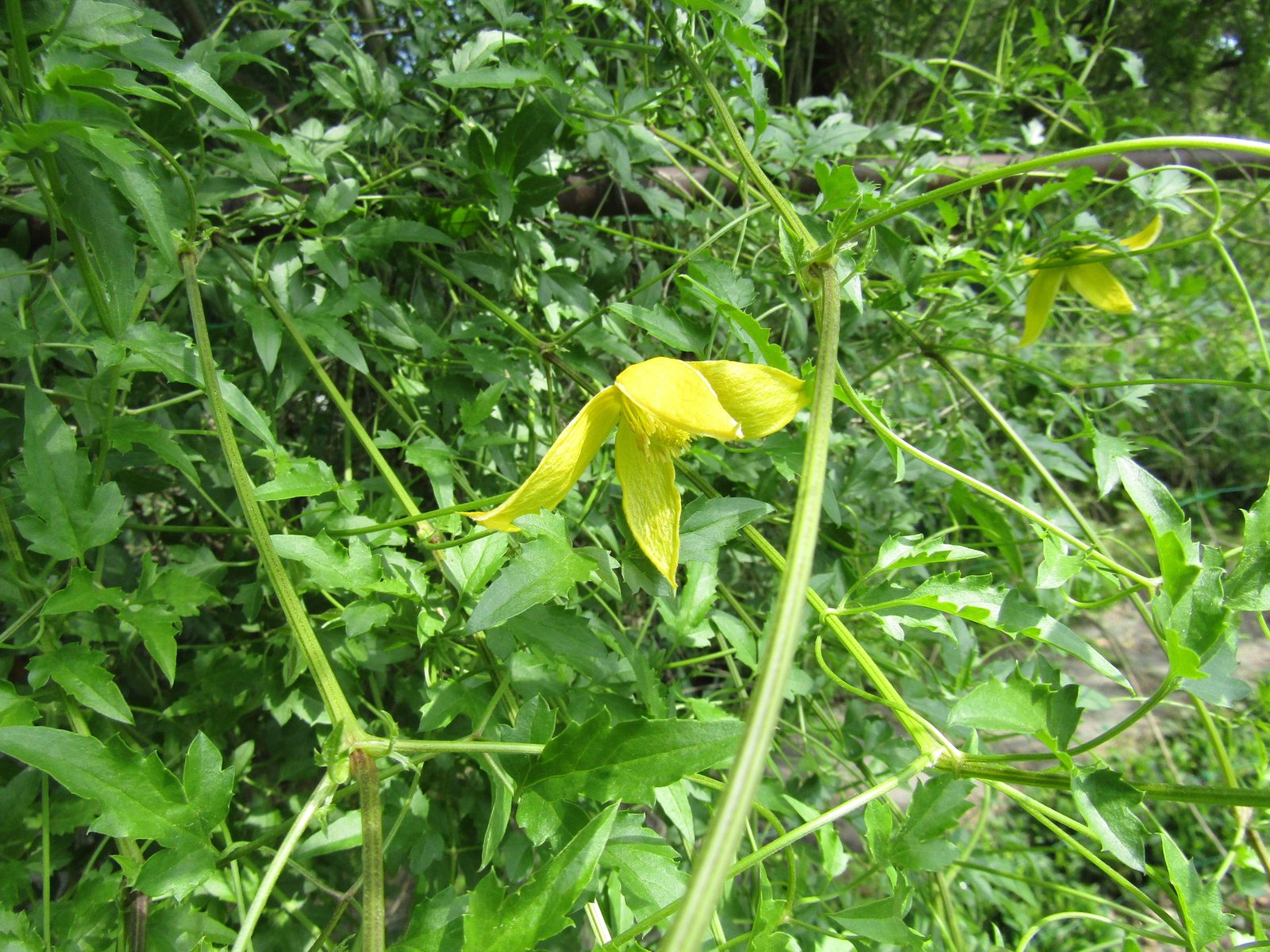
Golden clematis is a vigorous deciduous climber grown for its nodding yellow bells and long-lasting, silky seedheads. It flowers on the current season's growth and can cover a trellis or fence, but it self-seeds freely and is invasive in some regions.
At a glance
- Sun
- Full sun to partial shade; flowering is best with plenty of sun.
- Water
- Water regularly during the first growing season. Once established, water deeply during prolonged dry spells; avoid waterlogged roots.
- Soil
- Well-drained soil, preferably fertile and moisture-retentive; tolerates neutral to alkaline conditions and poorer soils once established.
- Height
- 12-20 ft (3.7-6 m)
- Spread
- 6-10 ft (1.8-3 m)
- Flowers
- Bright yellow, nodding, lantern-shaped flowers from summer into early autumn, followed by silvery, feathery seedheads.
- Foliage
- Deciduous green leaves divided into toothed leaflets; the stems climb by curling their leaf stalks around supports.
- Growth
- Fast once established.
- Care needed
- Medium
The year at a glance
- Pollinators
- Deer resistant
- Drought tolerant
- Cold hardy
- Wildlife
- Low allergen
| J | F | M | A | M | J | J | A | S | O | N | D | |
|---|---|---|---|---|---|---|---|---|---|---|---|---|
| Flowers | ||||||||||||
| Fruit | ||||||||||||
| Plant |
Northern hemisphere months. In Australia, shift them by six.
- Difficulty
- Moderate
- Toughness
- Very tough
Will it suit your garden?
Pick your zone, country, light and whether you have pets.
Full sun is 6 or more hours of direct sun a day, part shade 3 to 6 hours, shade under 3.
How it grows
Planting day
2 ft (0.6 m)
After 1 year
3 ft (1.1 m)
After 2 years
5 ft (1.5 m)
After 3 years
6 ft (1.8 m)
full size
About 3 years to full size.
From a typical nursery size, at an average rate for this kind of plant. A rule of thumb, not a forecast.
Good to know
- Cats and dogs
- Toxic
- Invasive in
- Canada
- In the garden
- Spreads vigorously: plan to contain it.
- Growth rate
- Fast
Care
Jobs through the year
- WaterApr–May, Sep–Oct, every 14 days
- For established plants, water deeply only if dry; water new plants more often.
- WaterJun–Aug, every 10 days
- Water established plants deeply during prolonged drought, allowing drainage.
- PruneFeb–Mar
- Cut stems to strong buds 30–45 cm above ground before new growth.
- MulchMar–Apr
- Spread compost or leaf mould over roots, keeping stems clear.
- FeedApr
- Apply balanced fertilizer only if growth is weak.
- ProtectApr–Jun
- Tie young shoots to sturdy, thin supports and protect emerging shoots from slugs.
- DeadheadAug–Oct, every 14 days
- Where spread is a concern, remove seedheads before dispersal and pull seedlings.
- Check local invasive-plant restrictions before planting, particularly in western Canada.
- Provide a sturdy trellis or wires with thin sections that the leaf stalks can grasp; tie in young shoots.
- Water deeply through the first growing season and during extended drought.
- Mulch the root area with compost or leaf mould, keeping mulch clear of the stems.
- Apply a balanced fertiliser in spring if growth is weak; avoid repeated high-nitrogen feeding.
- Where planting is permitted, remove seedheads before seeds disperse if seedlings would be a problem.
Pruning. Pruning group 3: in late winter or early spring, cut all stems back to a strong pair of buds about 12-18 in (30-45 cm) above the ground. Remove dead stems and guide new shoots onto their support.
Through the year
- Late winter
- Prune hard before new growth begins and inspect the trellis or wires.
- Spring
- Plant where locally permitted, mulch the root area and water new plants thoroughly.
- Late spring
- Tie in young shoots before they become tangled or trail across neighbouring plants.
- Summer
- Water during prolonged dry weather and check young growth for aphids.
- Late summer
- Remove developing seedheads where self-seeding needs to be prevented.
- Autumn
- Pull unwanted seedlings while small and collect any remaining seedheads where spread is a concern.
In the garden
- Train over a strong fence or trellis for summer flowers and a light screen.
- Grow on an arch where the hanging flowers can be seen from below.
- Combine with purple-flowered shrubs and perennials for a yellow-and-purple summer display.
- Use on a freestanding support in a mixed border, keeping its vigorous stems away from small shrubs.
Garden styles it suits: Cottage garden, English country, Romantic rose garden, Modern rustic, Autumn colour and Traditional.
Plant it with: Shrub roses, Catmint, Russian sage, Hardy geraniums, Purple coneflower and Stonecrop.
Wildlife: Flowers provide pollen for visiting insects. Dense growth can shelter small birds, but its wildlife value does not justify planting it where it is invasive.
Problems to watch for
- Unwanted seedlings: remove seedheads before dispersal and pull seedlings promptly; do not plant where restricted.
- Slugs and snails on young shoots: inspect emerging growth and use barriers or locally approved iron-phosphate bait if needed.
- Aphids on soft growth: wash off small colonies with water and encourage natural predators.
- Poor growth or root rot in wet soil: improve drainage or move the plant; do not keep the root zone saturated.
Safety
Toxic to people, cats, dogs and horses if eaten. Fresh leaves, stems and other plant parts contain irritating compounds that can cause mouth irritation, drooling, vomiting or diarrhoea; sap may irritate skin. Most accidental exposures cause irritation rather than severe poisoning, but seek medical or veterinary advice after ingestion.
Where it spreads. An invasive escape in parts of western Canada, including Alberta, where it is regulated as a noxious weed. Windborne seeds can spread well beyond gardens. Check provincial, state and local restrictions before planting, and do not assume similarly named yellow-flowered clematis species have the same legal status.
Easily confused with
Oriental clematis (Clematis orientalis)
Typically has thinner, paler yellow to greenish-yellow flower segments that spread more widely as the flowers mature. Golden clematis usually has thicker, brighter yellow segments forming a more pronounced lantern;
Old man's beard (Clematis vitalba)
Also produces fluffy seedheads, but its flowers are small, creamy white and held in clusters rather than large yellow bells.
The name
Clematis comes from the Greek for a climbing or vine-like plant, while tangutica refers to the Tangut region of northwestern China.
Propagation. Take softwood cuttings in late spring or early summer, or layer a low stem. Seed can produce variable plants and may need a cold period to germinate; avoid seed propagation where escape is a concern.
Checked against open data
- Accepted botanical name
- Clematis tangutica
- In the US and Canada
- Introduced in Canada.
- Native range
- Afghanistan, China North-Central, China South-Central, Inner Mongolia, Kazakhstan, Kirgizstan, Mongolia, Qinghai, Tadzhikistan, Tibet, West Himalaya and Xinjiang.
- Measured
- Average height 350 cm.
Sources: GBIF (CC BY 4.0), USDA PLANTS and Trefle (CC BY 4.0). The care and design notes are LandscapeGPT's own.
See it in your own yard.
Upload a photo of your yard and see it redesigned with plants that suit your climate, each checked against your zone.