Golden honeysuckle
Lonicera × tellmanniana. Family Caprifoliaceae. Climber.
Also called Tellmann's honeysuckle.
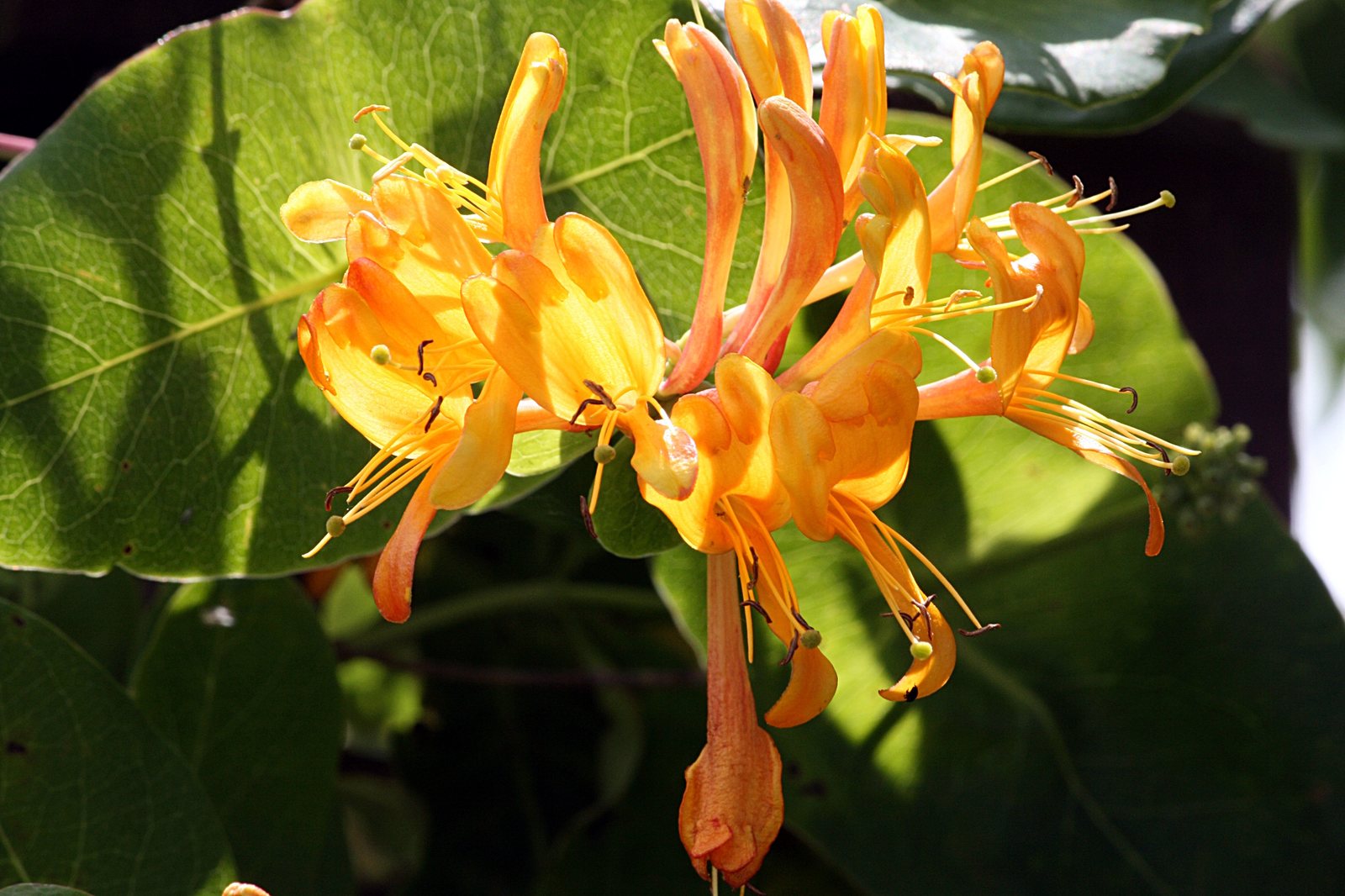
Golden honeysuckle is a deciduous, twining climber grown for clusters of rich yellow to orange-yellow flowers in late spring and early summer. Unlike many climbing honeysuckles, its flowers have little or no scent. Give it a sturdy support and cool, moist soil around its roots.
At a glance
- Sun
- Full sun to partial shade; flowering is best with plenty of light, but afternoon shade helps in hot summers.
- Water
- Keep evenly moist while establishing; water established plants deeply during prolonged dry spells.
- Soil
- Fertile, humus-rich, moist but well-drained soil; tolerates clay, loam and a range of soil pH if drainage is adequate.
- Height
- 15-20 ft (4.6-6 m)
- Spread
- 5-8 ft (1.5-2.4 m)
- Flowers
- Late spring to early summer; tubular golden-yellow to orange-yellow flowers in clusters.
- Foliage
- Opposite pairs of oval, dark green leaves with paler undersides; the upper leaf pairs join around the stem below the flower clusters.
- Growth
- Moderate to fast once established
- Care needed
- Medium
The year at a glance
- Pollinators
- Wildlife
- Low allergen
| J | F | M | A | M | J | J | A | S | O | N | D | |
|---|---|---|---|---|---|---|---|---|---|---|---|---|
| Flowers | ||||||||||||
| Fruit | ||||||||||||
| Plant |
Northern hemisphere months. In Australia, shift them by six.
- Difficulty
- Moderate
- Toughness
- Fairly tough
Will it suit your garden?
Pick your zone, country, light and whether you have pets.
Full sun is 6 or more hours of direct sun a day, part shade 3 to 6 hours, shade under 3.
How it grows
Planting day
2 ft (0.6 m)
After 1 year
3 ft (0.98 m)
After 2 years
4 ft (1.4 m)
After 3 years
6 ft (1.7 m)
After 5 years
6 ft (1.8 m)
full size
About 3 years to full size.
From a typical nursery size, at an average rate for this kind of plant. A rule of thumb, not a forecast.
Good to know
- Cats and dogs
- Mildly toxic: may upset a stomach
- Growth rate
- Fast
Care
Jobs through the year
- WaterApr–May, Sep–Oct, every 14 days
- Water established plants deeply during dry spells; water young plants more frequently.
- WaterJun–Aug, every 7 days
- Water deeply in dry weather to prevent root stress and mildew.
- MulchMar–Apr
- Apply 5–8 cm of organic mulch, keeping it away from main stems.
- FeedMar–Apr
- Feed lightly with balanced fertiliser only if growth is weak.
- PruneJun–Jul
- Immediately after flowering, shorten flowered side shoots and thin congested or damaged stems.
- PruneFeb–Mar
- Only if renovation is needed, remove selected old stems; expect fewer flowers.
- ProtectMar, Oct
- Check strong supports and loosen ties before they constrict twining stems.
- Provide a strong trellis, wires or an arch; stems twine but do not cling directly to walls.
- Tie young shoots loosely to the support and spread them out to build an open framework.
- Water deeply through the first growing season and during later droughts.
- Apply a 2-3 in (5-8 cm) organic mulch each spring, keeping it clear of the main stems.
- Feed lightly with a balanced fertiliser in spring if growth is weak; avoid heavy nitrogen feeding.
Pruning. Prune just after flowering, shortening flowered side shoots and removing dead, damaged or congested stems. Renovate an overgrown plant in late winter by cutting back selected old stems, accepting reduced flowering that season.
Through the year
- Early spring
- Plant while the soil is workable, water thoroughly and install support before growth becomes tangled.
- Spring
- Mulch the root area and tie new shoots along the support.
- Late spring
- Check soft growth for aphids and wash off small colonies with water.
- Early summer
- After flowering, shorten flowered side shoots and thin crowded growth.
- Summer
- Water during dry spells and take semi-ripe cuttings if you want more plants.
- Late winter
- Check ties and supports; remove dead stems or begin gradual renovation if needed.
In the garden
- Train over an arch to frame a path with golden early-summer flowers.
- Cover a fence or trellis at the back of a mixed border without relying on it for winter screening.
- Pair with purple-flowered clematis for contrasting flowers, using a support strong enough for both.
- Grow against a wall on wires, with low perennials shading the root area.
Garden styles it suits: English country, Cottage garden, Romantic rose garden, Arts and Crafts, Woodland and Wildlife garden.
Plant it with: Clematis, Hardy geranium, Lady's mantle, Catmint, Foxglove and Astrantia.
Wildlife: The tubular flowers provide nectar for long-tongued insects and may attract hummingbirds in North America. Any berries that develop may be eaten by birds; dense stems also offer shelter.
Problems to watch for
- Aphids can distort young shoots: wash off small colonies and encourage ladybirds and other predators.
- Powdery mildew may coat leaves in dry conditions: keep roots evenly moist, mulch and thin congested growth.
- Leaf spots can develop in damp, crowded growth: remove badly affected fallen leaves and improve airflow.
- Sparse flowering often follows heavy pruning, deep shade or excessive nitrogen: prune after flowering, provide more light and reduce feeding.
Safety
Not an edible honeysuckle. Berries and other parts should not be eaten; honeysuckle ingestion can cause vomiting, diarrhoea and abdominal discomfort in people, cats and dogs. Species-specific evidence for this hybrid, particularly in horses, is limited, so keep it away from grazing animals and seek medical or veterinary advice after ingestion.
Easily confused with
Trumpet honeysuckle (Lonicera sempervirens)
Usually has red or coral tubular flowers with yellow interiors and may retain leaves in mild winters; yellow-flowered cultivars can be harder to distinguish.
Henry's yellow honeysuckle (Lonicera tragophylla)
Also has largely scentless yellow flowers and joined upper leaves; it generally has larger leaves with conspicuously pale undersides. A reliable nursery label is useful for separating these close relatives.
Goldflame honeysuckle (Lonicera × heckrottii)
Flowers usually have pink to reddish exteriors and yellow interiors, and are fragrant rather than uniformly golden and nearly scentless.
The name
The genus name Lonicera honours the German physician and botanist Adam Lonicer.
Propagation. Layer a low, flexible stem in spring, or take semi-ripe cuttings in summer. Propagate vegetatively to retain the hybrid's characteristics; seed is unreliable and seedlings may differ.
Checked against open data
- Accepted botanical name
- Lonicera tellmanniana
Sources: GBIF (CC BY 4.0). The care and design notes are LandscapeGPT's own.
See it in your own yard.
Upload a photo of your yard and see it redesigned with plants that suit your climate, each checked against your zone.