Golden Japanese forest grass
Hakonechloa macra 'Aureola'. Family Poaceae. Ornamental grass.
Also called Golden hakone grass, Variegated Japanese forest grass.
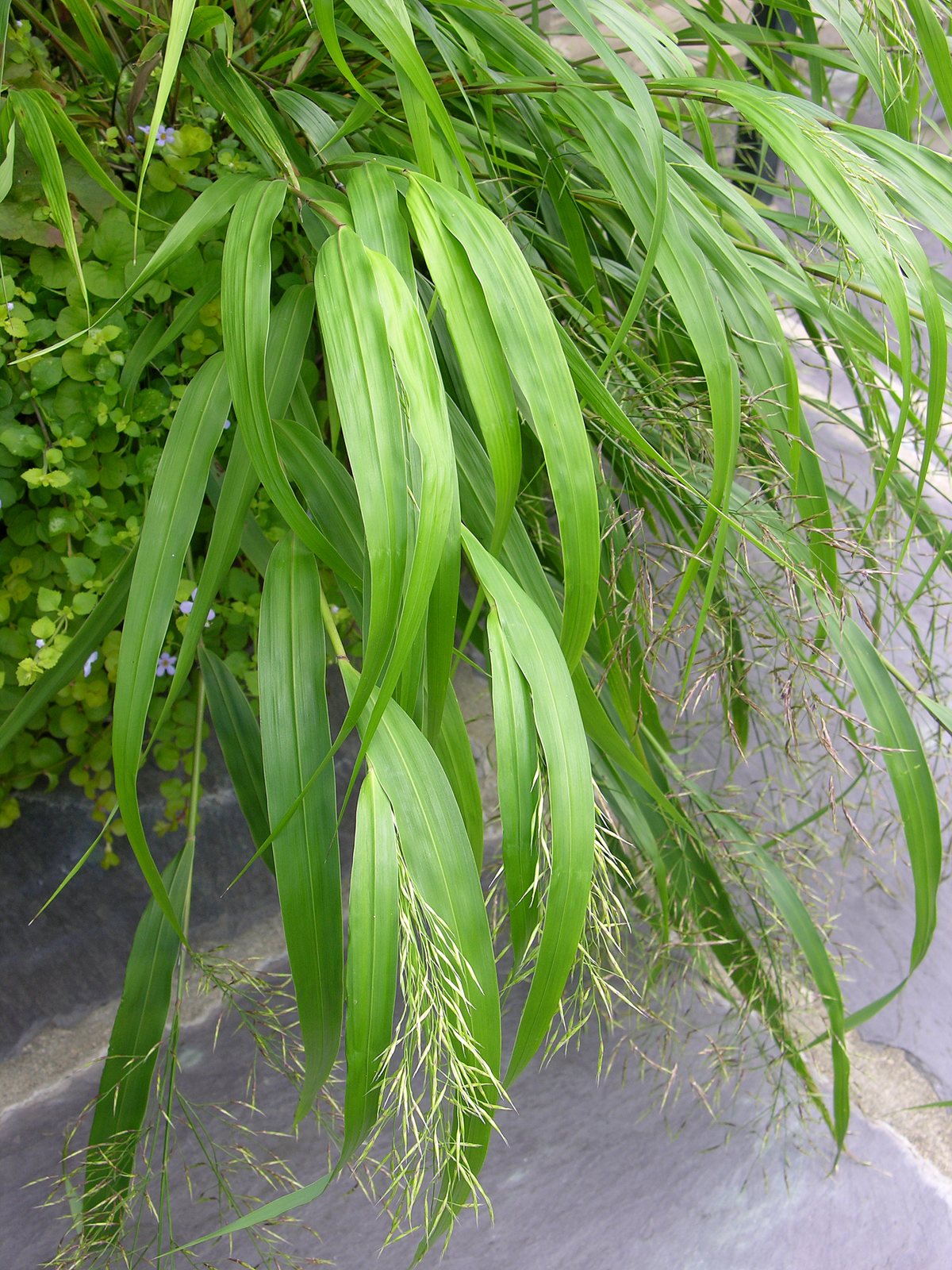
Hakonechloa macra 'Aureola' is a deciduous ornamental grass with arching, yellow leaves striped with green. It forms a slowly widening mound that softens shady paths, containers and woodland borders, growing best where summers are not excessively hot or dry.
At a glance
- Sun
- Partial shade or bright, dappled shade. Gentle morning sun improves the golden colour; protect from hot afternoon sun, especially in warmer climates.
- Water
- Keep the soil evenly moist, especially during establishment and summer. It tolerates neither prolonged drought nor waterlogged soil.
- Soil
- Humus-rich, moisture-retentive but well-drained soil; mildly acidic to neutral conditions are ideal.
- Height
- 1-1.5 ft (0.3-0.45 m)
- Spread
- 1.5-2 ft (0.45-0.6 m)
- Foliage
- Slender, arching golden-yellow leaves with narrow green stripes. Leaves are greener in deep shade and may develop pink or reddish tints in autumn before turning tan and dying back.
- Growth
- Slow; allow several years for a substantial clump.
- Care needed
- Low
The year at a glance
- Deer resistant
| J | F | M | A | M | J | J | A | S | O | N | D | |
|---|---|---|---|---|---|---|---|---|---|---|---|---|
| Plant |
Northern hemisphere months. In Australia, shift them by six.
- Difficulty
- Easy
- Toughness
- Fairly tough
Will it suit your garden?
Pick your zone, country, light and whether you have pets.
Full sun is 6 or more hours of direct sun a day, part shade 3 to 6 hours, shade under 3.
How it grows
Planting day
1.1 ft (0.35 m)
After 1 year
1.2 ft (0.36 m)
After 2 years
1.2 ft (0.36 m)
After 3 years
1.2 ft (0.37 m)
After 5 years
1.2 ft (0.38 m)
full size
About 4 years to full size.
From a typical nursery size, at an average rate for this kind of plant. A rule of thumb, not a forecast.
Good to know
- Cats and dogs
- Safe
- Growth rate
- Slow
Care
Jobs through the year
- WaterApr–May, Sep–Oct, every 14 days
- Water established clumps if soil begins drying; young plants need more frequent watering.
- WaterJun–Aug, every 7 days
- Water deeply in dry weather to maintain evenly moist, not waterlogged, soil.
- MulchApr–May
- Apply leaf mould or compost to conserve moisture, keeping the crown uncovered.
- PruneFeb–Mar
- Cut dead foliage to a few inches above ground before fresh shoots emerge.
- DivideApr–May
- Divide established clumps only for propagation or when the centre declines.
- ProtectJun–Aug
- Provide shade from hot afternoon sun and shelter from drying winds if leaves scorch.
- ProtectMar–May
- Check fresh shoots for slug and snail damage and control pests if needed.
- Water deeply when the soil begins to dry; check container plants more frequently in warm weather.
- Apply a thin layer of compost in spring rather than feeding heavily.
- Mulch with leaf mould or compost to conserve moisture, keeping it clear of the crown.
- Shelter plants from hot, drying winds and strong afternoon sun.
- Divide established clumps in spring only when you need more plants or the centre begins to decline.
Pruning. Cut the dead foliage to a few inches above the ground in late winter or early spring, before new shoots emerge. Avoid cutting into the fresh shoots, which can appear among the old stems.
Through the year
- Late winter
- Cut back dead foliage before new growth starts.
- Spring
- Plant or divide clumps as growth begins, then water thoroughly.
- Mid-spring
- Top-dress with compost and renew the moisture-conserving mulch.
- Summer
- Water during dry spells and check exposed plants for scorched leaf tips.
- Autumn
- Leave fading foliage for seasonal colour, or remove it once fully dead if it becomes untidy.
- Winter
- Keep containers free-draining; in cold regions, shelter pots or insulate them to protect the roots.
In the garden
- Edge a shaded path with repeated clumps so the arching leaves soften its outline.
- Plant beneath open-canopied trees with ferns and hostas, provided tree roots do not leave the soil dry.
- Use in a shaded container where the foliage can spill over the rim.
- Mass beside dark-leaved perennials to create a bright, flowing band of foliage.
- Plant beside stones or a pond margin, above any permanently saturated ground.
Garden styles it suits: Japanese, Woodland, Japandi, Modern courtyard, Moss and fern garden and Pacific Northwest woodland.
Plant it with: Hostas, Japanese painted fern, Heucheras, Brunnera, Hellebores and Astilbes.
Wildlife: Clumps provide modest shelter for small invertebrates. Its inconspicuous, wind-pollinated flowers offer little nectar value to pollinators.
Problems to watch for
- Brown tips or scorched leaves: increase watering if the soil is dry and provide protection from afternoon sun and drying winds.
- Crown or root rot in wet soil: improve drainage, reduce watering and avoid burying the crown.
- Slugs and snails on young shoots: check plants after dark, remove pests and use wildlife-conscious controls where needed.
- Weak growth or loss of golden colour in deep shade: move to brighter filtered light without exposing the plant to hot afternoon sun.
Safety
Not known to be toxic to cats, dogs, horses or people; no part is recognised as poisonous. It is an ornamental plant, not a food plant, and eating grass can still cause mild stomach upset in pets.
Easily confused with
All Gold Japanese forest grass (Hakonechloa macra 'All Gold')
Its leaves are uniformly yellow to yellow-green rather than clearly striped green and yellow.
Evergold Japanese sedge (Carex oshimensis 'Evergold')
It has a broad creamy-yellow stripe down the centre of each leaf, dark green margins and a tighter, usually evergreen clump rather than the deciduous, cascading growth of 'Aureola'.
The name
Hakonechloa combines Hakone, a mountainous area of Japan, with the Greek word for grass, while 'Aureola' refers to the golden foliage.
Propagation. Divide established clumps in spring as new growth begins, keeping several shoots and a good portion of roots on each division. Replant promptly and keep moist; seed will not reliably reproduce 'Aureola'.
Checked against open data
- Accepted botanical name
- Hakonechloa macra
- In the US and Canada
- Introduced in the lower 48 states.
- Native range
- Japan.
Sources: GBIF (CC BY 4.0), USDA PLANTS and Trefle (CC BY 4.0). The care and design notes are LandscapeGPT's own.
See it in your own yard.
Upload a photo of your yard and see it redesigned with plants that suit your climate, each checked against your zone.