Goldflame honeysuckle
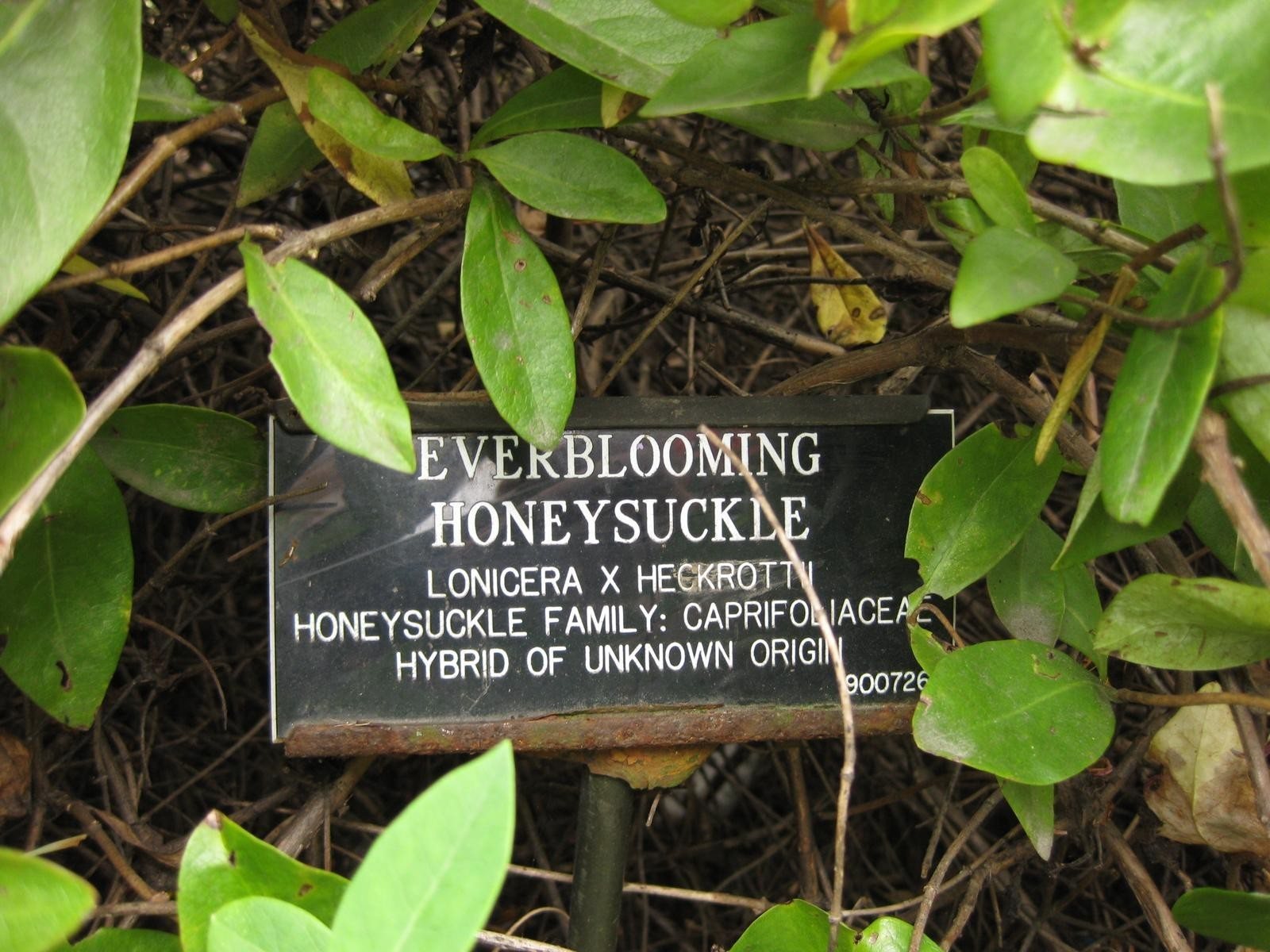
Lonicera × heckrottii. Family Caprifoliaceae. Climber.
Also called Gold Flame honeysuckle, Heckrott's honeysuckle.
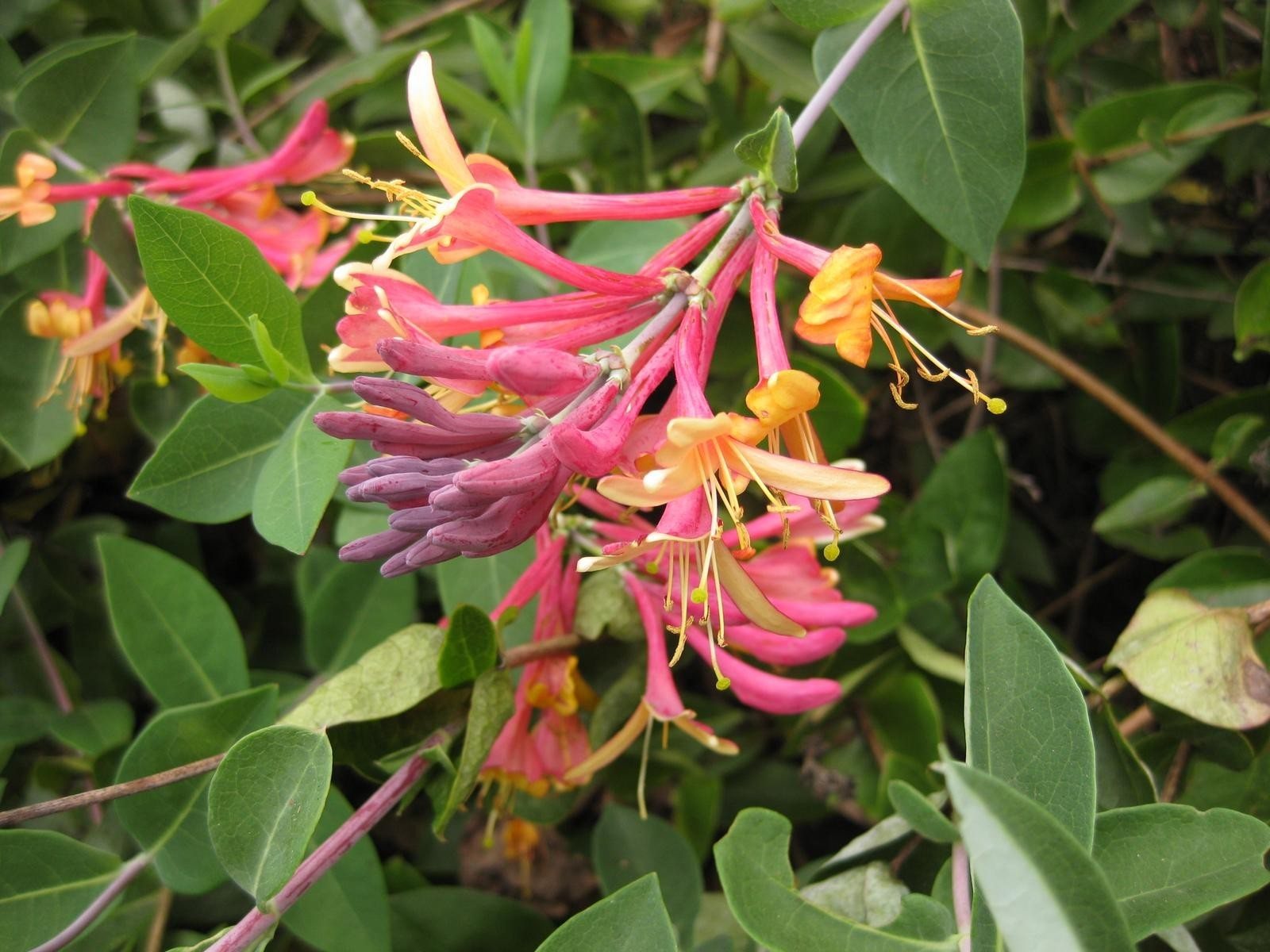
Goldflame honeysuckle (Lonicera × heckrottii, commonly sold as 'Gold Flame') is a twining climber grown for fragrant clusters of pink-and-yellow tubular flowers. It flowers over a long summer season and suits a trellis, arch or fence near a seating area, where you can enjoy its scent.
At a glance
- Sun
- Full sun to partial shade; flowering is best with plenty of sun. In hot climates, give it afternoon shade and keep the roots cool.
- Water
- Moderate; keep the root zone evenly moist while establishing, then water deeply during prolonged dry spells.
- Soil
- Fertile, humus-rich, well-drained soil; tolerates clay, loam and sandy soil if drainage and moisture are adequate.
- Height
- 10-15 ft (3-4.6 m)
- Spread
- 3-6 ft (0.9-1.8 m)
- Flowers
- Late spring through summer, often continuing intermittently into autumn; deep pink to reddish-pink buds open to pink tubes with yellow or cream interiors.
- Foliage
- Opposite, oval, blue-green leaves; upper pairs may join around the stem. Deciduous in cold climates, sometimes semi-evergreen in mild winters.
- Growth
- Moderate to fast once established
- Care needed
- Medium
The year at a glance
- Pollinators
- Heat tolerant
- Wildlife
- Low allergen
- Fragrant
| J | F | M | A | M | J | J | A | S | O | N | D | |
|---|---|---|---|---|---|---|---|---|---|---|---|---|
| Flowers | ||||||||||||
| Plant |
Northern hemisphere months. In Australia, shift them by six.
- Difficulty
- Moderate
- Toughness
- Fairly tough
Will it suit your garden?
Pick your zone, country, light and whether you have pets.
Full sun is 6 or more hours of direct sun a day, part shade 3 to 6 hours, shade under 3.
How it grows
Planting day
2 ft (0.6 m)
After 1 year
3 ft (0.98 m)
After 2 years
4 ft (1.4 m)
After 3 years
6 ft (1.7 m)
After 5 years
6 ft (1.8 m)
full size
About 3 years to full size.
From a typical nursery size, at an average rate for this kind of plant. A rule of thumb, not a forecast.
Good to know
- Cats and dogs
- Mildly toxic: may upset a stomach
- Growth rate
- Fast
Care
Jobs through the year
- WaterApr–May, Sep–Oct, every 14 days
- Water established plants during dry spells; new plants need more frequent watering.
- WaterJun–Aug, every 7 days
- Water deeply in dry weather to prevent root stress and reduce mildew risk.
- MulchMar–Apr
- Apply 5–8 cm of compost or organic mulch, keeping stems clear.
- PruneFeb–Mar
- Remove dead and tangled stems; shorten overlong shoots to strong buds and thin old stems if crowded.
- ProtectMay–Aug, every 14 days
- Guide and loosely tie young stems to a sturdy support; check tips for aphids.
- Provide a sturdy trellis, wires or an arch; guide young stems onto the support and tie them loosely.
- Water deeply through the first growing season and during dry weather thereafter.
- Apply a 2-3 in (5-8 cm) layer of organic mulch in spring, keeping it clear of the stems.
- Top-dress with compost in spring; avoid heavy nitrogen feeding, which encourages leafy growth at the expense of flowers.
- Keep the base cool with mulch or low-growing companion plants, without crowding the crown.
Pruning. In late winter or early spring, remove dead, damaged and tangled stems and shorten overlong shoots to a strong pair of buds. For an overgrown plant, remove some of the oldest stems at the base to encourage replacement growth.
Through the year
- Late winter
- Check supports and prune out dead or congested stems before new growth begins.
- Spring
- Plant when the soil is workable, water thoroughly and mulch the root zone.
- Late spring
- Guide new shoots along wires or trellis and check soft tips for aphids.
- Summer
- Water during dry spells and maintain airflow around the foliage to reduce mildew.
- Late summer
- Take semi-ripe cuttings from healthy, non-flowering shoots.
- Autumn
- Check ties, clear fallen diseased leaves and replenish mulch if the soil is exposed.
In the garden
- Train over an arch beside a path so the flowers and fragrance are close to nose level.
- Cover a sunny trellis or open fence to create a flowering screen without the bulk of a hedge.
- Combine with climbing roses on a strong support for contrasting flower shapes and a longer display.
- Grow against a sheltered courtyard boundary, with low perennials shading the root zone.
Garden styles it suits: Cottage garden, English country, Romantic rose garden, Sensory garden, Pollinator garden and Secret garden.
Plant it with: Climbing roses, Clematis, Hardy geraniums, Catmint, Lady's mantle and Salvia.
Wildlife: Flowers provide nectar for bees and other long-tongued insects, and attract hummingbirds where these occur in North America. Dense stems can shelter small birds; fruit production is usually sparse.
Problems to watch for
- Powdery mildew causes a white coating on leaves, especially when roots are dry and air is still; water the root zone, thin congested growth and remove badly affected leaves.
- Aphids cluster on soft shoot tips; wash them off with water and encourage ladybirds and other predators.
- Sparse flowering often follows deep shade or excessive nitrogen feeding; provide more light and reduce fertiliser.
- Leaf scorch and premature leaf drop can follow drought or hot, exposed conditions; water deeply, mulch and provide afternoon shade in hot climates.
Safety
Do not eat the berries, which may cause stomach upset, vomiting or diarrhoea. Toxicity information specifically for this hybrid is limited, including for cats, dogs and horses; it is not established as safe for them. Keep berries and plant trimmings away from pets and livestock, and do not use the flowers as food.
Easily confused with
Coral honeysuckle (Lonicera sempervirens)
Usually has longer, narrower red or coral flower tubes with little or no scent; Goldflame has conspicuously two-lipped pink-and-yellow flowers and a noticeable fragrance.
Dutch honeysuckle (Lonicera periclymenum)
Can have similarly fragrant pink-and-cream flowers, but its upper leaves remain separate rather than joining around the stem.
Japanese honeysuckle (Lonicera japonica)
Bears paired white flowers that age yellow at the leaf axils, rather than terminal clusters of pink-and-yellow flowers; it is also much more aggressive and invasive in many regions.
The name
Lonicera honours the German botanist Adam Lonicer, while Goldflame refers to the warm pink-and-yellow flower colours.
Propagation. Take softwood cuttings in late spring or semi-ripe cuttings in summer, or layer a low stem into the soil. Use vegetative propagation to preserve the named cultivar; seed is rarely available and will not reliably come true.
Checked against open data
- Accepted botanical name
- Lonicera heckrottii
Sources: GBIF (CC BY 4.0) and Trefle (CC BY 4.0). The care and design notes are LandscapeGPT's own.
See it in your own yard.
Upload a photo of your yard and see it redesigned with plants that suit your climate, each checked against your zone.