Grass tree
Xanthorrhoea johnsonii. Family Asphodelaceae. Tree.
Also called Johnson's grass tree.
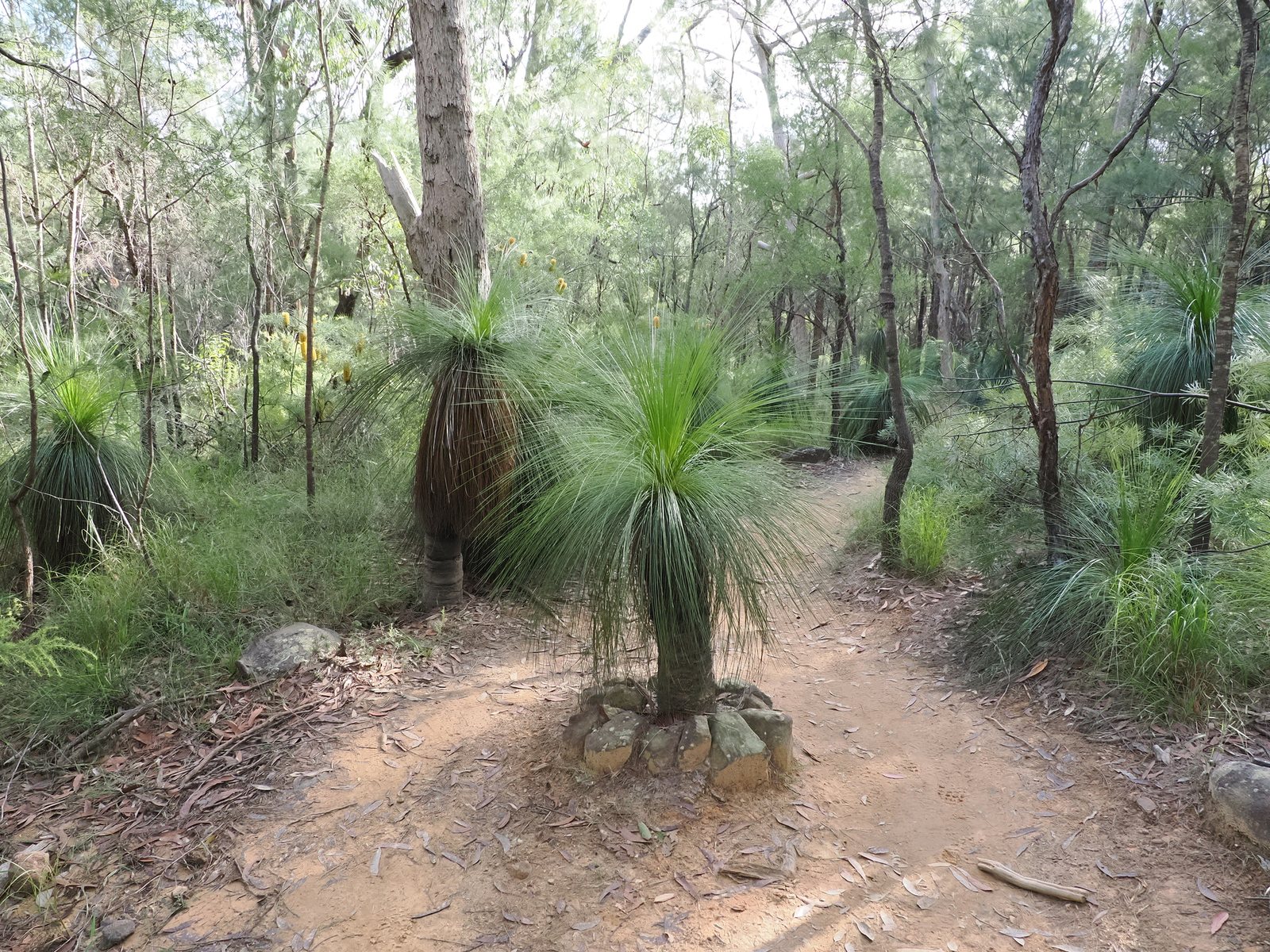
This very slow-growing Australian evergreen forms a dense fountain of narrow leaves above a stout, often blackened trunk, with tall flower spikes on mature plants. Gardeners grow it as a sculptural specimen in sunny, sharply drained gardens; it dislikes root disturbance and cold, wet winters.
At a glance
- Sun
- Full sun; tolerates light shade but develops a less dense crown.
- Water
- Water regularly while establishing, allowing the soil to drain between waterings. Established plants tolerate drought but may need occasional deep watering during prolonged dry weather.
- Soil
- Well-drained sandy or gravelly soil, preferably acidic to neutral. Avoid heavy, waterlogged ground; use a raised mound where drainage is marginal.
- Height
- 10-16 ft (3-5 m) over many decades; flowering spikes can extend above the crown.
- Spread
- 5-8 ft (1.5-2.4 m)
- Flowers
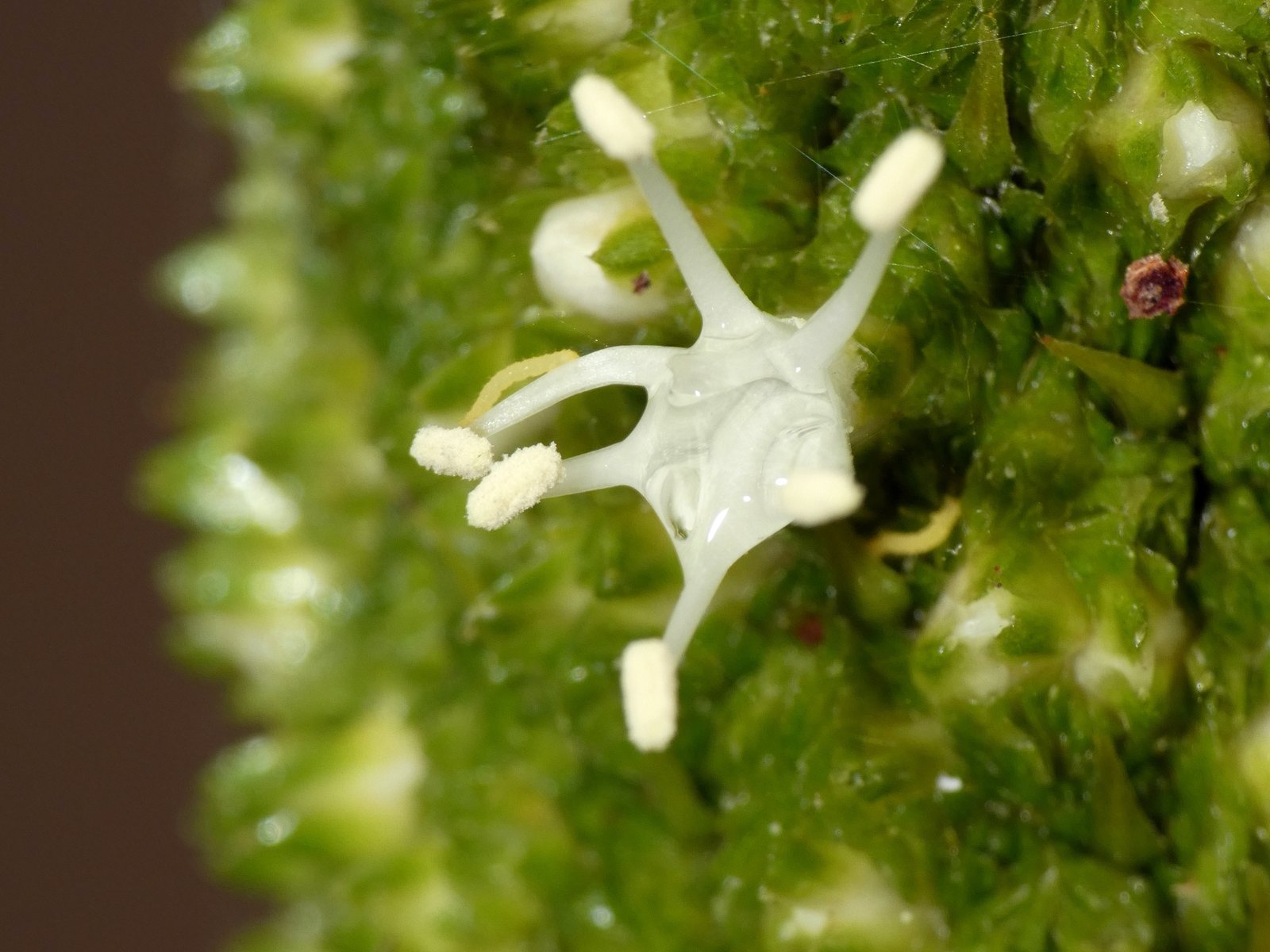
- Usually spring to summer, though flowering is irregular: tiny cream-white flowers densely cover a tall, upright spike. Fire can stimulate flowering, but is not necessary.
- Foliage
- Evergreen. Long, narrow, stiff green to blue-green leaves form a rounded, arching crown; old leaves can remain as a skirt around the trunk.
- Growth
- Very slow; developing a substantial trunk takes decades.
- Care needed
- Medium
The year at a glance
- Pollinators
- Drought tolerant
- Heat tolerant
- Wildlife
- Low allergen
| J | F | M | A | M | J | J | A | S | O | N | D | |
|---|---|---|---|---|---|---|---|---|---|---|---|---|
| Flowers | ||||||||||||
| Fruit | ||||||||||||
| Plant |
Northern hemisphere months. In Australia, shift them by six.
- Difficulty
- Hard
- Toughness
- Fairly tough
Will it suit your garden?
Pick your zone, country, light and whether you have pets.
Full sun is 6 or more hours of direct sun a day, part shade 3 to 6 hours, shade under 3.
How it grows
Planting day
7 ft (2 m)
After 1 year
7 ft (2.1 m)
After 2 years
7 ft (2.1 m)
After 3 years
7 ft (2.2 m)
After 5 years
8 ft (2.3 m)
About 32 years to full size.
From a typical nursery size, at an average rate for this kind of plant. A rule of thumb, not a forecast.
Good to know
- Cats and dogs
- Safe
- Native to
- Australia
- Growth rate
- Slow
Care
Jobs through the year
- WaterApr–May, Sep, every 21 days
- Water established ground plants only during prolonged dryness; newly planted specimens need closer monitoring.
- WaterJun–Aug, every 14 days
- Deep-water established ground plants during drought, allowing drainage and drying between waterings.
- WaterJan–Mar, Oct–Dec, every 21 days
- Check sheltered containers and water lightly only when needed; avoid saturation and complete root-ball drying.
- FeedApr–May
- Feed sparingly with low-phosphorus native-plant fertiliser only if growth is weak.
- MulchMay
- Use a light gravel mulch, leaving the trunk and crown uncovered.
- PruneSep–Dec
- Remove flower stalks only once dry, or retain for seed; leave healthy leaves and the growing tip untouched.
- ProtectJan–Apr, Oct–Dec
- In zone 6–7, overwinter manageable containers in bright frost-free shelter; cold wet ground can be fatal.
- Choose a nursery-propagated plant or a legally salvaged specimen with an established root system; avoid freshly dug, poorly rooted trunks.
- Plant with the crown at its original depth and keep the root ball intact; do not tease out the roots.
- Water the root zone during establishment, but never leave it standing in water.
- Feed sparingly in spring with a low-phosphorus fertiliser formulated for Australian native plants.
- Keep mulch away from the trunk and crown; gravel mulch suits well-drained sites.
- In cold climates, use a container while the plant is manageable and overwinter it in a bright, frost-free place.
Pruning. Remove spent flower stalks near their base once they have dried, unless you want seed. Leave healthy leaves and the growing tip untouched; remove dead leaves only as needed, and do not burn garden plants to encourage flowering.
Through the year
- Spring
- Plant after frost risk has passed, keeping the root ball undisturbed.
- Spring
- Apply a light dose of low-phosphorus native-plant fertiliser if growth is weak.
- Summer
- Check newly planted specimens regularly and water deeply when the root zone begins to dry.
- Late summer
- Leave flowering spikes for wildlife and seed, or cut them off once dry.
- Autumn
- Check drainage and move container plants under cover before frost in cold regions.
- Winter
- Keep sheltered container plants bright and only lightly watered; prevent prolonged saturation outdoors.
In the garden
- Use a single mature specimen as a focal point in a gravel courtyard, with space around its arching crown.
- Combine with banksias, grevilleas and low native grasses in an Australian native planting.
- Repeat young plants among rocks and gravel for a strong rhythm in an architectural garden.
- Place against a plain wall where the leaf silhouette and tall flower spike can be seen clearly.
Garden styles it suits: Australian native, Architectural minimal, Contemporary minimal, Dry gravel garden, Desert / xeriscape and Wildlife garden.
Plant it with: Kangaroo paw, Lomandra, Wallaby grass, Dwarf banksia, Prostrate grevillea and Waxflower.
Wildlife: Flower spikes provide nectar and pollen for bees, other insects and nectar-feeding birds. The persistent leaf skirt can shelter small animals and invertebrates.
Problems to watch for
- Root rot, including Phytophthora: prevent with excellent drainage, clean nursery stock and careful watering; an established infection can be fatal.
- Transplant failure: buy a well-rooted plant, keep its roots intact and maintain even moisture during establishment without waterlogging.
- Frost damage: shelter young plants and protect the crown from severe frost; cold combined with wet soil is particularly damaging.
- Poor growth after feeding: avoid heavy fertilising and high-phosphorus products; use a low-phosphorus native-plant formulation sparingly.
Safety
Not known to be toxic to people, cats or dogs, although species-specific safety information is limited. Grass-tree foliage and flowering growth have been associated with livestock poisoning; keep horses and other grazing animals from eating it. The stiff leaf tips can scratch skin and eyes.
Easily confused with
Kingia (Kingia australis)
It has a similar trunk and grassy crown, but produces several stalks topped by rounded flower heads rather than a long, densely flowered spike.
Cabbage tree (Cordyline australis)
Its leaves are much broader and strap-shaped, mature trunks commonly branch, and its small flowers appear in branching clusters.
Spiny-headed mat-rush (Lomandra longifolia)
It forms a ground-level clump of broader, flat leaves rather than a substantial trunk, and bears short, branching flower clusters among the foliage.
The name
Xanthorrhoea comes from Greek words meaning 'yellow flow', referring to the resin produced by plants in the genus.
Propagation. Grow from fresh seed in a free-draining seed mix, kept warm and lightly moist. Seedlings develop slowly; pot them on carefully with minimal root disturbance. Mature trunks are not suitable for ordinary division or cuttings.
Checked against open data
- Accepted botanical name
- Xanthorrhoea johnsonii
- Native range
- New South Wales and Queensland.
Sources: GBIF (CC BY 4.0) and Trefle (CC BY 4.0). The care and design notes are LandscapeGPT's own.
See it in your own yard.
Upload a photo of your yard and see it redesigned with plants that suit your climate, each checked against your zone.