Great mullein
Verbascum thapsus. Family Scrophulariaceae. Perennial.
Also called Common mullein, Aaron's rod, Woolly mullein.
Great mullein is usually a biennial: it forms a woolly leaf rosette in its first year, then a tall spike of yellow flowers in its second year before dying. Gardeners grow it for its bold outline, silver-grey foliage and bee-friendly flowers, but it seeds freely and is unsuitable where it is invasive.
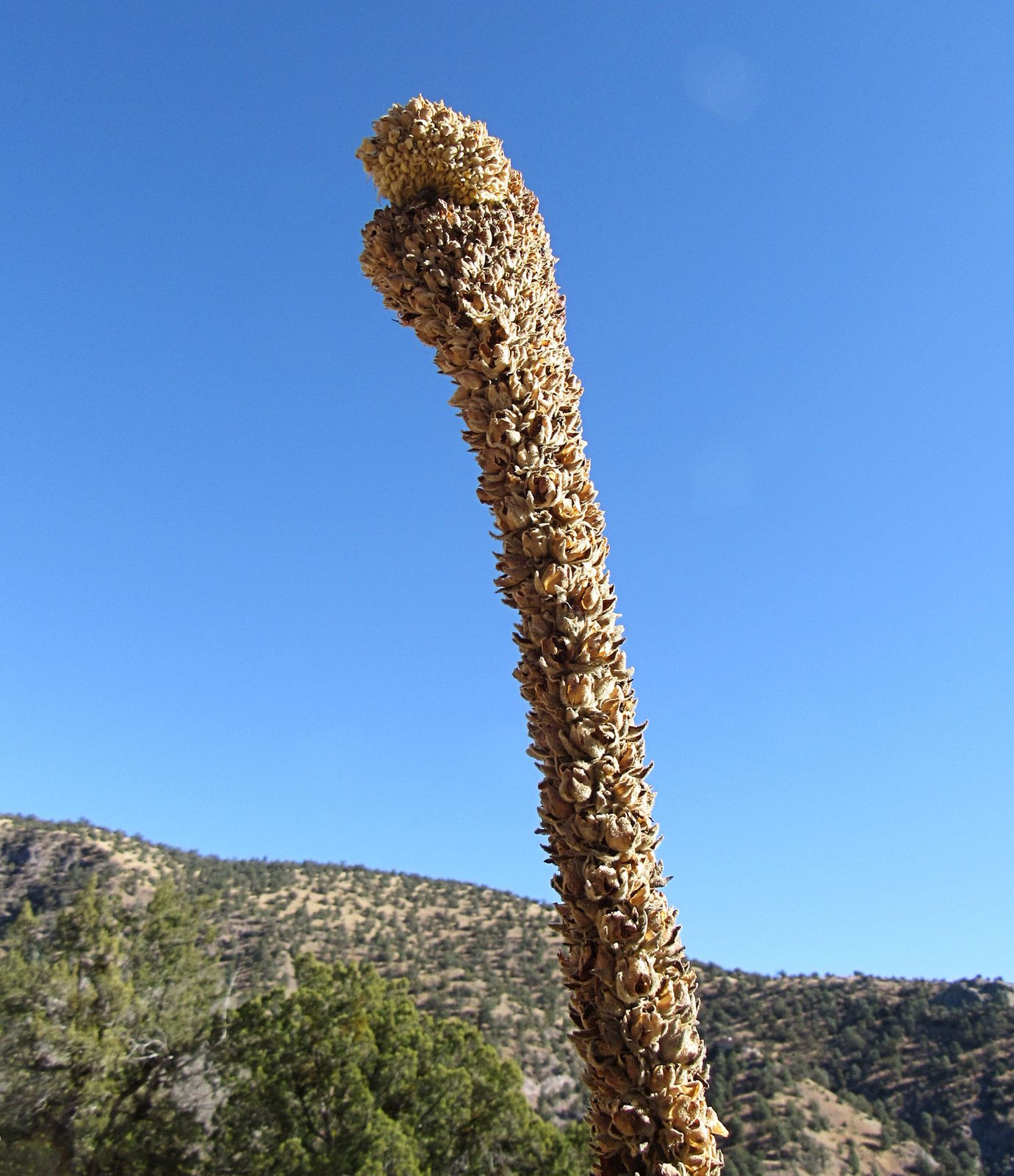
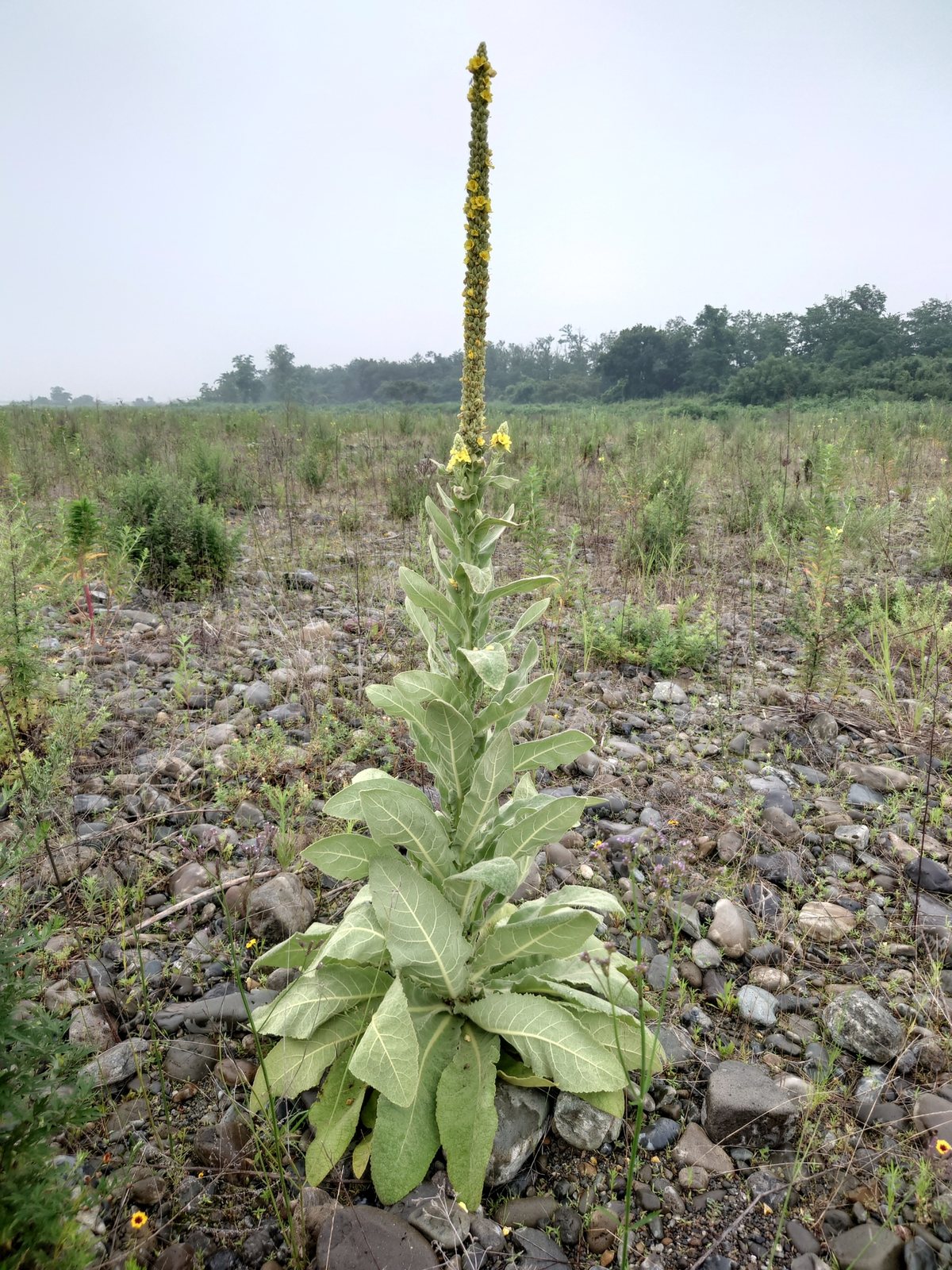
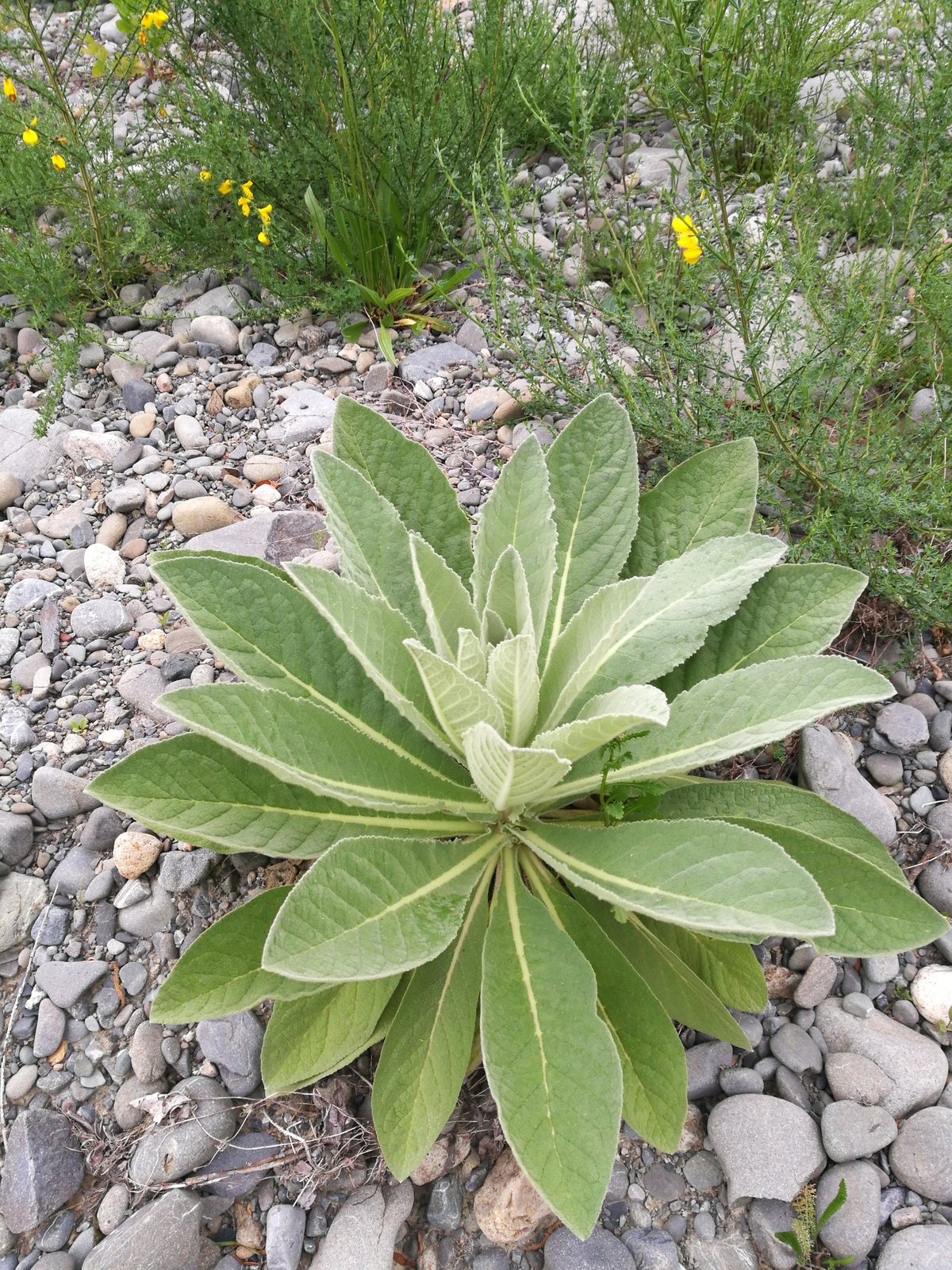
At a glance
- Sun
- Full sun.
- Water
- Low once established; water young plants during prolonged dry spells and avoid persistently wet soil.
- Soil
- Well-drained, preferably lean soil, including sandy, gravelly or chalky ground. Avoid heavy, waterlogged soil.
- Height
- 3-7 ft (0.9-2.1 m)
- Spread
- 1-2 ft (0.3-0.6 m)
- Flowers
- Summer into early autumn; small yellow flowers open successively along a tall, dense spike.
- Foliage
- Evergreen. Large, softly felted, grey-green leaves form a basal rosette, with smaller leaves clasping and extending down the flowering stem. Rosettes often retain leaves through winter but may lose foliage in severe cold.
- Growth
- Fast; usually flowers in its second summer, though flowering can be delayed in poor conditions.
- Care needed
- Low
The year at a glance
- Pollinators
- Deer resistant
- Drought tolerant
- Cold hardy
- Heat tolerant
- Wildlife
- Low allergen
| J | F | M | A | M | J | J | A | S | O | N | D | |
|---|---|---|---|---|---|---|---|---|---|---|---|---|
| Flowers | ||||||||||||
| Fruit | ||||||||||||
| Plant |
Northern hemisphere months. In Australia, shift them by six.
- Difficulty
- Easy
- Toughness
- Very tough
Will it suit your garden?
Pick your zone, country, light and whether you have pets.
Full sun is 6 or more hours of direct sun a day, part shade 3 to 6 hours, shade under 3.
How it grows
Planting day
1 ft (0.3 m)
After 1 year
3 ft (0.92 m)
After 2 years
5 ft (1.5 m)
full size
About 2 years to full size.
From a typical nursery size, at an average rate for this kind of plant. A rule of thumb, not a forecast.
Good to know
- Cats and dogs
- Mildly toxic: may upset a stomach
- Native to
- the UK
- Invasive in
- the US, Canada and Australia
- In the garden
- Spreads vigorously: plan to contain it.
- Growth rate
- Fast
Care
Jobs through the year
- WaterApr–May, Sep, every 21 days
- Water established plants only during extended drought; young rosettes need more frequent watering.
- WaterJun–Aug, every 14 days
- Water only during extended drought, allowing soil to dry between soakings.
- PruneMar–May
- Remove rotten rosettes and unwanted seedlings while their taproots are small.
- DeadheadJul–Sep, every 7 days
- Cut finished spikes at the base before capsules ripen to limit invasive spread.
- PruneSep–Oct
- Remove dying flowering rosettes; wear gloves if the leaf hairs irritate skin.
- ProtectJan–Feb, Oct–Dec
- Clear wet leaf litter from rosettes and keep crowns freely drained.
- ProtectMar–May
- Check local invasive-plant restrictions before sowing or allowing self-seeding.
- Plant in full sun with excellent drainage.
- Water new rosettes until established; thereafter water only during extended drought.
- Do not routinely feed; rich soil encourages oversized, less sturdy growth.
- Keep mulch away from the crown and avoid moisture-retaining mulch on damp sites.
- Thin unwanted seedlings while small, before their taproots develop.
Pruning. Cut flowering stalks off at the base before seed capsules ripen to limit spread. Remove the dying rosette after flowering; wear gloves if the leaf hairs irritate your skin.
Through the year
- Early spring
- Check overwintered rosettes and remove plants with rotten crowns.
- Spring
- Where growing it is appropriate, surface-sow seed on open, well-drained soil and thin seedlings.
- Late spring
- Remove unwanted seedlings and stake unusually exposed flowering stems if necessary.
- Summer
- Water establishing plants during dry spells; established plants usually need little attention.
- Late summer
- Cut flower spikes before capsules ripen unless limited self-seeding is wanted and locally appropriate.
- Autumn
- Remove spent plants and keep fallen leaves from smothering young rosettes.
In the garden
- Use occasional plants as vertical accents among low plants in a sunny gravel garden.
- Pair the silver rosettes with lavender and catmint for contrasting leaf shapes.
- Place behind shorter cottage-garden flowers to add height without a broad canopy.
- Use in a managed pollinator border within its native range, removing excess seedlings.
Garden styles it suits: Cottage garden, Dry gravel garden, Desert / xeriscape, Pollinator garden, Architectural minimal and Mediterranean.
Plant it with: Lavender, Catmint, Yarrow, Sea holly, Stonecrop and Lamb's ears.
Wildlife: Flowers provide pollen for bees. In Britain, the foliage feeds mullein moth caterpillars. Its wildlife value outside its native range does not outweigh the need to control invasive spread.
Problems to watch for
- Crown or root rot in wet ground: improve drainage or move young plants to a drier site; discard rotting plants.
- Powdery mildew: provide full sun and airflow, and remove badly affected foliage.
- Mullein moth caterpillars, especially in the UK: tolerate some feeding for wildlife, or hand-pick if a small plant is being stripped.
- Excessive self-seeding: remove spikes before seed ripens and pull seedlings promptly; avoid disturbing soil unnecessarily.
Safety
Not generally known to be poisonous to cats, dogs or horses, but species-specific safety information is limited. Leaf hairs can irritate people's skin, mouth and throat, and seeds contain rotenone and should not be eaten. Keep children and pets from chewing the plant, and seek medical or veterinary advice after significant ingestion.
Where it spreads. Introduced and aggressively self-seeding in disturbed ground across much of North America and parts of Australia. It is listed as invasive in parts of the western United States and British Columbia, Canada, and is an environmental weed in southeastern Australia, including Victoria and Tasmania. Check local weed guidance before planting; seed can remain viable in soil for decades.
Easily confused with
Common foxglove (Digitalis purpurea)
Young foxgloves also form hairy rosettes, but their leaves are greener, more wrinkled and toothed. Flowers are large hanging bells rather than small, open yellow flowers; foxglove is highly poisonous.
Moth mullein (Verbascum blattaria)
Leaves are green and mostly hairless rather than densely woolly, and yellow or white flowers are spaced loosely along slender stems.
Orange mullein (Verbascum phlomoides)
It has similarly woolly leaves but generally larger yellow flowers; its upper leaves do not extend down the stem to form the conspicuous wings typical of great mullein.
The name
The common name mullein is generally traced to a word meaning soft, referring to the felted leaves, while great distinguishes this tall species from smaller mulleins.
Propagation. Propagate by seed in spring or late summer where local guidance permits. Press seed onto the surface because it needs light to germinate, and transplant seedlings while small to avoid disturbing the taproot. It is not normally divided.
Checked against open data
- Accepted botanical name
- Verbascum thapsus
- In the US and Canada
- Introduced in Alaska, Canada, Hawaii and the lower 48 states.
- Native range
- Afghanistan, Altay, Austria, Azores, Baleares, Baltic States, Belarus, Belgium, Central European Rus, China South-Central, Corse and Czechoslovakia.
- Measured
- Soil pH 7 to 7.5. Average height 82 cm.
Sources: GBIF (CC BY 4.0), USDA PLANTS and Trefle (CC BY 4.0). The care and design notes are LandscapeGPT's own.
See it in your own yard.
Upload a photo of your yard and see it redesigned with plants that suit your climate, each checked against your zone.