Griffith's spurge 'Fireglow'
Euphorbia griffithii 'Fireglow'. Family Euphorbiaceae. Perennial.
Also called Euphorbia griffithii 'Fireglow', 'Fireglow' spurge.
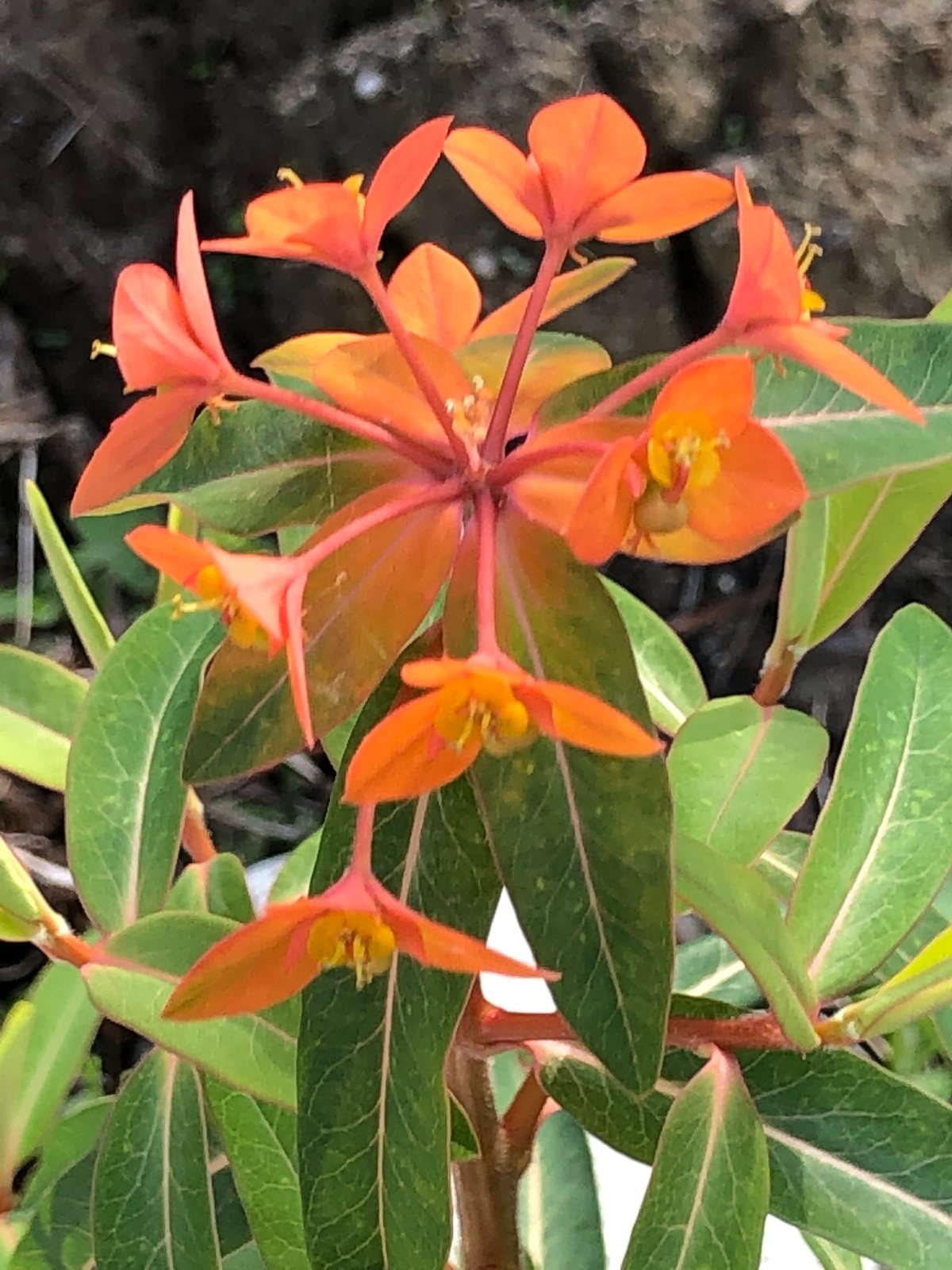
A spreading, deciduous perennial grown for its fiery orange-red flower bracts in late spring and early summer. Red-tinged shoots and warm autumn foliage extend its interest, but its creeping roots need room and its irritating milky sap requires careful handling.
At a glance
- Sun
- Full sun to partial shade; afternoon shade helps in hot climates.
- Water
- Moderate; keep the soil evenly moist during active growth, especially in the first year.
- Soil
- Moist, well-drained soil enriched with organic matter; tolerates clay if it does not remain waterlogged.
- Height
- 2-3 ft (0.6-0.9 m)
- Spread
- 2-3 ft (0.6-0.9 m), spreading farther over time by rhizomes
- Flowers
- Late spring to early summer; orange-red bracts surround small yellow flowers.
- Foliage
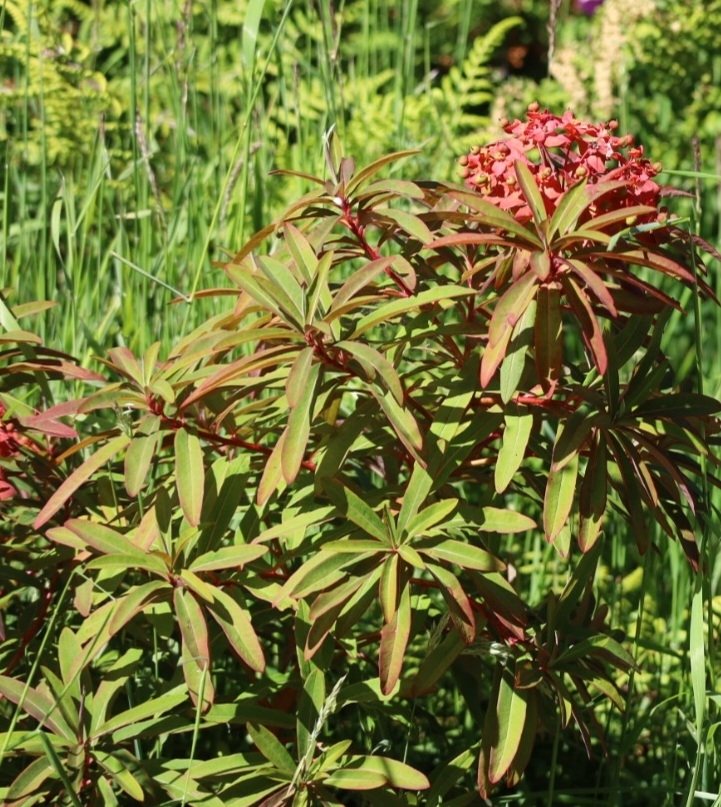
- Upright reddish stems carry narrow green leaves, often bronze-red when young, with yellow, orange or red autumn colour.
- Growth
- Moderate to fast once established
- Care needed
- Medium
The year at a glance
- Pollinators
- Deer resistant
- Low allergen
| J | F | M | A | M | J | J | A | S | O | N | D | |
|---|---|---|---|---|---|---|---|---|---|---|---|---|
| Flowers | ||||||||||||
| Plant |
Northern hemisphere months. In Australia, shift them by six.
- Difficulty
- Moderate
- Toughness
- Fairly tough
Will it suit your garden?
Pick your zone, country, light and whether you have pets.
Full sun is 6 or more hours of direct sun a day, part shade 3 to 6 hours, shade under 3.
How it grows
Planting day
1 ft (0.3 m)
After 1 year
1.6 ft (0.49 m)
After 2 years
2.2 ft (0.68 m)
After 3 years
2.5 ft (0.75 m)
full size
About 2 years to full size.
From a typical nursery size, at an average rate for this kind of plant. A rule of thumb, not a forecast.
Good to know
- Cats and dogs
- Toxic
- In the garden
- Spreads vigorously: plan to contain it.
- Growth rate
- Fast
Care
Jobs through the year
- WaterApr–May, Sep–Oct, every 14 days
- Water established plants deeply if soil is drying; first-year plants need more frequent watering.
- WaterJun–Aug, every 7 days
- Water established plants deeply during dry weather to maintain even moisture without waterlogging.
- MulchMar–Apr
- Spread a thin compost mulch to conserve moisture, keeping emerging shoots clear.
- PruneFeb–Mar
- Cut remaining dead stems to ground level before growth starts; wear gloves, sleeves and eye protection.
- DivideMar–Apr
- Divide congested clumps or remove encroaching rhizomes as needed; wear gloves, sleeves and eye protection.
- Water deeply during dry spells; prolonged drought can cause leaves to yellow and drop.
- Apply a thin layer of compost in spring; rich feeding is usually unnecessary.
- Mulch around the clump to conserve moisture, keeping mulch clear of emerging shoots.
- Remove unwanted spreading shoots with their attached rhizomes before they establish.
- Divide congested clumps in early spring, wearing gloves and eye protection.
Pruning. Cut dead stems to ground level in late autumn or before new growth begins in spring. Wear gloves, long sleeves and eye protection, and avoid contact with the milky sap.
Through the year
- Early spring
- Cut down remaining dead stems before shoots emerge; divide or remove spreading rhizomes if needed.
- Spring
- Plant into moist, well-drained soil and apply compost and mulch.
- Late spring
- Check the edge of the clump and dig out shoots growing into neighbouring plants.
- Summer
- Water during prolonged dry weather to keep the foliage in good condition.
- Autumn
- Leave stems while the foliage colours, then cut them down once dead, or wait until early spring.
In the garden
- Plant in a hot-coloured border with orange avens and purple cranesbills.
- Use beside Siberian irises in a moisture-retentive border, where the upright stems contrast with narrow iris leaves.
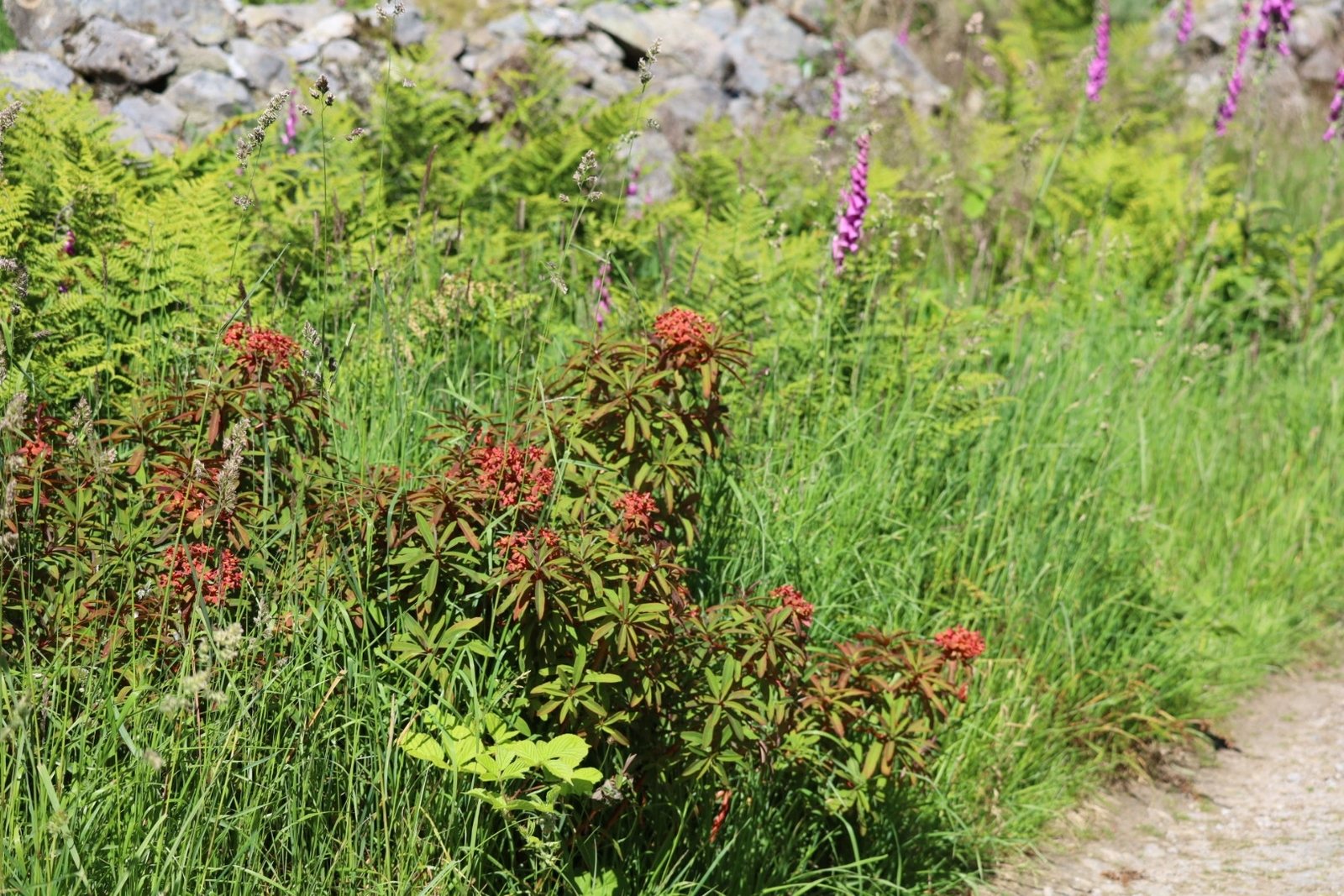
- Plant at a bright woodland edge for spring colour against ferns and fresh green foliage.
- Repeat generous clumps through a large perennial border, leaving space for the rhizomes to spread.
Garden styles it suits: Cottage garden, English country, New perennial (prairie), Woodland, Hot border and Autumn colour.
Plant it with: Siberian iris, Hardy geranium, Avens, Lady fern, Bistort and Daylily.
Wildlife: The small flowers provide accessible nectar and pollen for visiting insects. Deer and rabbits usually avoid the plant, though browsing resistance is not guaranteed.
Problems to watch for
- Unwanted spread: dig out encroaching shoots with their rhizomes and check the clump's boundary each spring.
- Powdery mildew: improve air circulation, avoid overcrowding and water the soil during dry weather.
- Root rot in waterlogged soil: improve drainage or move the plant to a moist but freely draining site.
- Yellowing or scorched foliage in drought: water deeply and provide afternoon shade in hot locations.
Safety
Toxic to people, cats, dogs and horses if eaten. All parts contain irritating milky sap; ingestion can cause mouth irritation, vomiting and diarrhoea, while skin contact can cause inflammation or blistering. Sap in the eyes can cause serious injury and needs immediate rinsing and urgent medical advice.
Where it spreads. Can spread aggressively by rhizomes in moist garden soil, including in UK gardens and temperate parts of North America. Treat it as a potentially vigorous garden spreader rather than assuming it will stay in its original clump.
Easily confused with
Griffith's spurge 'Dixter' (Euphorbia griffithii 'Dixter')
Another orange-bracted cultivar, generally more compact and slower spreading. Appearance overlaps, so a reliable plant label is the safest distinction.
Marsh spurge (Euphorbia palustris)
Usually taller and broader, with yellow-green rather than orange-red flower bracts.
Cushion spurge (Euphorbia epithymoides)
Forms a shorter, rounded mound with bright yellow bracts rather than tall, spreading stems topped with orange-red bracts.
The name
The species name griffithii honours the British botanist William Griffith, while 'Fireglow' refers to the cultivar's fiery bract colour.
Propagation. Divide in early spring, keeping roots and growing buds on each piece. Division preserves 'Fireglow'; seedlings may differ from the parent. Wear gloves and eye protection when handling cut roots or stems.
Checked against open data
- Accepted botanical name
- Euphorbia griffithii
- Native range
- China South-Central, East Himalaya, Myanmar, Nepal and Tibet.
Sources: GBIF (CC BY 4.0) and Trefle (CC BY 4.0). The care and design notes are LandscapeGPT's own.
See it in your own yard.
Upload a photo of your yard and see it redesigned with plants that suit your climate, each checked against your zone.