Handkerchief tree
Davidia involucrata. Family Nyssaceae. Tree.
Also called Dove tree, Ghost tree.
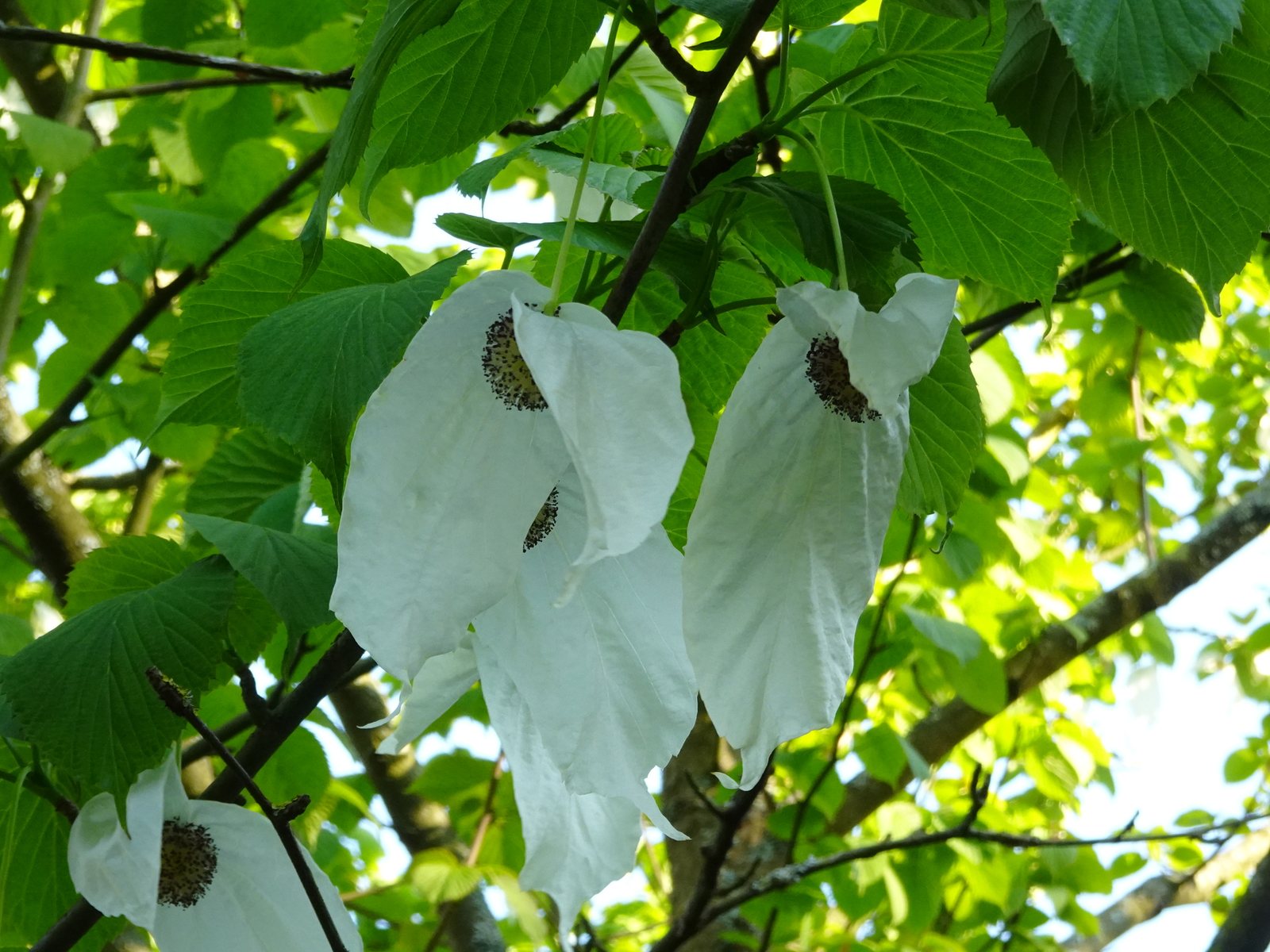
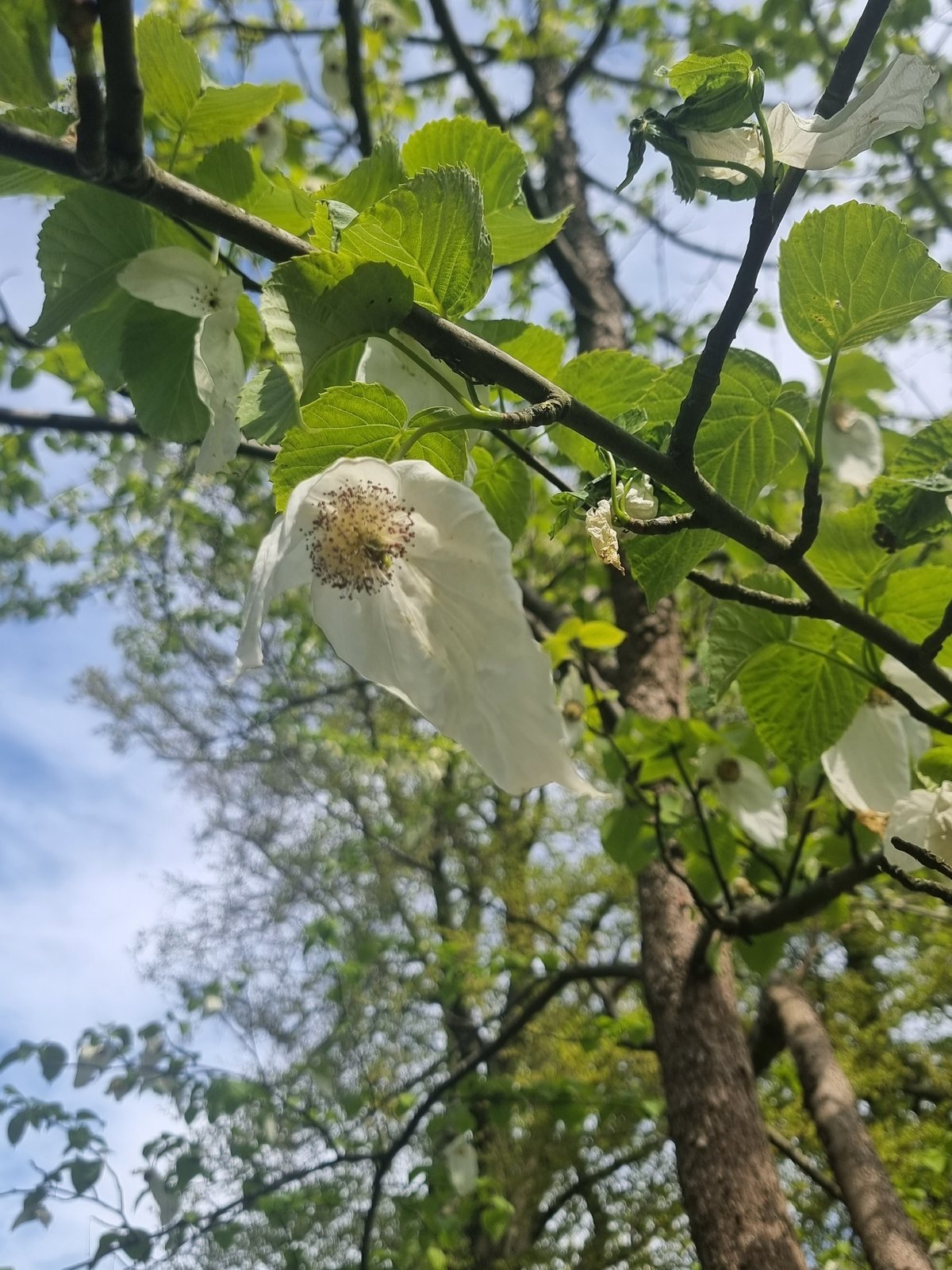
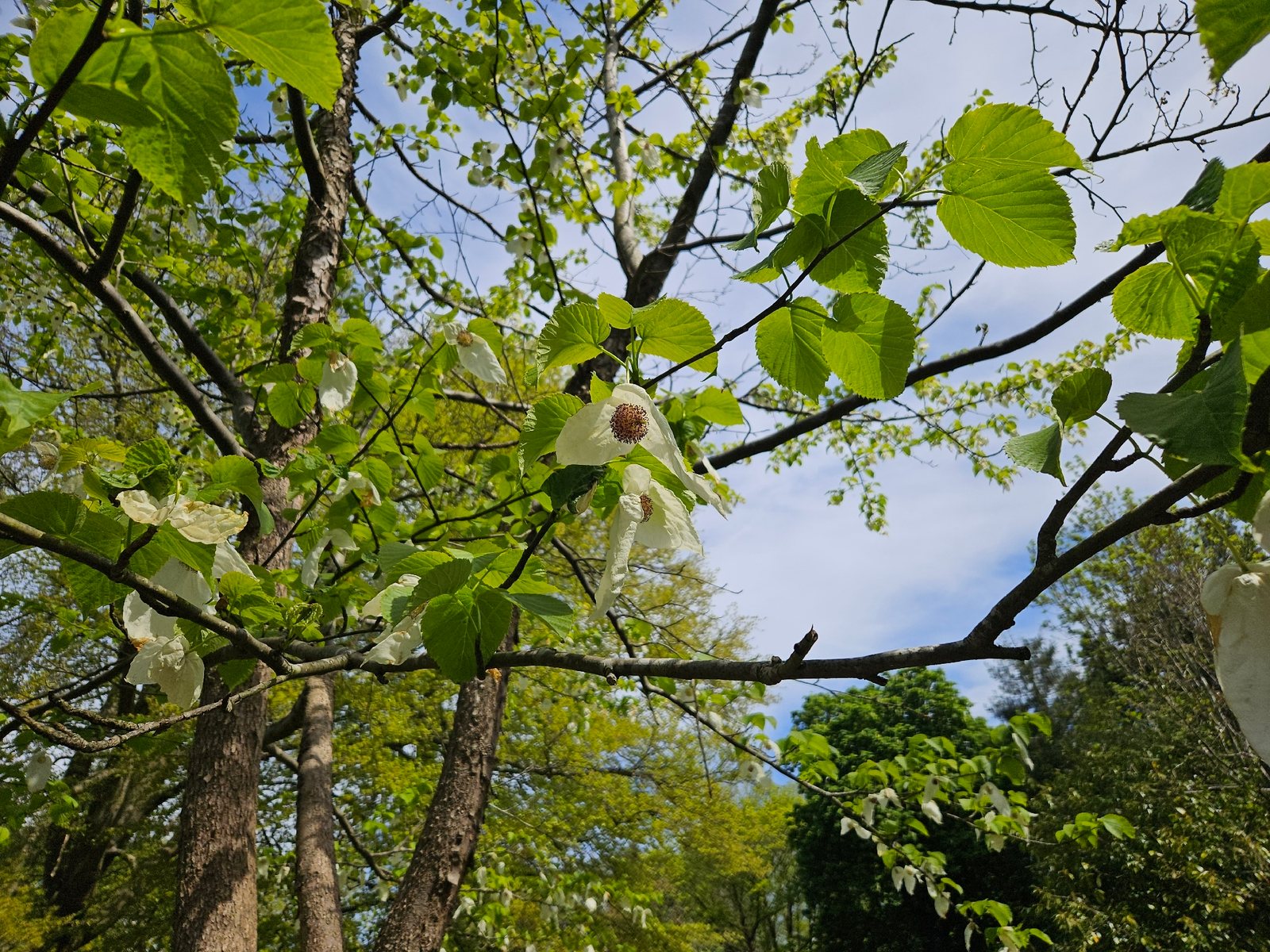
Davidia involucrata is a deciduous tree from China, grown for the large, hanging white bracts that surround its small flower heads in late spring. It makes a broad, handsome specimen tree for a sheltered garden with reliable moisture, but seed-grown trees often take 10-20 years to flower.
At a glance
- Sun
- Full sun or partial shade; afternoon shade is helpful in warmer areas. Shelter from strong, drying winds.
- Water
- Moderate to high; keep the root zone evenly moist but not waterlogged, especially during establishment and summer dry spells.
- Soil
- Deep, fertile, humus-rich, well-drained soil; slightly acidic to neutral is ideal. Avoid shallow, drought-prone or persistently wet ground.
- Height
- 40-60 ft (12-18 m)
- Spread
- 25-40 ft (7.5-12 m)
- Flowers
- Late spring to early summer: small rounded flower heads accompanied by two unequal, creamy-white bracts that hang like handkerchiefs.
- Foliage
- Alternate, heart-shaped, toothed green leaves, sometimes softly hairy beneath; autumn colour ranges from muted yellow to brown.
- Growth
- Moderate once established; often slow during the first few years.
- Care needed
- Medium
The year at a glance
- Wildlife
| J | F | M | A | M | J | J | A | S | O | N | D | |
|---|---|---|---|---|---|---|---|---|---|---|---|---|
| Flowers | ||||||||||||
| Fruit | ||||||||||||
| Plant |
Northern hemisphere months. In Australia, shift them by six.
- Difficulty
- Moderate
- Toughness
- Fairly tough
Will it suit your garden?
Pick your zone, country, light and whether you have pets.
Full sun is 6 or more hours of direct sun a day, part shade 3 to 6 hours, shade under 3.
How it grows
Planting day
7 ft (2 m)
After 1 year
8 ft (2.5 m)
After 2 years
10 ft (3 m)
After 3 years
11 ft (3.5 m)
After 5 years
15 ft (4.5 m)
About 26 years to full size.
From a typical nursery size, at an average rate for this kind of plant. A rule of thumb, not a forecast.
Good to know
- Cats and dogs
- Safe
- Growth rate
- Slow
Care
Jobs through the year
- WaterApr–May, Sep–Oct, every 14 days
- Water established trees when soil begins drying; young trees need more frequent moisture checks.
- WaterJun–Aug, every 7 days
- Water deeply during dry weather, keeping roots evenly moist without saturating the soil.
- MulchMar–Apr
- Apply 5–8 cm of organic mulch over the root zone, clear of the trunk.
- FeedMar–Apr
- Feed lightly only if growth is weak or soil is poor; avoid excess nitrogen.
- PruneFeb–Mar
- While dormant, remove damaged or crossing branches and correct competing leaders on young trees.
- ProtectApr–May
- Cover small newly planted trees with horticultural fleece when late frost threatens new growth.
- Plant during the dormant season when the ground is workable, allowing room for a broad mature crown.
- Water deeply through dry spells for the first two or three growing seasons; established trees also need water during prolonged drought.
- Apply a 2-3 in (5-8 cm) organic mulch over the root zone, keeping it clear of the trunk.
- Feed in spring only if growth is weak or the soil is poor; avoid heavy nitrogen feeding.
- Stake only if the root ball moves in wind, and remove supports once the tree is firmly rooted.
Pruning. Prune lightly in late winter while dormant, removing dead, damaged or crossing branches and correcting competing leaders while young. Avoid hard pruning or routinely reducing the crown.
Through the year
- Autumn
- Plant in mild regions while the soil is still warm and moist; water thoroughly after planting.
- Late winter
- Inspect the branch framework and carry out only necessary light pruning.
- Spring
- Plant in colder regions once the ground is workable; renew mulch and check tree ties.
- Late spring
- Watch for bracts on mature trees; protect small, newly planted specimens if a late frost threatens.
- Summer
- Water deeply during dry weather and check for leaf scorch.
- Autumn
- Collect ripe fallen fruits if you want to try seed propagation, and remove unnecessary stakes.
In the garden
- Use as a lawn specimen with enough open space to appreciate the hanging white bracts.
- Place at the edge of a woodland garden, with the crown in good light and the roots shaded by low planting.
- Position where its spring display can be seen from a window or a regularly used path.
- Combine with shade-tolerant shrubs, ferns and groundcover beneath the outer canopy.
Garden styles it suits: Woodland, Grand estate, English country, Romantic rose garden, White garden and Chinese scholar garden.
Plant it with: Japanese maple, Camellia, Rhododendron, Hosta, Epimedium and Japanese painted fern.
Wildlife: The crown provides shelter and potential nesting sites for birds. It is not generally chosen as a major nectar or wildlife-food tree.
Problems to watch for
- Failure to flower: young trees may need 10-20 years or longer; provide good light, steady moisture and avoid excessive nitrogen.
- Brown leaf edges or summer leaf drop: drought, heat and drying wind can cause scorch; water deeply, mulch and choose a sheltered site.
- Blackened young leaves or damaged bracts after frost: avoid frost pockets; protect small trees during forecast late frosts.
- Poor growth or root decline in wet soil: improve drainage before planting or choose a better-drained position; do not keep watering saturated soil.
Safety
Not known to be toxic to people, cats, dogs or horses, although species-specific safety information is limited, particularly for horses. The leaves, bracts and fruits are not food; discourage ingestion.
Easily confused with
Kousa dogwood (Cornus kousa)
Its flower heads have four pointed white bracts arranged in a flat cross, rather than two unequal, hanging bracts. Its leaves grow in opposite pairs, while handkerchief tree leaves are alternate.
The name
Davidia honours the French naturalist Armand David, while involucrata refers to the enclosing bracts whose shape gives rise to the names handkerchief tree and dove tree.
Propagation. Sow cleaned seed outdoors in a protected seed bed or deep pots after the fruits ripen. Germination is slow and irregular, often taking two years or longer; named selections are usually propagated by specialist grafting.
Checked against open data
- Accepted botanical name
- Davidia involucrata
- Native range
- China South-Central and China Southeast.
- Measured
- Average height 2000 cm.
Sources: GBIF (CC BY 4.0) and Trefle (CC BY 4.0). The care and design notes are LandscapeGPT's own.
See it in your own yard.
Upload a photo of your yard and see it redesigned with plants that suit your climate, each checked against your zone.