Hebe Autumn Glory
Hebe 'Autumn Glory'. Family Plantaginaceae. Shrub.
Also called Hebe 'Autumn Glory', Veronica 'Autumn Glory'.
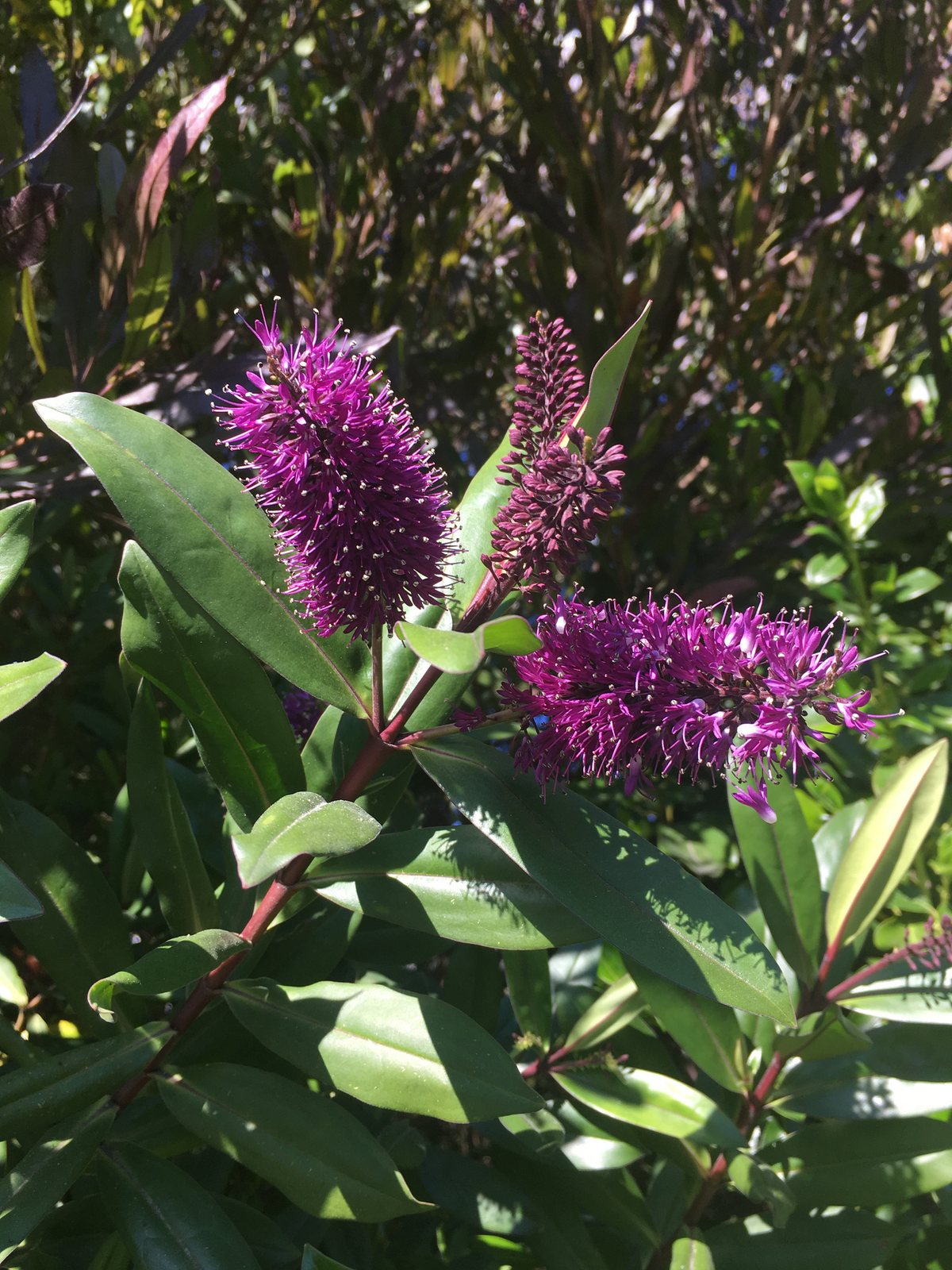
A compact evergreen shrub with dark green leaves, purple-tinted young stems and spikes of violet-blue flowers from summer into autumn. Grow it for year-round structure and late flowers in a sunny, sheltered border or container; it is best suited to mild winters.
At a glance
- Sun
- Full sun for the best flowering; light partial shade is suitable in hot climates.
- Water
- Water regularly during the first growing season. Once established, water during prolonged dry spells; container plants need more frequent checks.
- Soil
- Well-drained soil, from slightly acidic to slightly alkaline. Avoid heavy ground that stays wet in winter.
- Height
- 2-3 ft (0.6-0.9 m)
- Spread
- 2-3 ft (0.6-0.9 m)
- Flowers
- Violet-blue to purple flower spikes from summer into autumn, with timing and duration varying by climate.
- Foliage
- Evergreen. Small, opposite, oval to narrowly oval dark green leaves, often with purple-tinged margins and young growth.
- Growth
- Moderate
- Care needed
- Low
The year at a glance
- Pollinators
- Low allergen
| J | F | M | A | M | J | J | A | S | O | N | D | |
|---|---|---|---|---|---|---|---|---|---|---|---|---|
| Flowers | ||||||||||||
| Plant |
Northern hemisphere months. In Australia, shift them by six.
- Difficulty
- Moderate
- Toughness
- Needs looking after
Will it suit your garden?
Pick your zone, country, light and whether you have pets.
Full sun is 6 or more hours of direct sun a day, part shade 3 to 6 hours, shade under 3.
How it grows
Planting day
1.6 ft (0.5 m)
After 1 year
1.8 ft (0.55 m)
After 2 years
2 ft (0.6 m)
After 3 years
2.1 ft (0.65 m)
After 5 years
2.5 ft (0.75 m)
full size
About 5 years to full size.
From a typical nursery size, at an average rate for this kind of plant. A rule of thumb, not a forecast.
Good to know
- Cats and dogs
- Safe
- Growth rate
- Moderate
Care
Jobs through the year
- WaterApr–May, Sep–Oct, every 14 days
- Check established plants and water only during dry spells; water first-year plants more regularly.
- WaterJun–Aug, every 10 days
- Water established plants deeply during prolonged dry weather; check containers more often.
- FeedApr
- Apply a light balanced feed only if growth is weak or soil is poor.
- MulchApr–May
- Apply a thin mulch over the root area, keeping stem bases clear.
- PruneApr–May
- After hard frosts, remove damaged tips and lightly shorten leafy shoots; never cut into bare old wood.
- ProtectJan–Mar, Oct–Dec
- Not reliably hardy in zones 6–7: overwinter in a bright, frost-free container location; fleece alone is insufficient.
- Plant in spring in colder areas, choosing shelter from cold, drying winds.
- Water deeply when the root zone begins to dry, but never leave the roots waterlogged.
- Apply a light dressing of balanced fertiliser in spring only if growth is weak or the soil is poor.
- Keep a thin mulch over the root area, leaving the base of the stems clear.
- Use a freely draining potting mix in containers and move pots under cover during severe freezes.
Pruning. In spring, after the risk of hard frost has passed, remove frost-damaged tips and lightly shorten leafy shoots to keep the shrub compact. Snip off spent flower spikes if needed, but avoid cutting hard into bare old wood, which may not regrow.
Through the year
- Spring
- Plant once severe frosts have passed, or check established plants for winter damage.
- Late spring
- Lightly trim damaged or straggly shoots, keeping cuts within leafy growth.
- Summer
- Check soil moisture during dry weather, especially around new plants and in containers.
- Late summer
- Take semi-ripe cuttings from healthy, non-flowering shoots.
- Autumn
- Remove spent flower spikes if desired, but avoid heavy pruning or nitrogen-rich feeding.
- Winter
- Keep roots well drained and protect container plants from prolonged freezing and cold winds.
In the garden
- Plant along the front of a sunny shrub border for evergreen shape and late-season flowers.
- Repeat in a sheltered coastal garden with lavender and rock roses for contrasting foliage and flower forms.
- Grow in a well-drained container beside a sunny doorway or on a patio.
- Use as a loose, low edging in mild-climate gardens, allowing room for its rounded shape.
Garden styles it suits: Coastal, Modern courtyard, Dry gravel garden, Low-maintenance, Pollinator garden and Small-space.
Plant it with: Lavender, Rock rose, Santolina, Catmint, Salvia and Blue fescue.
Wildlife: The flowers provide nectar for bees and other visiting insects, particularly late in the growing season.
Problems to watch for
- Winter root rot: improve drainage, avoid low-lying wet sites and never leave container plants standing in water.
- Frost scorch or shoot dieback: choose a sheltered position, protect during severe freezes and wait until spring before removing damaged growth.
- Aphids on young shoots: rinse off small colonies with water and encourage ladybirds and other natural predators.
- Leggy growth and a bare centre: provide more sun and trim lightly each year; replace badly woody plants rather than cutting them back severely.
Safety
Not known to be toxic to people, cats, dogs or horses. No plant parts are recognised as poisonous, but it is an ornamental rather than an edible plant.
Easily confused with
Showy hebe (Veronica speciosa (syn. Hebe speciosa))
Usually has substantially larger, broader, glossy leaves and denser spikes of pink to reddish-purple flowers.
Hebe Pagei (Veronica pinguifolia 'Pagei' (syn. Hebe pinguifolia 'Pagei'))
Forms a lower, spreading mound with rounded grey-green leaves and white flowers, rather than dark foliage and violet-blue flowers.
The name
Hebe is named after the Greek goddess of youth.
Propagation. Take semi-ripe cuttings in late summer from healthy, non-flowering shoots and root them in a freely draining medium under cover. Cuttings preserve the cultivar; seedlings will not reliably come true.
Checked against open data
- Accepted botanical name
- Veronica Hebe 'Autumn Glory' is an older name for Veronica.
Sources: GBIF (CC BY 4.0). The care and design notes are LandscapeGPT's own.
See it in your own yard.
Upload a photo of your yard and see it redesigned with plants that suit your climate, each checked against your zone.