Hebe Mrs Winder
Hebe 'Mrs Winder'. Family Plantaginaceae. Shrub.
Also called Hebe 'Mrs Winder', Veronica 'Mrs Winder', Shrubby veronica 'Mrs Winder'.
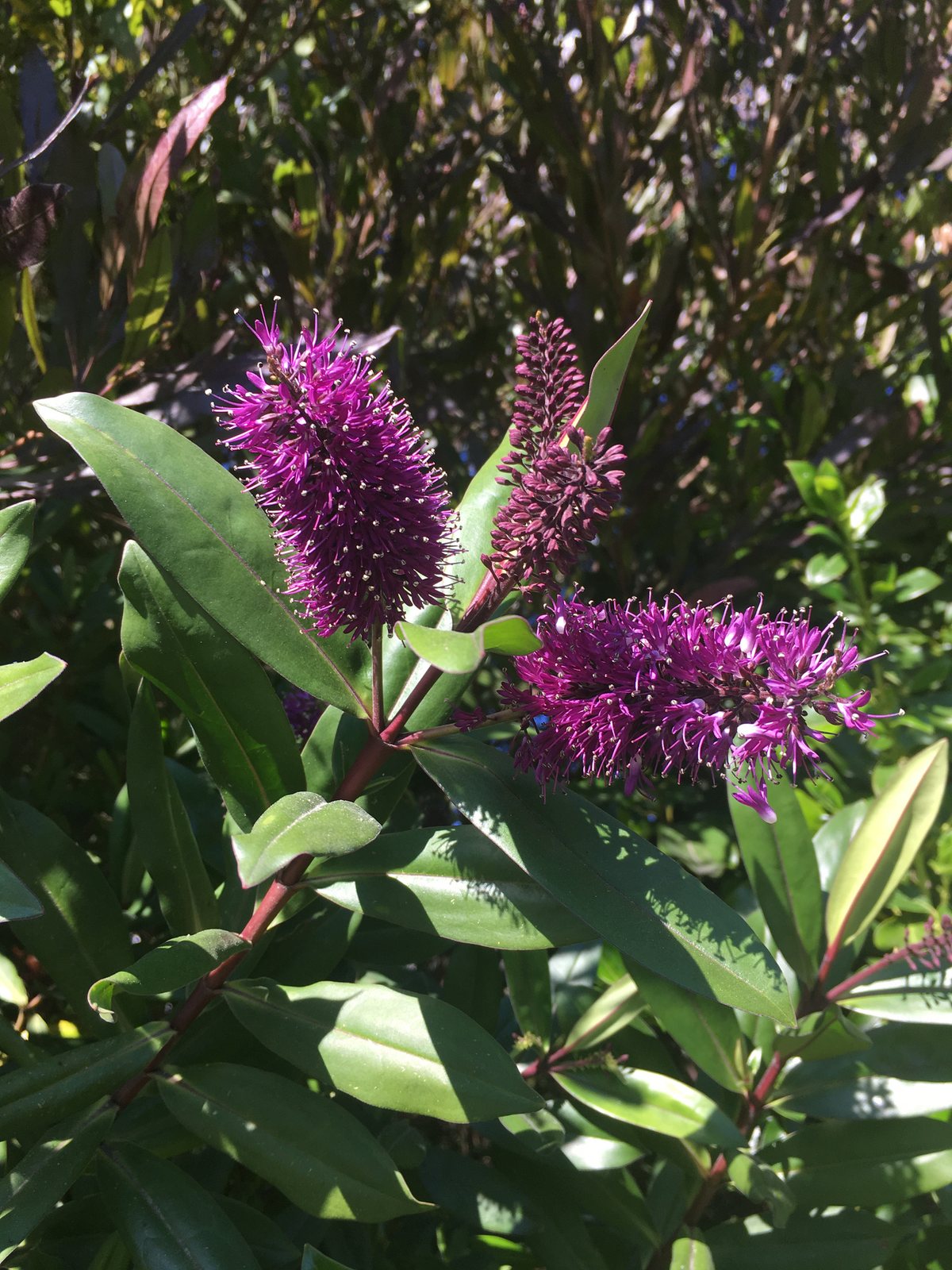
An evergreen shrub grown for its narrow, dark green leaves, which take on bronze-purple tones in cold weather. Violet-purple flower spikes appear in late summer and autumn, though flowering can be sparse. It suits mild coastal gardens and sheltered borders with freely draining soil.
At a glance
- Sun
- Full sun to light partial shade; foliage colour and flowering are usually best in sun.
- Water
- Water regularly while establishing; once established, water during prolonged dry spells. Avoid persistently wet roots.
- Soil
- Well-drained soil, preferably moderately fertile; tolerates a range of soil pH but struggles in waterlogged clay.
- Height
- 3-5 ft (0.9-1.5 m)
- Spread
- 3-5 ft (0.9-1.5 m)
- Flowers
- Short spikes of violet-purple flowers in late summer and autumn; flowering varies with climate and growing conditions.
- Foliage
- Small, narrow, pointed evergreen leaves, dark green with bronze-purple colouring on young growth and in winter.
- Growth
- Moderate
- Care needed
- Low
The year at a glance
- Pollinators
- Drought tolerant
- Heat tolerant
- Low allergen
| J | F | M | A | M | J | J | A | S | O | N | D | |
|---|---|---|---|---|---|---|---|---|---|---|---|---|
| Flowers | ||||||||||||
| Plant |
Northern hemisphere months. In Australia, shift them by six.
- Difficulty
- Hard
- Toughness
- Needs looking after
Will it suit your garden?
Pick your zone, country, light and whether you have pets.
Full sun is 6 or more hours of direct sun a day, part shade 3 to 6 hours, shade under 3.
How it grows
Planting day
1.6 ft (0.5 m)
After 1 year
2.1 ft (0.64 m)
After 2 years
2.6 ft (0.78 m)
After 3 years
3 ft (0.92 m)
After 5 years
4 ft (1.2 m)
full size
About 5 years to full size.
From a typical nursery size, at an average rate for this kind of plant. A rule of thumb, not a forecast.
Good to know
- Cats and dogs
- Safe
- Growth rate
- Moderate
Care
Jobs through the year
- WaterApr–May, Sep–Oct, every 14 days
- Water established plants only when dry; water young plants more often.
- WaterJun–Aug, every 7 days
- Water deeply during dry spells, allowing the surface to dry between waterings.
- PruneApr–May
- After hard frosts, remove damaged tips and lightly trim into leafy growth only.
- MulchApr–May
- Apply a thin mulch, keeping it clear of the stems.
- FeedApr–May
- Feed lightly only if growth is weak; avoid nitrogen-rich feeding.
- ProtectJan–Apr, Oct–Dec
- In zones 6–7, overwinter in a bright frost-free container space; fleece alone is insufficient.
- Plant in spring in colder areas, choosing a sheltered site away from drying winter winds.
- Water deeply during the first growing season whenever the root zone begins to dry.
- Apply a thin mulch in spring, keeping it clear of the stems.
- Feed lightly in spring only if growth is weak; avoid heavy nitrogen feeding.
- Protect young plants with horticultural fleece during severe frost, and shelter containers from prolonged freezing.
Pruning. In spring, once the risk of hard frost has passed, remove frost-damaged tips and lightly shorten straggly shoots to leafy growth. Avoid cutting hard into bare old wood, which may not regrow.
Through the year
- Spring
- Plant in a sheltered, freely draining position and water thoroughly.
- Mid-spring
- Remove winter-damaged growth once new shoots show which stems are alive.
- Late spring
- Renew mulch and give a light feed only if needed.
- Summer
- Water young plants during dry weather; check containers more frequently.
- Late summer
- Take semi-ripe cuttings from healthy, non-flowering shoots.
- Autumn
- Check drainage and avoid pruning that would encourage tender new growth.
- Winter
- Protect against severe frost and keep container drainage holes clear.
In the garden
- Use near the front or middle of a mixed border for evergreen structure and dark winter foliage.
- Plant with lavender, rosemary and rock roses in a sunny, well-drained coastal border.
- Repeat plants along a path as a loose, low evergreen boundary rather than a tightly clipped hedge.
- Grow in a large, well-drained container in a sheltered courtyard, where its winter leaf colour is easy to see.
Garden styles it suits: Coastal, Dry gravel garden, Low-maintenance, Winter interest, Modern courtyard and Pacific Northwest woodland.
Plant it with: Lavender, Rosemary, Rock rose, Blue fescue, Bergenia and Stonecrop.
Wildlife: Flowers provide nectar for bees and other visiting insects when the shrub blooms.
Problems to watch for
- Root rot in wet soil: improve drainage before planting, avoid low spots and do not leave pots standing in water.
- Frost and wind scorch: choose a sheltered site, protect during severe freezes and wait until spring before removing damaged growth.
- Leaf spot: remove badly affected leaves, clear fallen debris and improve airflow; water the soil rather than the foliage.
- Leggy growth and a bare centre: provide more sun and trim lightly each spring; replace very woody plants rather than cutting them back hard.
Safety
Not known to be toxic to people, cats, dogs or horses. No particular part is recognised as poisonous, but it is not an edible plant and should not be offered as animal feed.
Easily confused with
Hebe Red Edge (Hebe 'Red Edge')
Has shorter, broader grey-green leaves with conspicuous pink-red margins, rather than the narrow, dark leaves of 'Mrs Winder'.
Hebe Autumn Glory (Hebe 'Autumn Glory')
Usually forms a lower, more compact mound with broader, glossy green leaves; 'Mrs Winder' is more upright and develops stronger bronze-purple foliage tones.
The name
Hebe is named after the Greek goddess of youth.
Propagation. Take semi-ripe cuttings in late summer, remove the lower leaves and root them in a free-draining propagation mix under cover. Cuttings preserve the cultivar; seedlings will not reliably come true.
Checked against open data
- Accepted botanical name
- Veronica Hebe 'Mrs Winder' is an older name for Veronica.
Sources: GBIF (CC BY 4.0). The care and design notes are LandscapeGPT's own.
See it in your own yard.
Upload a photo of your yard and see it redesigned with plants that suit your climate, each checked against your zone.