Henry's lily
Lilium henryi. Family Liliaceae. Bulb.
Also called Orange Turk's cap lily.
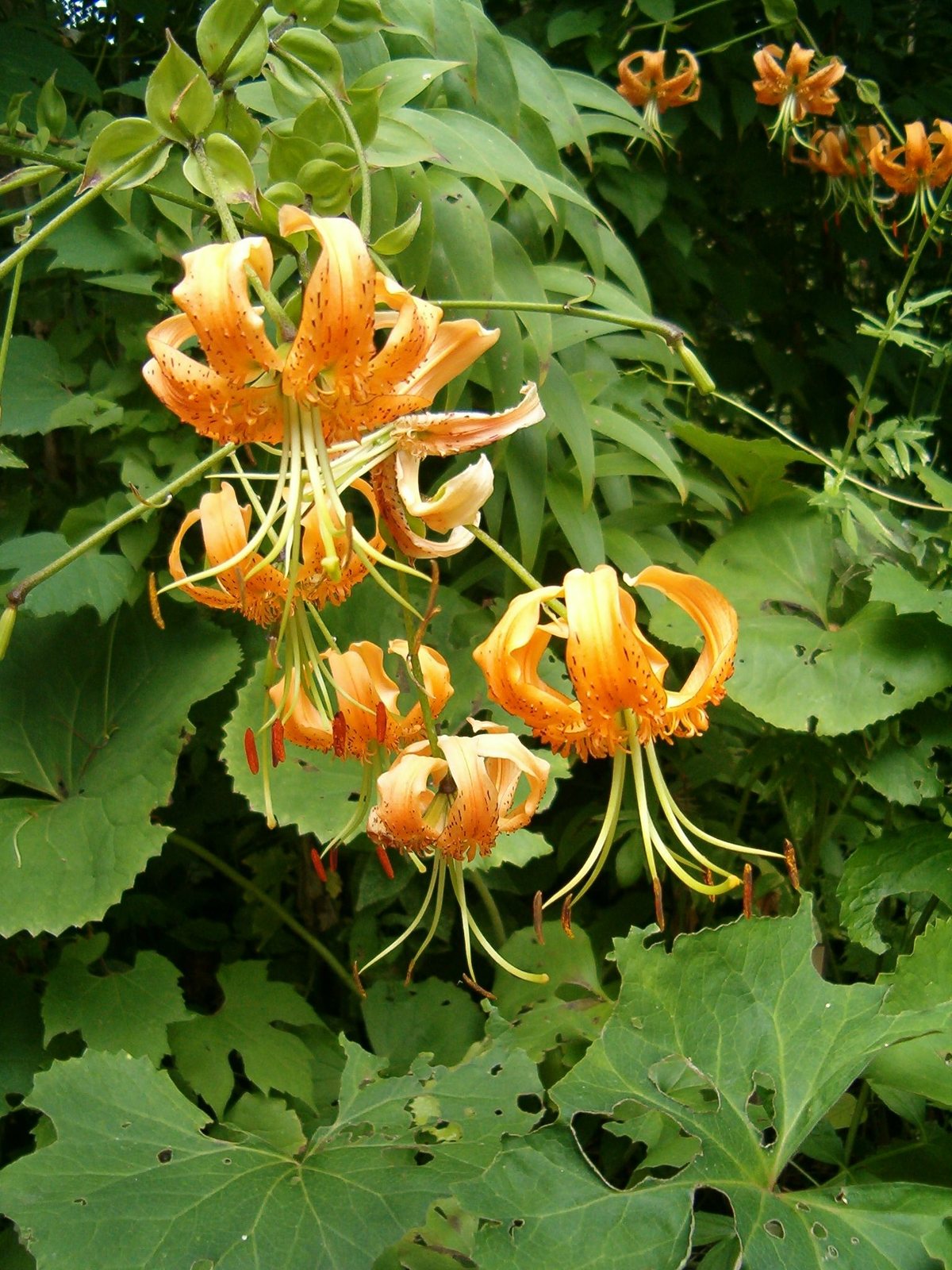
Henry's lily is a tall, deciduous Chinese lily with arching stems and nodding orange flowers whose petals curl sharply backwards. It flowers later than many lilies, bringing height and warm colour to mixed borders in late summer.
At a glance
- Sun
- Full sun to partial shade; afternoon shade is helpful in hot climates. Keep the root area cool with mulch or low-growing companions.
- Water
- Keep evenly moist during spring growth and flowering, but never waterlogged. Water during prolonged dry spells; dormant bulbs need good drainage rather than regular watering.
- Soil
- Fertile, humus-rich, well-drained soil. Tolerates slightly acidic to alkaline conditions, including chalky soil if moisture and drainage are adequate.
- Height
- 4-8 ft (1.2-2.4 m)
- Spread
- 1-2 ft (0.3-0.6 m)
- Flowers
- Late summer into early autumn; nodding orange flowers with dark spots, raised papillae near the centre and strongly recurved petals.
- Foliage
- Glossy green, lance-shaped leaves spaced along tall stems; foliage dies back after flowering.
- Growth
- Moderate; bulbs gradually form larger clumps over several years.
- Care needed
- Medium
The year at a glance
- Pollinators
- Low allergen
| J | F | M | A | M | J | J | A | S | O | N | D | |
|---|---|---|---|---|---|---|---|---|---|---|---|---|
| Flowers | ||||||||||||
| Plant |
Northern hemisphere months. In Australia, shift them by six.
- Difficulty
- Moderate
- Toughness
- Fairly tough
Will it suit your garden?
Pick your zone, country, light and whether you have pets.
Full sun is 6 or more hours of direct sun a day, part shade 3 to 6 hours, shade under 3.
How it grows
Planting day
0.7 ft (0.22 m)
After 1 year
6 ft (1.8 m)
full size
About 1 years to full size.
From a typical nursery size, at an average rate for this kind of plant. A rule of thumb, not a forecast.
Good to know
- Cats and dogs
- Toxic
- Growth rate
- Moderate
Care
Jobs through the year
- WaterApr–May, Sep, every 14 days
- Water established ground plants deeply during dry spells; check newly planted bulbs more often.
- WaterJun–Aug, every 7 days
- Water established ground plants when rainfall is insufficient, keeping growing roots evenly moist.
- FeedMar–Apr
- Apply balanced bulb fertilizer as shoots emerge, following the label.
- MulchMar–Apr
- Apply leaf mould or compost to cool roots, keeping emerging stems clear.
- ProtectMar–Aug, every 7 days
- Inspect for slugs and lily beetles; remove beetles, eggs and larvae.
- ProtectApr–May
- Install stakes early in exposed sites and secure stems loosely as they grow.
- DeadheadAug–Sep, every 7 days
- Remove spent flowers before capsules form, retaining all healthy foliage.
- PruneOct–Nov
- Cut down stems only once fully yellowed or dead; remove diseased debris.
- DivideOct–Nov
- Divide congested clumps after foliage dies back and replant bulbs promptly.
- Plant bulbs in autumn or early spring, about 6-8 in (15-20 cm) deep, in freely draining soil.
- Water deeply during dry weather while stems and leaves are growing.
- Apply a balanced fertiliser as shoots emerge, following the label rate.
- Mulch with leaf mould or compost, keeping it clear of emerging stems.
- Stake tall stems early in exposed gardens, using loose ties.
- Divide congested clumps after the foliage dies back; replant bulbs promptly.
Pruning. Remove faded flowers before seed capsules develop unless you want seed. Leave stems and leaves until they yellow and die naturally, then cut them down near ground level.
Through the year
- Early spring
- Plant any unplanted bulbs as soon as the soil is workable; protect emerging shoots from slugs.
- Spring
- Feed, refresh the mulch and install stakes before stems become tall.
- Late spring
- Check leaves for lily beetles where present and inspect the undersides for larvae.
- Summer
- Water during dry spells and tie growing stems loosely to their supports.
- Late summer
- Remove spent flowers while retaining all healthy leaves.
- Autumn
- Cut down dead stems; plant new bulbs or divide crowded clumps once dormant.
In the garden
- Plant in groups through the middle or back of a deep mixed border, allowing the arching stems room to spread.
- Combine with late-flowering perennials and grasses for a warm-coloured late-summer border.
- Use beside deciduous shrubs or at a bright woodland edge, where low planting shades the soil.
- Place behind lower perennials that conceal the bare lower stems without crowding emerging shoots.
Garden styles it suits: English country, Cottage garden, Romantic rose garden, Woodland, Hot border and Chinese scholar garden.
Plant it with: Hardy geraniums, Japanese anemones, Phlox, Coneflowers, Switchgrass and Hostas.
Wildlife: Flowers can attract bees and butterflies, although visitation varies. It is not a native host plant in the United States, Canada, the United Kingdom or Australia.
Problems to watch for
- Lily beetles can strip leaves and damage buds, particularly in the UK and affected parts of North America. Hand-pick adults and remove eggs and larvae from leaf undersides.
- Slugs and snails eat emerging shoots. Check at dusk, remove hiding places nearby and use an approved iron-phosphate bait if needed.
- Botrytis causes brown leaf spots and premature dieback in damp weather. Improve airflow, water at soil level and remove affected debris.
- Bulb rot develops in waterlogged soil. Improve drainage before planting and discard soft or decaying bulbs.
Safety
Extremely toxic to cats: all parts, including pollen, and water from a vase containing lilies can cause fatal kidney failure. Suspected exposure requires immediate veterinary treatment. It is not known to cause this lily-specific poisoning in dogs or horses, and is not generally considered poisonous to people, but swallowing plant material may cause stomach upset; do not treat it as food.
Easily confused with
Tiger lily (Lilium lancifolium)
Also has orange, spotted, recurved flowers, but usually carries conspicuous dark bulbils in the leaf axils. Henry's lily lacks these stem bulbils.
Turk's cap lily (Lilium martagon)
Usually has conspicuous whorls of leaves and smaller, commonly pink-purple flowers earlier in summer. Henry's lily has leaves spaced along the stem and larger orange flowers later.
Showy lily (Lilium speciosum)
Has similarly recurved late-season flowers, but they are typically white with pink or crimson colouring rather than orange.
The name
The species name henryi honours Augustine Henry, the Irish physician and plant collector who collected it in China.
Propagation. Separate offsets from dormant clumps and replant immediately, or propagate individual bulb scales under clean, lightly moist conditions. Seed is also possible, but seedlings take several years to flower.
Checked against open data
- Accepted botanical name
- Lilium henryi
- Native range
- China South-Central and China Southeast.
Sources: GBIF (CC BY 4.0) and Trefle (CC BY 4.0). The care and design notes are LandscapeGPT's own.
See it in your own yard.
Upload a photo of your yard and see it redesigned with plants that suit your climate, each checked against your zone.