Hidcote St John's wort
Hypericum × hidcoteense 'Hidcote'. Family Hypericaceae. Shrub.
Also called Hypericum 'Hidcote', Hypericum patulum 'Hidcote', Shrubby St John's wort.
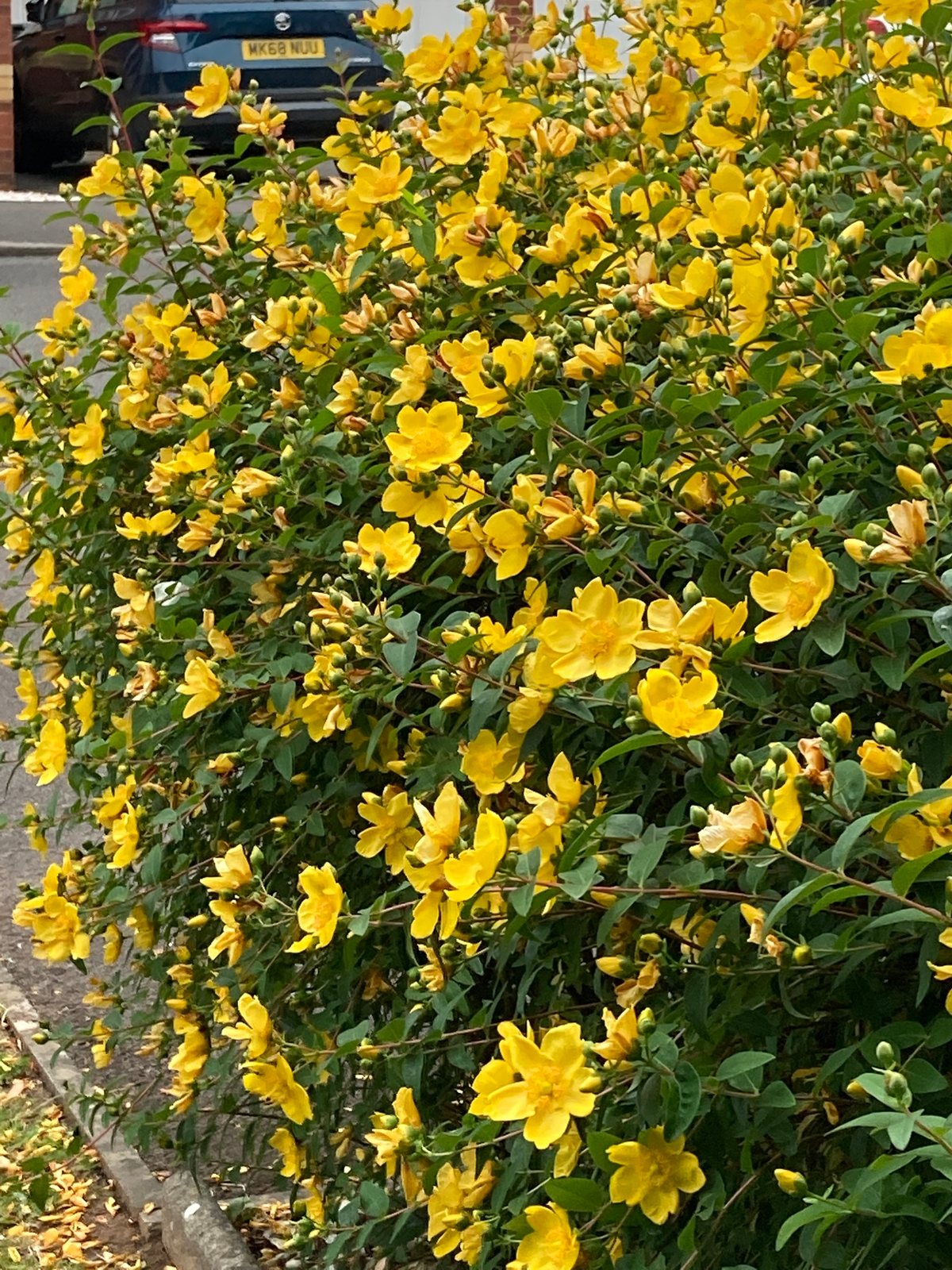
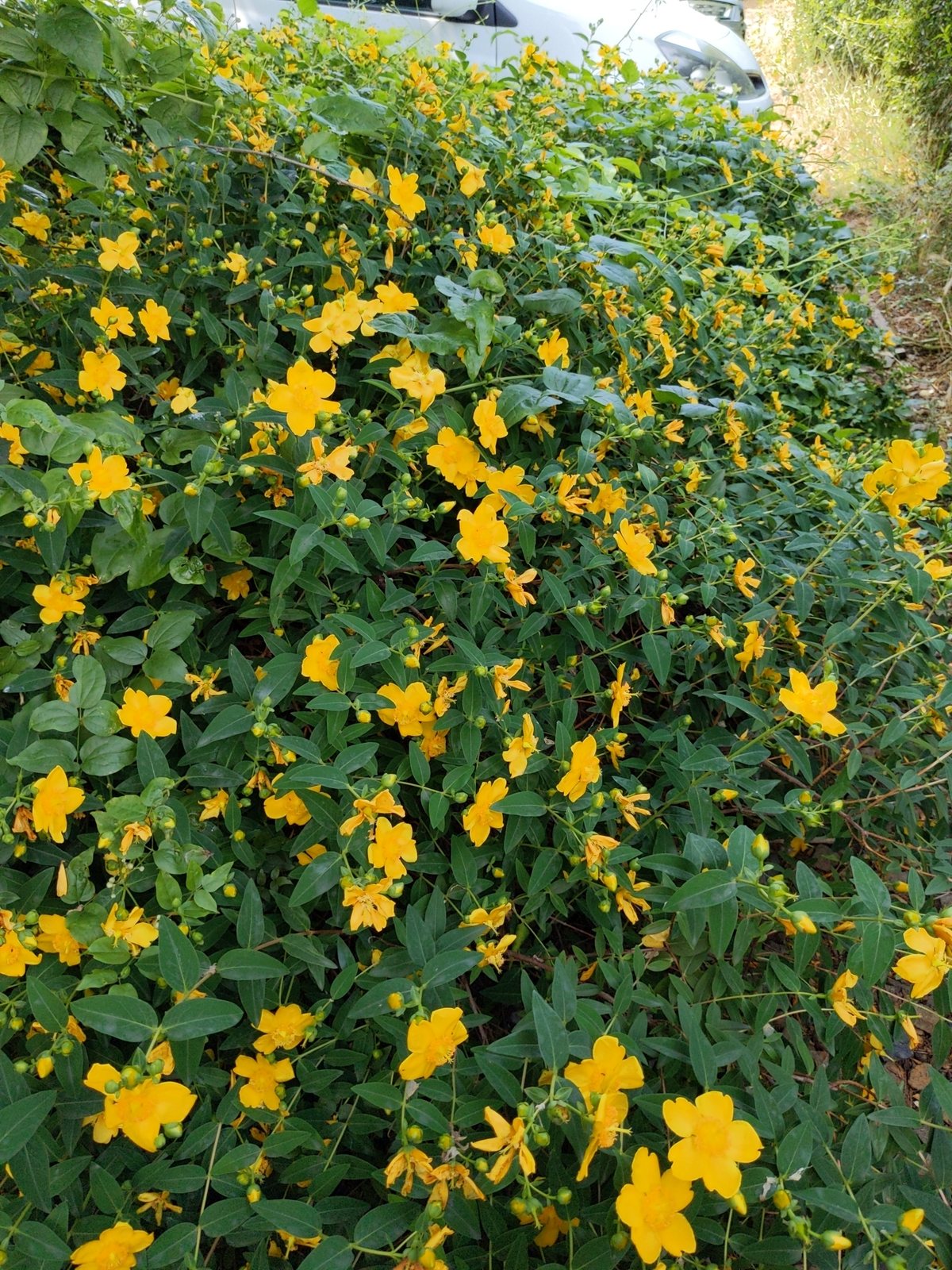
A rounded, densely branched shrub grown for its large golden-yellow flowers over a long summer season. It makes an informal low hedge or a useful middle layer in mixed borders, keeping some foliage through mild winters but becoming deciduous in colder gardens.
At a glance
- Sun
- Full sun to partial shade; flowering is strongest with at least 6 hours of direct sun.
- Water
- Moderate; water regularly while establishing, then during prolonged dry spells. Established plants tolerate some drought.
- Soil
- Most well-drained soils, including clay that does not remain waterlogged; tolerates acidic, neutral and alkaline conditions.
- Height
- 3-5 ft (0.9-1.5 m)
- Spread
- 3-5 ft (0.9-1.5 m)
- Flowers
- Golden-yellow, bowl-shaped flowers with prominent stamens from early summer into early autumn.
- Foliage
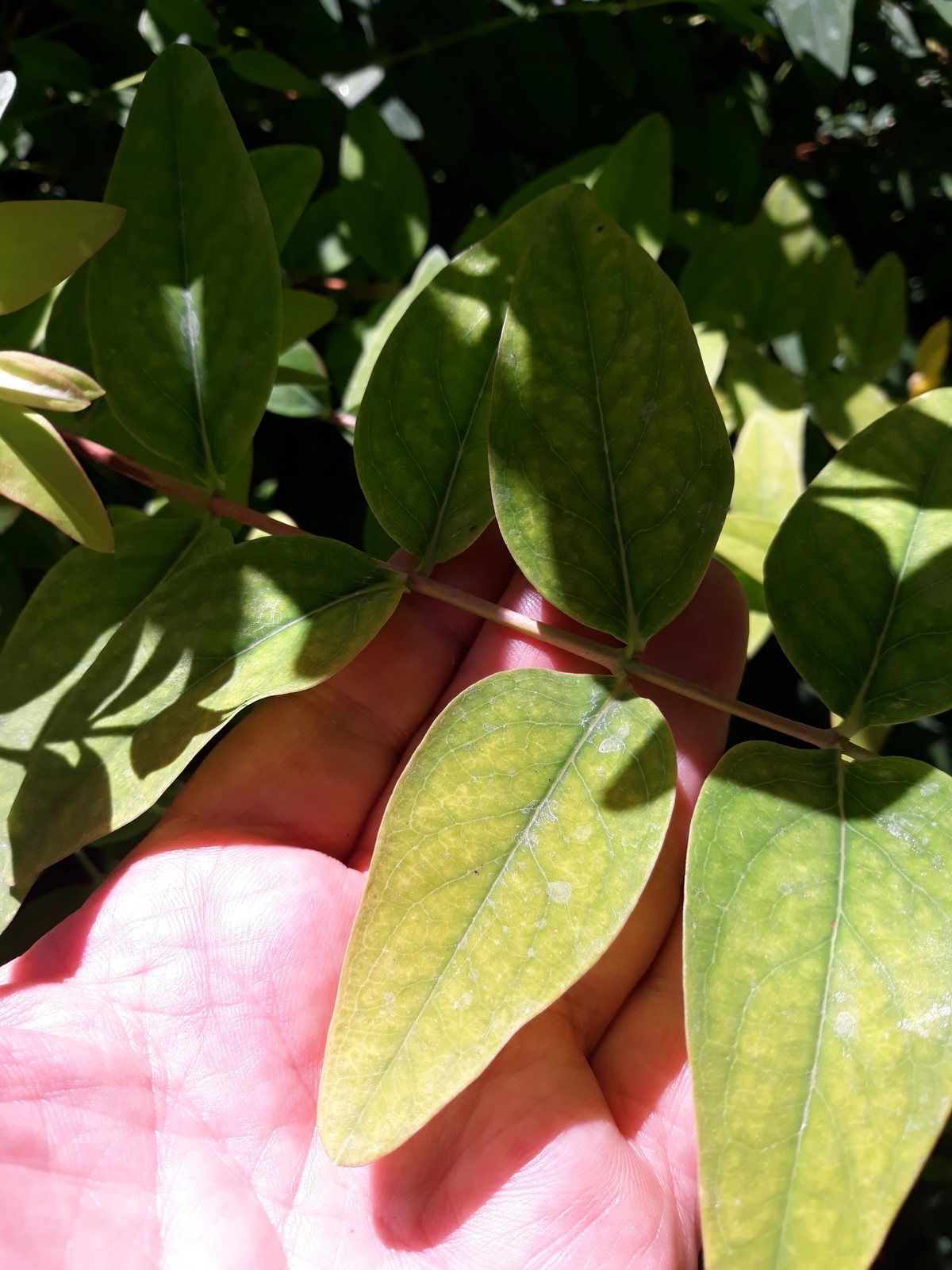
- Opposite, oval to narrowly oval, dark green leaves; semi-evergreen in mild climates and deciduous in colder ones.
- Growth
- Moderate to fast
- Care needed
- Low
The year at a glance
- Pollinators
- Deer resistant
- Drought tolerant
- Heat tolerant
- Wildlife
- Low allergen
| J | F | M | A | M | J | J | A | S | O | N | D | |
|---|---|---|---|---|---|---|---|---|---|---|---|---|
| Flowers | ||||||||||||
| Plant |
Northern hemisphere months. In Australia, shift them by six.
- Difficulty
- Easy
- Toughness
- Very tough
Will it suit your garden?
Pick your zone, country, light and whether you have pets.
Full sun is 6 or more hours of direct sun a day, part shade 3 to 6 hours, shade under 3.
How it grows
Planting day
1.6 ft (0.5 m)
After 1 year
2.2 ft (0.68 m)
After 2 years
2.8 ft (0.85 m)
After 3 years
3 ft (1 m)
After 5 years
4 ft (1.2 m)
full size
About 4 years to full size.
From a typical nursery size, at an average rate for this kind of plant. A rule of thumb, not a forecast.
Good to know
- Cats and dogs
- Toxic
- Growth rate
- Fast
Care
Jobs through the year
- WaterApr–May, Sep–Oct, every 14 days
- Water established shrubs only when soil is dry; check first-year plants more frequently.
- WaterJun–Aug, every 14 days
- Water established shrubs deeply during prolonged drought; young plants need more frequent watering.
- PruneMar
- Remove winter damage and shorten remaining shoots by about one-third before strong growth.
- MulchMar–Apr
- Apply 5–8 cm of organic mulch, keeping it away from stems.
- FeedApr
- Feed lightly only if growth is weak or soil is poor.
- Water deeply during the first growing season whenever the upper soil begins to dry.
- Apply 2-3 in (5-8 cm) of organic mulch in spring, keeping it clear of the stems.
- Feed lightly with a balanced fertiliser in spring only if growth is weak or the soil is poor.
- Allow space for its mature width rather than keeping it narrow with repeated shearing.
- Avoid winter-wet sites; improve drainage or choose a raised planting area.
Pruning. In early spring, remove dead or frost-damaged stems and shorten the remaining growth by about one-third to maintain a rounded shape. Overgrown or winter-damaged plants can be cut back to 6-12 in (15-30 cm), provided the base is healthy.
Through the year
- Early spring
- Prune before strong new growth starts, removing winter damage first.
- Spring
- Plant in colder regions, water thoroughly and mulch around the root area.
- Late spring
- Check new shoots for aphids and wash off small colonies with water.
- Summer
- Water young plants during dry spells; established shrubs need water mainly during prolonged drought.
- Late summer
- Take semi-ripe cuttings from healthy, non-flowering shoots.
- Autumn
- Plant in mild regions while the soil is warm; avoid hard pruning before winter.
In the garden
- Plant as an informal low hedge along a boundary or broad path, allowing room for its arching branches.
- Use in the middle of a mixed border with blue or purple flowers to contrast with the yellow blooms.
- Group several plants on a sunny bank for dense cover and a long flowering season.
- Combine with ornamental grasses and other undemanding shrubs in a low-maintenance planting.
Garden styles it suits: English country, Cottage garden, Traditional, Low-maintenance, Pollinator garden and Family-friendly.
Plant it with: Catmint, Hardy geranium, Salvia, Russian sage, Feather reed grass and Japanese spirea.
Wildlife: The open flowers supply pollen for bees and other insects. Dense branching offers shelter for small garden wildlife.
Problems to watch for
- Rust can produce orange-brown pustules and premature leaf fall; remove fallen infected leaves, improve airflow and avoid wetting the foliage when watering.
- Aphids may cluster on soft new shoots; wash them off with water and encourage natural predators.
- Waterlogged soil can cause root rot and dieback; improve drainage and avoid frequent watering of already damp soil.
- Severe winters can kill stems, especially near the colder end of its range; wait until spring to assess damage, then prune back to healthy growth.
Safety
Toxicity data for 'Hidcote' specifically are limited. Some Hypericum species contain compounds that can cause digestive upset and sunlight-sensitive skin reactions after ingestion by people, cats, dogs or horses, particularly grazing animals eating substantial quantities. Keep foliage and flowers out of food and animal feed, and do not use this ornamental shrub as herbal St John's wort.
Easily confused with
Rose of Sharon (Hypericum calycinum)
A much lower, spreading plant, usually under 2 ft (0.6 m) tall, with large flowers bearing a conspicuous brush of long stamens; it spreads by underground stems.
Tutsan (Hypericum androsaemum)
Has smaller yellow flowers followed by conspicuous fleshy fruits that change from red to black; 'Hidcote' is grown for its much larger flowers rather than showy fruit.
Common St John's wort (Hypericum perforatum)
An upright herbaceous plant with clusters of much smaller flowers and leaves showing translucent dots when held to the light; it does not form the same dense woody shrub.
The name
St John's wort is named for the flowering of some Hypericum species around St John's Day, 24 June; wort is an old word for a plant.
Propagation. Take semi-ripe cuttings in summer and root them in a free-draining propagation mix. Use cuttings rather than seed to preserve the cultivar's characteristics.
Checked against open data
- Accepted botanical name
- Hypericum hidcoteense
Sources: GBIF (CC BY 4.0). The care and design notes are LandscapeGPT's own.
See it in your own yard.
Upload a photo of your yard and see it redesigned with plants that suit your climate, each checked against your zone.