Holy basil (tulsi)
Ocimum tenuiflorum. Family Lamiaceae. Annual.
Also called Tulsi, Tulasi, Sacred basil, Ocimum sanctum.
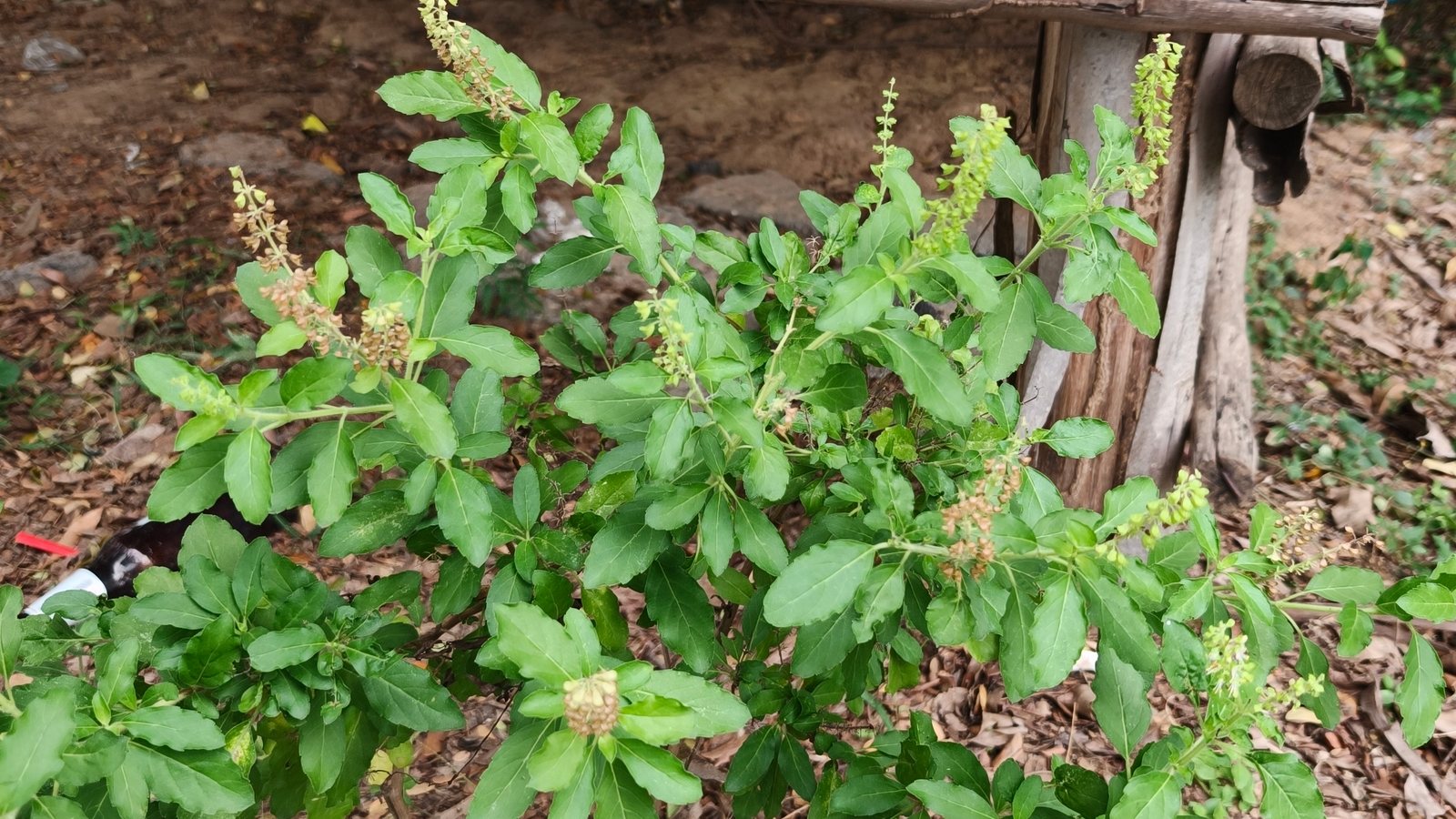
Holy basil is a frost-tender, short-lived perennial usually grown as an annual for its aromatic leaves, herbal teas and bee-attracting flowers. Its branching stems make a small, bushy plant for warm herb beds and containers; it can persist for several years in frost-free tropical conditions.
At a glance
- Sun
- Full sun; light afternoon shade is useful in very hot climates.
- Water
- Water when the surface soil begins to dry, keeping the root zone moist but never waterlogged.
- Soil
- Well-drained, moderately fertile soil; use a free-draining potting mix in containers.
- Height
- 1-3 ft (0.3-0.9 m)
- Spread
- 1-2 ft (0.3-0.6 m)
- Flowers
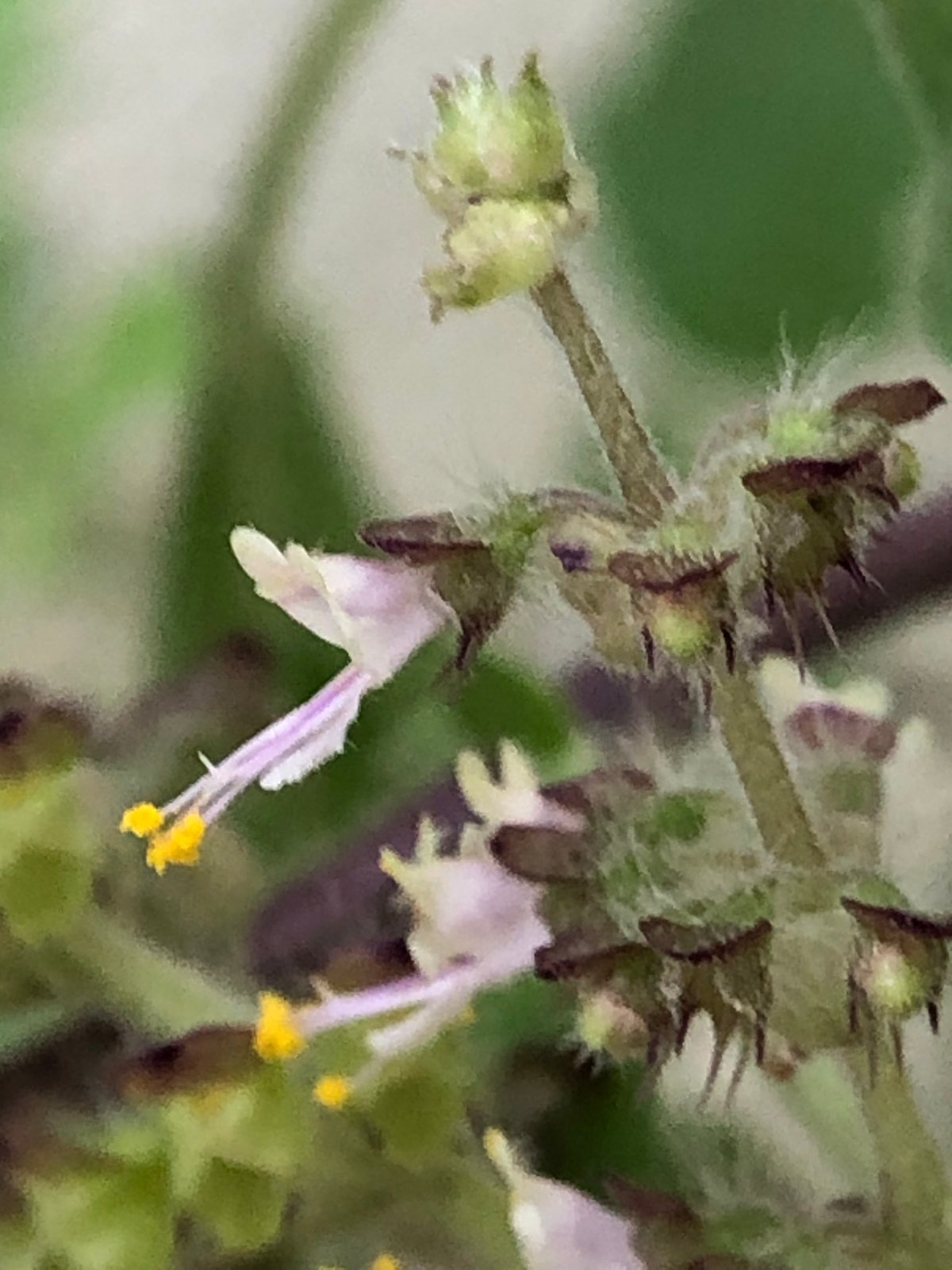
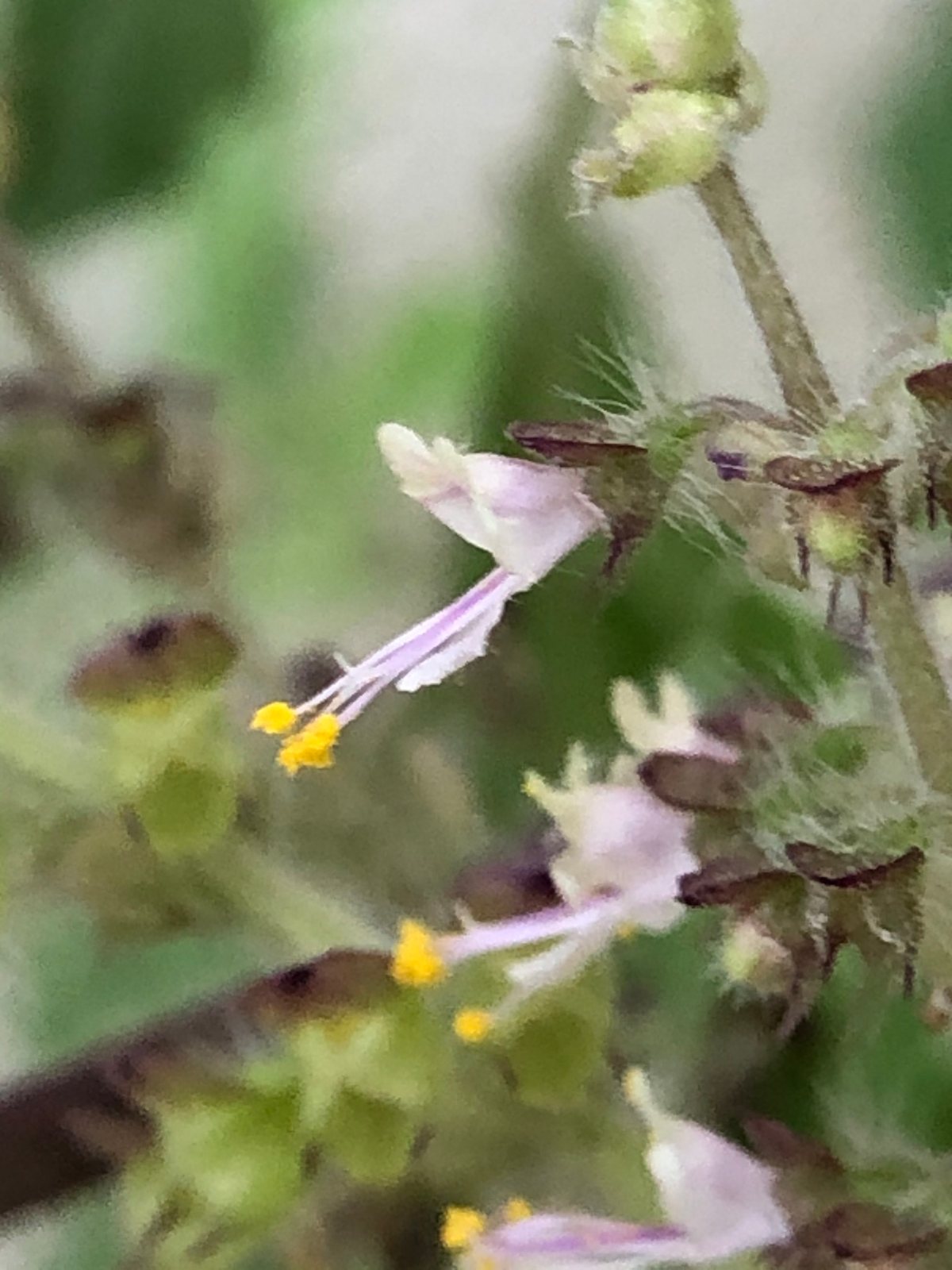
- Small white, pink or purple flowers in upright spikes from summer into autumn; flowering can continue longer in frost-free climates.
- Foliage
- Opposite, oval, toothed leaves with fine hairs and a strong, often clove-like scent; leaves and stems may be green or purple.
- Growth
- Fast in warm weather.
- Care needed
- Low
The year at a glance
- Pollinators
- Heat tolerant
- Low allergen
- Fragrant
- Edible
| J | F | M | A | M | J | J | A | S | O | N | D | |
|---|---|---|---|---|---|---|---|---|---|---|---|---|
| Flowers | ||||||||||||
| Fruit | ||||||||||||
| Plant |
Northern hemisphere months. In Australia, shift them by six.
- Difficulty
- Easy
- Toughness
- Needs looking after
Will it suit your garden?
Pick your zone, country, light and whether you have pets.
Full sun is 6 or more hours of direct sun a day, part shade 3 to 6 hours, shade under 3.
How it grows
Planting day
0.5 ft (0.15 m)
After 1 year
2 ft (0.6 m)
full size
Full size in one season.
From a typical nursery size, at an average rate for this kind of plant. A rule of thumb, not a forecast.
Good to know
- Cats and dogs
- Safe
- Native to
- Australia
- In the garden
- Spreads vigorously: plan to contain it.
- Growth rate
- Fast
Care
Jobs through the year
- WaterMay–Jun, Sep, every 4 days
- Water established outdoor plants when the surface dries; check seedlings more often and skip after rain.
- WaterJul–Aug, every 3 days
- Keep the root zone moist, not saturated, adjusting for rainfall and heat.
- MulchJun
- Apply a thin compost or organic mulch once soil is warm, keeping stems clear.
- PruneJun–Aug, every 14 days
- Pinch growing tips above a leaf pair to encourage branching.
- DeadheadJul–Sep, every 7 days
- Remove most flower spikes for leaf production, leaving some for bees or seed.
- HarvestJun–Sep, every 7 days
- Pick leaves and tender tips above a leaf pair, leaving enough foliage for regrowth.
- ProtectMay, Sep–Oct
- Shield from cold nights; bring pots indoors before frost or take a final harvest.
- Plant outside after frost danger has passed and nights are consistently warm, preferably above 50°F (10°C).
- Space plants 12-18 in (30-45 cm) apart for airflow.
- Water at soil level when the surface dries; empty saucers beneath pots.
- Mix a little compost into the bed before planting; feed container plants lightly every four to six weeks during active growth.
- Apply a thin mulch once the soil is warm, keeping it clear of the stems.
Pruning. Pinch out growing tips once plants have several pairs of leaves, cutting just above a leaf pair to encourage branching. During summer, remove flower spikes for continued leaf production, or leave some for pollinators.
Harvest
Pick leaves and tender shoot tips once the plant is well branched and growing strongly, usually before many flowers open. Cut just above a leaf pair, leave plenty of foliage to regrow, and use fresh or dry promptly for tea.
Through the year
- Early spring
- Sow seeds indoors in warmth, about six weeks before your expected last frost; cover only lightly.
- Late spring
- Harden off seedlings and plant outside once frost has passed and nights are reliably warm.
- Early summer
- Pinch shoot tips to build bushy plants and begin light harvesting.
- Summer
- Check pots frequently for drying and harvest regularly; leave a few flower spikes for bees.
- Early autumn
- Dry a final supply of leaves and collect mature seed if wanted.
- Late autumn
- Remove frost-killed plants, or move a healthy potted plant into a warm, brightly lit, frost-free space.
In the garden
- Place in a sunny herb bed near the kitchen for convenient picking.
- Grow in pots beside a warm doorway or seating area where the scented leaves are within reach.
- Repeat small groups through a vegetable garden to add upright flowers and attract bees.
- Use green- or purple-leaved plants as informal foliage accents among calendulas and other edible flowers.
Garden styles it suits: Potager (kitchen garden), Herb parterre, Sensory garden, Pollinator garden, Edible landscape and Small-space.
Plant it with: Tomatoes, Peppers, Calendula, French marigolds and Zinnias.
Wildlife: Flower spikes provide nectar and pollen for bees and other small pollinating insects.
Problems to watch for
- Cold damage: blackened leaves and stalled growth follow chilly weather; delay planting and protect plants from frost.
- Aphids and whiteflies: inspect shoot tips and leaf undersides; rinse off small infestations or use insecticidal soap according to the label.
- Root rot: wilting in wet soil suggests poor drainage; reduce watering and repot into a freely draining mix if roots remain healthy.
- Leaf spots or mildew: improve spacing, water the soil rather than the leaves, and remove badly affected foliage.
Safety
Not known to be toxic to people, cats, dogs or horses, although species-specific veterinary safety information is limited. Leaves are used as a culinary herb and tea; concentrated essential oils and medicinal extracts are not equivalent to eating the leaves and should not be given to pets.
Where it spreads. Can self-seed in frost-free tropical gardens, including Hawaii and northern Australia. Remove seed heads if seedlings begin appearing outside the planted area.
Easily confused with
Sweet basil (Ocimum basilicum)
Typical sweet basil has smoother, less hairy, often larger leaves with a sweeter scent; holy basil usually has noticeably hairy, toothed leaves and a stronger clove-like aroma.
Clove basil (Ocimum gratissimum)
Clove basil generally becomes a much larger woody shrub with larger leaves; both can smell strongly of cloves, so scent alone is unreliable.
The name
Tulsi comes from Sanskrit tulasī, while the botanical name tenuiflorum means slender-flowered.
Propagation. Sow seed in a warm place at about 70-80°F (21-27°C), pressing it onto the surface and covering very lightly. Soft, non-flowering stem cuttings also root readily in warm conditions.
Checked against open data
- Accepted botanical name
- Ocimum tenuiflorum
- In the US and Canada
- Introduced in Pacific Basin and Puerto Rico.
- Native range
- Andaman Is., Assam, Bangladesh, Bismarck Archipelago, Borneo, Cambodia, Caroline Is., China South-Central, China Southeast, East Himalaya, Hainan and India.
Sources: GBIF (CC BY 4.0), USDA PLANTS and Trefle (CC BY 4.0). The care and design notes are LandscapeGPT's own.
See it in your own yard.
Upload a photo of your yard and see it redesigned with plants that suit your climate, each checked against your zone.